Cambozola
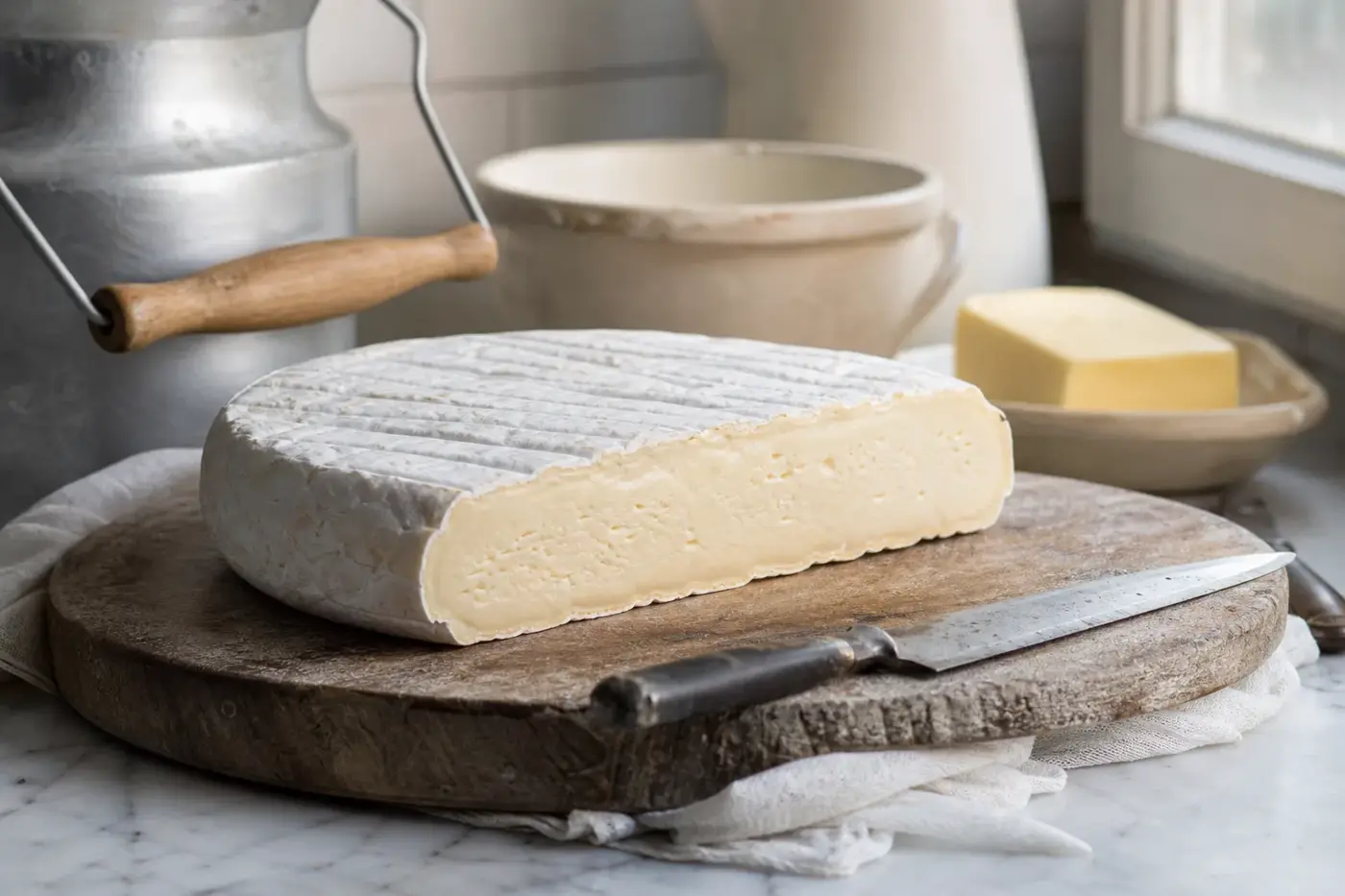
Look into a cut wedge of Cambozola: fine blue marbling threads through a soft, creamy body.
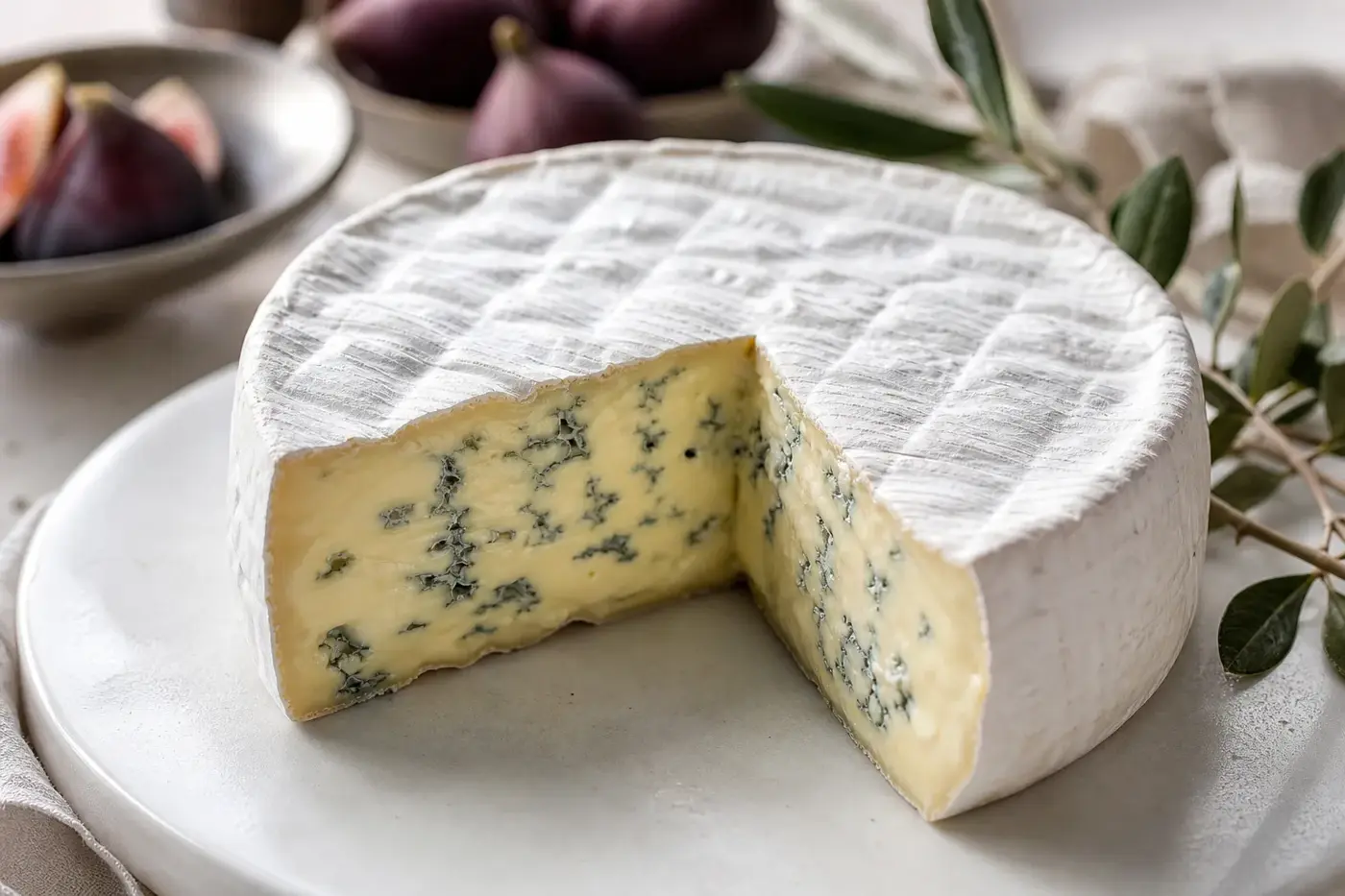
Look into a cut wedge of Cambozola: fine blue marbling threads through a soft, creamy body. Germany’s Käserei Champignon Hofmeister brings surface ripening and blue mould together in this cheese. It looks gentle enough, though its name has seen the inside of a European court case over the protection of Gorgonzola. Some cheeses make a quieter entrance. [1][2][3][5]
Your quick introduction to Cambozola
| What you’d like to know | The details |
|---|---|
| Brand name | CAMBOZOLA [2] |
| Who makes it | Käserei Champignon Hofmeister GmbH & Co. KG [1] |
| Maker’s home | Lauben, Upper Allgäu, Germany [1] |
| Cheese family | Soft-ripened cheese with blue mould [2][3] |
| Related protected name | Gorgonzola, registered PDO in Great Britain; original EU registration 21 June 1996 [6] |
| Information date | November 2026 |
Follow those blue threads through the cream
Creaminess comes first in the maker’s description of Classic. As the cheese ripens, fine blue marbling develops through its yielding paste. That is the cheese term for its body, where the blue mould brings its flavour. [3]
If you are finding your way around cheese, Cambozola makes one distinction easy to grasp: texture and ripening style are different things. Blue cheeses do not all feel alike. Surface ripening concerns the outside; internal blue growth is another feature, and this branded cheese combines both. You can explore those broader distinctions in the guide to cheese styles. [2][3]
Back to the Allgäu, with Camembert first
Before Cambozola came Camembert. The company’s history describes a cheese developed for a delicate mushroom fragrance, giving you a clue to the Champignon name and its mushroom branding. Soft-ripened cheese was already familiar territory for the business when Cambozola arrived. [1]
You will find the maker, Käserei Champignon Hofmeister GmbH & Co. KG, in Lauben in the Upper Allgäu of southern Germany. Its published history traces the dairy back to Heising in the Allgäu in 1908. The Hofmeister family took over Champignon in 1961. [1]
Those Allgäu roots tell you about the manufacturer, not necessarily the production address of every cheese. Champignon describes a group with several German locations. When you buy, distinguish the company address from the production information for your particular cheese. [1]
Camembert and Gorgonzola help set the scene
Creamy Camembert meets piquant Gorgonzola: that was the pairing in an advertisement recorded in the legal proceedings. The Advocate General’s account neatly captures Cambozola’s historical pitch. Two familiar cheese names introduced a soft cheese with blue character. [4]
Its arrival is harder to pin down. The manufacturer gives 1980 as the market launch, while the Advocate General’s opinion of 17 December 1998 records marketing in Germany from autumn 1977 and in Austria from March 1983. Those accounts leave the date of first launch unresolved. [1][4]
The comparison gives you a way into the cheese’s character, but Cambozola has its own brand identity and formulation. For the separate story of the other soft cheese, turn to Camembert. The Gorgonzola connection leads somewhere rather different: to the legal protection surrounding a registered geographical name. [2][4]
Get to know the rind and the blue within
The blue begins in the milk. According to the manufacturer, blue cultures are added there and develop fine marbling inside the cheese during maturation. The surface coating and internal blue growth have distinct roles: one surrounds the cheese, while the other runs through its paste. [2][3]
Black Label makes that contrast particularly clear. The maker describes grey natural mould outside and fine blue veins within, linking its aroma and creaminess to longer maturation at a low temperature. This is Black Label’s production description, not an ageing requirement for every Cambozola product. [2]
Before you compare two wedges, take a look at their variant names. That context helps you make sense of the rind and the blue on the cut face. Ranges also vary between markets, so match an overseas photograph or description to the cheese you actually have in front of you. [2][3]
How Cambozola’s name reached a European court
A name can bring a protected cheese to mind without making you mistake one cheese for another. That distinction was central to the Cambozola dispute. It reached the Court of Justice through Austrian proceedings involving the Gorgonzola consortium, the German maker and an Austrian distributor. [5]
On 4 March 1999, in Case C-87/97, the Court interpreted the EU rules then governing protected designations and earlier trade marks. In considering evocation, it examined similarities between the names and between the cheeses. Stating the cheese’s German origin on the packaging did not remove the issue. [5]
The Court held that a name such as Cambozola could evoke Gorgonzola under Article 13(1)(b) of Regulation (EEC) No 2081/92. The national court had to decide whether the earlier trade mark could continue under Article 14(2). That included questions of good faith at registration and the relevant grounds for invalidity or revocation. [5]
Evocation alone did not establish consumer deception. The European judgment provided the legal tests, rather than settling every question. Applying the conditions for continued use of the earlier mark remained the national court’s responsibility. [5]
Brand names and place names: know the difference
You are looking at two different kinds of protection. A protected designation of origin, or PDO, ties a registered product name to its geographical origin and product specification; a trade mark identifies commercial origin. Cambozola’s legal history shows how geographical name protection can meet rights in an earlier brand. [4][7]
| Name and territory | What the record tells you | Source and information date |
|---|---|---|
| Gorgonzola, Great Britain | Registered PDO; UK scheme registration 31 December 2020 | Defra register, November 2026 [6] |
| Gorgonzola, EU | Original EU registration recorded by Defra as 21 June 1996; entry into force and current EU register status: Not established | Judgment and Defra register, November 2026 [5][6] |
Keep territory in mind as you read these records. Defra distinguishes the UK scheme for Great Britain from the EU scheme relevant to the EU and Northern Ireland. Its entry gives the exact protected name as Gorgonzola, so consider territory, registered name and applicable specification together when comparing legal descriptions. [6][7]
For the wider picture, visit protected names explained. The distinction here is straightforward: Cambozola identifies the branded cheese. Gorgonzola is the protected name at the centre of the dispute. [2][4]
Choose the Cambozola you want to taste
Classic is your starting point: soft-ripened cheese with fine blue marbling. The maker’s English-language product site also lists Black Label, with its grey mould exterior and longer cold maturation. On the German product page, you will find Classic, Balance and Finesse, with Finesse described as having a garlic note. [2][3]
Buying in the UK? Begin with the exact name on the pack or counter ticket, then read the information for that cheese. Recipes, formats and labelling can differ by market. An international range page helps you recognise the names; the actual label gives you the details for your purchase. [2][3]
Look for ingredients, highlighted allergens, milk treatment, storage instructions and any vegetarian statement. The manufacturer’s United States site describes products as suitable for vegetarians, while its corporate product page says its cheeses use microbial rennet. Use your UK product’s own information to confirm suitability. Rennet sets milk into curd; rennet explained takes you through its different sources. [2][10]
Bring it home, keep it cool, taste it simply
Keep the product information with your cheese rather than relying on memory. Buy an amount you can use within the label’s instructions, and retain the wrapper or cheesemonger’s details after opening. A cut wedge can easily become separated from its name, ingredients and storage directions. If those details are not displayed, ask the counter for the originals.
At home, the Food Standards Agency recommends a fridge between 0 and 5 °C in its guidance for England, Wales and Northern Ireland. Follow the cheese’s own storage and opening instructions too. For broader advice on opened cheese, turn to storing cheese. [8]
Take out only what you intend to serve and leave the rest refrigerated. The FSA advises keeping chilled food out of the fridge for the shortest possible time during preparation. Consult its current guidance for the applicable time limit and what to do afterwards. Keep that limit in mind while your cheese loses its refrigerator chill. [8]
The maker suggests seasonal fruit, including pears, figs and grapes, or nuts. For your first taste, try plain bread or a cracker with one fruit, giving yourself room to get to know the cheese. Taste it before adding more accompaniments. You needn’t invite the entire fruit bowl to the first meeting. [2]
This page summarises published guidance from the official sources it cites. It is not medical advice. Guidance differs between countries and changes over time, so check the current source for where you live, and ask your doctor, midwife, pharmacist or dietitian about your own circumstances.
Pregnant? Cook soft blue cheese thoroughly
For Cambozola, the relevant NHS pregnancy category is soft blue cheese. Its advice covers pasteurised and unpasteurised soft blue-veined cheeses alike: they must be thoroughly cooked. Soft or blue cheese cooked until steaming hot appears among its permitted choices. The guidance also covers mould-ripened soft cheeses with a white outside coating. [9]
During pregnancy, follow that cooking advice rather than relying on a pasteurised-milk statement alone. The NHS explains that soft-ripened dairy foods can contain Listeria bacteria. These can cause listeriosis and serious harm during pregnancy. [9]
For the guidance current in November 2026, see the NHS source linked below, then consult its current advice and ask your midwife or doctor about your circumstances. If you are buying for anyone with dietary restrictions, use the actual label and the supplier’s product information to establish ingredients and suitability. [9]
Questions people ask
What is Cambozola?
Cambozola is a branded soft cheese made by Germany’s Käserei Champignon Hofmeister. It combines surface ripening with blue mould and has a creamy body with fine blue marbling.
Is Cambozola made with pasteurised milk?
The page does not verify the milk treatment or even the milk species. Check the information supplied for the particular cheese.
Is Cambozola vegetarian?
The manufacturer describes products on its United States site as suitable for vegetarians, and its corporate product page says its cheeses use microbial rennet. For a particular UK product, confirm suitability from its own information.
Can I eat Cambozola during pregnancy?
The NHS advises that soft blue cheeses, whether pasteurised or unpasteurised, must be thoroughly cooked during pregnancy. See the current NHS pregnancy guidance and ask your midwife or doctor about your circumstances.
How should I store Cambozola?
For England, Wales and Northern Ireland, the Food Standards Agency recommends a fridge temperature between 0 and 5 °C. Follow the cheese’s own storage and opening instructions too.
Sources
- Käserei Champignon Hofmeister, History & today, undated company history, retrieved November 2026. Company account of its history, location and Cambozola launch.
- Käserei Champignon Hofmeister, Cambozola: Our cheese creations, undated United States market page, retrieved November 2026. Manufacturer’s descriptions of Classic, Black Label, dietary claims and accompaniments.
- Käserei Champignon Hofmeister, Cambozola: Unsere Käsekreationen, undated German market page, retrieved November 2026. Manufacturer’s German range and description of blue marbling.
- Court of Justice, Opinion of the Advocate General, Case C-87/97, delivered 17 December 1998. Historical proceedings and legal analysis, distinct from the subsequent judgment.
- Court of Justice, Judgment, Case C-87/97, 4 March 1999, ECLI:EU:C:1999:115.
- Department for Environment, Food & Rural Affairs, [Gorgonzola](../gorgonzola/), protected food name register entry, published 4 January 2021, retrieved November 2026.
- Department for Environment, Food & Rural Affairs, Protect a geographical food or drink name, updated 6 January 2021, retrieved November 2026.
- Food Standards Agency, How to chill, freeze and defrost food safely, published 18 December 2017, retrieved November 2026. Applies to England, Northern Ireland and Wales.
- NHS, Foods to avoid in pregnancy, current online guidance retrieved November 2026.
- Käserei Champignon Hofmeister, Our Brands & Products, undated corporate product page, retrieved November 2026. Manufacturer’s microbial rennet statement.
Researched through manufacturer publications, official court documents, the GB protected-name register and official UK food guidance, with unresolved verification requirements recorded for the editor below.
Last checked: November 2026
Last checked November 2026.
The editors suggest you read next
Who Makes the World's Cheese? The Big Dairy Groups
You pick up Galbani at the cheese counter, then pause over Kerrygold.