Casu Marzu
Lift su tappu, the lid cut into a wheel of Casu Marzu, and a spoon may be more useful than a knife.
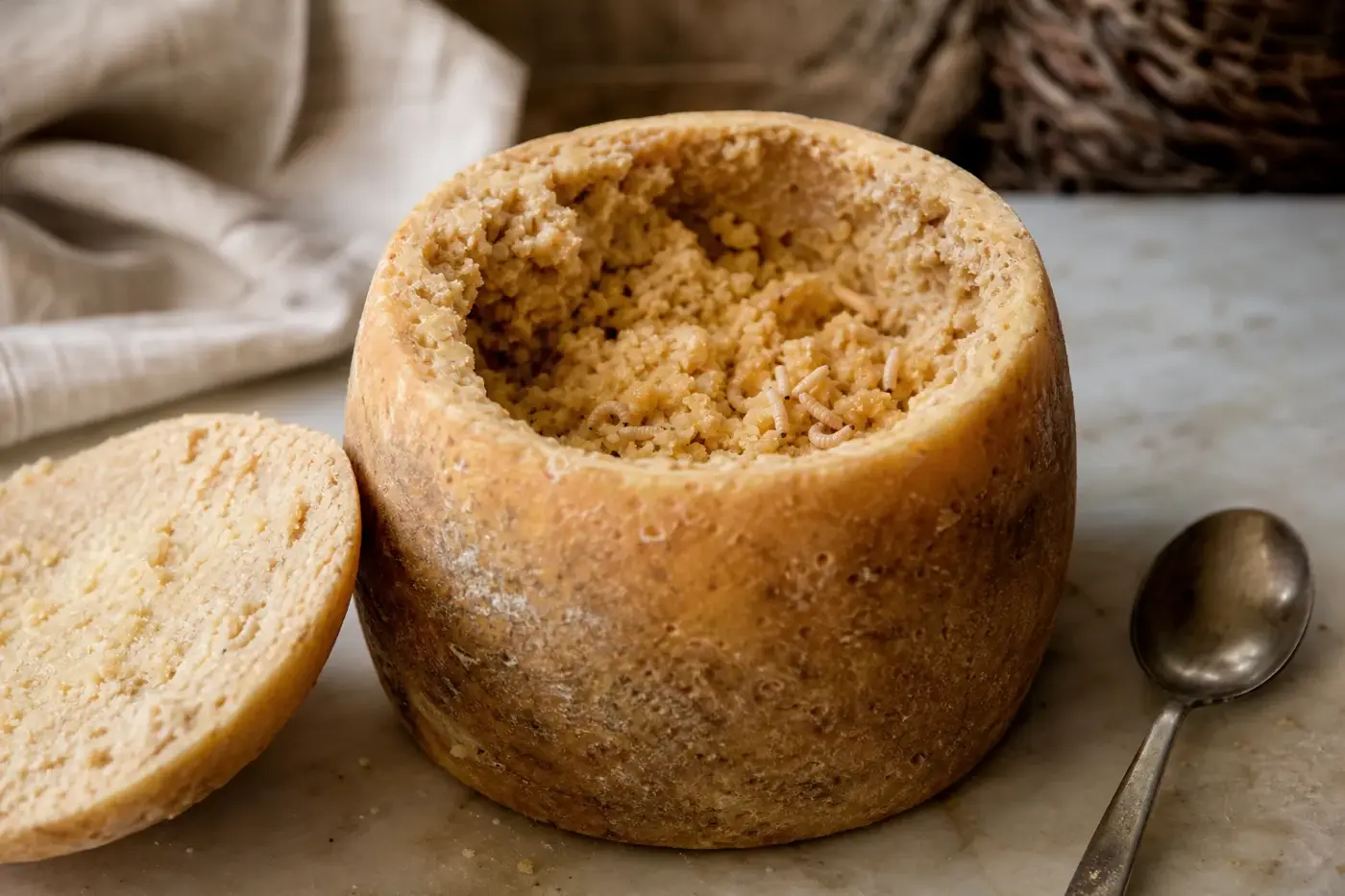
Lift su tappu, the lid cut into a wheel of Casu Marzu, and a spoon may be more useful than a knife. Beneath it lies a soft, sometimes spreadable interior, with a strong, penetrating smell and a pronounced, pungent flavour. Cheese fly larvae have been feeding on this sheep’s milk cheese, transforming the paste as they go.[1][2]
In Sardinia’s pastoral food culture, that transformation is something to value. For you, it may also prompt questions about hygiene, commercial sale and the medical reputation of a cheese whose inhabitants are alive.[1][2][3]
| Meet the cheese | What the records tell you |
|---|---|
| Familiar name | Casu Marzu.[1] |
| Name in Sardinia’s traditional food description | Casu frazigu; Casu marzu is a listed synonym.[1] |
| Traditional food recognition | Regional traditional food record; current listing status remains uncertain.[1] |
| Protected name registration and register ID | Not established here |
| Traditional home | Sardinia, Italy.[1] |
| Milk in the regional description | Whole sheep’s milk from the Sarda breed.[1] |
| Characteristic organism | Cheese fly larvae, Piophila casei.[1][2] |
| Legal minimum ageing | Not established here |
“Rotten cheese”: there is more to the name
Casu Marzu means “rotten cheese”, as translated in the scientific literature. Not a name that eases you gently into the subject. But the local distinction matters: what an outsider might call spoilage is deliberately valued here.[2]
Sardinia’s official description heads its entry Casu frazigu. Alongside it sit Casu becciu, Casu fattittu, Casu marzu and Hasu muhidu, plus the Italian formaggio marcio. Research also records casu modde, meaning soft cheese.[1][2]
These names give you a regional vocabulary, rather than one standardised product label. An ethnographic study of Sardinian shepherding records names that vary by locality, including the spelling casu martzu. They belong to people’s working and eating traditions.[3]
The official grouping helps you identify the cheese. The local names add detail, particularly when you put accounts from different places side by side.
A rugged rind, a yielding centre
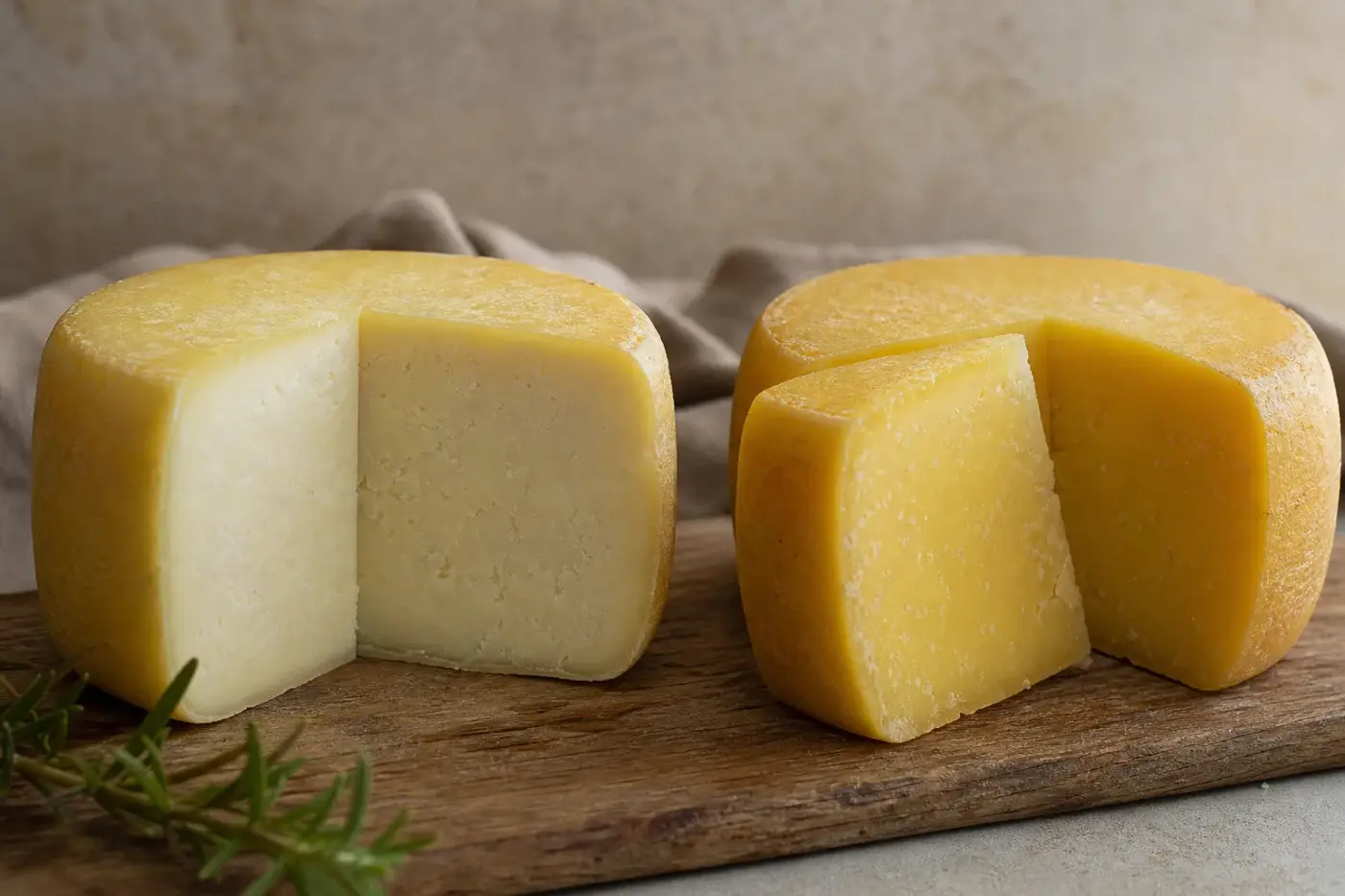
The regional description begins with a cylindrical wheel and an uneven rind. That rind is generally firmer around the side than across the flat faces. Its colour can deepen from yellow towards brown.[1]
Cut inside and the paste ranges from white through straw yellow to light brown. It can be soft or spreadable, quite a change from the rustic shell. The same account describes a strong, penetrating smell and a pronounced, pungent flavour.[1]
What you find depends on both the starting cheese and how far its transformation has progressed. A local account from Villaputzu describes a goat’s milk version with a greyish-yellow interior. Sheep’s milk defines the familiar regional description, but this documented local variation has its place in the story too.[4]
The fly works, the shepherd chooses
Casu Marzu begins with an existing cheese, not with larvae added directly to milk. The regional account describes several kinds of pecorino, meaning sheep’s milk cheese, as starting material. Scientific literature records a wider range, including cow’s milk cheeses.[1][2]
Next comes the cheese fly’s life cycle. Adult flies lay eggs, larvae develop inside the cheese, and their feeding changes its internal structure. Traditional production is associated with warmer months, when conditions favour the insect’s development.[2]
That does not mean shepherds wanted flies in every wheel. Ethnographic fieldwork records a clear distinction between cheeses intended for transformation and those intended to remain ordinary ripened cheese. The same fly could be encouraged in one wheel and discouraged from another.[3]
The shepherd’s judgement is part of the process. Making Casu Marzu involves choosing a particular wheel and following its development, not treating every cheese colonised by insects as desirable. For the story before this transformation, explore how cheese is made.
Beneath the rind, flavour takes shape
Softening is only part of what happens inside. Lipolysis breaks down fats; proteolysis breaks down proteins. A controlled Casu Marzu experiment published in 2010 investigated both processes.[2]
Researchers produced three batches of two cheese types, comparing exposed cheeses with protected controls. More open cheeses were colonised more readily and showed more intense fat and protein breakdown than compact cheeses. Colonisation also differed between batches, with the starting structure helping to shape the outcome.[2]
Another analytical study examined nine farmhouse Casu Marzu samples alongside farmhouse pecorino and factory-produced Pecorino Sardo. It used high-performance liquid chromatography, a laboratory separation method. The results revealed substantial differences in free amino acids and other nitrogen-containing compounds.[5]
Together, these studies give you a closer look at the transformation. Feeding larvae change the chemical material from which aroma and flavour develop. Sardinia’s regional description puts the sensory result plainly: a strong smell and a pronounced, pungent flavour.[1][2][5]
At home with the shepherds
Casu frazigu belongs to the household world of pecorino making. Sardinia’s regional record describes family consumption, with production spaces associated with livestock holdings and shepherds’ village homes.[1]
In ethnographic interviews, shepherds sometimes credited the flies with the decisive work. Their accounts reveal a practical understanding of living organisms: people can influence their behaviour, but cannot entirely command it.[3]
The cheese belongs among the relationships that sustain pastoral life. Households, animals, milk, buildings and seasonal conditions all play a part. Its cultural significance includes knowing how a particular wheel develops, then recognising the result as something worth sharing.[1][3]
The family setting is more firmly documented in these sources than any fixed ceremonial calendar. It gives you a clearer picture than assigning Casu Marzu indiscriminately to weddings, festivals or every island celebration.
Lift the lid and discover the customs
A lid cut from one flat face of the wheel gives access to the softened paste. The regional description calls that lid su tappu and records the interior being lifted out with a spoon.[1]
In the Villaputzu account, the cheese is accompanied by Sardinian wine, specifically Cannonau. Its pungency is part of the appeal, not something to disguise. This is not a cheese asking to fade politely into the background.[4]
These are reported customs, not serving recommendations. If you want broader pairing principles, cheese and wine pairing also covers alcohol-free alternatives.
This page summarises published guidance from the official sources it cites. It is not medical advice. Guidance differs between countries and changes over time, so check the current source for where you live, and ask your doctor, midwife, pharmacist or dietitian about your own circumstances.
Food safety goes beyond the larvae
The larvae may draw your eye first, but microbiological safety involves the whole production environment. In the 2010 controlled experiment, experimental conditions strongly affected the microbial results. Researchers treated hygiene management as central to any consideration of controlled production.[2]
Chemical analysis raised a separate concern. The later study’s nine Casu Marzu samples varied considerably in biogenic amines, compounds that can form when microorganisms act on amino acids. Two samples had markedly higher total concentrations than the others.[5]
That variation is an important part of the finding. It gives a reason to investigate production conditions and chemical differences between cheeses. It does not mean every wheel has an identical chemical profile.[5]
Cultural recognition, laboratory measurements and official consumer guidance answer different questions. For practical guidance on handling cheese and protecting vulnerable groups in your country, follow the official sources collected in cheese food safety.
Myiasis: understanding the medical evidence
Myiasis concerns infestation by fly larvae. The US Centers for Disease Control and Prevention, or CDC, describes it as infection involving larvae in human tissue.[6]
A CDC report on intestinal myiasis explains that swallowed eggs or larvae can sometimes survive in the gastrointestinal tract. Diagnosis needs care. Larvae in a stool sample do not necessarily establish intestinal infestation: they may simply have passed through, or flies may have contaminated an uncovered specimen after collection.[7]
The medical literature includes a 1952 report titled Intestinal infestation with maggots of the cheese fly (Piophila casei). Its bibliographic record supplies no abstract identifying Casu Marzu as the exposure.[8]
The distinction matters. A report involving the fly species is not the same as a clinically established case caused by this particular cheese. The Sardinian ethnography also notes an absence of cheese-specific cases in the literature it discusses, but that observation is not a systematic medical review.[3]
If you are concerned about possible myiasis, follow the CDC’s current US guidance and contact a healthcare provider for diagnosis and treatment. The guidance was published on 13 September 2024; November 2026 is this article’s reference date.[6]
Tradition and the rules on selling cheese
Casu frazigu appears in Sardinia’s official traditional food documentation. The region explains that its traditional food inventory concerns production, preservation and ageing practices established for at least 25 years.[1][9]
That recognition records continuity of practice. Commercial food businesses have separate duties under European food law. These include hygiene controls and the requirement that food placed on the market meets applicable safety requirements.[10][11]
| Your question about Italy and the EU | The framework at November 2026 |
|---|---|
| What does traditional recognition tell you? | It records established methods and continuity over time.[9] |
| Which rules govern food businesses? | EU food law and hygiene rules, including Regulations 178/2002 and 852/2004.[10][11] |
| Is there room for traditional methods? | Regulation 852/2004 allows procedures for national adaptations, subject to its conditions.[11] |
| What about making food at home? | Both regulations exclude specified private domestic activities from their scope.[10][11] |
Regulation 852/2004 requires food businesses to protect food against contamination and maintain appropriate pest controls. Its provisions for continuing traditional methods sit within that hygiene framework. Tradition does not stand outside it.[11]
The current position on commercial sale in Italy, including any applicable adaptations, remains an open question here. A regional traditional food description does not itself establish authorisation for a particular commercial operation.[1]
Why “banned everywhere” misses the detail
The useful legal questions begin with where an activity happens and what it involves. Domestic preparation, manufacture for sale, retail supply and import are different activities. EU rules expressly distinguish specified private domestic activities from food business operations.[10][11]
Payment is not the deciding factor either. Regulation 178/2002 defines food businesses broadly enough to include undertakings operating without profit. What an operation does matters more than whether money changes hands.[10]
For Casu Marzu, the Italian and EU framework gives you more useful detail than a sweeping worldwide claim. Research into controlled production explores possible approaches. Approval for a particular commercial operation would need its own authoritative documentation.[2][11]
Follow the trail through Sardinia’s cheeses
If Casu Marzu has drawn you into Sardinian cheese, Pecorino Sardo and Fiore Sardo are the next names to explore. Keep the general term pecorino distinct from any particular named cheese. Research on Casu Marzu describes a range of starting cheeses, not just one.[2]
Traditional food inventories and European name-protection schemes are different things too. To get a clearer sense of that distinction, continue with protected names explained.
Questions people ask
What is Casu Marzu made from?
The Sardinian regional description records whole sheep’s milk from the Sarda breed. Casu Marzu starts with an existing cheese, rather than with larvae added directly to milk.
Why does Casu Marzu contain larvae?
Adult cheese flies lay eggs, and the larvae develop inside the cheese. Their feeding changes its internal structure, making the paste soft and sometimes spreadable.
What does Casu Marzu taste like?
Sardinia’s regional description calls its flavour pronounced and pungent, with a strong, penetrating smell. An account from Villaputzu associates the cheese with Cannonau wine.
Is Casu Marzu legal to sell?
The current position on commercial sale in Italy, including any applicable adaptations, has not been verified. Traditional food recognition does not itself establish authorisation for a particular commercial operation.
Can cheese fly larvae cause myiasis?
The US Centers for Disease Control and Prevention explains that swallowed eggs or larvae can sometimes survive in the gastrointestinal tract, but larvae in a stool sample do not necessarily establish an infestation. Anyone concerned about possible myiasis should follow the CDC’s current guidance and contact a healthcare provider for diagnosis and treatment.
Sources
- Regione Autonoma della Sardegna, Scheda identificativa dei prodotti tradizionali della Regione Sardegna: Casu frazigu, in the regional cheese descriptions, sections 1 to 12. Edition date not stated in the document. Retrieved November 2026.
- University of Sassari and AGRIS researchers, Production under controlled conditions of “Casu Marzu” cheese: effect of the Piophila casei colonization on microbial and chemical composition of the cheeses, A.I.V.I., number 7, March 2010. Original experimental research.
- Università degli Studi di Milano, The Wisdom of the Flies. Society, Environment, and Metabolic Justice in Rural Sardinia, doctoral thesis, academic year 2024 to 2025, especially the discussion accompanying figures 24 and 25. Original ethnographic research.
- Villaputzu Sardegna, Su casu marzu, il formaggio con i vermi della tradizione di Villaputzu, local visitor account, retrieved November 2026. Used for its reported local description and Cannonau association, not its legal assertions.
- Italian Journal of Food Safety, Comparison of γ-Aminobutyric Acid and Biogenic Amine Content of Different types of Ewe’s Milk Cheese Produced in Sardinia, Italy, 2015. Original analytical study, including nine Casu Marzu samples.
- US Centers for Disease Control and Prevention, About Myiasis, 13 September 2024, especially “Diagnosis”.
- US Centers for Disease Control and Prevention, Intestinal Myiasis, Morbidity and Mortality Weekly Report, 15 March 1985, editorial note. Used for the diagnostic distinctions, not historical treatment advice.
- US National Library of Medicine, bibliographic record for Intestinal infestation with maggots of the cheese fly (Piophila casei), Journal of the American Medical Association, 17 May 1952, volume 149, pages 262 to 263, PMID 14927333.
- Regione Autonoma della Sardegna, Pubblicata la revisione dell’Elenco dei prodotti agroalimentari tradizionali della Sardegna, 27 July 2026. Explains the traditional inventory’s minimum continuity criterion.
- European Parliament and Council, Regulation (EC) No 178/2002, consolidated version dated 1 January 2026, especially Articles 1, 3 and 14. EUR-Lex.
- European Parliament and Council, Regulation (EC) No 852/2004 on the hygiene of foodstuffs, consolidated version dated 24 March 2021, especially Articles 1 and 13 and Annex II, Chapter IX. EUR-Lex.
This desk-researched article brings together regional documentation, original experimental and ethnographic research, published medical records and official European legislation.
Last checked: November 2026
Last checked November 2026.
The editors suggest you read next
Parmigiano Reggiano
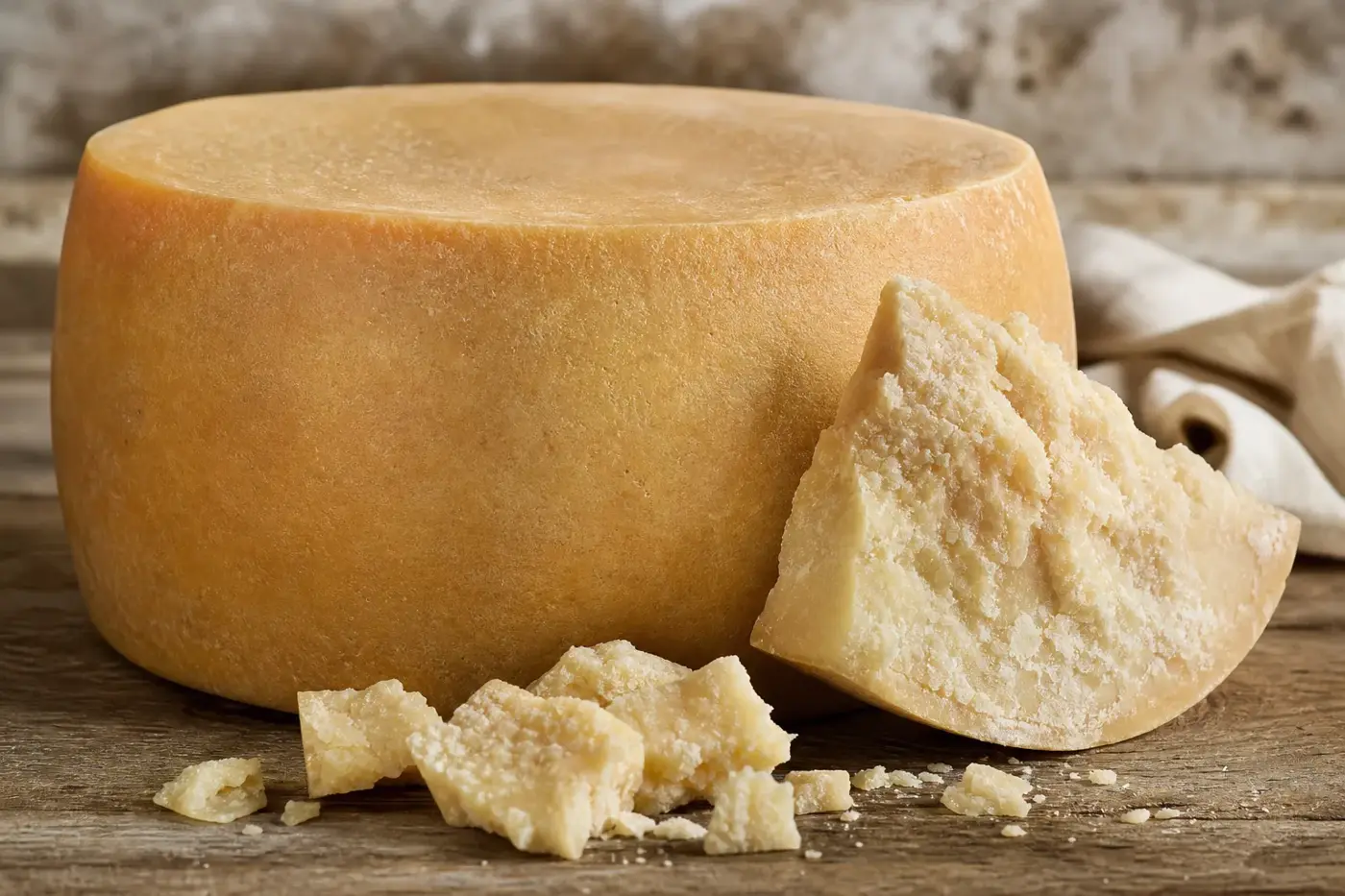
Break into a wheel of Parmigiano Reggiano and flakes fall away, revealing a finely granular cheese, pale straw to straw in colour.