Caws Cerwyn
A small piece, a creamy mouthful, then a name that takes you into the hills.
A small piece, a creamy mouthful, then a name that takes you into the hills. Caws Cerwyn is a gentle cow’s milk cheese from Pant Mawr Farmhouse Cheeses at Rosebush in Pembrokeshire, given a short, natural maturation. It takes its name from the highest mountain in the Preseli range, among the hills around the family’s farm. [1][2]
| Get to know Caws Cerwyn | The details |
|---|---|
| Maker | Pant Mawr Farmhouse Cheeses [1] |
| Home | Rosebush, Pembrokeshire, Wales [2] |
| Milk | Cow’s milk [1] |
| Style | Semi-hard; the maker describes it as a tender hard cheese [1] |
| Coagulant | Vegetarian rennet, according to the maker’s statement covering its range [2] |
| Maturation | Short and natural; exact duration not established [1] |
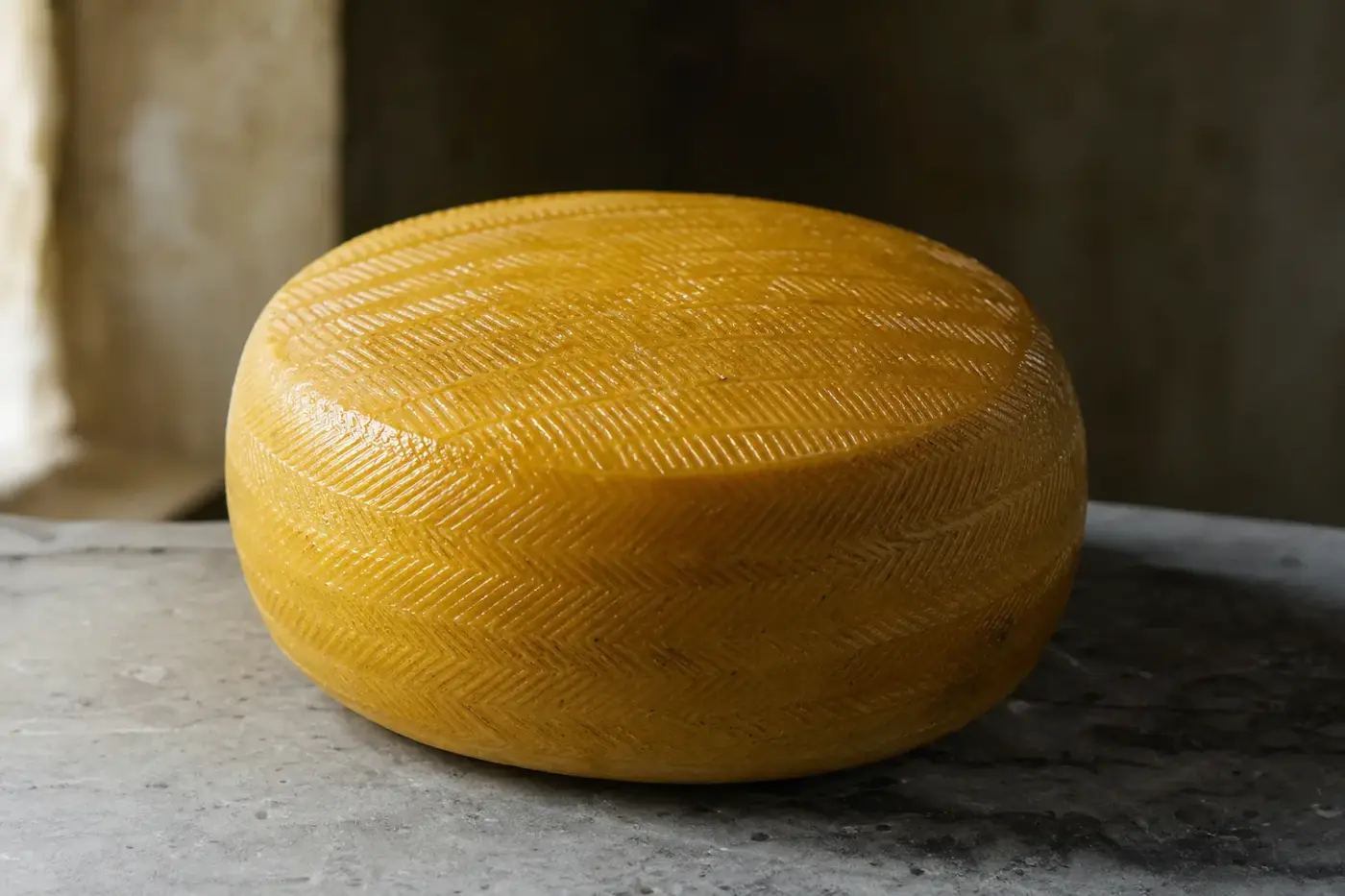
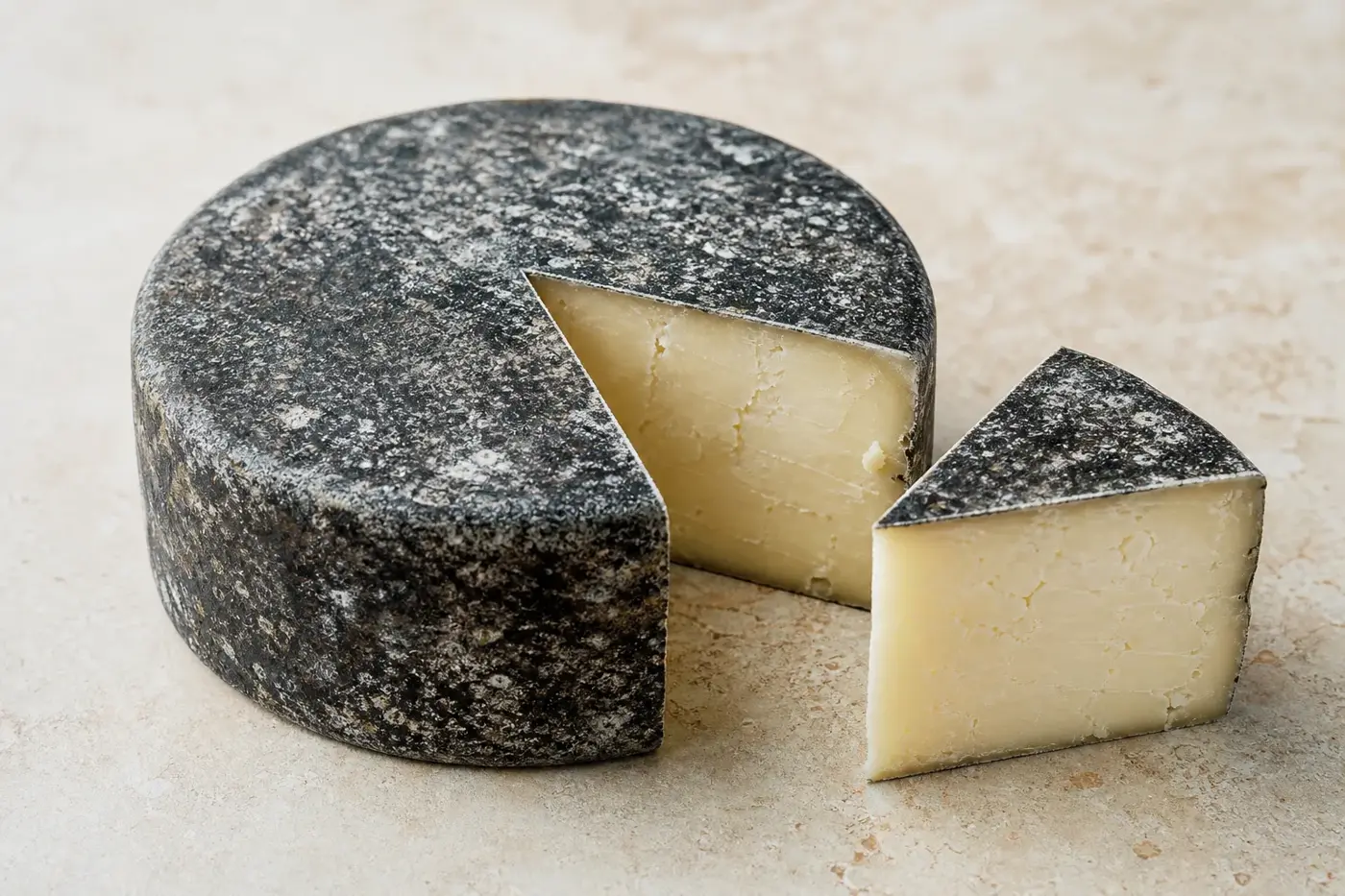
| The whole cheese | Round, with a yellow-gold, patterned exterior in the maker’s photograph [3] |
Give the quiet cheese your first mouthful
Not every cheese needs to shout across the board. Pant Mawr describes young Caws Cerwyn as mellow, light and creamy, so it offers you a gentle starting point if you prefer restraint to a forceful finish. [1] Give it a little room before bringing stronger flavours into the mouthful.
Try your first piece alone, then reach for bread or an accompaniment. Cheese, pickle and a strongly seasoned cracker in one bite give your taste buds rather a crowded meeting. A simpler beginning lets you notice what you enjoy about Cerwyn itself.
Separate what you feel from what you taste, too. Notice the firmness, how readily the piece breaks, then what happens as you chew. Each deserves a moment; the guide to telling cheese styles apart explores how milk, rind, texture and method contribute to a cheese’s identity.
Meet the family who came home to Wales
Pant Mawr’s story begins in 1984, when the family returned to Wales after involvement in dairy enterprises in Libya and North Yemen. Its account describes a family operation on a traditional hill farm at Rosebush, in the foothills of the Preseli Mountains. [2] That is the setting behind the piece on your plate.
The dairy says it uses locally produced milk and recipes developed through its own cheesemaking experience. [2] Those details give you something concrete to consider. Cerwyn belongs to a particular dairy, with its own choices about recipe and maturation.
Let those choices lead your questions. Why offer this cheese young, and what texture is the maker aiming for? How does Cerwyn sit beside the other cheeses in the range? You can get a much more interesting tasting from those questions than from asking only whether it is strong or mild.
Pant Mawr also describes a farm shop, so contact the maker about access and arrangements before travelling. [2] When choosing Cerwyn, ask about the actual piece on offer. Its age, condition and accompanying storage instructions are the useful details to bring home with it.
Take the name back to the Preseli hills
Cerwyn’s name gives you a direct route into its landscape. Pant Mawr says the cheese takes its name from the highest mountain in the Preseli range, and places the farm at the foot of those hills. [1][2] The connection is close to home.
You do not need a sweeping account of countryside or tradition to make that interesting. The name points to the dairy’s own surroundings. It gives you a specific place to think about as you taste, rather than a general impression of somewhere rural.
If you are serving Cerwyn to guests, begin with where the dairy works and why it chose the name. Keep it brief, leaving everyone time to taste. That clear link between maker and place gives your guests something memorable to carry into their first mouthful.
Before the bread, have a proper look
In the maker’s product photograph, you can see a round cheese with a yellow-gold exterior and closely repeated surface markings. [3] Ask the seller about the rind type, its treatment and the colour of the paste. The outside gives you only part of the picture.
When choosing cheese for a board, ask to see a freshly cut face too. Look at the centre, then just beneath the rind, noticing any differences in colour or texture. You will have something specific to compare with the maker’s description once you taste.
Ask how to treat the exterior before serving, and keep that advice with the wrapping. This is especially useful when several cheeses share a board. A brief note naming each cheese and its handling instructions also helps whoever clears the table put everything away correctly.
From milk to curd, follow your curiosity
Cerwyn starts with cow’s milk, and Pant Mawr states that its cheeses use vegetarian rennet. [1][2] Rennet helps milk form a curd: the gel from which cheese develops as liquid whey is removed. If that stage catches your interest, turn to the guide to rennet and its different sources.
For milk treatment, detailed curd handling and the exact maturation period of young Caws Cerwyn, you will need more detail than the maker’s available information supplies. Keep the label to hand. Ask the maker or cheesemonger about any production detail that matters to you.
To follow the whole journey, read how cheese is made, from milk through curd to finished cheese. Knowing the stages gives you a useful starting point for questions about Cerwyn. Keep general cheesemaking practice separate from Pant Mawr’s own recipe, though: one does not tell you every detail of the other.
Young or mature? Give both a place
Mature Caws Cerwyn spends five to six months ageing, according to Pant Mawr. The maker describes it as fuller in flavour, with a rounded nut-like character and a smooth, velvety consistency. [4] When you choose your cheese, make sure you distinguish that version from young Cerwyn.
If you can taste them side by side, have plain bread between the two. Notice three things: firmness, flavour intensity and how long the finish lasts. That gives you more to go on than simply declaring one piece “stronger”.
Begin with the young cheese, giving its gentler character your attention first. Taste the mature version, then return to the young one. Try each alone and with an accompaniment; you may prefer one by itself and the other with bread. There is no need to appoint a winner: the board can accommodate two favourites.
See where the butter and nut notes take you
Butter-like and nut-like flavours sit at the heart of Pant Mawr’s description of Cerwyn, which it presents as mellow overall. These are the maker’s tasting notes, not a fromage.co.uk tasting. [1] Treat them as invitations to notice, rather than answers you are expected to give.
Smell a freshly cut piece before adding anything else, and take a moment over its aroma. Then try a small piece and chew slowly. Which of the maker’s descriptions, if any, matches what you experience?
Next, bring in plain bread. Keeping that first accompaniment simple lets your second mouthful answer a useful question: do you enjoy Cerwyn most on its own, or as part of a simple lunch? Either is a good reason to make room for it, without an elaborate pairing.
Serve a little and let Cerwyn speak first
Bring a modest piece towards room temperature while keeping the rest refrigerated. The cheesemonger Good Food recommends taking out only what you intend to eat, leaving cheese wrapped as it loses its refrigerator chill to limit drying. [5] Prepare the serving piece rather than leaving the whole cheese out.
For Wales, England and Northern Ireland, the Food Standards Agency advises keeping chilled food out for the shortest possible time during preparation, with a maximum of four hours. Its hot-weather guidance says to avoid leaving food out longer than two hours when temperatures are higher than usual, and to discard perishables exceeding that limit. Both sources are referenced here as of November 2026. [6][7]
Keep your serving routine simple:
- Cut the piece you expect to serve; leave the rest in the fridge.
- Keep that piece wrapped until you arrange the board.
- Offer plain bread and one or two accompaniments separately.
- Taste Cerwyn before more assertive cheeses, then return to it for comparison.
For alcohol-free pairings, the following are editorial suggestions, not combinations tasted by the site. Start with plain bread, then compare it with crisp apple, ripe pear or plain oatcakes. Put still water alongside, and give everyone room to try the cheese and accompaniments separately.
Keep chutney beside the cheese rather than on it. Begin with less than you think you need, then add it gradually. You can find the amount you enjoy without losing Cerwyn’s mild flavour in the mouthful.
Wrap it well, with the label close by
Good Food recommends waxed cheese paper, or greaseproof paper as an alternative, followed by a lidded container in the fridge. This helps reduce drying and the absorption of smells from other foods. [5] It is a straightforward routine that helps you look after the cheese between servings.
For Wales, England and Northern Ireland, the FSA recommends a fridge temperature between 0 and 5 °C, measured with a fridge thermometer. Follow the product’s own storage and date instructions. [6] Keep those instructions with the cheese so they remain available after you have opened it.
Keep the original label alongside the wrapped cheese, even after cutting. Next time, take out only the amount you want and follow the time limits above. For the wider routine, including organising different cheeses in one fridge, turn to how to store cheese at home.
General information only, not medical advice: follow the official guidance where you live.
Questions people ask
What does Caws Cerwyn taste like?
Pant Mawr describes the young cheese as mellow, light and creamy. Its tasting notes include butter and nut flavours.
Is Caws Cerwyn vegetarian?
Pant Mawr states that its cheeses use vegetarian rennet. Caws Cerwyn is made from cow’s milk.
Is Caws Cerwyn made with pasteurised milk?
The milk treatment is not verified in the maker’s available information. Ask the maker or cheesemonger if this detail matters to you.
How does mature Caws Cerwyn differ from the young cheese?
Pant Mawr says mature Caws Cerwyn ages for five to six months. The maker describes it as fuller in flavour, with a rounded nut character and a smooth, velvety consistency.
How should Caws Cerwyn be stored?
Good Food recommends waxed cheese paper, or greaseproof paper as an alternative, followed by a lidded container in the fridge. For Wales, England and Northern Ireland, the Food Standards Agency recommends a fridge temperature between 0 and 5 °C and advises following the product’s storage and date instructions. See the Food Standards Agency’s guidance for more information.
Sources
[1] Pant Mawr Farmhouse Cheeses. Caws Cerwyn. Current product page, undated, retrieved November 2026. Product description.
[2] Pant Mawr Farmhouse Cheeses. About Pant Mawr Farmhouse Cheeses. Current company account, undated, retrieved November 2026. Maker’s account.
[3] Pant Mawr Farmhouse Cheeses. Caws Cerwyn, product photograph linked from the current product page, undated, retrieved November 2026. Photograph.
[4] Pant Mawr Farmhouse Cheeses. Mature Caws Cerwyn. Current product page, undated, retrieved November 2026. Mature product description.
[5] Good Food. Cheese Care Guide. Undated cheesemonger guidance, retrieved November 2026. Used for wrapping and presentation recommendations; Good Food sells cheese. Cheese care guidance.
[6] Food Standards Agency. How to chill, freeze and defrost food safely. Published 18 December 2017, current version retrieved November 2026. Applies to England, Northern Ireland and Wales. Official guidance.
[7] Food Standards Agency. Food safety in a heatwave, advice for consumers. Published 27 June 2024, current version retrieved November 2026. Applies to England, Northern Ireland and Wales. Official hot-weather guidance.
This article combines desk research from Pant Mawr’s descriptions and photograph with official storage guidance and clearly identified editorial serving suggestions.
Last checked: November 2026
Last checked November 2026.
The editors suggest you read next
Caerphilly
Your knife meets a rind-ripened Caerphilly, and one wedge offers two pleasures: a fresh, crumbly centre and a softer, creamy layer just beneath the rind.