Cheese Caves and Ripening Rooms
Step into the Combalou mountain's collapsed rock at Roquefort-sur-Soulzon.
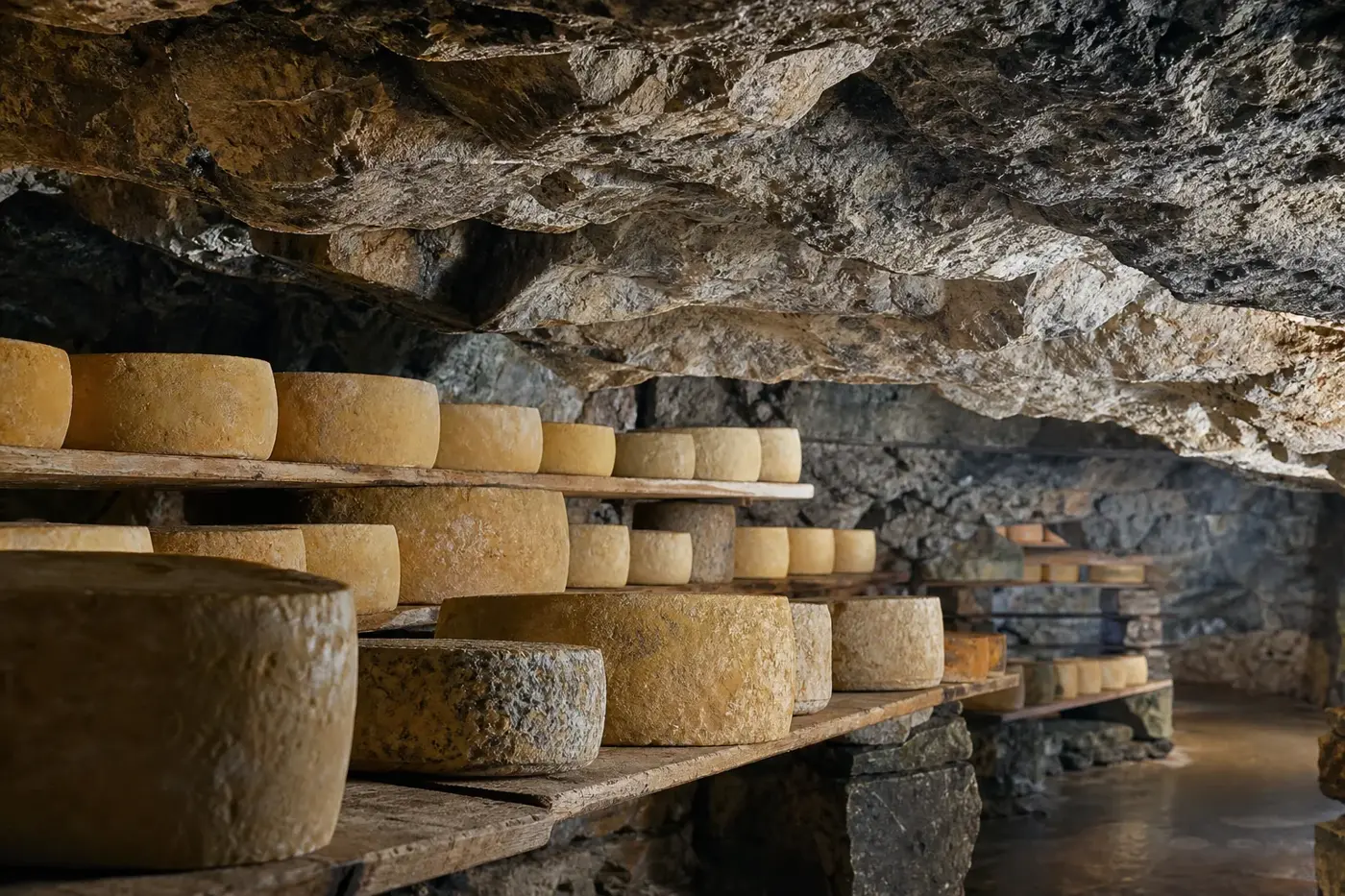
Step into the Combalou mountain's collapsed rock at Roquefort-sur-Soulzon. Cool, humid air circulates naturally around the cheese; in a purpose-built room, ducts do the directing. Neither setting is simply somewhere to leave cheese and hope for the best. Temperature, moisture, microorganisms and regular care turn newly made cheese into what you find at the counter. [1,7]
Where your cheese grows into itself
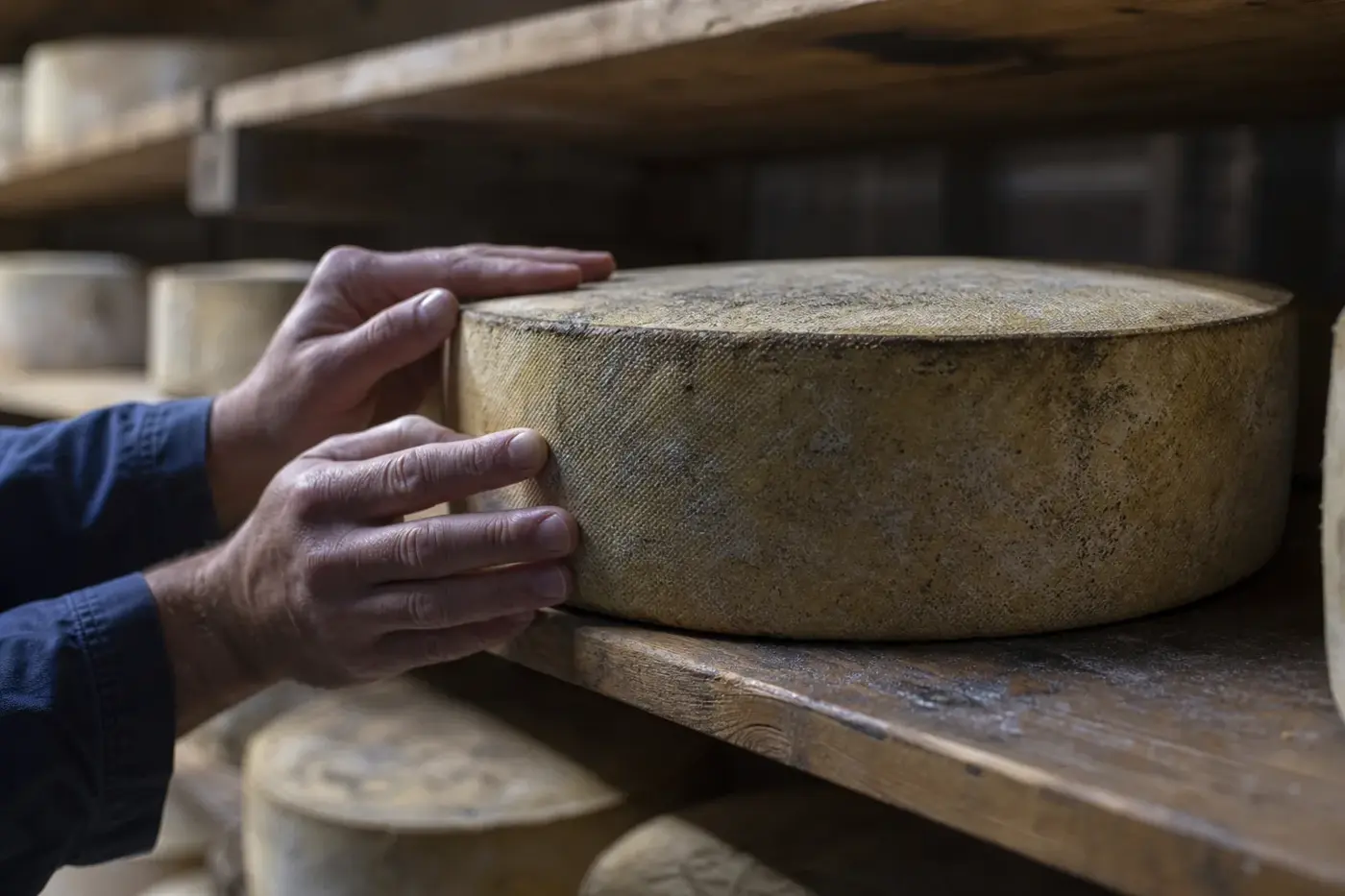
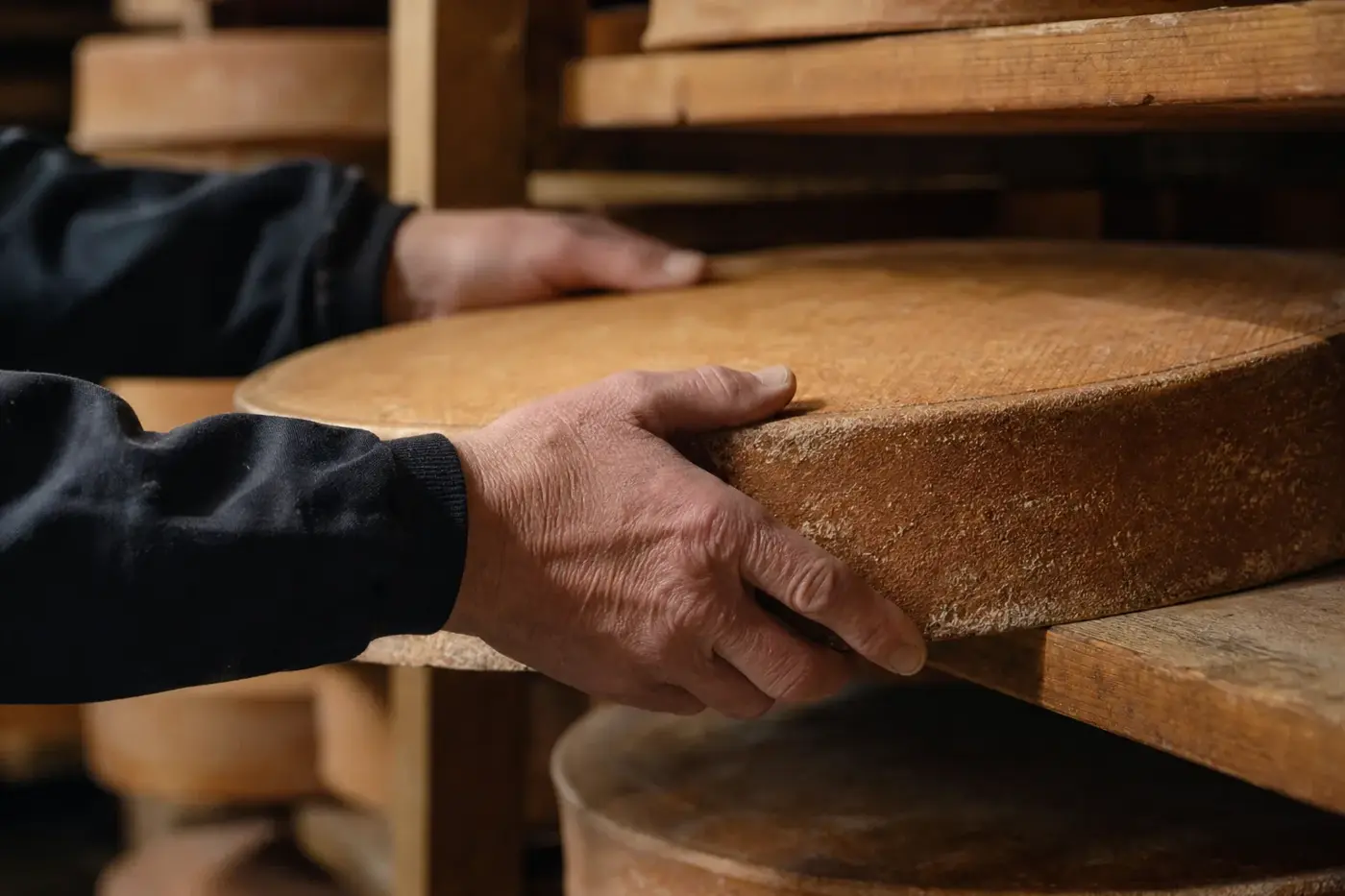
By the time cheese enters a ripening room, it has usually been shaped, drained and salted, though the order depends on the cheese. Now comes affinage: the managed work of maturation. It means tending the surroundings and caring for the cheese's surface as it develops. This is less a holiday for cheese than a carefully supervised change of character. [3]
Inside, enzymes break down proteins and fats, building texture and flavour. Outside, selected bacteria, yeasts and moulds may form a rind. The room influences both, working with the acidity, salt, moisture and structure already established during cheesemaking. You can follow that earlier work in how cheese is made. [3]
Down into the cave, along to the cellar
A natural cave takes its character from its rock. Its shape, fissures and connections with outside air all influence conditions within. For the person tending the cheese, knowing those connections matters, right down to the differences between one corner and another. [1]
An underground cellar has been built by people, sometimes with vaults or partly cut into rock. A purpose-built ripening room is an engineered chamber, above or below ground, equipped to regulate its atmosphere. Each gives you a different starting point from a natural cave. [4,8]
What stone can do, and where it needs help
Stone and surrounding soil can soften rapid changes in outdoor conditions. Insulation slows heat exchange through walls and ceilings. Think buffering rather than control: these features help a room stay stable, but ventilation and the cheeses themselves still shape its atmosphere. [1,4]
A Portuguese experimental ripening chamber shows you what active control brings to the job. Researchers connected sensors to a refrigeration compressor, humidifier and extraction fan, with ducts and valves directing air towards different cheese stacks. Rather than depending on the building's fabric alone, they could adjust conditions inside the room. [4]
Follow the air to understand the cheese
You might barely notice a small difference in airflow. For a cheese, it can mean a measurable loss of water. In two industrial Raclette ripening trials, researchers weighed nine racks and found that local air velocity had the strongest effect on mass loss. [5]
Air speeds of 0.06 to 0.48 metres per second accompanied losses of 4.1 to 8.7% of initial cheese mass. Faster airflow meant greater losses, and the upper racks lost most. The practical lesson is simple: take measurements close to the cheeses. [5]
Temperature, humidity and airflow work together, so you cannot treat them as independent dials. Temperature affects the pace of ripening reactions and microbial growth. Relative humidity describes how close air is to saturation at its current temperature, influencing how readily cheese loses water. Airflow carries heat and moisture around the room and away from the surface, so changing one setting can alter the effects of the others. [3,5]
For an illustration, the US industry body, the American Cheese Society, gives ranges of 8 to 18 °C (46 to 64 °F) for hard cheeses. For cheeses ripened by bacteria on the surface, it gives 12 to 14 °C (54 to 57 °F). [3]
Those Raclette results belong to that experiment, not to a universal ripening programme. Ripeners need settings suited to the cheese and its stage of development, supported by temperature and humidity records and checks on air distribution. A damp surface-ripened cheese needs different conditions from a drier natural-rind cheese. Those contrasting surfaces also give you a useful starting point for telling cheese styles apart. [6,12]
Get to know the rind's living company
Look closely at a rind and you are looking at a living community, not simply a gift from the cave. Microorganisms can arrive through milk, added cultures and the processing environment. A DNA-based survey of artisan cheesemaking facilities found distinctive environmental communities and substantial correspondence between organisms on processing surfaces and cheeses. Shelves, equipment and handling all belong in that picture. [7]
Finding the same organisms in two places shows overlap, rather than a complete travel itinerary. To trace their journey from one room to another, researchers need evidence about strains, movement and time. [7]
Mould propagules can travel through air, while direct contact and rind washing offer other routes onto cheese. Conditions then select which organisms flourish. In a survey of 137 cheeses, sequencing and rind measurements showed that moisture predicted community composition better than geographical distance. Cheeses made far apart could carry strikingly similar communities. [6,7,8]
An established cellar population is therefore part of the story, alongside the conditions and care that favour particular organisms. If you hear that a population is unique, that claim needs evidence. [6,7]
Give the cheese room on the shelf
A shelf does more than hold a cheese: it touches its surface. Wooden boards can retain moisture, and researchers have studied microbial films on shelves used for surface-ripened cheeses. Stainless steel and suitable plastics offer other practical arrangements. What matters is how the material behaves against the cheese, whether it stays sound and whether its cleaning system works. [8,9]
Air needs room, too. A loaded rack redirects airflow, so crowded cheeses or those shielded by neighbouring stacks can experience different conditions from cheeses facing a supply duct. The Portuguese chamber study modelled these paths and compared them with measurements. Rack geometry belongs in the room's design, not just its storage plan. [4]
In Great Britain, Article 3 of assimilated Regulation (EC) No 1935/2004 sets requirements for food-contact materials. They must not transfer constituents to food in quantities that endanger health, unacceptably change its composition or impair its sensory characteristics. A board's species or a rack's appearance alone cannot establish compliance. [10]
The European farmhouse dairy hygiene guide puts cleaning and drying at the heart of caring for traditional equipment. It recommends cleaning maturation boards after each maturation cycle and ensuring evaporator water drains correctly, rather than dripping onto dairy products. Maintaining a working rind community and removing contamination need to be planned together. [8]
Join the round, from first look to written record
A working round in the ripening room connects observation with action, then puts both into a written record. The sequence below brings together documented tasks and monitoring practices. Individual dairies arrange them around their cheeses and hygiene plans. [8]
-
Read the room, not just the panel. Review temperature and humidity records alongside the cheeses' development. Compare locations, especially if one rack is drying differently from another. The control-panel reading may not match conditions inside a stack. [5]
-
Give the cheeses a close look. Check rind coverage, surface moisture and physical condition against the development expected for that cheese. Add your observations to the batch record so changes can be followed accurately. [9,14]
-
Turn and tend with purpose. Turning, brushing, rubbing and washing are distinct jobs, chosen for the cheese. A washed rind needs its specified surface care; another cheese may need much less intervention. [3]
-
Keep the equipment in the picture. Attend to boards, brushes, cloths and ventilation equipment. The European farmhouse dairy hygiene guide specifically includes maturation boards, handling tools, filters and evaporator condensate drainage in its cleaning considerations. [8]
-
Record what happens next. Link each cheese with its location and the work done to it. Decisions to move, mature further or release a batch then have a documented basis. [14]
Why some cheeses need their own room
Different cheeses need different moisture and temperature programmes. Separate rooms make those programmes easier to manage and help organise work around contrasting surface communities. A white mould rind, a washed rind and a dry natural rind are not interchangeable environments. Tools and movement between areas need deliberate hygiene management. [8]
Aroma matters too, particularly around cheeses producing pungent volatile compounds. Separate rooms give greater control over shared air, although doors, staff and equipment still connect them. In smaller premises, separation may depend on timing and protected working areas as well as walls, provided the business controls cross-contamination. [6,8]
Roquefort, where the cave belongs in the rules
For Roquefort, the cave is more than an atmospheric backdrop. It is part of the production specification. The French specification published in February 2026 places cave ripening within the Combalou mountain's collapsed rock at Roquefort-sur-Soulzon. Here, fleurines supply naturally circulating cool, humid air to this legally defined setting. [1]
The producer body explains that the cheese spends at least 14 days in the ripening caves, followed by maturation. Together, those two stages must last at least 90 days. Keep those minimums distinct: one describes time in the caves, the other the overall ageing period. [2]
The specification also connects the cheese's open structure and piercing with the air that Penicillium roqueforti needs to develop inside it. Here you can see the cave and the cheesemaker's earlier work meeting. Air can support those blue veins only if the cheese gives it a route in. [1]
Behind every characterful cheese, care and records
A ripening room must support hygienic work as well as the cheese's development. In Great Britain, assimilated Regulation (EC) No 852/2004 requires food premises to be clean and maintained in good repair. Its layout requirements include space for hygienic work and minimising airborne contamination. Those duties sit alongside the conditions that give each cheese its character. [11]
The Food Standards Agency's published business guidance calls for procedures based on hazard analysis and critical control points, usually shortened to HACCP. Records and regular review must support them; Article 5 provides the legal basis in Great Britain. A ripening operation must identify hazards introduced by its particular cheeses, equipment and working practices, then check that its controls work. [12,13]
Traditional materials need demonstrated care, not an exemption for being traditional. In research on sanitising wooden maturation boards, investigators challenged wood with Listeria innocua, a test organism, to evaluate a steam-mediated heating process. The useful principle is to assess cleaning through evidence. Neither a board's age nor its established microbes provide that assurance. [9]
Traceability is practical work, too. Article 18 of assimilated Regulation (EC) No 178/2002 requires businesses in Great Britain to identify suppliers and the businesses they supply. Connecting batch identity with location, treatments and release decisions makes those records useful within the ripening operation. For pathogen-specific background, see Listeria and cheese safety. [14]
Look past the lovely stone walls
A cave can offer valuable natural conditions, while a purpose-built room can provide precise adjustment and repeatable monitoring. What counts is how well the cheese, its environment and competent care work together. Architecture alone does not decide the quality of ripening. [1,4]
Ask whether the rind is developing as intended, whether different rack positions produce consistent results, and whether hygiene and batch records support the work. Stone walls and electronic controls are different tools for the same practical challenge. Once cheese leaves that system, its needs change again: storing cheese at home is a separate task from professional ripening. [4,5,11]
General information only, not medical advice: follow the official guidance where you live.
Questions people ask
What is affinage?
Affinage is the managed work of maturing cheese. It includes tending the environment and treating the cheese's surface as it develops.
How does a cheese cave differ from a ripening room?
A natural cave takes its character from its rock, fissures and connections with outside air. A purpose built ripening room is an engineered chamber equipped to regulate its atmosphere.
How long does Roquefort spend in the cave?
Roquefort spends at least 14 days in the ripening caves, followed by maturation. The two stages together must last at least 90 days.
Why is Roquefort pierced?
Piercing helps provide the air needed for Penicillium roqueforti to develop inside the cheese. Its open structure also gives air a route to support the blue veins.
Why are different cheeses sometimes ripened in separate rooms?
Different cheeses need different moisture and temperature programmes and can have contrasting surface communities. Separate rooms also give greater control over shared air around pungent cheeses.
Sources
-
French Ministry of Agriculture and INAO. Cahier des charges de l'appellation d'origine protégée « Roquefort », specification published in February 2026. The accompanying national instrument is the Arrêté du 6 février 2026, published on 11 February 2026.
-
Confédération Générale de Roquefort. FAQ, undated published guidance, retrieved November 2026. An industry and designation-management source, used for its explanation of the two ageing stages.
-
American Cheese Society. Best Practices Guide for Cheesemakers, 2025 edition, section on ageing and ripening. Industry guidance, rather than legislation.
-
Foods. Applying Computational Fluid Dynamics in the Development of Smart Ripening Rooms for Traditional Cheeses, 2021. Experimental monitoring, airflow modelling and cheese assessment in a prototype chamber.
-
Journal of Food Process Engineering. Local air velocity, a key factor governing the Raclette cheese mass loss in an industrial ripening room, volume 41, article e12822, 2018.
-
Cell. Cheese rind communities provide tractable systems for in situ and in vitro studies of microbial diversity, 2014. Sequencing survey, rind measurements and laboratory community experiments.
-
Applied and Environmental Microbiology. Facility-Specific “House” Microbiome Drives Microbial Landscapes of Artisan Cheesemaking Plants, 2013. Environmental and cheese microbial-community research.
-
Farmhouse and Artisan Cheese and Dairy Producers European Network, hosted by the European Commission. European guide for good hygiene practices in the production of artisanal cheese and dairy products, retrieved edition; publication year not verified. Sections on premises, equipment, cleaning and maturation.
-
Dairy Science & Technology. Sanitising wooden boards used for cheese maturation by means of a steam-mediated heating process, retrieved research paper; publication year not verified. Experimental evaluation using Listeria innocua.
-
UK legislation publisher. Regulation (EC) No 1935/2004, Article 3, assimilated text for Great Britain, retrieved November 2026. Food-contact material requirements.
-
UK legislation publisher. Regulation (EC) No 852/2004, Annex II, official indexed text retrieved November 2026. Chapter I, paragraphs 1 and 2(a), on premises and layout.
-
Food Standards Agency, published on GOV.UK. Managing food safety, current published guidance retrieved November 2026.
-
UK legislation publisher. Regulation (EC) No 852/2004, Article 5, assimilated text for Great Britain, retrieved November 2026. HACCP-based procedures, monitoring, verification and records.
-
UK legislation publisher. Regulation (EC) No 178/2002, Article 18, assimilated text for Great Britain, retrieved November 2026. Traceability requirements.
This piece was researched from the published Roquefort specification, primary scientific studies, legislation and official or industry technical guidance, with the working-visit sequence assembled as desk research.
Last checked: November 2026
Last checked November 2026.
The editors suggest you read next
What Happens as Cheese Ripens?
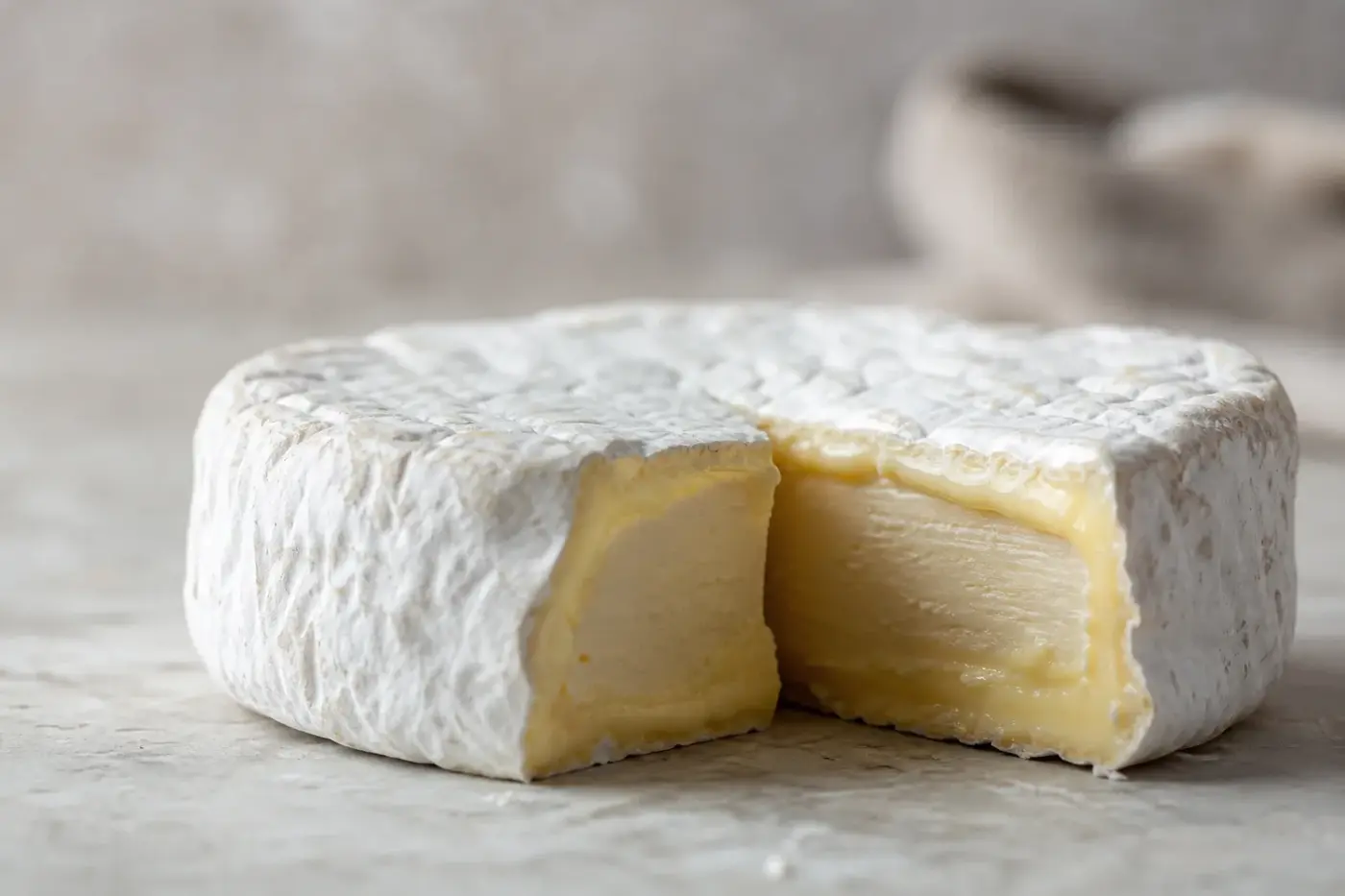
Your knife slips through the rind and finds a supple band, beginning to flow around a still firm centre.