How Long Is Cheese Aged?
Cut into a Camembert de Normandie and consider its calendar.

Cut into a Camembert de Normandie and consider its calendar. At three weeks old, it can already be ready for delivery; Parmigiano Reggiano still has months to go before reaching the beginning of its consortium’s age range.[3,5] You can eat cheese fresh, or after weeks, months or years of ripening. Time matters, but the recipe and ripening conditions decide what that wait produces.[1,2]
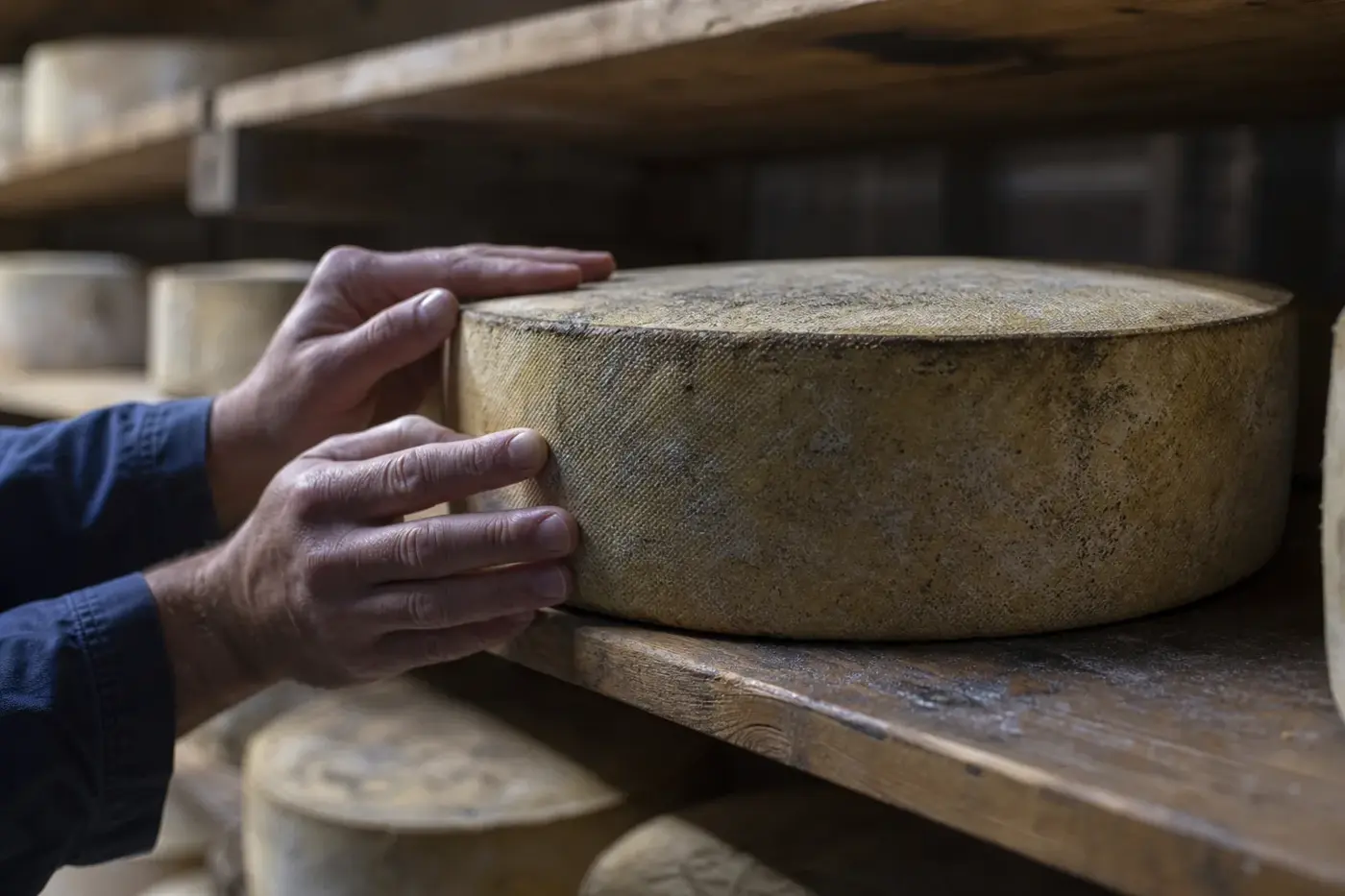
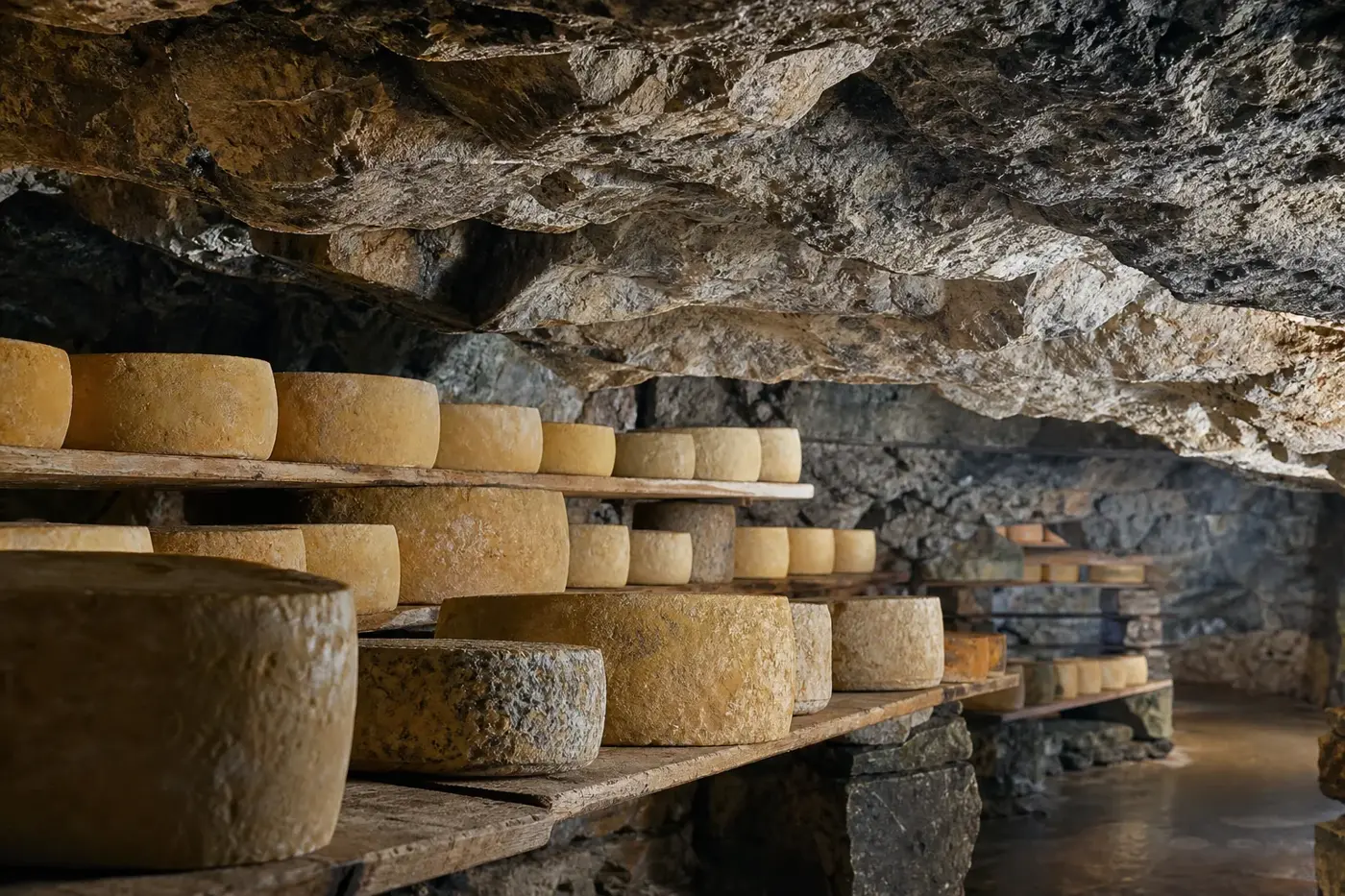
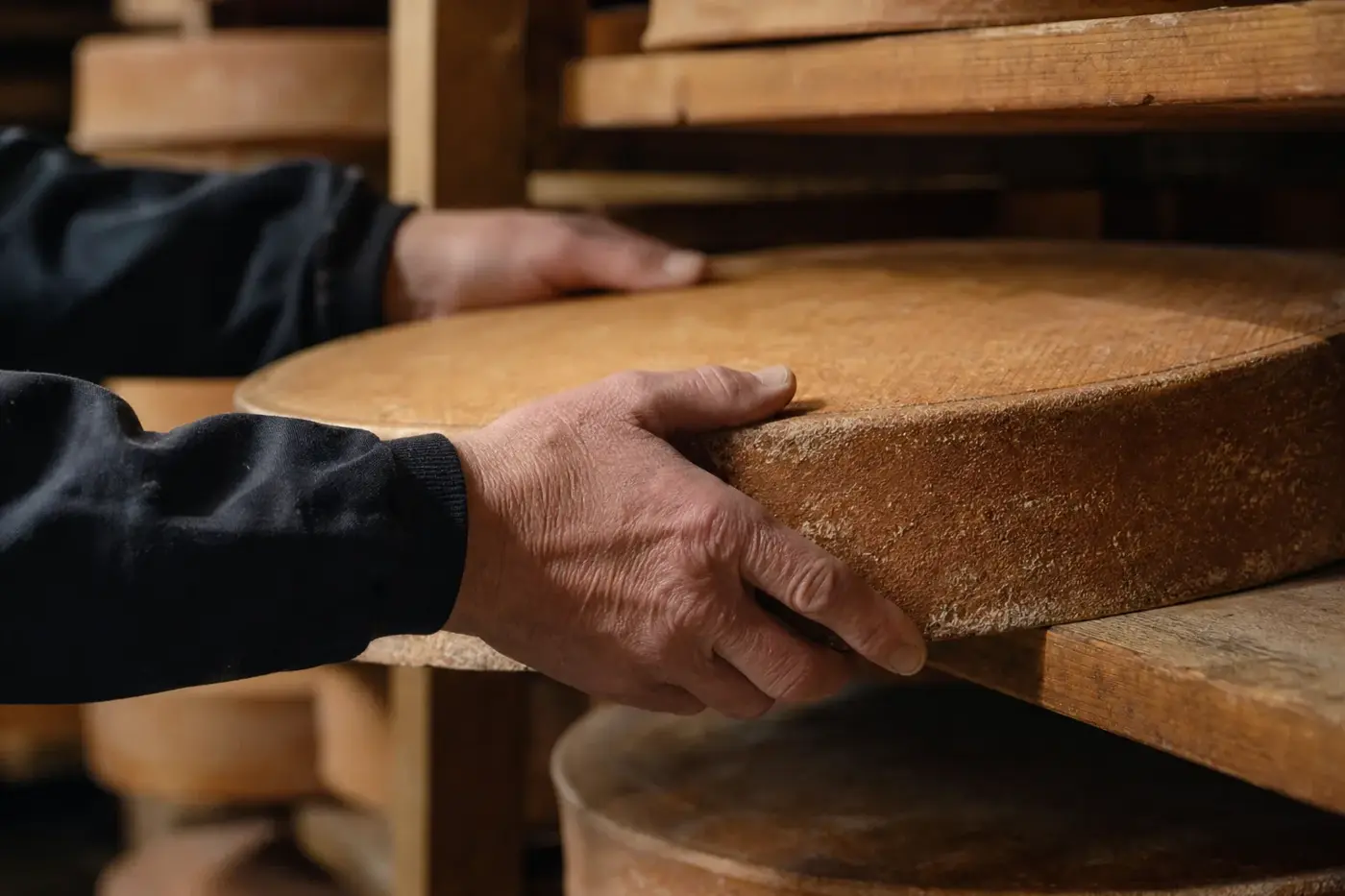
Step inside the ripening room
A cheese’s body, rind and flavour can change dramatically after manufacture. This controlled development is ageing, or ripening, shaped by temperature, humidity, organisms and enzymes. The care it receives during maturation is called affinage. The person tending that transformation is an affineur.[1,2]
Fresh cheeses generally skip deliberate ripening. The Codex General Standard for Cheese defines unripened cheese as ready to eat shortly after manufacture, while ripened cheese needs time in suitable conditions to develop its characteristic changes. Codex is an international reference standard; the rules applying to a product depend on the jurisdiction.[1]
Keep that distinction in mind when exploring how cheese is made. Making the curd, the solid portion separated from liquid whey, establishes the starting structure. Ripening develops it into the cheese you are meant to enjoy.[1,2]
Three weeks or three years? Find your cheese’s timetable
Some cheese is ready shortly after manufacture. Other cheese spends years maturing before it reaches you. These times describe production and maturation, not how long your purchased piece will keep at home.[3,4,5]
| Cheese | Time to know | What it means for the cheese |
|---|---|---|
| Fresh cheese | No deliberate ripening | Ready shortly after manufacture under the Codex definition.[1] |
| Camembert de Normandie | At least 21 days before delivery | The French specification sets this delivery threshold, including at least 12 days in the ripening room.[3] |
| Comté | 4 to 18 or 24 months, sometimes longer | The range described by the Comté interprofession.[4] |
| Parmigiano Reggiano | 12 months upwards; commonly 24 to 36 months | Ages described by its consortium, with longer maturation too.[5] |
Three weeks and three years are very different appointments with your cheeseboard. Neither, unfortunately, explains why the piece you bought disappears so quickly. Before asking how old a cheese is, ask what kind of cheese it was made to become: that intended character gives the number meaning.[1,3,5]
A soft centre has only half the story
Cut into a soft, surface-ripened cheese and you may find distinctly different textures in the same piece. In many of these cheeses, change starts at the rind and moves towards the centre, as ripening organisms act beneath the surface. Those changes can happen quickly. A bloomy rind is the characteristic surface growth of selected moulds.[2]
Hard cheeses can undergo substantial protein breakdown too. Instead of a flowing paste, though, you may find a grainy, fractured texture. The Parmigiano Reggiano consortium describes increasing granularity and crumbliness with maturation. Softening and becoming easier to fracture are different expressions of structural change.[6]
Texture alone, then, cannot tell you a cheese’s age. Fresh cheese may already be soft, while a long-ripened hard cheese can stay firm enough to shave or grate. Nor does all mould ripening travel inwards from the rind: Codex also recognises cheeses ripened by mould within their interior.[1,6]
What sets the pace in the ripening room?
Moisture and salt work together. Available water affects microbial activity, while salt influences the organisms and enzymes responsible for maturation. What matters is the salt in the cheese’s moisture, not simply the percentage on its nutrition label. Two cheeses with the same total salt content can offer different ripening conditions if their moisture contents differ.[2,7]
Cultures get things moving. The bacteria, moulds and yeasts used to develop a cheese’s character release enzymes that break down its components. Their activity depends on their surroundings. That is why a ripening room is managed for the particular cheese, rather than set to one temperature and left to suit everything.[2]
Shape matters when change starts at the rind. A thin disc has less distance between its surface and centre than a thick wheel. Where ripening moves inwards, that geometry helps explain why you need to consider dimensions alongside age when judging development.[2]
Temperature and humidity influence both speed and outcome. In a 2020 experiment, researchers compared Camembert-type cheeses made with four salts, following an initial warmer, humid ripening stage with refrigeration. Protein breakdown increased and hardness declined during the study. A number of weeks tells you more when you understand the conditions behind it.[2,7]
Follow the flavour from milk to spice
Behind those changing flavours are processes with rather less appetising names. Proteolysis breaks down proteins; lipolysis breaks down fats. Both matter in ripening, as enzymes released by ripening organisms help produce compounds associated with the developing cheese.[7]
In the Camembert experiment, researchers measured protein breakdown through water-soluble nitrogen. They also used instruments to assess texture. Appearance alone was not their measure of age.[7]
Parmigiano Reggiano gives you a vivid way to taste the journey. Its consortium describes the 12 to 18 month cheese through milk, yoghurt and fresh fruit. At 30 to 36 months, the descriptions move towards spices, nuts and meat stock, alongside a more crumbly, granular texture.[6]
Camembert de Normandie takes another route. France’s INAO describes its flavour moving from milky and mild towards more pronounced and fruity with further ripening. That is quite different from a hard cheese becoming increasingly granular. “Stronger” leaves rather a lot untold.[8]
Older is not automatically better. You might prefer a younger, more elastic bite, or the brittle texture of a longer-aged cheese. Both have their pleasures; the detailed Parmigiano Reggiano guide puts those choices in the context of that particular cheese.[6]
The minimum age is only the beginning
A minimum maturation requirement tells you where a defined product’s journey can begin, not where the maker must stop. Read the wording closely. Time in a ripening room, elapsed time since manufacture and the earliest permitted delivery date can be separate measures.[3]
Camembert de Normandie makes that distinction clear. Its French specification requires at least 12 days in the ripening room and a minimum interval of 21 days before delivery to customers. Those are production requirements, not one perfect eating age for every cheese.[3]
Beyond that minimum, the maker has another decision to make. Comté’s interprofession describes wheels kept for 18 or 24 months, sometimes longer, with the duration depending on the individual wheel. An age on a label may reflect a maker’s selection rather than the minimum required by the relevant specification.[4]
Pay just as much attention to the name. Requirements for Camembert de Normandie apply to that named product, not every cheese labelled Camembert. The guide to protected names explains how specifications and geographical protection fit together.[3,8]
In the cellar, readiness takes more than a birthday
An affineur is looking for a particular result, not merely an anniversary. Cheese is spared the pressure of achieving everything by its next birthday. In Comté production, the interprofession describes regular turning and rubbing with salt to encourage development. Each wheel’s progress helps decide how long it stays in the cellar.[4]
The calendar supplies only part of the answer. Sensory checks add more: the Parmigiano Reggiano consortium’s method examines appearance, smell, taste and consistency.[6]
Put the age on the label to work
A number of months tells you more than an adjective, but it is still only part of the label. Production history matters too. Ask whether the seller means a stated minimum or an approximate age, and whether that description applies to the particular cheese in front of you.[5,12]
For Parmigiano Reggiano, the consortium describes a minimum maturation of 12 months. It also says most cheese on the market is between 24 and 36 months old. The first figure is its stated starting point; the second describes the ages you will commonly encounter.[5]
Current UK guidance requires food labels to be accurate and not misleading. Keep one distinction firmly in mind: months of maturation answer a different question from a use-by or best before date. See how to read a cheese label for the other details worth your attention.[9,12]
At home, give your cheese the right care
Your fridge is not a maker’s ripening room, so follow the storage instructions rather than trying to reproduce a maturation schedule. Food Standards Agency guidance for England, Wales and Northern Ireland recommends refrigerating dairy products and keeping the fridge between 0 and 5 °C. Check the temperature with a fridge thermometer.[10]
Commercial affinage involves conditions and handling managed for the cheese. At home, your priority is keeping food under the conditions stated on its label. Follow instructions about consumption after opening as well as the printed date; storing cheese at home covers these practical steps.[4,9,10]
UK official guidance distinguishes use-by dates, which concern safety, from best before dates, which concern quality. Do not eat cheese after its use-by date. The FSA says smell cannot establish the safety of food bearing a use-by date, because you cannot detect the organisms that cause food poisoning that way.[9,11]
For food with a best before date, the FSA says smell, appearance and changes in texture can help identify spoilage. Consider what you notice in relation to the kind of cheese you bought. Expected rind growth and unexpected mould need different consideration, so consult mould on cheese before deciding whether affected cheese can be retained.[11]
Deterioration is not further maturation. Follow the FSA guidance for the type of cheese and date label involved.[11]
General information only, not medical advice: follow the official guidance where you live.
Questions people ask
How long is cheese aged?
Fresh cheese has no deliberate ripening period and is ready shortly after manufacture. Comté may mature for 4 to 18 or 24 months, sometimes longer, while Parmigiano Reggiano is aged for at least 12 months.
Why do soft and hard cheeses change differently as they age?
In many soft cheeses, ripening starts at the surface and moves towards the centre, often producing rapid changes in texture. Hard cheeses can develop a grainy, fractured texture as proteins break down.
How does the flavour of Parmigiano Reggiano change with age?
The Parmigiano Reggiano consortium describes the cheese at 12 to 18 months in terms of milk, yoghurt and fresh fruit. At 30 to 36 months, its descriptions include spices, nuts and meat stock, with a more crumbly, granular texture.
How should I store cheese at home?
The Food Standards Agency advises refrigerating dairy products and keeping the fridge between 0 and 5 °C in England, Wales and Northern Ireland. It also recommends using a fridge thermometer to check the temperature; see its guidance and follow the storage instructions on the label.
Can I eat cheese after its date?
The Food Standards Agency advises against eating cheese after its use by date and says smell cannot establish whether such food is safe. For food with a best before date, it says smell, appearance and texture changes can help identify spoilage; see the agency’s guidance.
Sources
-
Codex Alimentarius Commission. Codex General Standard for Cheese, CODEX STAN 283-1978, retrieved edition incorporating amendments through 2013. Sections 2.1 to 2.1.3 define cheese, ripened cheese, mould-ripened cheese and unripened cheese. Official document.
-
American Cheese Society. Best Practices Guide for Cheesemakers, second edition, February 2017. Chapters 5 and 6, particularly surface mould-ripened cheeses and section 6.6 on ageing and ripening. Industry technical guidance, used for production principles rather than current regulatory requirements. Guide.
-
French Ministry of Agriculture. Cahier des charges de l'appellation d'origine « Camembert de Normandie », associated with Décret n° 2013-1059, published in the ministry's Bulletin officiel, 29 November 2013; document linked by INAO when checked. Production requirements and control table distinguish ripening-room duration from delivery timing. Official specification.
-
Comté interprofession, Comté USA. In the Cellar (Aging Comté), undated, checked November 2026. The interprofession's account of maturation periods, turning and salting. Published account.
-
Consorzio del Formaggio Parmigiano Reggiano. FAQ, undated, checked November 2026. Answers on minimum age and longer maturation. These are attributed industry statements. Official FAQ.
-
Consorzio del Formaggio Parmigiano Reggiano. Sensory analysis, undated, checked November 2026. Sensory assessment method, texture changes and the consortium's age-specific tasting descriptions. Sensory guide.
-
Applied Biological Chemistry. Physicochemical changes during 4 weeks ripening of Camembert cheeses salted with four types of salts, volume 63, article 66, 2020. Original experimental research comparing four salting treatments, with chemical, instrumental texture and sensory measurements. Research article.
-
Institut national de l'origine et de la qualité. Camembert de Normandie, undated, checked November 2026. Product description, sensory development and distinction between Camembert and Camembert de Normandie. Official product page.
-
GOV.UK. Understanding food labelling: Best before and use-by dates, current guidance checked November 2026. Date meanings, storage conditions and instructions after opening. Official guidance.
-
Food Standards Agency. How to chill, freeze and defrost food safely, published 2017, current page checked November 2026. Applies to England, Northern Ireland and Wales. Section 1 covers refrigeration and checking fridge temperature. Official guidance.
-
Food Standards Agency. Home food fact checker, updated August 2026. Applies to England, Northern Ireland and Wales. The dairy section distinguishes spoilage checks for best-before-labelled food from the limitations of smell for use-by-labelled food. Official guidance.
-
GOV.UK. Understanding food labelling: Overview, current guidance checked November 2026. Accuracy and misleading food labels. Official guidance.
This article was researched from official production documents, attributed cheese-industry accounts, original dairy research and current UK public guidance.
Last checked: November 2026
METADATA
- Content ID: A479
- Type: Article, production explainer
- Body word count: 1,590, manually counted, excluding the H1, reference markers, Markdown formatting and link destinations.
- Meta title: How Long Is Cheese Aged? Ripening Times Explained
- Meta description: Cheese ageing ranges from weeks to years. Compare named examples, understand minimum maturation rules and learn what cheese age means for home storage.
- Suggested slug: how-long-cheese-aged
- Aliases: cheese ageing times; cheese aging times; cheese ripening times; cheese maturation
- Original contribution: Desk research synthesising maturation times, delivery thresholds, sensory development and domestic date-label guidance.
- Publisher: detimiL gnitekraM latigiD citegrenyS
- Freshness: Safety and production-rule checks at least every 6 months.
- Featured image: ORIGINAL DIAGRAM. Compare outside-in surface ripening with the development of a granular texture in a hard cheese. Labels: rind, centre, younger, further ripened, protein breakdown. Use separate paths without a shared numerical timescale. Technical reviewer to approve before publication.
- Featured image alt text: Diagram comparing outside-in ripening in a soft cheese with texture development in a hard cheese.
- Publication status: Held for the editorial checks recorded below.
EVIDENCE LOG
All sources below were checked on 7 November 2026. Source numbers correspond to the published Sources block.
-
Definition, fresh cheese and broad timescale: Source [1], retrieved edition amended through 2013, sections 2.1 to 2.1.3. Supports controlled biochemical and physical development and readiness shortly after manufacture for fresh cheese. This edition is identified explicitly rather than represented as the latest Codex revision.
-
Ripening mechanisms and contrasting structures: Source [2], second edition, 2017, chapters 5 and 6. Supports outside-in surface ripening, microbial and enzymatic development, and cheese-specific environmental management. The size explanation is an editorial inference from outside-in ripening and geometry, not a measured universal relationship.
-
Camembert de Normandie timing: Source [3], official ministry specification, 2013, manufacturing provisions and final control table. Separately records 12 days minimum in the ripening room and 21 days minimum before customer delivery. Neither is presented as a typical eating optimum.
-
Comté periods and cellar care: Source [4], undated interprofession account. Relied on the passages describing 4 months through 18 or 24 months or longer, regular turning, salt rubbing and wheel-dependent development. No independent claim about current registration status is made.
-
Parmigiano Reggiano ages: Source [5], official consortium FAQ, minimum-age and maximum-maturation answers. The 12-month starting point and common 24 to 36 month market range remain attributed to the consortium; a binding specification was not retrieved.
-
Sensory development and assessment: Source [6], sections on smell, tactile analysis and maturation. Supports attributed flavour descriptions, increasing granularity and structured sensory assessment. No site tasting is implied.
-
Experimental science: Source [7], 2020, methods and results. Four salt treatments were compared over four weeks using chemical analyses, instrumental texture measurements and sensory assessment. Findings support protein breakdown and declining hardness within that experiment, not a universal schedule or an isolated causal test of humidity.
-
Camembert sensory trajectory and naming: Source [8], “Arômes et saveurs” and product-name explanation. Supports the attributed milky-to-more-pronounced sensory progression and keeping the named product separate from the broader Camembert name.
-
UK date marking: Source [9], sections on date meanings and storage instructions. Supports the distinction between maturation information and consumer keeping instructions.
-
Domestic refrigeration: Source [10], section 1. Supports the stated fridge range, thermometer check, refrigeration of dairy products and following packaging instructions. Its territorial scope is retained beside the advice.
-
Spoilage and sensory checks: Source [11], dairy section. Supports best-before spoilage observations and the inability of smell to establish safety for use-by-labelled food. No mould-trimming method is supplied.
-
Label accuracy: Source [12], overview. Supports the attributed UK guidance that food labels must be accurate and not misleading. The buying questions are editorial advice, not invented statutory definitions of maturity terms.
-
Recall-check record: The FSA alerts index was retrieved on 7 November 2026. Retrieval of the index alone does not complete a named-product recall assessment.
Flags and publication checks
- SAFETY UNCHECKED: A479. Official storage and date-label guidance has been retrieved, but the required human safety review and complete relevant recall assessment remain outstanding. The editor must complete both before publication.
- LEGAL UNCHECKED: A479. The Camembert de Normandie specification was retrieved from the ministry through INAO. The editor's competent reviewer must confirm its operative maturation provisions against any subsequent amendments before publication. Parmigiano Reggiano figures remain explicitly attributed consortium statements.
- Technical review: Assign the named production reviewer before publication, including review of the size inference, salt-and-moisture explanation and proposed diagram.
- Editorial checks: Add the real author or editor and reviewers; confirm all internal targets are published, source links open, the final imported word count is within range, and the intended canonical and indexing settings are correct.
Last checked November 2026.
The editors suggest you read next

What Happens as Cheese Ripens?
Your knife slips through the rind and finds a supple band, beginning to flow around a still firm centre.