What Happens as Cheese Ripens?
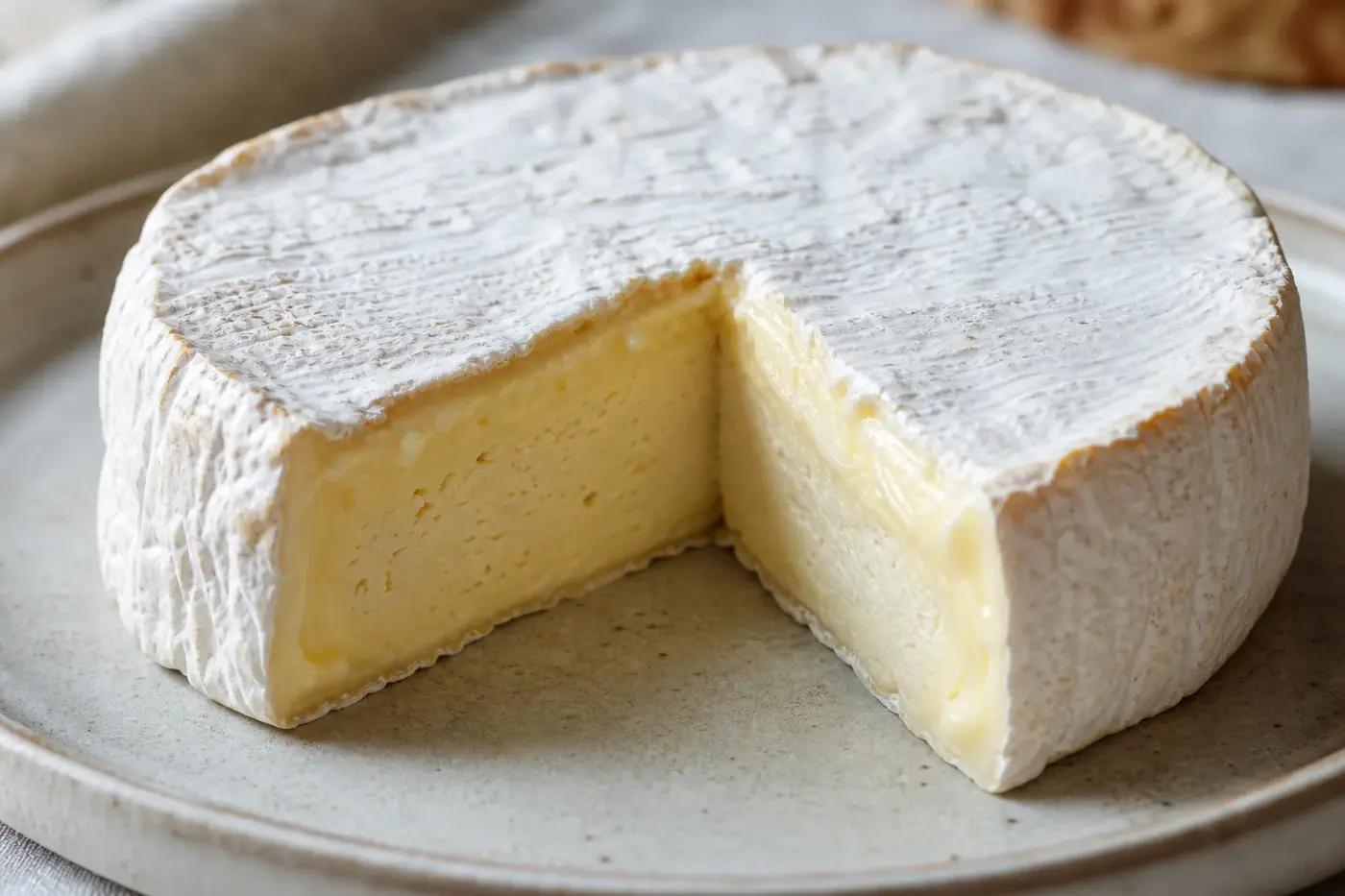
Your knife slips through the rind and finds a supple band, beginning to flow around a still firm centre.
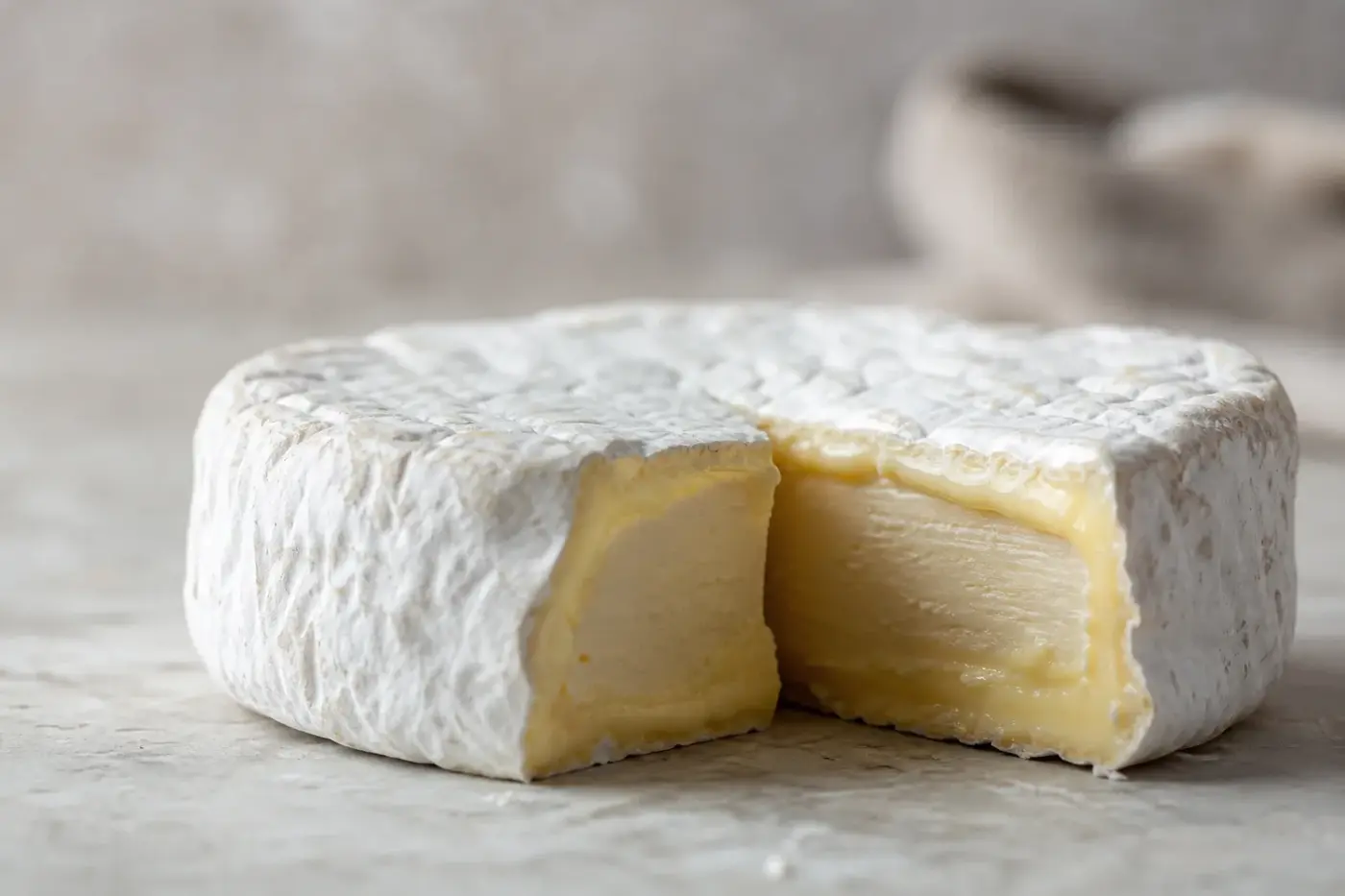
Your knife slips through the rind and finds a supple band, beginning to flow around a still firm centre. Cut another cheese and blue veins reach deep into the paste. You are seeing ripening at work: enzymes dismantle proteins and fats, microbes transform nearby compounds, and water moves or evaporates. Together, they build the texture, aroma and flavour on your plate. [1, 4, 5]
A young cheese still has a story to tell
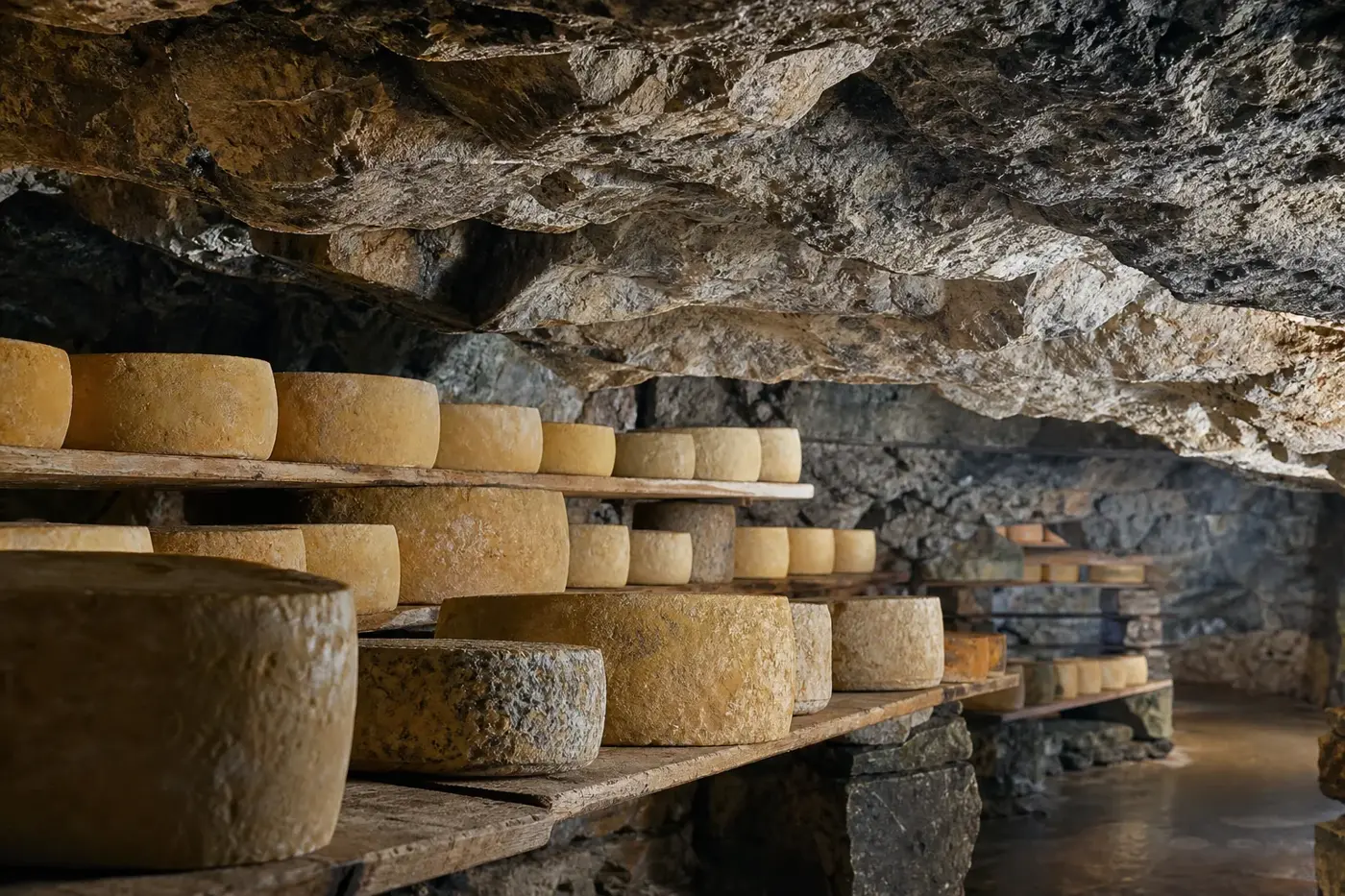
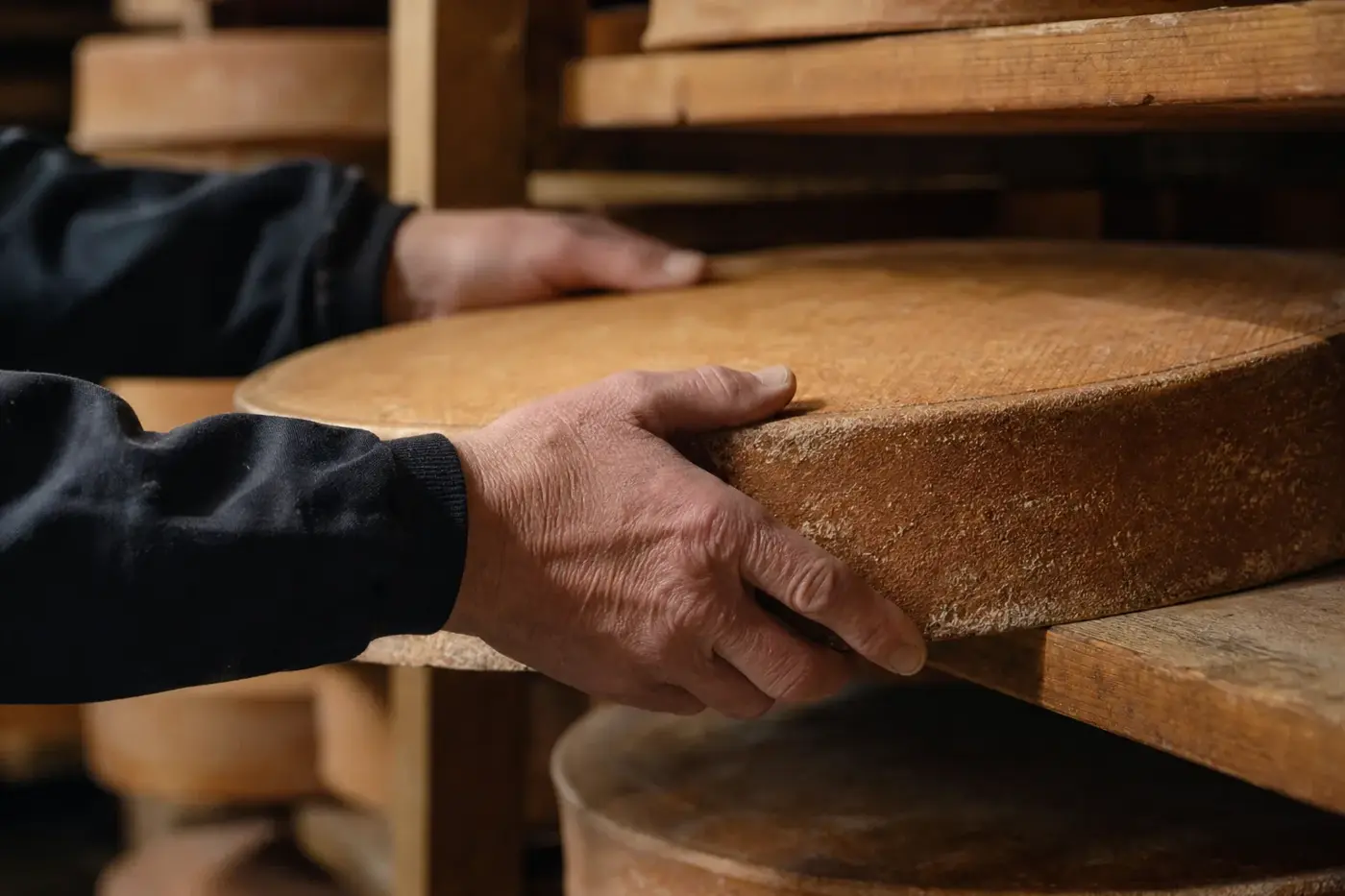
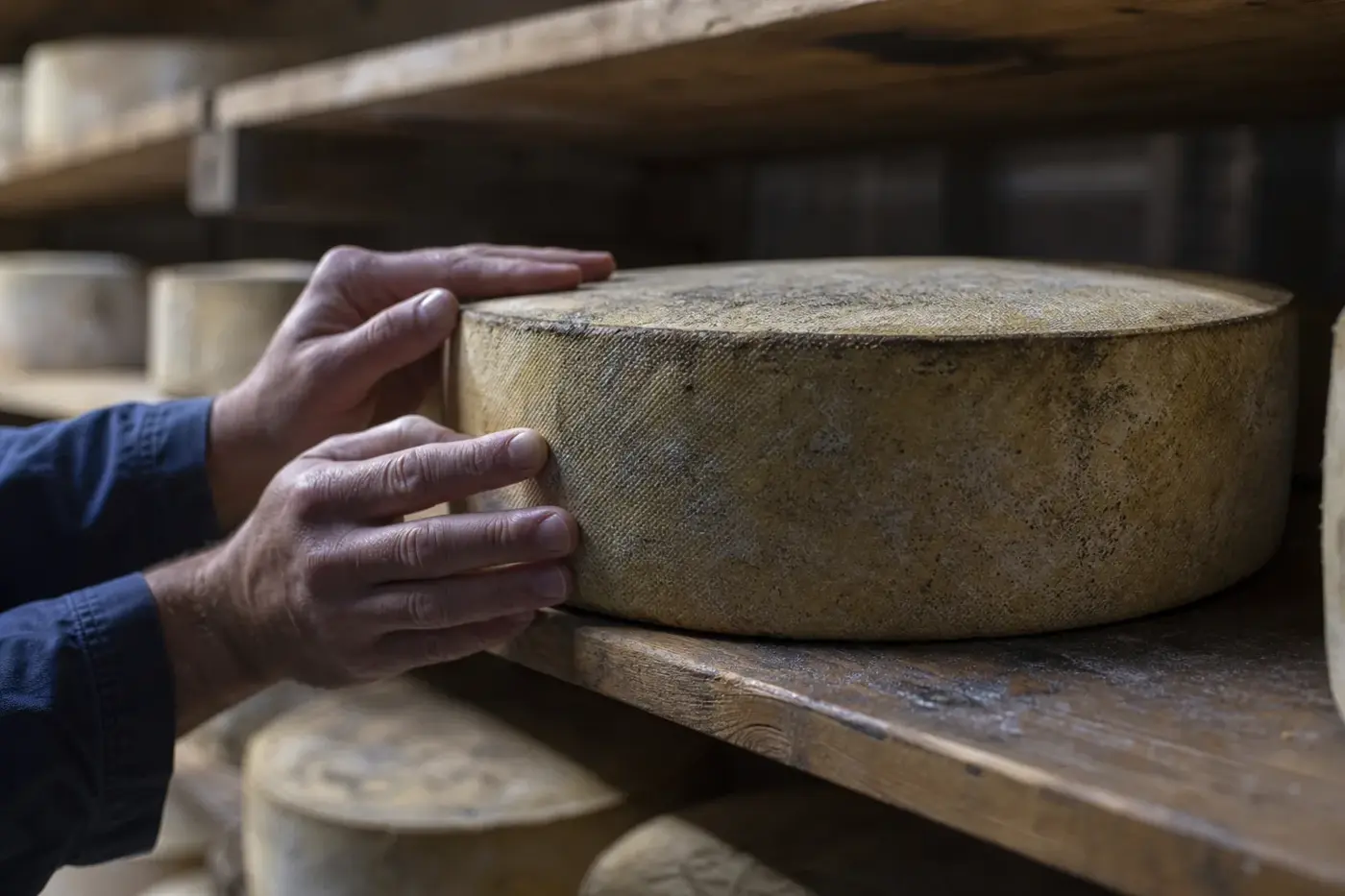
Making a cheese is not always the end of the story. Ripening, also called maturation, is its controlled development after making; affinage is the management of that journey, from its surroundings to the care it receives. Fresh cheeses are intended to be eaten without a deliberate ripening period. Ripened cheeses need further changes to develop their characteristic structure and flavour. [1]
Those changes overlap rather than forming a tidy queue. Protein breakdown, fat breakdown and microbial metabolism move at different speeds in different parts of the cheese. Their foundations begin in cheesemaking, when the maker determines how much water, fat, protein and mineral material the young curd keeps. [1, 2]
Start with the curd, not the birthday
To understand an old cheese, look first at its young curd. This is the coagulated milk material separated from whey, the liquid drained away during cheesemaking. Casein proteins form a network that holds water and fat. Milk supplies both that structure and the material ripening organisms will use; the making method determines what stays behind. [1, 6]
Moisture, salt and acidity help decide which microbes grow and how their enzymes work. The crucial detail is the salt dissolved in the cheese's water: two cheeses with the same overall salt content can offer different environments if their moisture levels differ. Acidity, measured as pH, also affects enzyme activity and the interactions between proteins and minerals. [2, 9]
An experimental Cheddar study varied calcium and phosphorus, residual lactose and the salt-to-moisture ratio. It offers a useful thought to keep beside an age label: time is only part of maturation. Conditions work together, and changing the starting cheese changes where it can go. A birthday alone tells you surprisingly little about a cheese's character. [2]
How protein breakdown changes your next bite
The name is proteolysis; the action is protein breakdown. Enzymes cut casein into smaller fragments called peptides, then other enzymes release individual amino acids from those fragments. Cutting that protein network changes how the cheese holds together. The released compounds can contribute taste or become starting materials for further aroma development. [1, 3]
The cheese draws on several sources of enzymes. Some coagulant, the substance used to set milk into curd, remains after making; it can include chymosin, an enzyme used in rennet, a preparation containing milk setting enzymes. Milk contributes its own enzymes, particularly plasmin. Starter bacteria, introduced chiefly to acidify milk, and other ripening organisms supply proteinases and peptidases, enzymes acting on proteins and peptides. [2, 3]
Which enzymes take the lead depends on the cheese. In an eight-month study of a high-temperature cooked hard cheese, researchers tracked casein breakdown using electrophoresis and chromatography with mass spectrometry. The cleavage patterns pointed to plasmin initiating much of the primary breakdown. Chymosin contributed less, with bacterial enzymes then working on the peptides. [3]
What those fragments become matters to your mouthful. Some peptides taste bitter; amino acids and their later transformations help develop savoury character. More extensive protein breakdown changes flavour as well as structure. It does not, however, send every cheese towards the same soft destination. [1, 3]
Fat brings more than richness
Fat is more than part of a cheese's structure. Through lipolysis, enzymes called lipases split it into free fatty acids. Some contribute sharp or pungent flavours directly; others feed further microbial reactions. How much breaks down, and in what pattern, depends on the cheese and its ripening organisms. [1, 4]
Blue cheese gives you a particularly clear example. Laboratory research showed that spores of Penicillium roqueforti could turn particular fatty acids into ketones associated with blue cheese aroma. Octanoic acid, for instance, can become 2-heptanone, a molecule with one fewer carbon atom. Fat supplies aroma precursors as well as physical structure. [4]
So total fat content cannot tell you the whole flavour story. Ask instead which fatty acids are released, and which organisms transform them. A small family of aroma compounds can shape a cheese's recognisable smell more powerfully than the broad labels full-fat or low-fat suggest. [4]
The microbes have a changing menu
By the time ripening begins, much of the milk's lactose has left with the whey or been fermented during cheesemaking. Any remaining lactose can still be used. In controlled Camembert-type experiments, researchers tracked microbial counts alongside carbon substrates and found that lactose became negligible early in ripening. [1, 5]
Next on the menu is lactate, produced during lactic fermentation. Surface fungi can consume it, changing the acidity around them, while microbes also use nitrogen-containing compounds released by protein breakdown. One reaction supplies the next. You are looking at an interacting community whose food supply changes as the cheese develops. [5, 8]
Follow that soft band beneath the rind
That soft band under the rind begins with changes at the surface. On some mould-ripened cheeses, yeasts and moulds consume lactate, making their surroundings less acidic. Amino acid breakdown can generate ammonia too, helping raise the pH. In controlled experiments, the changing surface supported a succession of organisms, not a single culture working alone. [5, 8]
The resulting chemical gradient helps explain the cross-section on your plate: a softer outer band around a firmer centre. Changing acidity and mineral distribution alter how the casein network interacts with water, while protein breakdown plays its part. Together, these processes can make the outer paste, the body beneath the rind, supple and eventually flowing. The centre, meanwhile, remains less developed. [1, 6]
There is more to this than mould simply dissolving cheese from above. Acidity, mineral movement and enzyme activity work together. An experimental study comparing milk and buttermilk formulations recorded rising pH, changing texture and different microstructures during ripening. The cheese's composition can change how this inward progression unfolds. [6]
Inside the cheese, veins and eyes emerge
Do not let the rind claim all your attention. In internally ripened styles, enzymes and bacteria work throughout the body, including places no visible rind organism reaches. An active surface can coexist with interior ripening. The distinction tells you where particular changes concentrate, although much of the chemistry is shared. [1, 3]
Blue mould grows in internal openings where oxygen is available, and piercing admits air to encourage that veined pattern. Experiments with Penicillium roqueforti on cheese media show that oxygen, carbon dioxide, salt and neighbouring organisms affect both growth and sporulation. Sporulation means producing the spores that give the growth its visible blue-green colour. [1, 9]
Eyes have a different origin. In Swiss-type cheeses, propionic acid bacteria can use lactate and release carbon dioxide, which collects and expands at suitable starting points inside the cheese. Experimental research into eye formation has investigated plant particles as those starting points. More recently, it has also examined hollow structures carrying entrapped air. [1, 10, 11]
Older does not always mean softer
Protein breakdown weakens the original network, but moisture loss pulls texture in another direction. As water evaporates, cheese can become more concentrated even while its proteins are being cut into smaller pieces. The texture you encounter reflects the balance between those changes, the starting composition, and the acidity and mineral state of the protein network. [2, 6, 13]
The result might be a supple paste, a flowing layer or a firm body that grows increasingly friable. Creaminess describes texture here, not a measurement of fat. Both a low-moisture cheese and a moist surface-ripened cheese can undergo substantial proteolysis. They can still arrive at quite different consistencies. [1, 2, 6]
The ripening room earns its place
Temperature sets the pace for microbial growth and enzyme activity; humidity influences drying. The composition of the air matters too. In a controlled Camembert-type experiment, changing the chamber atmosphere altered the balance of ripening organisms and the development of the underrind. The room is no mere backdrop: it actively shapes the cheese's biology. [7, 8]
Wrapping can steer maturation again by limiting water loss while allowing different degrees of gas exchange. A study comparing four gas-permeable wrapping films found that their water permeability influenced Camembert-type ripening dynamics. Care does not stop at the ripening room door. It extends through wrapping, transport and storage, as well as the time spent maturing. [13]
At home, keep the science of maturation separate from the storage instructions for your particular cheese. Follow how to store cheese for day-to-day handling. If you want help telling rind from body, see cheese styles.
Take a closer look at your cut cheese
A visible change can have more than one cause. Use these connections to follow how surface and interior processes develop together, shaping the cheese you have just cut. [2, 5, 9, 10, 13]
| What you notice | What is happening | What it means for your cheese |
|---|---|---|
| Softer band beneath the rind | Surface deacidification and protein breakdown | The outer paste softens before the centre. [5, 6] |
| Blue-green growth in openings | Mould grows and produces spores where conditions allow | Veins develop within the body. [9] |
| Rounded eyes | Gas expands at suitable starting points, or nuclei | Openings enlarge inside the cheese. [10, 11] |
| Drier, firmer outer layer | Water leaves the surface | The exterior becomes more concentrated. [13] |
| Changed taste without a visible rind | Internal enzymes and microbes transform proteins and other substrates | Flavour develops throughout the paste. [1, 3] |
Every cheese has its moment
Longer ageing can deepen flavour. It can also bring excessive drying, a collapsing texture or an overpowering ammonia character. Every style needs a balance between desirable changes and those that carry it too far. The right stage belongs to the intended cheese, not to some grand competition for the oldest wedge. [7, 13]
A controlled Camembert-type study compared three temperatures and three relative humidities. At the same assessment age, the coolest, driest treatment produced a hard core and dry underrind. The warmest, most humid treatment produced an entirely runny body with a strong ammonia odour. Same ripening time, very different stages. [7]
When you read an age statement, put it alongside style, moisture, method and storage history. Two cheeses of the same age can be at different sensory stages. Nor does a cheese intended for short maturation necessarily improve if you keep it until it resembles a much older style. [7, 13]
Know the difference between wanted cultures and unexpected growth
Desirable ripening needs suitable organisms within a controlled production system. A mould selected for a particular style has a defined job to do. Unexpected growth on another cheese calls for a different assessment. Appearance alone cannot tell you whether an organism is a wanted ripening culture. [9, 12]
In England, Wales and Northern Ireland, the Food Standards Agency describes food safety management as identifying hazards and introducing procedures to remove them or reduce them to an acceptable level. Its guidance also emphasises safe handling by suppliers, traceability and regular review of production procedures. Controlled ripening sits within this wider system of hygiene and hazard management. [12]
For practical help with household storage, see how to store cheese. For unexpected growth, turn to mould on cheese.
General information only, not medical advice: follow the official guidance where you live.
Questions people ask
What is the difference between ripening and affinage?
Ripening, also called maturation, is the controlled development of a cheese after it is made. Affinage is the management of the conditions and care it receives during that development.
Why does cheese soften beneath the rind first?
On some mould ripened cheeses, surface organisms consume lactate, making their surroundings less acidic. Changes in acidity and mineral distribution, together with protein breakdown, can soften the outer paste while the centre remains firmer.
How do blue veins form inside cheese?
Blue mould grows in internal openings where oxygen is available. Piercing lets air into the cheese, encouraging the veined pattern.
How do the holes in Swiss cheese form?
Propionic acid bacteria can use lactate and release carbon dioxide. The gas collects and expands at suitable starting points inside the cheese.
Does cheese always improve with age?
Longer ageing can deepen flavour, but it can also cause excessive drying, a collapsing texture or an overpowering ammonia character. The right stage depends on the intended cheese rather than an ideal of maximum age.
Sources
-
American Society for Microbiology, The Basics of Cheesemaking, Microbiology Spectrum, 2013. Expert synthesis used for terminology and the broad distinction between internal and surface ripening. Journal article.
-
American Dairy Science Association, Influence of Calcium and Phosphorus, Lactose, and Salt-to-Moisture Ratio on Cheddar Cheese Quality: Proteolysis During Ripening, Journal of Dairy Science, volume 89, issue 2, 2006, pages 444 to 453. Original experimental research; publisher's indexed abstract consulted. Publisher record.
-
American Dairy Science Association, Comprehensive analysis of proteolysis during 8 months of ripening of high-cooked Old Saare cheese, Journal of Dairy Science, indexed online in 2017. Original experimental research; indexed abstract consulted. PubMed record.
-
Nature, Formation of Ketones from Fatty Acids by Spores of Penicillium roqueforti, volume 182, 1958, page 1237. Original laboratory research; publisher's introductory passage consulted. Publisher record.
-
Original experimental study, Controlled production of Camembert-type cheeses. Part I: Microbiological and physicochemical evolutions, 2004. Indexed abstract consulted. PubMed record.
-
Camembert-Type Cheese with Sweet Buttermilk: The Determination of Quality Properties and Microstructure, 2024. Original experimental study, full text archived by the US National Library of Medicine. Full paper.
-
American Dairy Science Association, Temperature and relative humidity influence the ripening descriptors of Camembert-type cheeses throughout ripening, Journal of Dairy Science, volume 98, issue 2, 2015, pages 1325 to 1335. Original experimental research; abstract consulted. PubMed record.
-
American Dairy Science Association, Microbiological and Biochemical Aspects of Camembert-Type Cheeses Depend on Atmospheric Composition in the Ripening Chamber, Journal of Dairy Science, volume 89, 2006. Original experimental research; full paper consulted. Full paper.
-
Effects of atmospheric conditions, NaCl and pH on growth and interactions between moulds and yeasts related to blue cheese production, International Journal of Food Microbiology, 2000. Original experimental research; abstract consulted. PubMed record.
-
Mechanism and control of the eye formation in cheese, International Dairy Journal, 2015. Original experimental research; indexed publisher excerpt consulted. Publisher record.
-
Nuclei carrying entrapped air are the most likely starting points for eye formation, International Dairy Journal, publisher record retrieved November 2026. Original experimental research; indexed publisher excerpt consulted. Publisher record.
-
Food Standards Agency, Managing food safety, updated 21 August 2026, applying to England, Northern Ireland and Wales. Sections on managing food safety procedures, suppliers and traceability. Official guidance.
-
American Dairy Science Association, Camembert-type cheese ripening dynamics are changed by the properties of wrapping films, Journal of Dairy Science, 2011. Original experimental research; indexed publisher abstract consulted. Publisher record.
This desk-researched article connects experimental findings on protein breakdown, microbial succession, surface chemistry, gas formation and moisture movement, with food safety context from current FSA guidance.
Last checked: November 2026
Last checked November 2026.
The editors suggest you read next
What Does an Affineur Do? The Work of Ageing Cheese
At Jasper Hill in Vermont, a spruce bark band holds a soft cheese as its centre becomes spoonable.