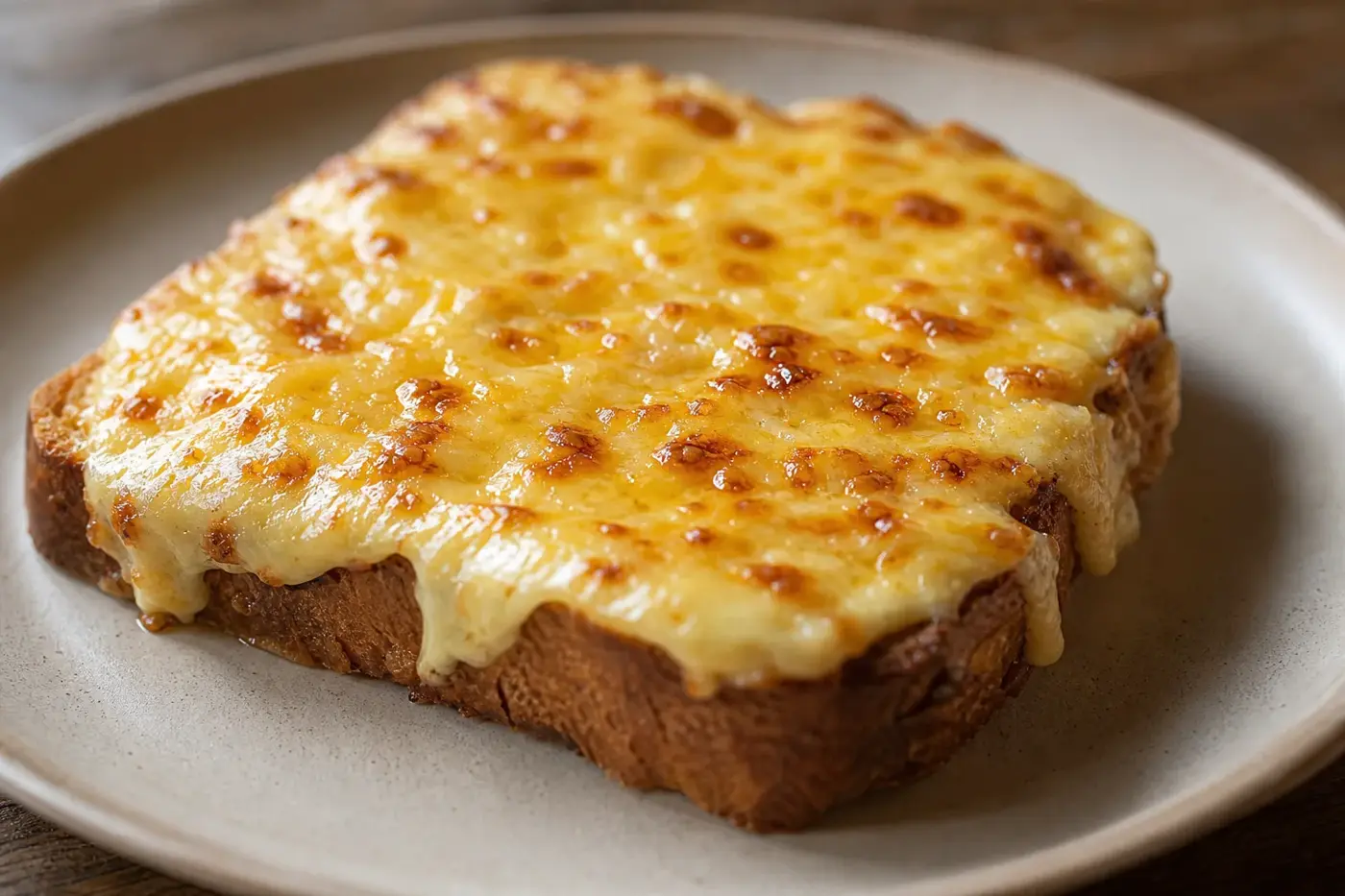
Under the grill, cheese bubbles and turns golden. You catch the sharp scent of mustard, and suddenly the toast looks rather pleased with itself. Ale, mustard and Worcestershire sauce give Welsh rarebit its depth and bite, but the saucepan does the quiet work first. Butter and flour thicken the ale before the cheese melts in gently, making a topping that clings rather than runs. [1,2]
Give your cheese on toast the saucepan treatment
With rarebit, you put the seasoning inside the cheese topping. Ordinary cheese on toast usually means sliced or grated cheese melted straight over bread; here, ale, mustard and seasoning become a spreadable sauce. You prepare the bread and sauce separately, then bring them together for the final browning. [1,2]
The boundary has never been entirely tidy. Some historical recipes put toasted cheese directly onto toast; modern versions might use a flour thickened sauce or combine cheese with beer and egg. The roux used here, a cooked paste of butter and flour, helps you find the right texture. It is useful, but not compulsory for every rarebit. [3,8,14]
Choose cheese with something to say
Mature Cheddar gives you plenty of flavour and a dependable melt. Wales.com's recipe notes recommend it, and the Welbeck recipe uses it too. Grate it before you start, then stir small handfuls into the warm base, letting each melt before adding the next. That gives you more control than persuading a large lump to melt with stronger heat. [1,2]
Want Welsh cheese in your Welsh rarebit? Choose a Welsh-made mature Cheddar, or replace half with Caerphilly. The chef writing for Wales.com describes Caerphilly's lactic tang, but notes that its crumbly texture makes it less successful for melting alone. An equal blend brings that character along, with Cheddar handling the dependable groundwork. [1]
Keep the total cheese quantity unchanged. Salt and moisture vary between cheeses, so taste the finished mixture before adding salt and judge its thickness before spreading. You can explore the style further in Cheddar. [1,3]
Give the saucepan a gentle hand
Flour thickens the liquid into a base that helps your cheese mixture sit neatly on the toast. Cook the butter and flour first, then whisk in the ale gradually until you have a smooth, thick base. [1,2]
Lower the heat before adding cheese. Welbeck takes the pan off the heat altogether at this point, warning that continued heating can make the mixture grainy. Let the residual warmth do the work first. Return the pan to gentle heat only if the cheese needs encouragement. [2,4,5]
Put rarebit on the table for four
This recipe adapts Wales.com's version, measuring the Worcestershire sauce rather than adding it by eye, and giving the flour and mustard by weight. Treat this fromage.co.uk adaptation as an untested recipe. [1]
Serves: 4, with one generous slice each.
Preparation: about 15 minutes, plus cooling until spreadable.
Final grilling: allow about 5 minutes, but follow the topping, not just the clock.
Heat: high grill, called a broiler in the US. A fan oven temperature is not applicable. [1,2]
Equipment: saucepan, whisk, wooden spoon, grater, measuring jug, scales, baking tray and grill.
Gather the good things
- 15 g (0.5 oz) butter
- 10 g (0.35 oz) plain flour
- 5 g (0.18 oz) English mustard powder
- 1 g (0.04 oz) cayenne pepper, optional
- 10 ml (0.34 US fl oz) Worcestershire sauce
- 150 ml (5.1 US fl oz) ale
- 300 g (10.6 oz) mature Cheddar, grated
- 4 large, thick slices of bread, about 320 g (11.3 oz) in total
- Black pepper, to taste
Give your topping a solid landing place: choose bread with a reasonably close crumb and a continuous surface. The source recipe uses thick white sandwich bread; a wide, sturdy slice works better than a thin one full of large holes. If very large slices are awkward to serve, divide them after cooking. [1,2]
Take it from saucepan to golden toast
-
Begin with the roux. Melt the butter over medium to low heat. Stir in the flour and cook, stirring, for about 2 minutes. Keep it from browning. [1,2]
-
Make the base smooth. Stir in the mustard and cayenne. Add the ale a little at a time, whisking until smooth after each addition. Stir in the Worcestershire sauce, then cook for about 2 minutes, stirring, until thickened. [1,4,5]
-
Melt the cheese gently. Take the pan off the heat. Add the grated cheese in small handfuls, stirring between additions; if it stops melting, return briefly to low heat. Stop heating as soon as the mixture is smooth, then add black pepper and taste before considering extra salt. [1,2,3]
-
Let it become spreadable. Set the mixture aside while you prepare the toast. You want it to hold on the bread, not pour like gravy. Cooling helps it reach that spreadable consistency. [1,2,3]
-
Toast both sides. Heat the grill to high and toast both sides of the bread. Put the slices on a baking tray, then divide the cheese mixture between them. Spread it evenly towards the edges. [1,2]
-
Watch for the golden finish. Return to the grill until the topping is bubbling, golden and hot throughout, checking frequently. Allow about 5 minutes, adjusting for your appliance and the topping's starting temperature. Serve immediately, with your accompaniments ready. [1,2,10]
Get a troublesome topping back on track
Split sauce, soggy toast and a scorched surface are preparation or texture problems. These fixes are for freshly made mixture handled according to the storage guidance below. [1,2,3]
| What's happened? | The likely cause | What you can do |
|---|---|---|
| Split or grainy sauce | Too much heat, or cheese added too quickly. | Take it off the heat and stir gently. If badly separated, start again with lower heat and smaller additions of cheese. [1,2] |
| Soggy toast | Bread not toasted enough, or topping too loose. | Toast both sides thoroughly. Let the mixture cool until spreadable before assembling, then serve promptly. [1,3] |
| Scorched surface | Topping too close to strong heat, or left unattended. | Lower the tray and watch continuously. Remove badly burnt areas and adjust the grill position for your next batch. [1,2] |
| Topping runs off | Mixture too hot, too fluid or piled unevenly. | Cool it further, then spread evenly. Save excess for another slice rather than overloading small toast. [1,2,3] |
Make room for your kind of rarebit
Swap the ale for milk
You can use 150 ml milk instead of the ale, adding it gradually to the roux in the same way. Welsh Food and Drink gives milk as an alternative liquid. This equal-volume substitution is an untested adaptation of the recipe above. You are making a milk based sauce, not recreating ale's flavour. [3]
Add the richness of an egg yolk
Egg enriched rarebits are an established variation. Adding a yolk here is an untested adaptation: take the finished sauce off the heat, let it lose its fierce heat, then stir in one yolk before spreading. Start without extra liquid and judge the consistency before assembling. [14]
Cook an egg enriched topping thoroughly. The Food Standards Agency's guidance for England, Wales and Northern Ireland gives 70 °C (158 °F) for 2 minutes, or 75 °C (167 °F) for 30 seconds, at the centre of food. Use a clean food thermometer: a golden surface cannot tell you enough. [10]
Give one seasoning change the floor
Keep your first batch simple. Reduce or omit the cayenne if you want less chilli heat; keep the mustard for its characteristic seasoning. Welsh Food and Drink also records versions with different beers or milk. Change one component at a time so you can judge what best suits your cheese. [3]
Follow Welsh rabbit through the history books
On 6 April 1725, John Byrom recorded eating Welsh rabbit in London. His journal entry, later printed by the Chetham Society, lets you glimpse the dish in an early written record. It establishes the name's use at that date, but offers neither a recipe nor an explanation for the name. [7]
Hannah Glasse gets straight to the cooking. In the second edition of The Art of Cookery, made Plain and Easy, published in 1747, her Welsh version calls for bread toasted on both sides and cheese toasted on one side. The cheese goes onto the bread and is browned with a hot iron; mustard is optional. The published transcription also includes Scotch and English rabbits, giving national labels to several related preparations. [8]
Then the spelling begins to shift. A transcription of Francis Grose's 1788 dictionary records both “Welch rabbit” and “Welch rare bit”, documenting eighteenth-century usage without identifying who first changed the name. By 1937, The New Yorker was still discussing the wording and defending the older rabbit form. Cheese on toast can apparently sustain quite a correspondence. [8,9]
You may know the story that cheese stood in for rabbit. That is an interpretation of the name, and Wales.com's modern recipe presents the connection as a supposed joke. The written record tells you more firmly about words and preparations than that origin story. Whatever the original intention, the Welsh association remains clear in the country's food writing today. [1,8]
Give the rich topping a crisp companion
A leafy salad with sharp mustard dressing and a small portion of pickled onions or cucumber brings crispness and acidity alongside the thick cheese topping. Wales.com's recipe suggests leafy salad with mustard dressing, or chutney if you serve rarebit as a cheese course. [1]
For a contrasting drink, try sparkling water or an unsweetened apple drink, served separately from the dressing and pickles. Adults of legal drinking age who choose alcohol could have a small serving of ale. You are looking for contrast, rather than another thick or sweet element on your plate.
This page summarises published guidance from the official sources it cites. It is not medical advice. Guidance differs between countries and changes over time, so check the current source for where you live, and ask your doctor, midwife, pharmacist or dietitian about your own circumstances.
Look beyond the cheese for allergens
The standard recipe contains milk in the butter and cheese, wheat in the flour and usual bread, and mustard. Ale commonly brings barley; bread may contain other cereals or seeds, while an optional yolk adds egg. Worcestershire sauce may contain anchovies, so look specifically for fish on the bottle as well as its other ingredients. [12]
The Food Standards Agency advises consumers in England, Wales and Northern Ireland to read labels for their particular allergens, including precautionary statements. Look at the cheese, bread, beer, mustard, sauce and accompaniments individually, and repeat this whenever you substitute an ingredient. A fish-free condiment alone does not make the whole dish suitable for every dietary requirement. [12]
Ingredient information and dietary assumptions are not the same thing. For that distinction, see how to read a cheese label and cheese allergy vs lactose intolerance.
Save the mixture for fresh toast later
For the best toast texture, make only the slices you intend to eat and store any extra mixture separately. The handling advice here follows the Food Standards Agency for England, Wales and Northern Ireland, as at November 2026. [10,11]
Divide leftover mixture into small containers, cool it and refrigerate within 1 to 2 hours. Keep your fridge at 0 to 5 °C (32 to 41 °F). Use cooked leftovers within 48 hours or freeze them, following any shorter relevant instructions on the ingredients' packaging. [11]
Reheat only once, until steaming hot throughout. If you spread chilled mixture onto fresh toast, make sure the centre heats through before the surface scorches; lower the tray if necessary. The FSA's temperature and time combinations above give you a measurable check. For general cheese storage, see how to store cheese at home. [10]
Questions people ask
What is the difference between Welsh rarebit and cheese on toast?
Cheese on toast usually means sliced or grated cheese melted directly over bread. Welsh rarebit typically has a spreadable cheese sauce with ale, mustard and seasoning, prepared separately from the toast.
What cheese is best for Welsh rarebit?
Mature Cheddar is a straightforward choice with a dependable melt. For a Welsh cheese version, the page suggests Welsh mature Cheddar or replacing half the Cheddar with Caerphilly, which adds a lactic tang but is less successful at melting on its own.
Can I make Welsh rarebit without alcohol?
The page suggests replacing the 150 ml of ale with milk, though this adaptation has not been tested. Check that the Worcestershire sauce and every other ingredient contain no alcohol: cooking reduces alcohol but does not reliably remove it, according to the USDA’s retention tables.
Why has my Welsh rarebit sauce gone grainy?
Excessive heat or adding the cheese too quickly may cause a grainy or split sauce. Remove it from the heat and stir gently; if it is badly separated, remake it using lower heat and smaller additions of cheese.
How should I store leftover Welsh rarebit mixture?
For England, Wales and Northern Ireland, the Food Standards Agency advises cooling leftovers in small containers and refrigerating them within 1 to 2 hours, with the fridge at 0 to 5 °C. It advises using cooked leftovers within 48 hours or freezing them, and reheating them only once until steaming hot throughout. Check the current Food Standards Agency guidance and any shorter instructions on the ingredients’ packaging.
Sources
-
Welsh Government, Wales.com. Welsh rarebit: our traditional recipe. Undated web edition, retrieved November 2026. Recipe, cheese selection, preparation and serving suggestions.
Read at wales.com -
Welbeck Farm Shop and The Harley Café. Welsh Rarebit. Undated recipe card. A commercial producer and retailer's own recipe, used for its documented method rather than independent quality claims.
Read at welbeckfarmshop.co.uk -
Welsh Food and Drink. Welsh Rarebit. Undated web recipe, retrieved November 2026. Published by a commercially funded food publication; used for its recipe and recorded variations.
Read at welshfoodanddrink.wales -
Epicurious. Welsh Rabbit. 2004 web recipe. Retrieved search extract covering the butter, flour, liquid and cheese sequence.
Read at epicurious.com -
Sainsbury's Magazine. Welsh rarebit. Undated web recipe. Retrieved search extract covering the flour and mustard base, gradual addition of ale and subsequent cheese addition.
Read at sainsburysmagazine.co.uk -
Bartolucci and colleagues. Phase behavior of Cacio and Pepe sauce. arXiv:2501.00536, version 1, 31 December 2024. Experimental preprint, not treated here as a verified peer reviewed publication.
Read at arxiv.org -
Chetham Society, John Byrom's journal. The private journal and literary remains of John Byrom, nineteenth-century printed edition, journal entry dated 6 April 1725, printed page 109. Passage retrieved through the indexed scan extract.
Read at upload.wikimedia.org -
Word histories. The cultural background to “Welsh rabbit”. 19 December 2017. Secondary source reproducing passages identified as Glasse's second edition, 1747, and Grose's second edition, 1788.
Read at wordhistories.net -
The New Yorker. The Rabbit of Wales. 6 March 1937. Contemporary evidence of the twentieth-century naming debate.
Read at newyorker.com -
Food Standards Agency. Cooking your food. Published 18 December 2017, live edition retrieved November 2026. Applies to England, Northern Ireland and Wales.
Read at gov.uk -
Food Standards Agency. How to chill, freeze and defrost food safely. Published 18 December 2017, live edition retrieved November 2026. Applies to England, Northern Ireland and Wales.
Read at gov.uk -
Food Standards Agency. Food allergy and intolerance advice for consumers. Published 18 February 2020, landing page updated 7 August 2026, retrieved November 2026. Applies to England, Northern Ireland and Wales.
Read at gov.uk -
United States Department of Agriculture, Agricultural Research Service. USDA Table of Nutrient Retention Factors. Release 6, December 2007, alcohol retention entries.
Read at ars.usda.gov -
Daughters of the British Empire. Welsh Rarebit. 26 June 2024, reproducing a recipe attributed to a 1986 cookery book. Retrieved recipe extract documents an egg enriched variation.
Read at dbenational.org
Research combined published recipes, official food handling guidance, experimental sauce research and historical records or transcriptions; no site cooking trial or tasting was undertaken.
Last checked: November 2026
Last checked November 2026.
The editors suggest you read next