Cheeses of the Canary Islands
Run your fingers around a Majorero wheel and the pattern of woven palm leaves tells you where to begin.
Run your fingers around a Majorero wheel and the pattern of woven palm leaves tells you where to begin. Palmero brings a trace of smoke; Flor de Guía owes its curd to dried thistle flowers. Across the Canary Islands, three protected cheese traditions bring volcanic terrain, contrasting pastures and distinctive island techniques to your plate.[1,3,5,7]
You have more than one island cheese to get acquainted with. Local goats and sheep supply milk for fresh cheeses, firm aged wheels and mixed-milk styles. The regional agricultural authority describes each tradition, leaving you with the pleasant problem of choosing where to start.[1,3,5,7]
| Your starting point | What to know |
|---|---|
| Where you are | Canary Islands, Spain.[7] |
| Principal milks | Goat, sheep and cow.[2,4,6] |
| Protected traditions listed by ICCA | Majorero; Palmero; the Guía cheese group.[1,3,5] |
| EU register identifiers | Not supplied here |
| Source coverage | November 2026.[1,3,5] |
Follow the milk, meet the islands
Start with the animals behind your slice. Goat milk anchors much of the islands’ cheesemaking, but sheep and cows have their parts to play. Majorero centres on the Majorera goat, Palmero on the Palmera goat, while the Guía group begins with Canarian sheep’s milk.[2,4,6]
Give mixed-milk cheese your attention too. Guía’s specification permits sheep, cow and goat milk in the same cheese; Majorero allows a smaller addition of sheep’s milk to goat milk. Ask which milks went into the wheel: an island name gets the conversation going, but it is not an ingredient list.[2,6]
Now picture the grazing. ICCA describes the Majorera goat’s adaptation to Fuerteventura’s aridity, while the Palmera goat inhabits La Palma’s steep slopes and abundant vegetation. Those contrasts tell you rather more than expecting every cheese to taste vaguely “volcanic”. Geology is not a tasting note.[1,3]
Majorero: a palm-leaf pattern with a story
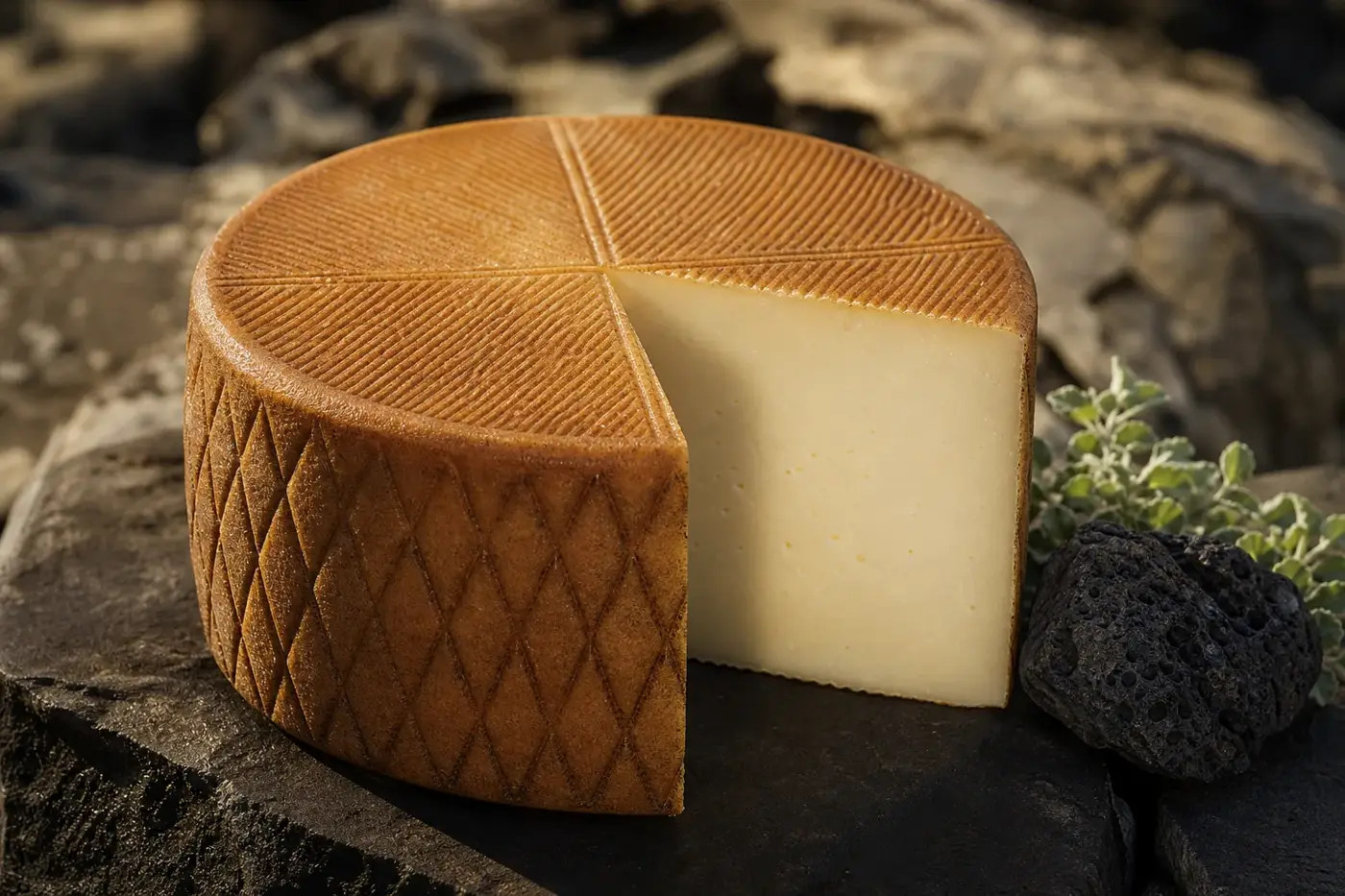
Majorero’s rind gives you something to read before you taste. The familiar diamond-like pattern around its sides reproduces pleita, the woven palm-leaf band traditionally wrapped around the curd. Its flat faces carry another geometric pattern, divided into four quadrants.[2]
Modern moulds can reproduce both impressions. So the traditional design in front of you may belong to a cheese that never sat inside handwoven palm leaves. The mould has changed; the pattern has stayed.[2]
In Spain, the 2026 specification defines Queso Majorero as a pressed cheese made with Majorera goat’s milk. It permits an optional addition of up to 15% Canarian sheep’s milk, and ICCA confirms that the milk may be raw or pasteurised. Production is associated with Fuerteventura as a whole.[1,2,10]
Next comes age. The specification sets a minimum maturation of eight days and names three categories: tierno, semicurado and curado, meaning young, semi-mature and mature. For the latter categories, minimum age depends on the wheel’s weight, so ask about both maturity and age.[2]
ICCA describes young Majorero as compact, white and mild. With maturity, the paste becomes ivory and firmer, gaining slight acidity and a peppery edge. Oil, paprika or gofio, a toasted cereal flour, may dress the surface: ask which treatment you are looking at, rather than leaving rind colour to tell the whole story.[1,7]
Palmero: follow the gentle smoke to La Palma
Palmero begins exclusively with milk from the Palmera goat. Named Queso Palmero or Queso de La Palma in the specification, it keeps its whole journey on the island: milk production, cheesemaking and maturation. Here, the island connection runs all the way from milk to finished cheese.[4]
The method uses milk directly after milking and natural rennet from suckling kids. Rennet is the coagulant that turns liquid milk into curd. It is a less visible part of the story than smoke, but just as important to understanding what you are buying.[4]
Smoking is frequent, not compulsory. Almond shells, prickly pear and Canary Island pine are among the principal plant materials identified in the specification. Look for dark bands where cheeses rested on supports during smoking, another little piece of the making written on the rind.[4]
Expect a gentle presence rather than a blast of smoke. The specification calls for low-intensity toasted aromas, slight acidity and moderate saltiness. ICCA describes a bright white paste that becomes more ivory and matt with age, sometimes with small, irregular eyes, the holes you see in the cheese.[3,4]
You can find Palmero fresh, young, semi-mature and mature. Try a younger cheese beside an aged example, and ask whether each has been smoked. You can then tease apart what time has done and what smoke has contributed, two details easily muddled at the counter.[4]
Guía: discover what thistle flowers can do
Head to north-western Gran Canaria for the Guía group. Its production area covers Santa María de Guía, Gáldar and Moya, and its specification requires at least 60% Canarian sheep’s milk. Milk from Canarian cows and their crosses may reach 40%; milk from Canarian goat breeds is limited to 10%.[6]
Here, thistle flowers have a practical job, rather than arriving as a flavouring. Flor de Guía uses coagulant obtained exclusively from dried thistle flower heads to set the milk. Media Flor combines thistle-derived coagulant with animal rennet, an important distinction if you are choosing cheese as a vegetarian.[6,7]
Read the full name before you choose: Queso de Flor de Guía, Queso de Media Flor de Guía or Queso de Guía. These identify versions within the group, not interchangeable names for the same cheese. Ask the maker to confirm the coagulant used in the particular cheese before you.[5,6,7]
ICCA puts soft paste and a characteristic bitter note at the heart of its description. Aromas become more pronounced during maturation, but you need not make the hardest or longest-aged wheel your goal. If supple texture and a persistent finish appeal, try one beside a firmer goat’s-milk cheese.[5]
Take your cheese hunt beyond the protected names
Leave a little space on your cheese itinerary for Tenerife and Lanzarote. ICCA’s regional guide documents cheesemaking beyond the protected names, including fresh and matured cheeses. On either island, ask for local goat’s-milk cheese at different ages, then use the producer’s address and stated place of manufacture to establish where it was made.[7]
La Gomera gives you another direction to explore. The official tourism account describes raw goat’s-milk cheeses, sometimes mixed with sheep’s milk, ranging from mild fresh examples to more intense matured ones. A regional name on a stall can open a conversation; a protected designation has defined requirements of its own.[4,6,8]
Let texture choose your next slice
What do you fancy eating? Young Majorero has a softer paste; mature Majorero is firmer and more pronounced. Palmero moves from bright white towards ivory with age, while Guía cheeses lead you towards softness and, potentially, that distinctive bitterness.[1,3,5]
For lunch, put fresh cheese beside bread and sliced fruit. For a tasting plate, try a semi-mature cheese next to a more developed wheel. Cut firmer cheeses into smaller pieces and softer ones into thicker slices: freshness and maturity suit different meals and appetites, rather than marking out grades of quality.
Almogrote: mature cheese takes to the toast
On La Gomera, mature cheese has another calling: almogrote. The official Canary Islands tourism account describes a pâté-like mixture of cured goat’s cheese from the island, hot pepper, olive oil and garlic, traditionally eaten with toasted bread. You get concentrated cheese flavour and sharp seasoning, quite a change from a slice straight off the wheel.[8]
The ICCA guide’s version includes tomato too, which it says softens the flavour and influences the colour. Read each recipe on its own terms, rather than assuming every account describes the same version. A small bowl with crisp toast, or a little spooned beside plain boiled potatoes, makes an easy way to serve it.[7]
Taste almogrote separately at first, before turning to your other cheeses. Garlic and chilli can dominate milder examples, and those quieter flavours deserve their moment too.
Find good company for your cheese
You do not need a crowded table to give each cheese company. Try plain bread with paprika-treated Majorero, potatoes beside smoked Palmero, and fresh pear or grapes with a firmer mature cheese. Keep accompaniments on separate dishes so you and your guests can taste the cheese alone before choosing its partner.
ICCA’s guide suggests light, fruity wines with fresh cheeses. For semi-mature goat’s cheeses, it points towards more persistent whites such as Malvasía; for Flor de Guía’s bitter notes, sweet Malvasía or Moscatel. Take these as starting points, with Forastera Gomera another island white grape variety for you to explore.[8]
Wine suggestions are for adults of legal drinking age who choose to drink; offer small servings. For an alcohol-free table, serve water and let fruit bring sweetness and contrast. You can find further ideas in cheese and wine pairing.
Four questions to ask before taking cheese home
At a cheesemonger, market or dairy shop, start with four questions. Which island made it, which milks does it contain, how old is it, and what treatment has its rind received? For the protected traditions, look for the full designation and the numbered certification label described in the relevant specification.[2,4,6]
Ask separately about milk treatment and coagulant if you have dietary preferences. Majorero may use raw or pasteurised milk; Palmero’s traditional specified rennet is animal-derived; Flor and Media Flor differ in their use of thistle coagulant. Plant coagulant describes only one part of production, so obtain the maker’s information for the cheese itself.[1,4,6,7]
If the terminology leaves you hesitating at the counter, the guides to milk treatment and rennet explain it. Keep those questions separate, and you can choose with the relevant details in hand.
Before you leave, get the storage instructions, including refrigeration requirements and directions after opening. Keep them with the cheese, especially when it has been cut from a larger wheel. The Food Standards Agency’s guidance for England, Wales and Northern Ireland explains that correct chilling helps stop harmful bacteria growing; consult it alongside the product’s instructions.[9]
At home, serve a modest selection rather than everything at once. Begin with fresh or young cheese, move to semi-mature, then taste aged, smoked or more bitter examples. Give almogrote a separate tasting.
Finally, note the maker and maturity of anything you particularly enjoy. Those details will get you back to a favourite more reliably than rind colour alone. A cheese notebook is a perfectly reasonable thing to own, whatever the rest of the household says.
General information only, not medical advice: follow the official guidance where you live.
Questions people ask
Which cheeses are protected in the Canary Islands?
ICCA lists Majorero, Palmero and the Guía cheese group as protected traditions. They come from Fuerteventura, La Palma and northwestern Gran Canaria respectively.
What milk is used to make Majorero?
Majorero is made with Majorera goat’s milk and can include up to 15% Canarian sheep’s milk. ICCA says the milk may be raw or pasteurised.
Is Palmero always smoked?
No, smoking is frequent but not compulsory. Palmero comes fresh, young, semi-mature and mature, so you can ask whether a particular cheese has been smoked.
What is the difference between Flor de Guía and Media Flor de Guía?
Flor de Guía uses coagulant obtained exclusively from dried thistle flower heads. Media Flor combines thistle derived coagulant with animal rennet.
What is almogrote?
Almogrote is a pâté-like spread made with La Gomera’s cured goat’s cheese, hot pepper, olive oil and garlic. It is traditionally eaten with toasted bread, and ICCA’s version also includes tomato.
Sources
-
Instituto Canario de Calidad Agroalimentaria, Gobierno de Canarias. [Queso majorero](../queso-majorero/). Undated web profile, retrieved November 2026. Regional authority’s account of the island, milk treatment, rind and sensory characteristics.
-
Instituto Canario de Calidad Agroalimentaria. Pliego de condiciones de la Denominación de Origen Protegida “Queso Majorero”. Consolidated amended specification, 2026.
-
Instituto Canario de Calidad Agroalimentaria, Gobierno de Canarias. [Queso Palmero](../queso-palmero/). Undated web profile, retrieved November 2026. Regional authority’s description of the breed, rind, smoking and changes during maturation.
-
Ministerio de Agricultura, Pesca y Alimentación, hosted by ICCA. Pliego de condiciones de la Denominación de Origen “Queso Palmero”. Specification identified by the ministry’s listing as in force from 11 July 2002.
-
Instituto Canario de Calidad Agroalimentaria, Gobierno de Canarias. Queso de Flor de Guía, de Media Flor y Queso de Guía. Undated web profile, retrieved November 2026.
-
Gobierno de Canarias. Pliego de condiciones: Queso de Flor de Guía y Queso de Guía. Corrected specification published in Boletín Oficial de Canarias, number 65, 30 March 2007; document linked by ICCA in November 2026.
-
Gobierno de Canarias, Instituto Canario de Calidad Agroalimentaria. Guía del queso. Undated retrieved edition. Regional cheese guide, including milk sources, island coverage, pairing discussion and almogrote.
-
Turismo de Islas Canarias. Gastronomía en La Gomera. Undated official tourism account, retrieved November 2026. Sections “Productos locales” and “Sabores auténticos”.
-
Food Standards Agency. How to chill, freeze and defrost food safely. Published 18 December 2017; retrieved November 2026. Publication landing page, applying to England, Northern Ireland and Wales.
-
Instituto Canario de Calidad Agroalimentaria. Resolution approving normal amendments to the Queso Majorero specification. Resolution dated 15 July 2026, published in Boletín Oficial de Canarias, number 150, 28 July 2026.
-
Agencia Española de Seguridad Alimentaria y Nutrición. Alertas alimentarias. Live public alert landing page, retrieved November 2026 for the editorial recall check.
Researched through regional agricultural publications, the specifications linked by ICCA, official tourism documentation and published food safety guidance; serving suggestions are editorial recommendations, with no first-hand tasting implied.
Last checked: November 2026
Last checked November 2026.
The editors suggest you read next
French Cheese: The Complete Guide
Picture Normandy’s pastures, then follow the milk towards the Loire’s goat dairies, the Jura’s shared cheesemaking traditions and the sheep country of the Pyrenees.