Dorstone
Cut through Dorstone’s finely wrinkled, ash-coated rind and the knife meets something unexpectedly light: fresh goat’s milk paste with an airy centre.
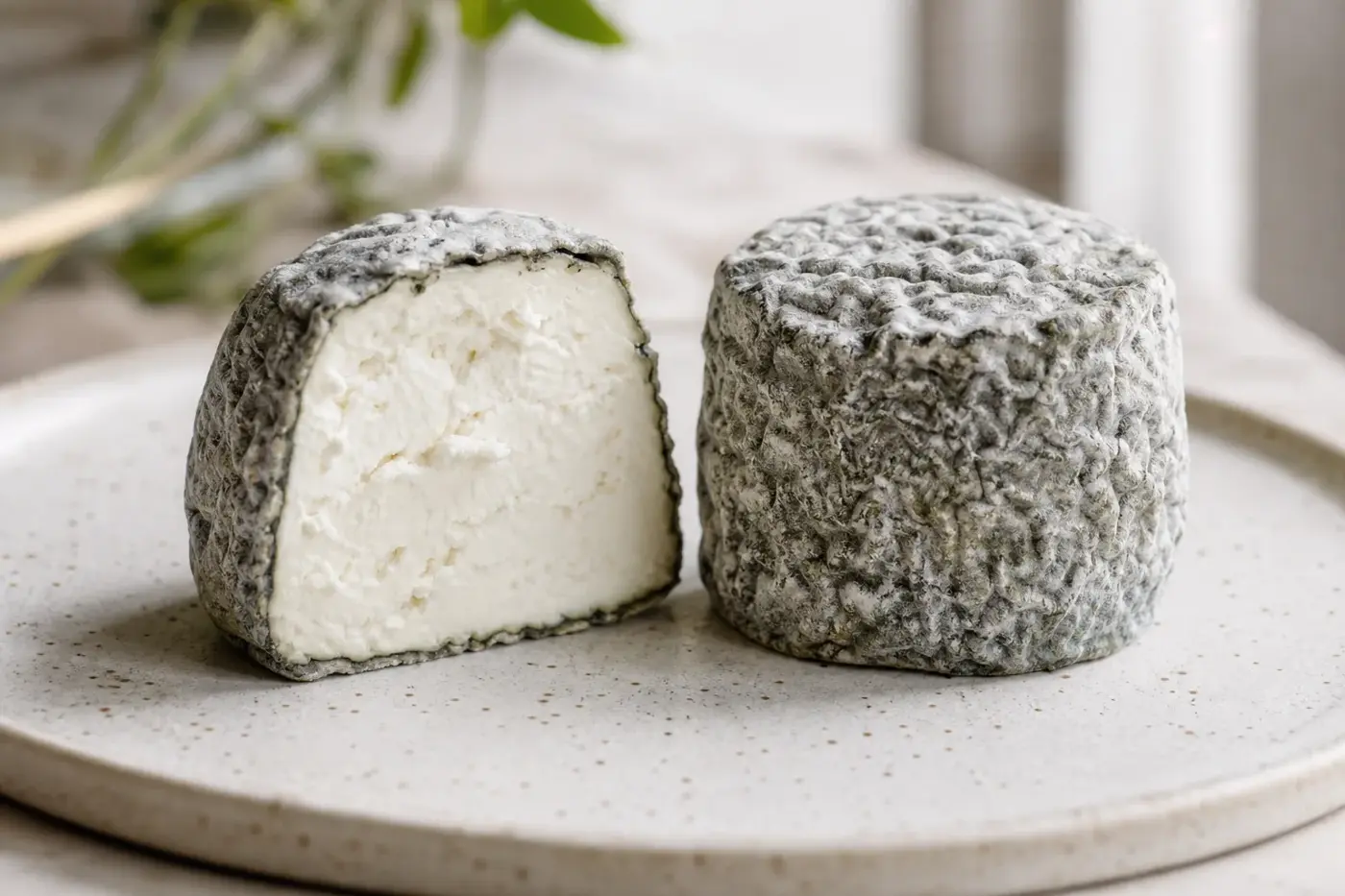
Cut through Dorstone’s finely wrinkled, ash-coated rind and the knife meets something unexpectedly light: fresh goat’s milk paste with an airy centre. Neal’s Yard Creamery in Herefordshire, England, makes this small, soft, lactic cheese, describing it as fluffy and zesty. You get folded surface, then soft landing. Quite a gentle cheese beneath all those serious wrinkles. [1]
| At a glance | A little more detail |
|---|---|
| Name to look for | Dorstone. [1] |
| Maker and home | Neal’s Yard Creamery, Dorstone Hill, Herefordshire, England. [2] |
| Milk | Pasteurised goat’s milk. [1] |
| Where the milk comes from | Bought-in milk from Wychmoor Farm, Titley, Herefordshire, named by the maker as its goat’s milk supplier. [2, 4] |
| Style | Soft, lactic and ash-coated, with a wrinkled rind. [1, 4] |
| What sets the curd | Vegetarian cardoon rennet, derived from thistle, as declared by the maker. [1] |
| Approximate weight | 180 g. [1] |
| Usual ageing | Neal’s Yard Dairy gives 3 to 4 weeks on its product page and a broader average of 3 to 6 weeks in its 2026 crib sheet. [3, 4] |
| Information date | November 2026 |
A Herefordshire hill comes first
Picture the hill overlooking the River Wye where Neal’s Yard Creamery settled in 1996. That is the landscape behind Dorstone’s name. The Creamery records its move from south-east England; Neal’s Yard Dairy records that the cheese was conceived afterwards and named after Dorstone Hill. First came the place, then something to put on your plate. [2, 3]
There are two businesses to meet here, each with a different job. Neal’s Yard Creamery makes Dorstone; Neal’s Yard Dairy selects, matures and sells it. The Creamery describes their shared beginnings before it became a separate business. Today, it is an independent dairy making fresh and mould-ripened cheeses, yoghurt and crème fraîche. [2]
Herefordshire supplies more than a handsome name and an address. The maker identifies Wychmoor Farm at Titley, also in the county, as its goat’s milk supplier. Your cheese begins with that connection between a local milk producer and a specialist creamery. [2]
Once Dorstone reaches your plate, look at the contrast between its airy interior and finely folded surface. If you are learning to recognise cheeses, milk, rind, texture and method offer more useful clues than shape alone.
Goat’s milk meets a useful thistle
Dorstone starts with pasteurised goat’s milk. The maker also specifies cardoon rennet and describes the cheese as vegetarian. These details come from Dorstone’s own published specification: they are not assumptions you should make simply because you are buying a goat’s cheese. [1]
The thistle has a practical part to play. Cardoon supplies a plant-derived coagulant, the ingredient that helps milk form curd. Slow acidification matters too: Neal’s Yard Dairy describes a yoghurty curd forming before draining and moulding. [1, 4]
If milk terminology leaves you pausing at the cheese counter, try raw, thermised and pasteurised cheese. For the ingredients that set the curd, rennet explained distinguishes animal, microbial and fermentation-produced varieties.
One ingredient detail deserves your attention. The Dairy’s current listing includes cultures containing trace cow’s milk, alongside pasteurised goat’s milk, salt and vegetarian coagulant. Its published allergen declaration identifies milk, so consult the information accompanying the particular cheese you have bought when checking ingredients. [3, 4]
The slow work behind those folds
Lightness starts with an overnight wait
Dorstone takes its time at the beginning, with a slow overnight set. “Lactic” points to the importance of acid development in setting the milk. Rather than quickly forming a firm block, the curd develops gradually, according to Neal’s Yard Dairy. It is then gently ladled out to drain, mixed with salt and packed into moulds. [3]
That sequence helps explain the texture you find on your fork. Predraining allows whey, the liquid portion, to leave the curd, the soft solids, before the cheese takes its individual shape. The Dairy connects this handling with Dorstone’s characteristic lightness and gentle acidity. [3]
Its product description presents a small, upright, turret-like cheese. The shape looks sturdy, but the paste inside is delicate. You are not cutting into a miniature hard cheese, so choose your cut and presentation with that softness in mind. [3]
Ash first, wrinkles later
The cheeses drain for a further 24 hours before being rolled in edible vegetable ash, according to Neal’s Yard Dairy. Ash supplies the coating. Geotrichum, a yeast-like rind organism, produces the fine folds: the two features that catch your eye arrive at different stages. [3]
Follow Dorstone into the Dairy’s maturation rooms and you can see how the surface changes. Young cheese arrives with a comparatively smooth, ash-dusted exterior. During maturation, the team uses different temperature and humidity conditions to guide rind growth and moisture loss. Gradually, that wrinkled surface develops. [5]
This is affinage, the managed maturing of cheese. Each batch needs attention rather than an inflexible timetable. The team responds to the cheeses’ condition, moving them between rooms as their rinds develop and their moisture changes. [5]
A young cheese, chosen with care
The Dairy’s retail product page gives an average age of 3 to 4 weeks. Its separate 2026 crib sheet records 3 to 6 weeks, emphasising brief maturation and keeping that freshness. Both ranges describe a young cheese, with its condition guiding the final selection. [3, 4]
The maturation team aims for a thin, balanced rind without overdrying the delicate interior. [4] You can taste the purpose of that care in Dorstone’s central contrast: a developed surface around a paste that stays fresh. The rind has a character of its own, but it does not take over the mouthful.
A mousse-like centre with a citrus lift
Fluffy yet creamy, with a zesty tang: that is how the maker describes Dorstone. Neal’s Yard Dairy’s 2026 tasting notes add citrus-led flavour, yoghurt notes, subtle goat character and a clean mineral finish. Freshness and texture are at the heart of what you are tasting. [1, 4]
Try separating what you feel from what you taste. The paste gives you lightness; acidity brings that fresh, bright impression. A mouthful can feel soft and substantial while still keeping a lively edge. The Dairy reaches for both mousse and denser ice cream to describe the combination. [4]
The rind brings another set of aromas. In a first-hand cheesemonger account published in 2014, The Courtyard Dairy described gentle yeasty and herbaceous aromas, with a bread-dough character especially noticeable at the surface. Keep that date in mind. The description still gives you something specific to look for as you taste. [6]
Ripening changes the relationship between surface and centre. The Dairy explains that rind development helps break down the paste and develop flavour compounds, while handling decisions control moisture. [5] Treat this as a broad picture, not a precise timetable for Dorstone’s aroma, flavour and texture at particular stages of ripeness.
For your own tasting, try a little paste alone, then a mouthful with the rind. Where do you notice the freshness? Pay attention to the firmer surface sensation and how long the flavour lasts. Those two mouthfuls tell you more than trying to track down a single prescribed tasting note.
Give the folds room on your plate
Dorstone does not need a crowded stage. Give it a small plate of its own, or an uncrowded spot on your cheese board, where you can see the folded surface. Keep bread nearby and offer a separate knife to make the delicate paste easy to serve.
- Take out only what you expect to serve. Let it lose its refrigerator chill while you prepare the table, away from direct heat. For England, Northern Ireland and Wales, the FSA advises keeping chilled food out for the shortest possible time, with a maximum of four hours during preparation. Count preparation and serving time together. [7]
- Give every portion rind and centre. Cut down through the centre from top to bottom, then divide into smaller wedges. Each piece will carry some centre and some outer rind.
- Keep your cuts clean. Use a clean, sharp knife. If the paste starts to drag, wipe the blade between cuts.
- Leave those folds in view. Place bread and accompaniments alongside the cheese rather than against it. Resist burying the surface beneath fruit.
On a mixed board, try Dorstone before the more forceful cheeses. Start with a plain mouthful, then add an accompaniment. That gives you a clear comparison and lets you get to know the cheese before another flavour joins in.
Squash, sage and a little restraint
Neal’s Yard Dairy, which matures and sells Dorstone, suggests roasted squash and sage alongside it. [4] You have a useful starting point there for serving the cheese with food. There is no need to surround it with several competing accompaniments.
For your first encounter, keep the selection small and let each addition earn its place. The cheese board need not become a cupboard clearance exercise.
| What to put alongside | How to serve it | What it brings |
|---|---|---|
| Plain bread | Thin slices, without a strongly flavoured topping. | Keeps your attention on the paste and rind. |
| Roasted squash | A modest piece alongside the cheese. | Follows the Dairy’s published squash pairing. [4] |
| Still or sparkling water | Serve alongside the cheese. | Keeps the cheese in the spotlight. |
Bread and water are practical starting choices; the squash suggestion comes from the Dairy. Begin simply, then try the squash and notice how it changes the mouthful. Give yourself time with each combination rather than inviting everything onto the plate at once.
Save that freshness for next time
Start with the storage instructions and date supplied with your cheese. The FSA’s household guidance for England, Northern Ireland and Wales advises refrigerating dairy products and keeping your fridge between 0 and 5 °C (32 to 41 °F). Follow the packaging instructions too. [7]
Keep the original wrapping and label together, so you still have the product information after your first serving. Put out a portion rather than repeatedly warming the whole cheese. Return the remainder promptly within the applicable guidance. [7]
For more on wrapping and organising your refrigerator, see how to store cheese at home. When you are ready to serve, Dorstone asks for little fuss. A clean cut, an uncluttered plate and room to enjoy that folded rind against the fresh centre will do nicely.
General information only, not medical advice: follow the official guidance where you live.
Questions people ask
What does Dorstone taste like?
The maker describes it as fluffy yet creamy, with a zesty tang. Neal’s Yard Dairy notes citrus and yoghurt flavours, subtle goat character and a clean mineral finish.
Is Dorstone made with pasteurised milk?
Yes, Dorstone is made with pasteurised goat’s milk. Neal’s Yard Dairy’s current product listing also includes cultures containing trace cow’s milk.
Is Dorstone vegetarian?
The maker describes Dorstone as vegetarian. It uses cardoon rennet, a plant-derived coagulant from thistle.
How long is Dorstone matured?
Neal’s Yard Dairy’s product page gives an average of three to four weeks. Its 2026 crib sheet gives a broader average of three to six weeks.
What goes well with Dorstone?
Neal’s Yard Dairy suggests roasted squash and sage. Plain bread is another way to serve it without drawing attention away from the cheese.
Sources
- Neal’s Yard Creamery. Goat’s Milk Cheeses, undated, current page retrieved November 2026. Dorstone product description, milk treatment, coagulant and weight. Maker’s product page.
- Neal’s Yard Creamery. Welcome to Neal’s Yard Creamery, undated, current page retrieved November 2026. Creamery history, location and milk suppliers. Maker’s website.
- Neal’s Yard Dairy. Dorstone, undated, current product page retrieved November 2026. Production account, name, ingredients and average age. Commercial source: the business matures and sells Dorstone. Product and maturation account.
- Neal’s Yard Dairy. Dorstone crib sheet, 2026 edition, retrieved November 2026. Style, maturation range, tasting notes, ingredients and pairing suggestions. Commercial source: the business matures and sells Dorstone. 2026 crib sheet.
- Neal’s Yard Dairy. Rinds: a window into the interaction between the cheese and its environment, 6 September 2021. First-hand account of its maturation work, including Dorstone. Rind development account.
- The Courtyard Dairy. What makes Dorstone goats’ cheese so special?, 17 September 2014. Historical first-hand account, used only for attributed sensory observations. Commercial source: a cheesemonger selling Dorstone. Dated cheesemonger account.
- Food Standards Agency. How to chill, freeze and defrost food safely, published 18 December 2017, current page retrieved November 2026. Household guidance applying to England, Northern Ireland and Wales. Official chilling guidance.
Researched from the maker’s published information, the affineur’s production and maturation records, an attributed historical sensory account and official household chilling guidance; serving suggestions are editorial recommendations.
Last checked: November 2026
Last checked November 2026.
The editors suggest you read next
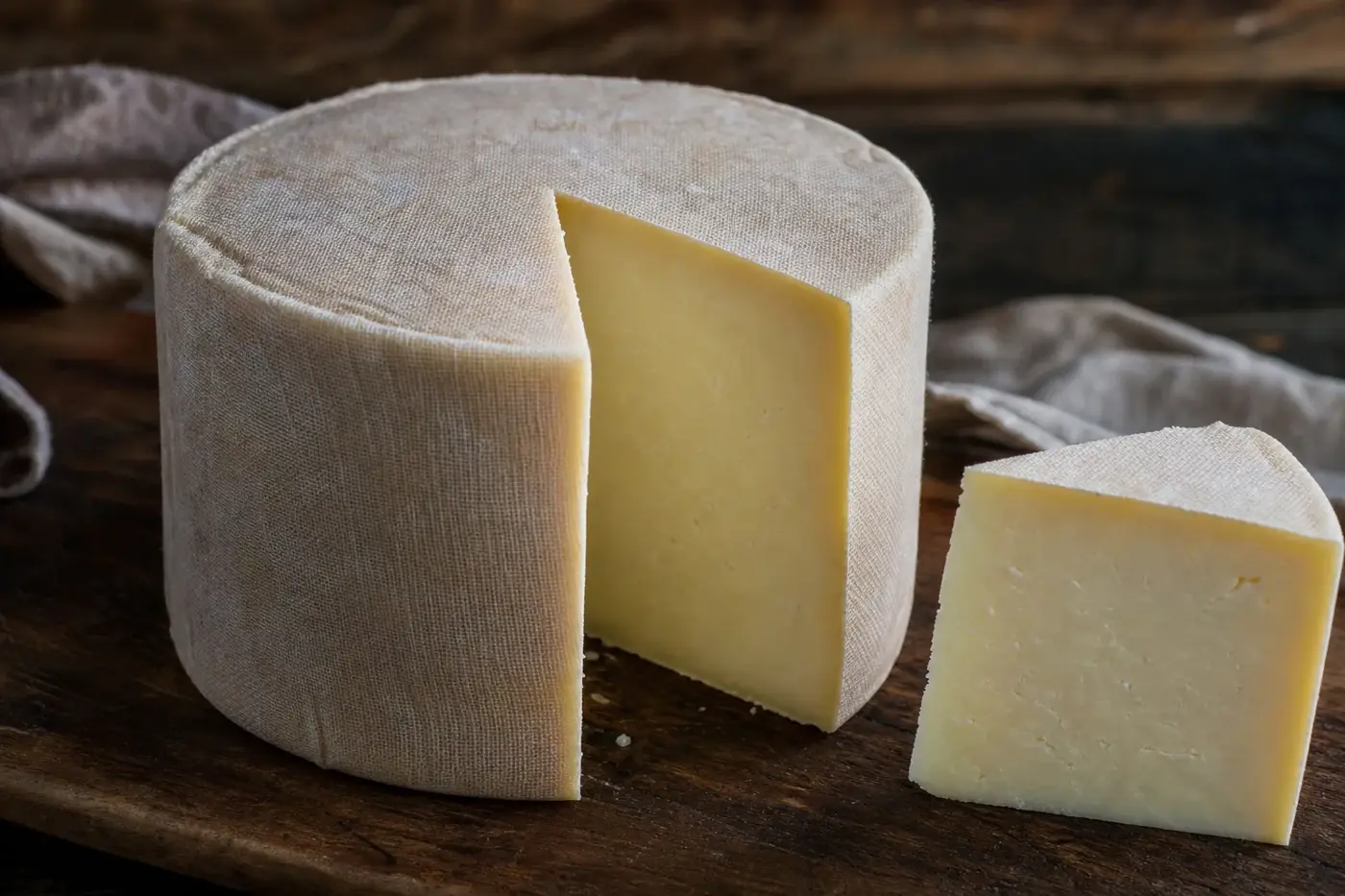
West Country Farmhouse Cheddar Cheese
Large pieces of curd turn and stack under the cheesemaker’s hands.