Elrick Log
Cut through the dark vegetable ash of Elrick Log and you reach a soft, white centre.
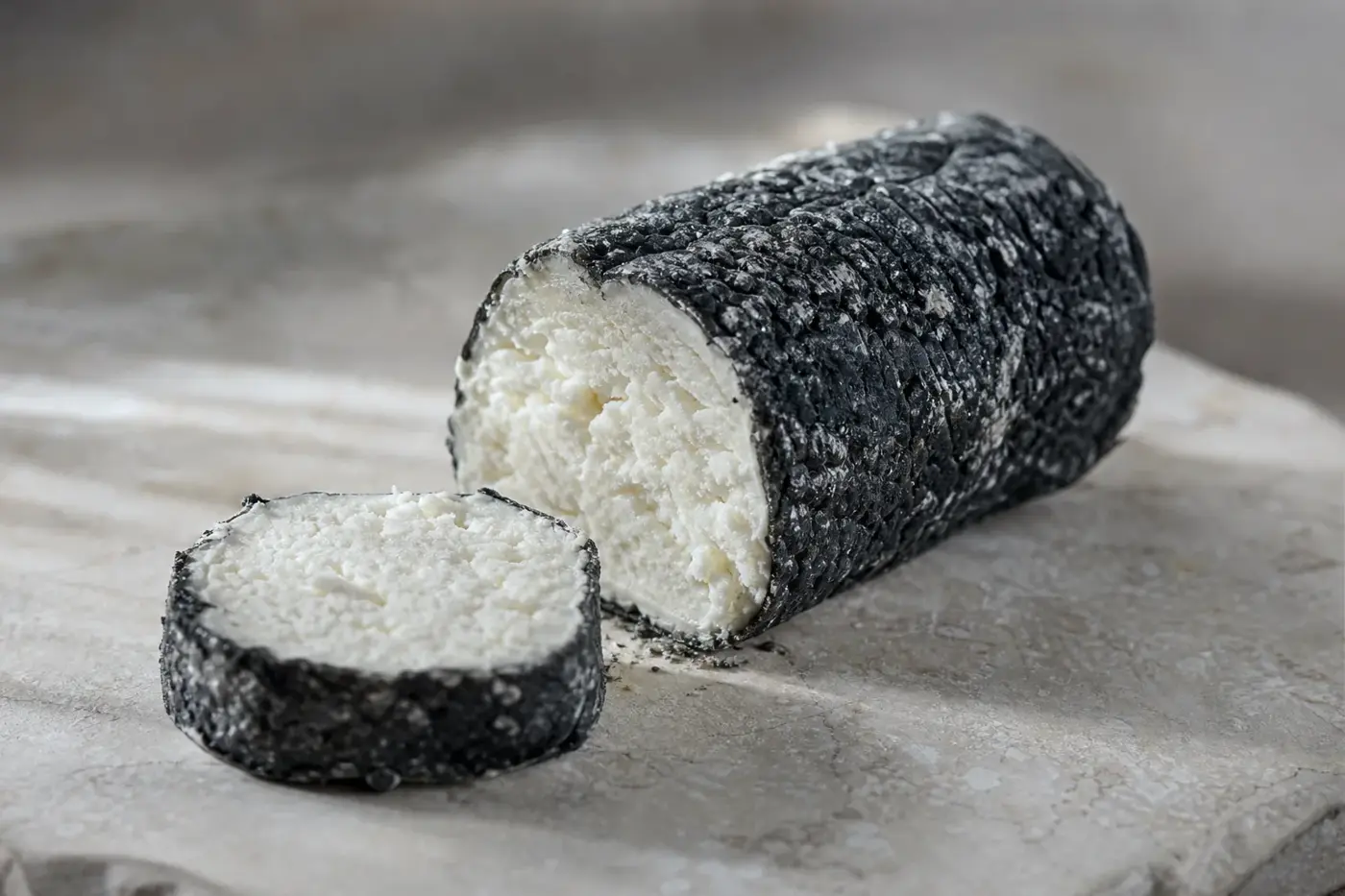
Cut through the dark vegetable ash of Elrick Log and you reach a soft, white centre. This lactic-style goat’s milk log comes from Errington Cheese in South Lanarkshire, Scotland. Taste it young for the maker’s fresh citrus notes; leave it longer and a spicier character steps forward.[1]
| Meet Elrick Log | What to know |
|---|---|
| Maker | Errington Cheese.[1] |
| Home farm | Walston Braehead Farm, South Lanarkshire, Scotland.[2] |
| Milk | Raw goat’s milk from the farm’s own herd.[1][3] |
| Style and shape | Soft, lactic-style log.[1] |
| Its dark coat | Vegetable ash and a naturally developing rind.[1][4] |
| Cultures and ripening flora | Starter cultures; the maker identifies Geotrichum in the developing rind.[4][5] |
| Coagulant | Rennet; origin needs confirmation.[1] |
| Suitable for vegetarians? | Confirmation needed. |
| Maker’s stated size | Individually wrapped logs of at least 190 g.[1] |
| First ready to taste | Around 10 days in the maker’s account of its lactic goat’s cheeses.[4] |
| Protection status | Confirmation needed for Great Britain, Northern Ireland, the EU, Switzerland and the US. |
| Record date | November 2026. |
Look beneath that dark Scottish coat
A small cylinder, an ash-covered surface, a pale centre: Elrick Log knows how to make an entrance. Errington describes a soft, fudgy texture with a marshmallow-like softness.[1] You can expect soft cheese with substance, rather than something inclined to wander off your cracker.
For your first taste, put a cut slice beside the whole log. Look at the centre, then at the cheese just beneath the rind, and taste each before reaching for bread. That little cross-section tells you more about its condition than the handsome exterior alone.
Even the name brings you back to the neighbourhood. Errington identifies Elrick Log as a historic name for neighbouring Elsrickle.[1] What sounds like a description of the cheese’s shape also connects it to the place where it is made.
Meet the family farm behind your slice
Cheesemaking began at Walston Braehead Farm in the early 1980s, with sheep’s milk. Dairy goats arrived in 2019, joining a farm already known for its ewe’s milk cheeses. Errington describes a family undertaking, making cheese by hand from its own milk.[2]
Elrick Log belongs to that newer goat’s milk chapter. The sheep’s milk tradition continues alongside it, so this is an addition to an established Scottish dairy, not a separate venture. The farm and its herd are as much a part of the cheese as its striking coat of ash.
The farm sits approximately 305 metres above sea level. Its account describes a growing season that starts later than in warmer places, with grass at the heart of the farming system. Different mixtures are grown for grazing, hay and silage to support both sheep and goats.[6]
When you choose a log, turn that farm story into one useful question: how ripe is this batch? Its appearance tells you which cheese you are looking at. A closer look, and a conversation about maturity and condition, help you work out how it will eat.
Follow the goats’ milk to the cheeseroom
The raw milk comes from Errington’s own goats. Saanen, Toggenburg, Alpine and Nubian animals make up the herd, keeping the milk supply directly within the farm’s cheesemaking operation.[1][3]
According to the farm, the goats spend more time indoors than the sheep because they have less protection from rain. They go onto grass when the weather allows. Goat’s milk production continues throughout the year, unlike the more seasonal ewe’s milk supply.[3]
Milking happens twice daily. The farm describes a parlour system that records individual animals and their milk production, before the milk passes through the receiving system into bulk tanks for cooling.[7] Behind your slice is this daily rhythm, from animal records to careful milk handling.
Errington generally brings an evening and a morning milking together for each cheese batch. The journey from parlour to cheeseroom is short.[5] If you want to understand what raw milk means alongside other treatments, explore raw, thermised and pasteurised milk.
Stay overnight for the curd, then watch the rind
Elrick Log’s lactic-style make begins with acidification. Errington adds starter cultures to start the process, followed by a small amount of rennet. The milk coagulates into a gel-like curd; whey is the liquid that the curd subsequently releases.[4][5]
The milk sets overnight. Next morning, the curd is carefully cut and ladled into moulds, which are topped up gradually. The logs are turned to help whey escape, and a gentle hand matters: the maker links excessive curd breakage with changes in drainage.[4]
After a couple of days draining in their moulds, the cheeses move onto mats and racks. Next comes a warmer ripening space called the hastener, where the rind starts developing. Errington identifies Geotrichum in that rind and says it does not add white mould cultures to these cheeses.[4]
That dark finish arrives after shaping. Elrick Log’s product description specifies a mixture of salt and ash sprinkled onto the cheese.[1] You are looking at a surface treatment, not something running through the curd.
The broader production account describes around 24 hours in the drying room before maturation. Cheeses move between rooms according to their condition, with around 10 days given as first readiness for Errington’s lactic goat’s cheeses.[4] Take that timing as a guide to the style’s development, rather than a minimum ageing period for Elrick Log itself.
Find the ripeness that wins you over
Fresh citrus, earthy mushroom, savoury depth, then increasing spice: that is the journey in Errington’s tasting description. The maker also attributes a subtle smokiness to the ash treatment.[1] Treat these as useful clues, not an examination your taste buds have forgotten to revise for.
Texture changes too. The production account describes softer edges and a more intense flavour as maturation progresses.[4] Tell your cheesemonger what you fancy: a log that holds its shape for neat slices, or a softer one for spreading.
As you taste, consider texture and flavour separately. “Soft” describes resistance in your mouth; “tangy” describes a flavour impression. Noting both makes it easier to compare logs at different stages, especially when you return to the cheese later. For more on that distinction, try recognising cheese styles.
A Silver medal, and a question of ripeness
Elrick Log received Silver in class 8, Goat, in the official Artisan Cheese Awards results for 2024. The listing names both Errington Cheese and Elrick Log.[8]
That gives you a specific, dated award to add to its story. For the log coming home with you, though, condition and ripeness still deserve your attention. Will it slice as you want, is it soft enough for your plans, and how will you serve it? The award is background; those questions help you choose.
Build your plate one mouthful at a time
Have plain bread or an unflavoured cracker ready, but taste the cheese on its own first. Then bring in one accompaniment at a time. Errington suggests honey, strawberries, walnuts and citrus marmalade.[1] Start with one sweet option so you can judge its effect without a crowded mouthful.
Prefer something savoury? The maker suggests ripe tomatoes and oil, or slices of Elrick Log added to salads.[9] A small tomato salad with bread alongside gives you a straightforward place to begin. Keep the dressing restrained until you have tasted the cheese, then decide how much company it needs.
Divide a 190 g log into six equal pieces and each will be approximately 32 g. That is a practical tasting portion, not a nutritional recommendation, and individual logs may weigh more.[1] Adjust what you put out to suit the other food on the table.
Try this simple sequence to give the cheese your full attention:
-
Put out only what you need. Leave the rest refrigerated while you arrange your plate.
-
Taste a small piece plain. Notice the centre’s resistance separately from the texture just beneath the surface.
- Add one accompaniment. Try tomato for a savoury direction or a little honey for contrast, then compare.
- Make a brief note. Record the date, where you obtained the cheese and whether you preferred it plain or accompanied.
Water gives you a neutral, alcohol-free drink for the tasting. Another time, keep your accompaniment the same but choose a log at a different stage of ripeness. You can then follow the changing cheese, rather than a changing plate.
Give your log a good home in the fridge
Keep the label with your cheese, especially after opening. Its storage instructions and date labels need to stay close at hand. FSA guidance for England, Wales and Northern Ireland recommends a fridge temperature between 0 and 5 °C, says dairy products belong in the fridge, and advises following packaging instructions and date labels.[10]
Errington recommends waxed paper for its lactic goat’s cheeses.[4] For practical help with wrapping and finding a place in the fridge, see storing cheese at home.
Serving a vegetarian guest? Ask about Elrick Log’s current rennet before you put it on their plate. The maker’s product description confirms rennet is used but does not identify its origin, so consult the current label or ask the maker for confirmation.[1] The guide to rennet types explains why that origin matters.
General information only, not medical advice: follow the official guidance where you live.
Questions people ask
What does Elrick Log taste like?
Errington describes fresh citrus flavours when the cheese is young, followed by earthy mushroom, savoury depth and increasing spice as it matures. The maker also attributes a subtle smokiness to the ash.
Is Elrick Log made with raw milk?
Yes, it is made with raw milk from Errington’s own goat herd. The herd includes Saanen, Toggenburg, Alpine and Nubian goats.
Is Elrick Log suitable for vegetarians?
Its vegetarian suitability has not been verified. The maker confirms that it contains rennet but does not identify its origin, so check with the maker or the current product label.
How should I store Elrick Log?
Errington recommends waxed paper for its lactic goat’s cheeses. The FSA advises keeping dairy products in the fridge at between 0 and 5 °C and following packaging instructions and date labels.
What goes well with Elrick Log?
Errington suggests honey, strawberries, walnuts and citrus marmalade. For a savoury plate, the maker suggests ripe tomatoes and oil, or slices of the cheese in salads.
Sources
- Errington Cheese, Errington’s Barn. Elrick Log. Undated product description and production notes, retrieved November 2026.
- Errington Cheese, Errington’s Barn. Our Cheesemaking Story. Undated company history, retrieved November 2026.
- Errington Cheese, Errington’s Barn. Great Farmhouse Cheese Starts with Great Milk. 24 June 2025.
- Errington Cheese, Errington’s Barn. How We Make Our Goat’s Cheeses, Elrick Log & Blackmount. 21 October 2025.
- Errington Cheese, Errington’s Barn. Turning Our Lanarkshire Milk into Farmhouse Cheese. 21 August 2025.
- Errington Cheese, Errington’s Barn. South Lanarkshire Land and our Approach to Farming it. 12 May 2025.
- Errington Cheese, Errington’s Barn. Milking Our Herds of Pasture-Grazed Sheep and Goats. 22 July 2025.
- Artisan Cheese Awards. Award Winners 2024 Artisan Cheese Awards. Official results, 2024, row naming Errington Cheese and Elrick Log.
- Errington Cheese, Errington’s Barn. Elrick Log in the Kitchen: A Summer Salad Favourite. 11 June 2025. Maker-published serving account and attributed recipe; the maker has a commercial interest in the cheese.
- Food Standards Agency. How to chill, freeze and defrost food safely. Live household guidance and printable version, retrieved November 2026; GOV.UK identifies its application as England, Northern Ireland and Wales.
This piece was researched from the maker’s published production and farming accounts, official competition results and official household food-handling guidance; serving suggestions are editorial synthesis, without a site tasting or recipe test.
Last checked: November 2026
Last checked November 2026.
The editors suggest you read next
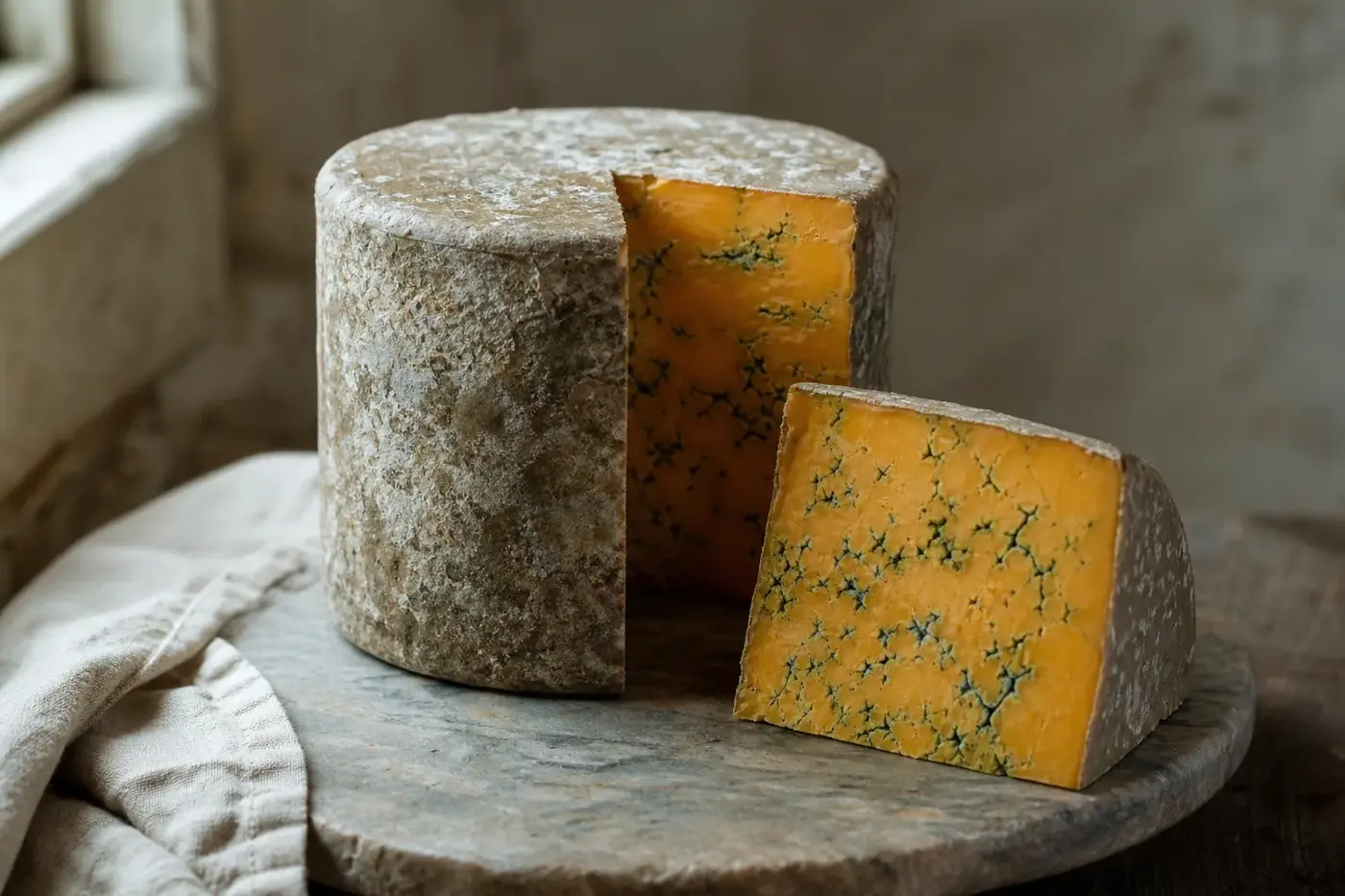
Shropshire Blue
Cut into Shropshire Blue and you get quite a colour scheme: orange crossed by blue-green veins.