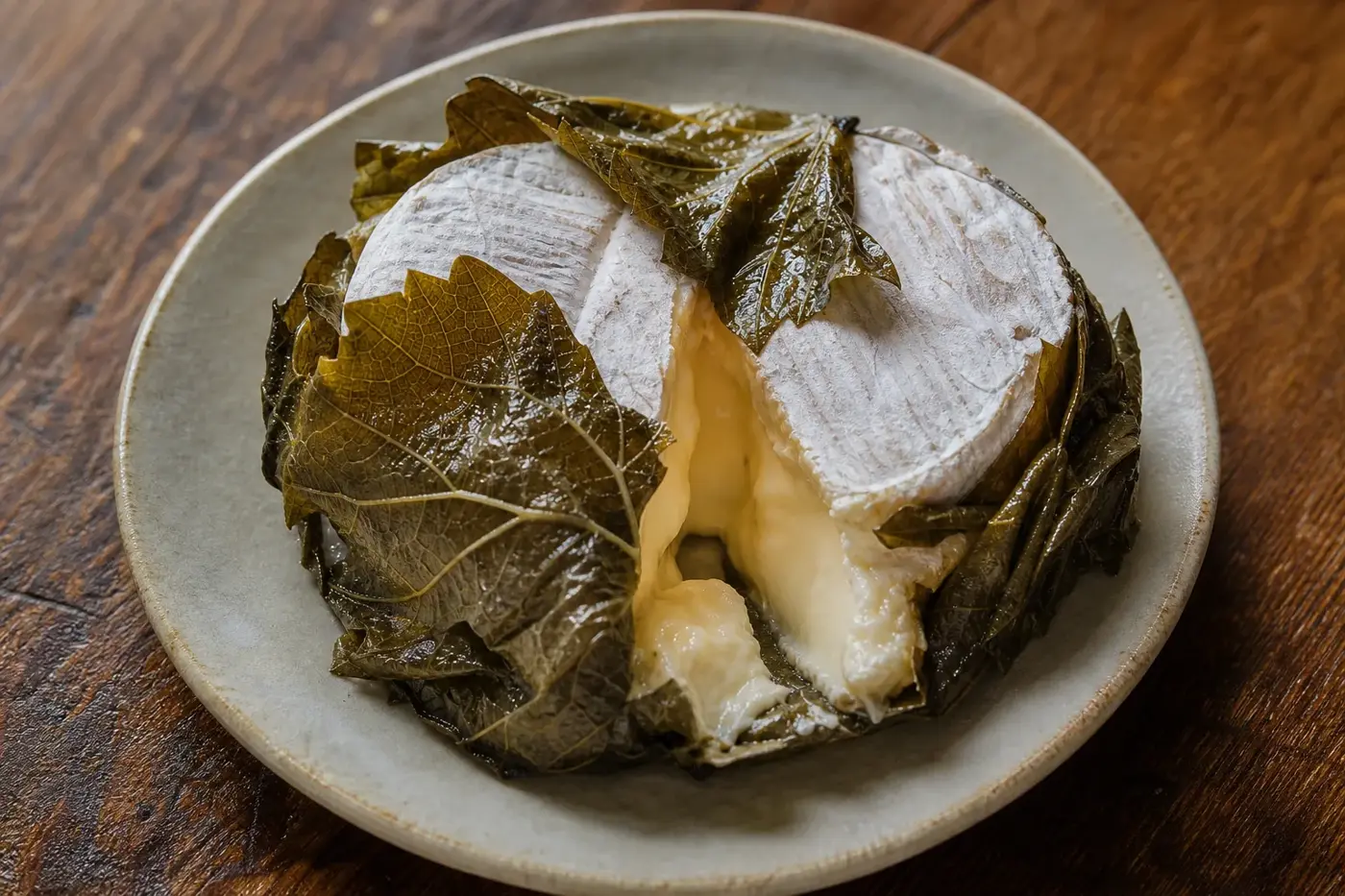
Lift back Eve’s vine leaf and look at the centre. With age, White Lake Cheese says, it becomes softer and more yielding. Made at Bagborough Farm in Pylle, England, this soft cheese brings Somerset goat’s milk together with a Somerset cider brandy wash. The wrapper is only the beginning. [1][2]
| Eve at a glance | The details to know |
|---|---|
| Maker | White Lake Cheese. [1] |
| Place | Bagborough Farm, Pylle, near Shepton Mallet, Somerset, England. [2] |
| Milk | Goat’s milk from White Lake’s own farm herd, according to the maker. [3] |
| Milk treatment | Thermised; described by the maker as unpasteurised. [1] |
| Coagulant | Vegetarian rennet. [1] |
| Style and finish | Soft cheese, washed in Somerset cider brandy and wrapped in a vine leaf. [1] |
| Declared weight | 130 g. [1] |
| Shape and dimensions | Details unavailable |
| Rind and paste | Details unavailable |
| Maturation period from manufacture | Details unavailable |
| Leaf intended for eating | Details unavailable |
| Protection status by jurisdiction | Details unavailable |
| Information date | November 2026 |
Follow the leaf back to a Somerset farm
White Lake’s cheesemaking business began on a Somerset family farm in 2004. The farm’s own story reaches further back, tracing cheesemaking there to the 1930s. Today, the dairy near Glastonbury makes small batches of goat’s, sheep’s and cow’s milk cheeses, with room left for experimentation. [2]
In Eve, you can see that farm setting meet the dairy’s willingness to try things. The milk comes from its own goats, while the finishing treatment uses Somerset cider brandy. Both choices give you something tangible to know about its agricultural roots and its place in White Lake’s range. [1][3]
The Somerset Levels belong in the herd’s story, too. White Lake says its goats eat feed sourced within the UK, supplemented with hay from unfertilised fields on the Levels. That is a detail about how the animals are kept, not a promise of a particular flavour in your cheese. [3]
For your first encounter, give Eve a small plate of its own. The strongly flavoured cheeses can wait their turn, however much they like being the centre of attention. Unwrap and cut a single cheese, leaving yourself room to notice the wrapper, surface and centre in turn.
Get acquainted with the milk
Eve’s milk is thermised, and White Lake describes it as unpasteurised. It should not be called pasteurised. [1] For help untangling those terms, turn to raw, thermised and pasteurised cheese.
The milk has a clear starting point. White Lake says its goat’s milk comes from the herd on its Somerset farm, and the farm’s separate history names French Alpine goats among that herd. [2][3]
Keep three questions in mind when you read about Eve. Which animal supplies the milk, where does it come from, and how has it been treated? The product page gives you the animal and treatment; the farm’s sourcing statement supplies the origin. Together, those details tell you considerably more than “farm cheese”.
Then comes the ingredient that helps the milk form a curd: vegetarian rennet. White Lake specifies it on Eve’s product page. For the wider distinctions between types, see rennet explained. [1]
Look beneath the cider brandy and vine leaf
The Somerset cider brandy wash and vine leaf wrapper are Eve’s defining finishing touches in the published production description. Their order of application and the maturation period remain open questions. To understand those details, you would need a technical account specifically about Eve.
| A step in the making | What the maker tells you |
|---|---|
| Coagulation ingredient | Vegetarian rennet. [1] |
| Surface treatment | Somerset cider brandy wash. [1] |
| Wrapping | Vine leaf. [1] |
| Timing of washing and wrapping | Details unavailable |
| Washing frequency and maturation conditions | Details unavailable |
If you are curious about what happens before those finishing touches, How cheese is made takes you through curd formation, draining and the other general stages. Use it for background, then return to the table above for the production details specific to Eve.
Tell the seller how you like your cheese
There is no established maturation period from manufacture to give you here. When you buy Eve, ask about its present condition instead. Tell the seller when you plan to serve it.
“Ready for Saturday” is a more useful request than “the oldest one, please”. Explain whether you want a cheese that cuts neatly or yields readily under a knife. That gives the seller a practical picture of the eating condition you have in mind.
Keep the packaging with the cheese so you retain its date, batch details and storage instructions. Read the date wording carefully. UK government guidance links use-by dates to safety and best-before dates to quality. [6]
Give the softening centre your attention
White Lake describes Eve’s centre as creamy and unctuous, developing with age, and connects that change with the wash and leaf wrapping. [1] A separate account specifically covering Eve’s aroma and flavour, including each ingredient’s and treatment’s contribution, remains a gap in the picture.
Give aroma, flavour and texture a moment each. “Strong” does not tell you very much on its own. Is the aroma more pronounced outside or on the cut face? Does the centre hold its shape, and how readily does a small piece spread across your tongue?
Start with the cheese alone, without bread, fruit or a drink. Then try a second mouthful on plain bread. That small comparison gives you a personal reference before you invite other flavours in.
Keep three observations separate: the cheese itself, any changes near the surface, and what happens when you remove the wrapper. Note what you actually notice, rather than searching for a prescribed apple, herbal or goat’s milk note. Your own words will be useful when you taste another example.
Make a little room for Eve at the table
You need very little: a plain plate, a small knife and bread without added herbs or fruit. Put accompaniments alongside rather than on top. Everyone can then decide how much, if anything, to add.
For England, Northern Ireland and Wales, the Food Standards Agency advises a fridge temperature of 5 °C (41 °F) or below. It also advises keeping chilled food out of refrigeration for the shortest possible time. [5]
Let that guidance shape your preparation and table time. Set out the amount you intend to serve shortly before eating. There is no need to leave the whole supply on display throughout a gathering.
Offer small pieces first, with more available as wanted. At a shared tasting, give everyone similarly sized portions, so you can compare the cheese rather than differences in quantity. This is about serving and comparison, not a nutritional recommendation.
Ease back the leaf
Lift back the leaf and present the cheese separately. Support it gently with a knife or spoon rather than pulling sharply at the wrapper.
Whether the leaf is intended for eating remains an open question here. Ask White Lake how it is intended to be handled.
Bring bread, fruit and a drink into the picture
Begin with plain bread, then try fresh apple or pear and an unsweetened cracker. These are comparisons, not rules. Use a modest amount of each and decide which combination gives you most pleasure.
Keep chutney to one side. You can always add a little; persuading it to leave a mouthful it has already taken over is another matter. Tasting the cheese first also makes each comparison easier to follow.
An alcohol-free drinks comparison can be every bit as useful as one with wine. Put water on the table. Between combinations, return to a mouthful of cheese on its own.
| Something to try alongside | A simple way to compare |
|---|---|
| Plain bread | Taste the cheese alone, then spread on bread. |
| Fresh apple or pear | Try a small slice after the cheese, then taste them together. |
| Still or sparkling water | Use between samples to keep the sequence simple. |
| Unsweetened black tea | Try without milk or sugar before deciding whether to adjust it. |
If you would like to explore cheese and drinks more broadly, there is more to discover. The cheese and wine pairing guide offers a wider approach.
Keep Eve chilled, with its details close by
Keep Eve refrigerated and follow the storage instructions supplied with your cheese. White Lake recommends refrigeration for its soft cheeses. It also advises keeping the original wrapping, or using foil for a remaining portion. [7]
The official guidance for England, Northern Ireland and Wales cited above puts dairy products in the fridge. Use a thermometer to check the temperature. The control dial alone is not enough to rely on. [5]
Before serving, read the date wording and any instructions for after opening. UK government guidance says you should not eat food after its use-by date, even if it looks and smells fine. Incorrect storage can also make food unsafe before that date. [6]
Eating condition and safety are different questions. If Eve looks unfamiliar, has damaged wrapping or differs markedly from the description supplied, ask the seller or maker about it. Have the batch information to hand for that enquiry.
For advice across your cheeseboard, turn to how to store cheese at home. If unexpected mould appears, consult mould on cheese: when to cut and when to bin. Do not apply advice intended for hard cheese to a soft cheese such as Eve.
General information only, not medical advice: follow the official guidance where you live.
Questions people ask
Is Eve made with pasteurised milk?
No. Eve is made with thermised goat’s milk, which White Lake describes as unpasteurised.
Is Eve suitable for vegetarians?
Eve is made with vegetarian rennet. White Lake specifies this on its product page.
Can you eat the vine leaf around Eve?
The maker’s advice on whether the leaf is intended to be eaten has not been verified. Ask White Lake how it is intended to be handled.
How should Eve be stored?
White Lake recommends refrigeration for its soft cheeses and advises retaining the original wrapping or using foil for a remaining portion. The Food Standards Agency advises keeping the fridge at 5 °C or below in England, Northern Ireland and Wales; see its guidance for details.
How does Eve change as it ages?
White Lake describes its centre as creamy and unctuous, becoming softer and more yielding with age. The maturation period from manufacture has not been verified.
Sources
- White Lake Cheese, Eve, undated product page, current version retrieved November 2026. Product description and “Product Information”.
Read at whitelake.co.uk - White Lake Cheese, Introduction to Your Cheese, undated, current version retrieved November 2026. “Our story” and farm location.
Read at whitelake.co.uk - White Lake Cheese, Sustainability, undated, current version retrieved November 2026. “Responsible Milk Sourcing”.
Read at whitelake.co.uk - White Lake Cheese, FAQ, undated, current version retrieved November 2026. “Will my cheese arrive ripe and ready?”
Read at whitelake.co.uk - Food Standards Agency, How to chill, freeze and defrost food safely, published 18 December 2017, current version retrieved November 2026. Applies to England, Northern Ireland and Wales.
Read at gov.uk - GOV.UK, Understanding food labelling: Best before and use-by dates, undated, current version retrieved November 2026.
Read at gov.uk - White Lake Cheese, Caring for Your Cheese, undated, current version retrieved November 2026. Refrigeration, wrapping and batch information.
Read at whitelake.co.uk
Researched from the maker’s product, farm and care information, with official guidance used for the handling and date advice; serving and pairing suggestions are editorial proposals, not a recorded tasting.
Last checked: November 2026
Last checked November 2026.
The editors suggest you read next
West Country Farmhouse Cheddar Cheese
Large pieces of curd turn and stack under the cheesemaker’s hands.