Flower Marie
At Greenacres Farm in East Sussex, curd is lifted by hand into square moulds.
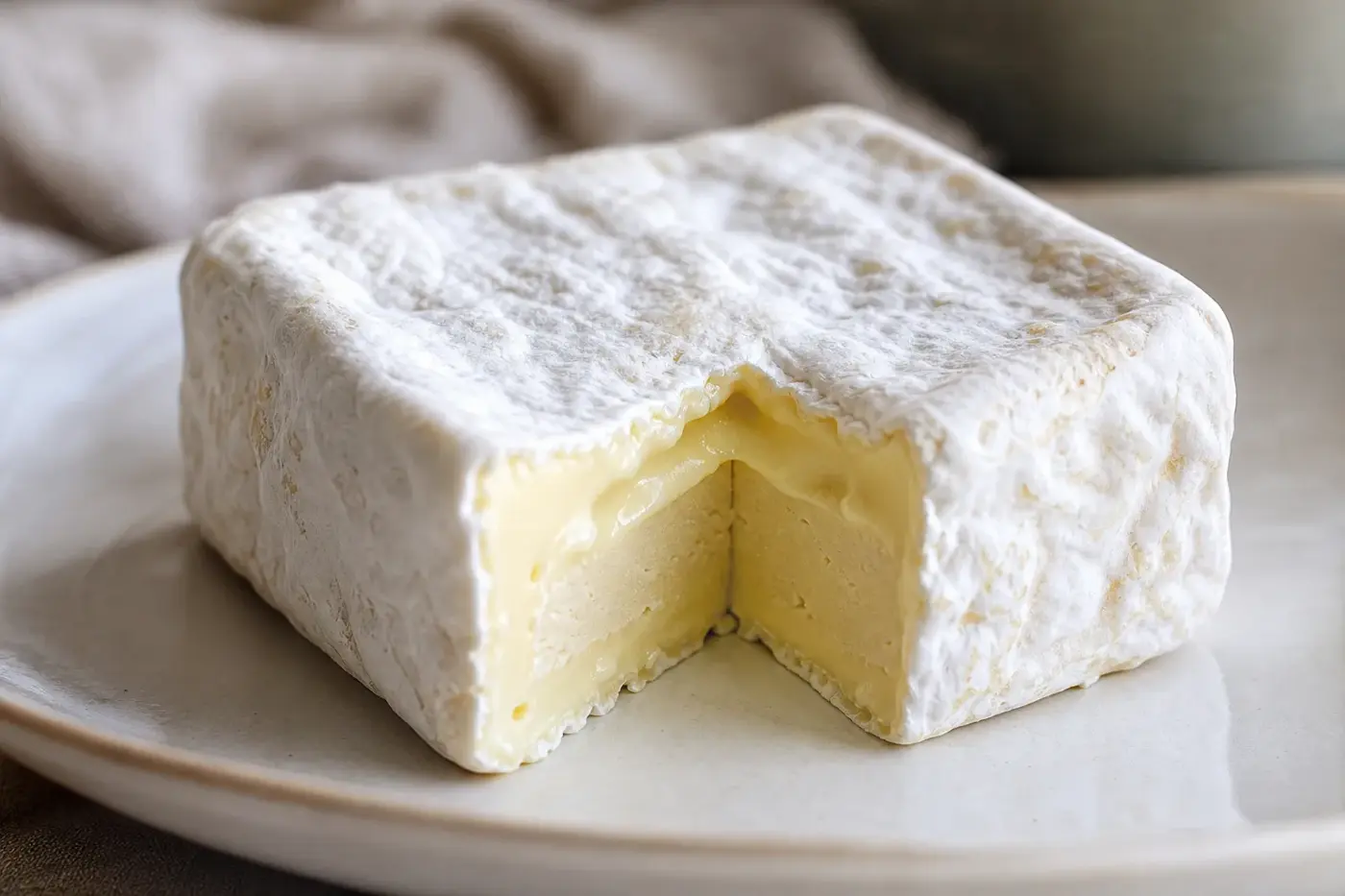
At Greenacres Farm in East Sussex, curd is lifted by hand into square moulds. Flower Marie begins here, firm, fresh and acidic. Beneath its white mould rind, the sheep’s milk cheese slowly softens towards the centre, gaining fuller flavour while keeping the delicacy Golden Cross Cheese describes. You get to choose when to catch it. [1, 2, 3]
Get acquainted with your little square
| What to know | The details |
|---|---|
| Maker | Golden Cross Cheese. [2] |
| Dairy | Greenacres Farm, Holmes Hill, East Sussex, England. [3, 9] |
| Milk | Raw sheep’s milk. [2] |
| Rennet | Vegetarian, according to the maker. [2] |
| Style | Soft, white mould-ripened. [1, 2] |
| Shape and sizes | Squares of 200 g or 600 g. [1] |
| A moment in its ripening | Wrapped at about 12 days. [1] |
| Culture | The maker names a Penicillium culture; species unconfirmed. [1] |
| Protection status | Unconfirmed for the EU, Great Britain, Northern Ireland, Switzerland or the US. |
A small square with plenty going on inside
There is no grand wheel here, and no need to clear half the table. Flower Marie brings sheep’s milk and a white mould-ripened surface together in a small square. The milk tells you about its ingredient; the rind tells you how its surface develops. Golden Cross describes a delicate cheese that becomes softer and fuller in flavour as it matures. [2]
For your first purchase, ask the cheesemonger to show you a cut face and explain its maturity. Do you want neat portions that hold their shape, or something soft enough to spread on bread? Start with that appetite, rather than asking for the oldest cheese available.
The guide to cheese styles helps you compare milk, rind and texture. With Flower Marie, look at both the white surface and the body beneath it. They are distinct parts of one ripening system, and their relationship explains much of the transformation you can see and taste. [5]
Two farms behind your Flower Marie
Flower Marie is made by Golden Cross Cheese at Greenacres Farm, Holmes Hill. The dairy describes itself as a family business, and its home page dates the start of its cheesemaking to 1989. Flower Marie shares the range with Golden Cross and Chabis. [3, 4, 9]
The milk carries the story beyond East Sussex. In the maker’s account referenced in November 2026, its own goats supply the milk for Golden Cross and Chabis. Flower Marie’s sheep’s milk comes from Wayfield Dairy Sheep at Stratford upon Avon. Its milk’s origin and its cheesemaking home are different places. [2, 4]
When you look for it, keep the maker’s name in mind as well as the county. A retailer’s description should name both Flower Marie and Golden Cross Cheese. For the details of the particular cheese you are taking home, turn to its current label.
What goes in, and what to ask before buying
Golden Cross says all its cheeses use raw milk and vegetarian rennet. Rennet helps milk proteins form a gel, the first step towards curd that can be handled and drained. You can explore its different sources in rennet explained; for Flower Marie, the maker declares it vegetarian. [2, 5]
Choosing cheese for a particular meal? Read the pack or ask the retailer about the batch on sale. If your occasion is further ahead, ask about expected supply and maturity together. You will get a clearer picture of what you can buy and how it will eat, rather than treating sheep’s milk as a calendar.
A slow beginning, then the rind gets to work
Flower Marie takes its time at the start. After the maker warms the milk and adds starter, vegetarian rennet and a Penicillium culture, the curd takes 14 to 16 hours to form. The set milk, or curd, is hand-ladled into square moulds as whey, the liquid portion, drains away. Turning, draining, brining and drying follow before the cheeses enter the maturing room. [1]
Those starter cultures are selected microorganisms that turn milk sugar into lactic acid. In cheesemaking generally, the speed of that acidification helps establish the curd’s mineral balance and the conditions for ripening. Setting the milk is only the beginning. Its pace matters to the delicate cheese that follows. [5]
Golden Cross gives the cheeses at least two days in its drying room. At about 12 days, they are wrapped. Maturation then continues under refrigeration. [1]
That white rind is more than a finishing touch. Research on bloomy-rind cheeses describes surface organisms consuming lactate and raising the surface pH, a measure of acidity. The changing acidity, alongside the redistribution of calcium and phosphate, helps soften the cheese progressively inwards. [6]
Protein breakdown has a role, too. Enzymes from the milk, coagulant and microorganisms act on the protein network, changing its texture and providing compounds involved in flavour development. These processes explain surface-ripened cheeses generally; Golden Cross’s sequence describes Flower Marie itself. [6]
If you would like to follow the journey beyond this little square, read how cheese is made. It takes you through the wider story, from setting the milk to draining and maturation.
Find your favourite point between tang and softness
Young Flower Marie is firm, fresh and acidic, according to Golden Cross. As it matures, softening moves from the outside towards the centre and acidity diminishes. The flavour becomes fuller and more complex without losing its delicacy. [1, 2]
You can explore that progression within a single piece. Taste a little near the centre, then try a piece with rind and the layer directly beneath it. Compare the textures, notice where the acidity registers, and see how long the flavour stays after you swallow.
Before bread or fruit joins in, make a few notes. Does the paste spread easily, and is the centre firmer than the outside? Does acidity lead, or sit behind other flavours? If you are sharing, compare observations before discussing which stage each person prefers.
Age is one question; your preference is another. Choose a firmer example for clean portions and a more pronounced fresh tang, or ask for a softer one if spreading is the pleasure you want. The maker’s description gives you the direction of travel. The cut face shows you what is actually for sale, and your notes help with the next purchase. [1]
Flower Marie takes its place in the 2026 awards
The Artisan Cheese Awards’ 2026 results list Flower Marie as Silver in Class 7, Sheep, and Class 11, Raw Milk. They also record Highly Commended in the Sheep class. The organiser names Golden Cross Cheese Co Ltd as the producer. [7]
If an award catches your eye, keep the particulars with it: competition, year, cheese, class and result. That recognition belongs to Flower Marie, not another cheese in the Golden Cross range. Those details give you a clearer claim that is easier to trace.
Make a little room for Flower Marie
Start simply, with plain bread or an unseasoned cracker and water to drink. Taste Flower Marie alone first, then introduce accompaniments one at a time. You can discover what you enjoy before a strong preserve appoints itself head of the cheeseboard.
Try a slice of pear or apple for freshness. Put a little honey on the side so anyone wanting sweetness can choose it, and keep strongly flavoured chutneys separate. Think of these as invitations to explore, not instructions for a perfect pairing.
For four people sharing the small square, cut it into quarters. Make smaller pieces when it is one of several cheeses, cutting through the centre so each portion gets both interior and rind. Use a clean knife and a plate with enough room to lift the pieces without crushing them.
Buying a cut piece? Ask for a portion that suits your number of guests and the other food you are serving. Keep accompaniments restrained when Flower Marie is the focus. On a mixed cheeseboard, give each cheese enough space that serving one does not disturb its neighbours.
Keep the cheese refrigerated and bring out only what you plan to eat. Follow the pack’s storage instructions. If you are serving food at a community or charity event in England, Wales or Northern Ireland, the Food Standards Agency provides separate guidance. [8, 10]
Keep it cold, and make a note of your favourite texture
Start with the storage instructions and dates on the pack. The Food Standards Agency’s consumer guidance for England, Wales and Northern Ireland recommends a fridge between 0 and 5 °C, checked with a thermometer. Keep Flower Marie refrigerated. Arrange raw foods so they cannot drip onto ready-to-eat food. [8]
Leave any portion intended for later in the fridge while you serve the rest. Read the instructions for use after opening as well as the date. If you want the fuller flavour of longer maturation, discuss that with the cheesemonger before buying, then follow the pack at home. [8]
For wrapping, fridge organisation and everyday handling, turn to how to store cheese at home. Keep a short note of the maturity you enjoyed so you can ask for something comparable next time. “Ripe” leaves plenty unsaid. “A firmer centre” or “a paste that spreads easily” gives you and your cheesemonger something much more useful to go on.
General information only, not medical advice: follow the official guidance where you live.
Questions people ask
What does Flower Marie taste like?
When young, it is firm, fresh and acidic. As it matures, its acidity diminishes and its flavour becomes fuller and more complex while remaining delicate.
Is Flower Marie made with raw milk, and is its rennet vegetarian?
Flower Marie is made with raw sheep’s milk. Golden Cross Cheese says it uses vegetarian rennet.
How is Flower Marie made?
The maker adds starter, vegetarian rennet and a Penicillium culture to warmed milk, then leaves it to set. The curd is hand ladled into square moulds, then turned, drained, brined and dried before maturing.
How should I serve Flower Marie?
Try it first with plain bread or an unseasoned cracker. Pear, apple or a little honey can be served alongside it.
How should I store Flower Marie?
Keep it refrigerated and follow the pack’s storage instructions and dates. The Food Standards Agency’s consumer guidance for England, Wales and Northern Ireland recommends a fridge between 0 and 5 °C, checked with a thermometer; consult that guidance for details.
Sources
- Golden Cross Cheese, Flower Marie, undated product description and production account, retrieved November 2026. Primary source for formats, manufacturing sequence and the maker’s account of maturation.
- Golden Cross Cheese, Products, undated range description, retrieved November 2026. Primary source for raw milk, vegetarian rennet, milk supplier and attributed sensory description.
- Golden Cross Cheese, About Us, undated company account, retrieved November 2026. Primary source for the dairy’s setting and its description of the business.
- Golden Cross Cheese, Home, undated company account, retrieved November 2026. Primary source for its stated 1989 starting date, range and own-herd goat milk.
- American Society for Microbiology, The Basics of Cheesemaking, Microbiology Spectrum, 2013, DOI 10.1128/microbiolspec.CM-0002-2012. Scientific review of coagulation, fermentation and ripening principles.
- Association of Food Scientists & Technologists (India), Understanding the role of pH in cheese manufacturing: general aspects of cheese quality and safety, Journal of Food Science and Technology, published online 2022, journal issue January 2024. Scientific review, particularly the ripening and proteolysis sections.
- Artisan Cheese Awards, Results 2026, 2026 results tables, retrieved November 2026. Primary awarding-organisation record.
- Food Standards Agency, How to chill, freeze and defrost food safely, published 18 December 2017, current retrieved text November 2026. Applies to England, Northern Ireland and Wales.
- Golden Cross Cheese, Contact Us, undated contact record, retrieved November 2026. Primary source for the dairy address.
- Food Standards Agency, Providing food at community and charity events, updated 4 September 2026. Applies to England, Northern Ireland and Wales; chilled-food section.
- Food Standards Agency, Alerts, current alert index, retrieved November 2026. Used for the editorial recall check.
Researched from the maker’s published records, scientific reviews, the awarding organisation’s results and official food-handling guidance, with serving suggestions identified as editorial recommendations.
Last checked: November 2026
Last checked November 2026.
The editors suggest you read next
West Country Farmhouse Cheddar Cheese
Large pieces of curd turn and stack under the cheesemaker’s hands.