Galbani
In 1911, Galbani opened its Melzo site beside the railway serving Milan and the surrounding region.
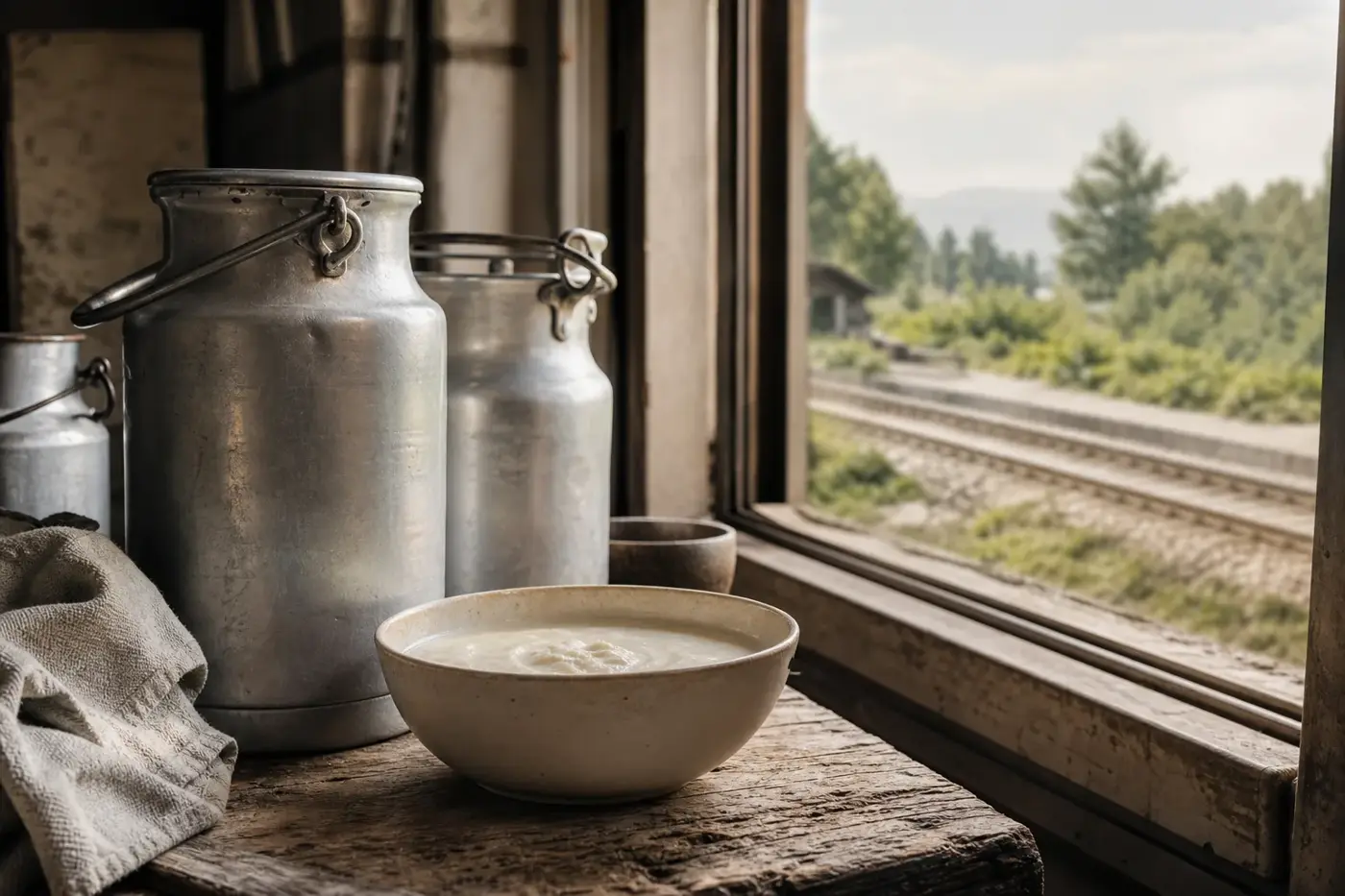
In 1911, Galbani opened its Melzo site beside the railway serving Milan and the surrounding region. For a cheesemaker, transport mattered: refrigeration and distribution would help carry perishable dairy products far beyond their neighbourhood. The business that began in Ballabio, in the Lombard Alps, grew through factory cheesemaking into an international Italian cheese brand. [1]
Today Galbani belongs to the French Lactalis group, which acquired the business in 2006. On a British pack, Galbani identifies the range; the label tells you about the particular cheese inside. [1,5,6,14]
Galbani at a glance (checked November 2026)
| Field | Detail |
|---|---|
| Kind | Cheese brand. [6] |
| Founded | 1882, according to Galbani’s history. [1] |
| Origins | Ballabio, Lombardy, Italy. [1,2] |
| Group | Lactalis, since 2006. [1,5,6] |
| British catalogue | Mozzarella, burrata, Dolcelatte, mascarpone, ricotta and Italian hard cheeses. [7] |
From Alpine robiola to the railway
Robiola, rather than mozzarella, belongs at the beginning of Galbani’s story. The company traces its history to 1882 and a father-and-son partnership in Ballabio. Its Italian corporate account describes a dairy established by the son and named after his father, with robiola as an early product. These were firmly Lombard beginnings, long before the mozzarella range now prominent in the British catalogue. [1,2,7]
The Melzo opening in 1911 brought the business alongside the railway. Galbani’s history also records investment in refrigeration after the First World War. Together, factory production, transport and cooling helped turn a regional dairy business into an industrial organisation capable of moving perishable products beyond its immediate neighbourhood. [1]
The range widened too. Galbani dates production of Bel Paese and mascarpone at Giussago to 1925, and the launch of Santa Lucia mozzarella to 1956. Fresh cheese became central to a business whose early reputation had rested on other products. [1]
Bel Paese: a cheese with an Italian identity
Bel Paese was conceived as more than a new cheese. Created in 1906 according to Galbani’s records, it had a deliberately Italian identity: the company connects its name to a book celebrating Italy’s geography. Its account describes distinctive packaging and an ambition to reach consumers in cities both at home and abroad. Cheese and presentation were developed together. [3]
That combination helped shape Galbani’s development. A named product could become familiar across a distribution network without depending solely on customers knowing a particular dairy or locality. Bel Paese helped establish the model of a recognisable Italian cheese sold through a recognisable brand, a reading grounded in the company’s documented emphasis on packaging, publicity and transport. [3]
The route to Lactalis
Galbani’s ownership trail runs through Danone and BC Partners. In its decision of 27 March 2002, the European Commission described Galbani as a wholly owned Danone subsidiary and cleared its proposed acquisition by BC Partners. That date marks regulatory clearance, with Danone as seller and BC Partners as the proposed buyer. [4]
The next Commission decision, dated 24 April 2006, records an agreement signed on 4 January 2006 for Lactalis to acquire Galbani from BC Partners. Galbani’s history dates its entry into Lactalis to 2006. Lactalis’s current British website still includes Galbani among its brands, establishing the continuing group relationship as well as the acquisition year. [1,5,6]
Galbani is the brand consumers see; Lactalis is the wider dairy group. The ownership history explains the business, while an individual mozzarella’s label explains the product. The separate Lactalis page covers the broader business.
A range of distinct cheeses
Mozzarella, burrata, Dolcelatte, mascarpone, ricotta and Italian hard cheeses all appear in the manufacturer’s British catalogue, checked in November 2026. The mozzarella range is divided further into cow’s milk, buffalo milk and products intended for hot dishes. For a cook choosing an ingredient, those distinctions matter more than the shared logo. [7]
Consider mascarpone and ricotta. Galbani describes its mascarpone as smooth and made from cow’s milk and cream; the listed ingredients are pasteurised cream, pasteurised milk and citric acid. Its ricotta has a grainy texture, according to the maker, and lists pasteurised whey, milk cream and/or whey cream, salt and acidity regulators. Whey is the liquid separated during cheesemaking. These are different ingredients with different textures, despite carrying the same brand. [8,9]
Choose mozzarella by milk and moisture
Milk species tells you one thing; moisture tells you another. Galbani’s standard 125 g mozzarella lists pasteurised whole milk, salt, non-animal rennet and citric acid. Its buffalo mozzarella lists buffalo milk, salt and rennet. Cucina, meanwhile, is a cow’s milk block described by the manufacturer as having low water content for cooking. [10,11,12]
Manufacturer’s UK product information, checked November 2026.
| Galbani UK product | Milk declared | Moisture information | Manufacturer’s suggested uses |
|---|---|---|---|
| Mozzarella 125 g | Cow’s milk | Salads and hot dishes. [10] | |
| Mozzarella di Latte di Bufala 125 g | Buffalo milk | Hot or cold dishes. [11] | |
| Mozzarella Cucina 400 g | Cow’s milk | Low water content, according to the maker | Pizza and lasagne. [12] |
For pizza or lasagne, Cucina has a clearly stated cooking purpose. For a tomato salad, standard mozzarella is the maker’s suggested choice. The grated format brings another ingredient into the picture: Galbani’s British page lists potato starch alongside the cheese. Check the formulation of the format you buy, rather than assuming every mozzarella has the same ingredients. The guide to mozzarella styles explores the wider family. [10,12,13]
What to read on a British pack
Start with the product name, then look beyond the front logo. The useful details separate Galbani’s Italian history from the characteristics of the cheese in your hand. The guide to reading a cheese label explains the wider terminology.
- Ingredients: identify the milk species, cream or whey, rennet and any additions. Galbani’s standard mozzarella and grated mozzarella have different published ingredient lists. [10,13]
- Milk treatment: look for an explicit statement such as “pasteurised”. The manufacturer declares this for standard mozzarella and Cucina. Check the pack for the particular product you are considering. [10,12]
- Production location: find wording that identifies where the cheese was made. Distinguish this from the address of the business responsible for the label. To identify the particular dairy, ask the manufacturer using the product and batch details.
- Storage: read the date, refrigeration instruction and instructions for use after opening together. Official British labelling guidance says storage conditions affect whether food remains safe until its use-by date. [14]
Italian branding is not a protected origin
Galbani is a brand name. A protected designation of origin, or PDO, identifies a registered product name governed by a specification. In Great Britain, the official register lists “Mozzarella di Bufala Campana” as a registered PDO, with UK scheme registration dated 31 December 2020. [15]
The exact wording matters. Galbani’s British product is called Mozzarella di Latte di Bufala. Buffalo milk describes an ingredient; the registered geographical name identifies something separate. Read the complete name on the pack and check the relevant register when origin matters to your choice. [11,15] Protected names explained sets out the differences between PDO, PGI and TSG.
Read nutrition product by product
Use the figures per 100 g on the pack to compare cheeses on the same basis. The NHS advises keeping track of cheese portions and frequency because cheese can be high in saturated fat and salt. A whole brand is too broad a category to tell you much about nutrition. [16]
For its standard mozzarella, Galbani publishes 18 g fat, 13 g saturated fat, 17 g protein and 0.7 g salt per 100 g. A calculated 30 g portion therefore provides 5.4 g fat, 3.9 g saturated fat, 5.1 g protein and 0.21 g salt. These figures describe that product, rather than mozzarella generally. [10]
Milk appears in the published ingredients for the mozzarella, mascarpone and ricotta discussed here. Check each pack’s allergen information, including any added flavourings or other ingredients. The guide to cheese allergy and lactose intolerance explains the distinction between these two conditions. [8,9,10]
This page summarises published guidance from the official sources it cites. It is not medical advice. Guidance differs between countries and changes over time, so check the current source for where you live, and ask your doctor, midwife, pharmacist or dietitian about your own circumstances.
Keep it chilled: storage and pregnancy guidance
A fridge between 0 °C and 5 °C is the Food Standards Agency’s recommendation for home storage in England and Wales, alongside following the pack’s storage instructions. Food Standards Scotland gives the same temperature range for Scottish households. Keep chilled products refrigerated and return them promptly after use. [17,18]
A use-by date concerns safety; a best-before date concerns quality, according to official British guidance. Follow instructions after opening as well as the printed date. Do not eat cheese still in its original chilled state after its use-by date. [14] The home storage guide covers the wider routine.
For pregnancy in the UK, the NHS lists mozzarella and ricotta made from pasteurised milk among the soft cheeses that can be eaten. Soft blue cheeses should be cooked until steaming hot before eating. Check the particular product’s milk treatment and consult the NHS guidance for its cheese category, checked here in November 2026. [19]
Put each cheese to work
Choose by the dish you want to make. Galbani suggests standard mozzarella with tomatoes and basil, and Cucina for pizza and lasagne. Its mascarpone page recommends tiramisu or stirring the cheese into tomato sauce. For ricotta, the maker suggests spreading it on bread or using it in sweet and savoury dishes. These serving ideas come from the manufacturer. [8,9,10,12]
Texture offers another useful starting point. For a pasta filling, decide whether you want the grainy texture Galbani describes for ricotta or the smooth consistency it describes for mascarpone. For a topping, choose between a block to grate yourself and a prepared grated product. Reading the label with a dish in mind makes its details useful: milk, texture, moisture and format become practical cooking decisions. [8,9,12,13]
Questions people ask
Who owns Galbani?
Galbani belongs to the French Lactalis group, which acquired the business in 2006. Before that, it was owned by BC Partners and, earlier, Danone.
What is the difference between Galbani mascarpone and ricotta?
Galbani describes its mascarpone as smooth and made from cow’s milk and cream. Its ricotta has a grainy texture and lists pasteurised whey, milk cream and/or whey cream, salt and acidity regulators.
Which Galbani mozzarella is suggested for pizza?
Galbani suggests Mozzarella Cucina for pizza and lasagne. It is a cow’s milk block that the manufacturer describes as having low water content for cooking.
Is Galbani buffalo mozzarella a protected designation of origin cheese?
Galbani’s British product is called Mozzarella di Latte di Bufala. The Great Britain register lists the different name Mozzarella di Bufala Campana as a protected designation of origin.
Can you eat Galbani mozzarella during pregnancy?
The NHS lists mozzarella made from pasteurised milk among the soft cheeses that can be eaten during pregnancy. Check the particular product’s milk treatment and consult the current NHS pregnancy guidance for its cheese category.
Sources
- Galbani, Our story, undated corporate history, online version checked November 2026. Founding, Melzo, refrigeration, Giussago, Santa Lucia and entry into Lactalis.
- Galbani, La storia, undated Italian corporate history, online version checked November 2026. Founding dairy and early robiola production.
- Galbani, Storia Bel Paese, undated brand history, online version checked November 2026. Creation, naming, packaging and distribution strategy.
- European Commission, Case No COMP/M.2757, BC Partners/Galbani, public non-opposition decision, 27 March 2002, paragraphs 1 and 4.
- European Commission, Case No COMP/M.4135, Lactalis/Galbani, public non-opposition decision, 24 April 2006, paragraphs 1 to 4. French authoritative text.
- Lactalis UK & Ireland, [Galbani](../galbani/), undated current brand page, checked November 2026.
- Galbani UK, Discover our range and [Mozzarella](../mozzarella/), undated online catalogue, checked November 2026.
- Galbani UK, Galbani Mascarpone 250g, undated manufacturer product information, checked November 2026.
- Galbani UK, Galbani Ricotta 250g, undated manufacturer product information, checked November 2026.
- Galbani UK, Galbani Mozzarella 125g, undated manufacturer product information and nutrition declaration, checked November 2026.
- Galbani UK, Galbani Mozzarella di Latte di Bufala 125g, undated manufacturer product information, checked November 2026.
- Galbani UK, Galbani Mozzarella Cucina 400g, undated manufacturer product information, checked November 2026.
- Galbani UK, Galbani Grated Mozzarella Cheese 180g, undated manufacturer product information, checked November 2026. Ingredient information only used.
- GOV.UK, Understanding food labelling: Best before and use-by dates, current online guidance, checked November 2026.
- Department for Environment, Food & Rural Affairs, [Mozzarella di Bufala Campana](../mozzarella-di-bufala-campana/), protected food name register entry, published 4 January 2021, current record checked November 2026.
- NHS, Dairy and alternatives in your diet, current online guidance, checked November 2026, “Cheese” section.
- Food Standards Agency, How to chill, freeze and defrost food safely, current online guidance, checked November 2026.
- Food Standards Scotland, Chilling food, current online guidance, checked November 2026.
- NHS, Foods to avoid in pregnancy, current online guidance, checked November 2026, “Cheese, milk and other dairy” section.
- Food Standards Agency, Alerts, live recall and allergy alert index, accessed November 2026 for the editorial recall check.
This piece was researched from manufacturer histories and British product information, European Commission merger decisions, the Great Britain protected food name register and official British consumer guidance.
Last checked: November 2026
Last checked November 2026.
The editors suggest you read next
Who Makes the World's Cheese? The Big Dairy Groups
You pick up Galbani at the cheese counter, then pause over Kerrygold.