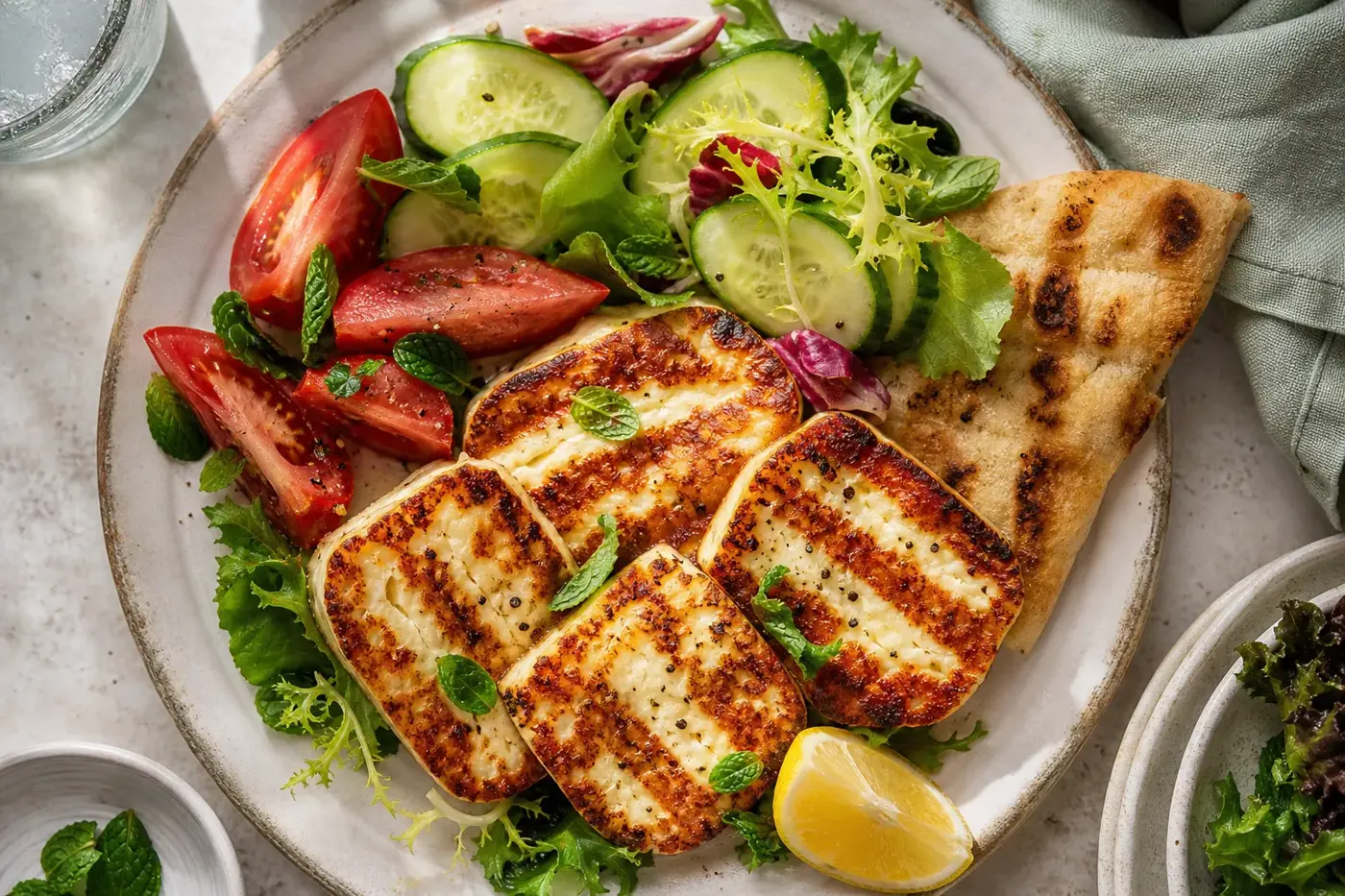
Your knife breaks through the deeply browned surface. Inside is the prize: a warm, soft, springy centre. To catch grilled halloumi at its best, cut even slices about 1 cm thick, dry them thoroughly and cook them briefly on a properly heated surface. You want colour outside before the middle turns tough.[1,2]
Meet the cheese from Cyprus that holds its own
Put a cheese meant for sauce on direct heat and it would melt. Halloumi holds its shape while its surface browns. This cheese from Cyprus has a compact, elastic texture that takes particularly well to the grill.[3]
Published research describes fresh halloumi as readily sliceable, with an elastic body. Its characteristic making process includes cooking the pressed curd in hot whey. By the time that springy slice reaches your pan, heat is already an old acquaintance.[3]
The explanation lies in its protein structure, not simply its fat content. A laboratory study of cow’s-milk halloumi-type cheeses, made at eight different acidity levels in triplicate, found that acidity changed calcium retention, protein interactions and melting behaviour. At your hob, the distinction is straightforward: halloumi softens but stays in one piece, rather than flowing across the pan.[4]
The name has protection, too. The EU registered ‘Χαλλούμι’ (Halloumi)/‘Hellim’ through Commission Implementing Regulation (EU) 2021/591, applicable from 1 October 2021.[5] If you are curious about the difference between a regional name and a cooking category, see protected names explained.
Your grilled halloumi recipe: brown, turn, tuck in
Get everything else ready before the cheese meets the pan. Halloumi has many virtues, but waiting politely while you finish the salad is not among them.
This recipe adapts preparation and cooking principles published by Good Food and PittaS, a producer with a commercial interest in promoting its cheese. The quantities and serving arrangement are an editorial adaptation, rather than a recipe developed in the fromage.co.uk kitchen.[1,2]
Serves: 2 as part of a meal, or 4 as a small accompaniment
Preparation: approximately 10 minutes
Cooking: approximately 4 to 6 minutes per batch
Equipment: ridged griddle pan or heavy frying pan, kitchen paper, pastry brush, thin spatula, chopping board and knife
Heat: medium-high hob heat; no oven or fan setting is used
Gather your cheese, lemon and greens
- 225 g (7.9 oz) halloumi, drained
- 5 ml (1 teaspoon) olive oil, for brushing
- 15 ml (1 tablespoon) lemon juice, plus lemon wedges to serve
- 5 g (0.2 oz) fresh mint or parsley leaves, roughly chopped
- Freshly ground black pepper, to taste
For a simple accompaniment:
- 250 g (8.8 oz) tomatoes, cut into wedges
- 150 g (5.3 oz) cucumber, sliced
- 50 g (1.8 oz) salad leaves, washed and dried
- 2 flatbreads, approximately 120 g (4.2 oz) in total
Seven steps to a golden plateful
- Give the accompaniments a head start. Arrange the tomatoes, cucumber and leaves on plates. Keep the lemon, herbs and flatbreads within reach, ready for the cheese to go straight from pan to table.
- Drain and dry. Lift the halloumi from its packaging and discard the packing liquid. Blot the block with kitchen paper.
- Cut evenly, then blot again. Make slices about 1 cm thick. Dry both cut faces, then brush lightly with the olive oil.[1]
- Bring the pan up to heat. Put the griddle over medium-high heat. Follow its manufacturer’s preheating instructions, particularly for coated pans.
- Give each slice breathing room. Arrange them in one layer with space between them. Leave the first side undisturbed for approximately 2 to 3 minutes, looking for browned ridges rather than repeatedly lifting every piece.[2]
- Turn once, carefully. Slide a thin spatula underneath each slice and turn it once. Cook the second side until browned and the middle is yielding.
- Finish and serve promptly. Transfer to your prepared plates. Add the lemon juice, herbs and pepper, then bring them to the table.
Allergen check: halloumi contains milk. Read the ingredient and precautionary allergen information for the cheese and every accompaniment, including flatbread and any substituted dressing.
Substitutions: this recipe does not specify an alternative cheese. Other grilling cheeses may differ in moisture, salt, melting and flavour. Follow the maker’s instructions and use the cheese’s own name.
A good crust begins with dry slices
Before your halloumi can colour, its surface moisture has to evaporate. Thorough drying therefore does more for browning than a generous pour of oil. Blot the cut faces of every slice, not just the outside of the block.[2]
Keep the thickness as even as you can from end to end. With a wedge, the thin edge dries out while the thicker end is still warming. Save broken pieces for a separate small batch; pressing them together will not make an intact slice.
Count your slices before cooking and decide how to divide them between plates. It is a tiny bit of planning that earns its keep when several people are eating. Your first batch need not sit waiting while you negotiate the portions.
Give it a hot pan and a little peace
Brush on a thin film of oil so the cheese makes contact with the pan without sitting in a pool. Once the slices are down, leave them alone. When you turn them, support the whole underside with a spatula rather than gripping a corner and pulling.
Choose your pan for the finish you fancy. A ridged griddle gives browned lines with paler patches between; a flat frying pan gives more continuous contact. Elaborate cross-hatching is unnecessary: supper is not an audition for a grill-mark calendar. One deliberate turn is easier than repeatedly rotating every slice.
If everything will not fit comfortably in one layer, use two pans or serve in batches. Keep the salad and bread beside the cooker. Have a plate waiting for each batch as it comes off the heat.
Catch the centre while it is still soft
Look for golden-brown surfaces and a centre that yields to gentle pressure from your spatula. Those are your cues to stop cooking. PittaS advises finishing while the interior is still yielding, because halloumi firms as it cools.[2]
Make the cheese your final cooking job. Dress the salad, warm the bread and set out the plates first. Then take the halloumi straight to the table, rather than leaving it on a platter while the rest of supper catches up.
Take your halloumi outdoors, or under the grill
Fancy barbecue marks, or prefer the oven grill to a pan? You have options. These adaptations draw on Good Food’s published methods, rather than recipes developed by fromage.co.uk.[1]
Cooking over charcoal or gas? Wait for the heat
Start with dry, lightly oiled slices 1 cm thick. For charcoal cooking, wait until the coals are ashen and the clean grill bars are hot. Good Food specifies high heat for a gas barbecue. Cook directly on the bars for approximately 2 to 3 minutes per side, until marked and softened.[1]
Support each slice with a spatula when you turn it. Check the size of your pieces against your particular grill: they need to be large enough that they cannot slip between the bars.
Under the oven grill, let colour guide you
Preheat the overhead grill to medium-high. Lay your prepared slices on a suitable grill rack or sturdy tray. Grill for approximately 3 to 4 minutes until browned, turn with a spatula, then cook the second side until coloured.[1]
You are grilling from above, called broiling in the US, rather than baking. Settings vary by appliance. Follow the manufacturer’s instructions rather than converting the setting into an invented Celsius, Fahrenheit or fan temperature.
A few small fixes for a better bite
Sticking, pale surfaces or a tough bite usually call for an adjustment to drying, heat or timing. The fixes below concern eating quality. They apply to cheese that has been handled and stored correctly.
| What you notice | What might explain it | What to try next |
|---|---|---|
| Quality problem: sticking or tearing | A wet surface, insufficient preheating or turning too soon | Dry thoroughly, preheat and support with a spatula |
| Quality problem: pale outside | Surface moisture or crowded slices | Blot the cut faces and give the slices space |
| Quality problem: tough texture | Cooking beyond browning or waiting to serve | Stop earlier; have your accompaniments ready first |
| Taste preference: too salty | Brining combined with salty ingredients | Leave out added salt and choose unsalted accompaniments |
These explanations draw on PittaS’s published cooking guidance.[2] If a mouthful tastes too salty, consider the whole plate first. Leave out olives, salty dressings and additional seasoning.
When you buy your next pack, compare salt per 100 g on the labels. Do not expect every block to taste the same.
Bring lemon, herbs and crunch to the table
Lemon, herbs and fresh vegetables give browned halloumi a bright contrast. PittaS’s recipes pair it with lemon, basil and pitta, or with tomatoes, red onion and herbs.[6,7] You can take those combinations as your starting point:
- Lemon and herbs: finish with lemon juice and torn mint or parsley.
- Watermelon: put cold cubes beside the hot slices, with mint and a squeeze of lemon.
- Tomatoes: serve ripe wedges with thinly sliced red onion.
- Flatbread: warm it for folding around the cheese and vegetables.
- Crisp salad: add cucumber, radishes or shredded lettuce for a contrasting bite.
These are editorial pairing suggestions, so adjust the lemon and herbs to suit your taste. Water alongside the meal keeps the citrus and fresh herbs prominent. It brings no other strong flavour to compete with them.
Fold yourself a generous flatbread supper
For two people, take the recipe’s cheese and vegetables and two large flatbreads. Divide the leaves and cucumber between the breads, add the tomatoes, then lay the freshly cooked halloumi on top. Spoon over the lemon and herb finish and fold loosely.
The idea adapts PittaS’s grilled halloumi pitta recipe, which combines grilled cheese with tomato, onion, basil and a dressing containing lemon. The producer has a commercial interest in promoting its cheese. You do not need any particular brand for this version.[6]
More in the mood for salad? Leave the vegetables in a wide bowl and add drained tinned chickpeas according to appetite. Lay the halloumi on top with those browned surfaces showing, and serve the flatbread alongside. Have everything except the cheese assembled before you heat the pan.
This page summarises published guidance from the official sources it cites. It is not medical advice. Guidance differs between countries and changes over time, so check the current source for where you live, and ask your doctor, midwife, pharmacist or dietitian about your own circumstances.
Keep leftovers safely, and reheat only once
Keep uncooked halloumi refrigerated according to the pack’s refrigeration, use-by and after-opening instructions. The Food Standards Agency guidance for England, Wales and Northern Ireland, as of November 2026, advises a fridge temperature between 0 and 5 °C (32 to 41 °F).[8]
For cooked leftovers, the FSA advises cooling and refrigerating within two hours. Eat them within 48 hours or freeze them. Reheat only once, making the food steaming hot throughout.[9] Where practical, keep leftover cheese separate from salad leaves.
Expect reheated halloumi to be firmer than freshly grilled cheese. PittaS notes that it tightens as it cools.[2] Reheat what you need for a meal rather than repeatedly warming a serving platter. For broader handling advice, see how to store cheese at home.
Before you buy, get to know the label
If you need vegetarian halloumi, look for a clear statement on the pack. If the wording leaves you wondering, read further or ask the maker. The Vegetarian Society distinguishes animal rennet, which is not vegetarian, from microbial and plant alternatives.[10]
Rennet is the enzyme preparation used to set milk into curd. If you would like to explore its different sources, turn to rennet explained.
A pack labelled “grilling cheese” needs its own preparation instructions. Choose it for the result its maker describes, and read the ingredients rather than assuming it shares halloumi’s formulation. For help separating the food’s name from the other wording on a pack, see reading a cheese label.
Questions people ask
How do you grill halloumi in a pan?
Cut the halloumi into even slices about 1 cm thick, blot both faces dry and brush lightly with olive oil. Heat a griddle or heavy frying pan over medium to high heat, then cook the slices in one layer for about 2 to 3 minutes on the first side. Turn once and cook until the second side is browned and the centre yields to gentle pressure.
Can you cook halloumi on a barbecue or under an oven grill?
For a barbecue, cook dry, lightly oiled slices directly on hot grill bars for approximately 2 to 3 minutes per side. Under a preheated oven grill, cook for approximately 3 to 4 minutes until browned, then turn and cook until the second side is coloured.
Why is my grilled halloumi tough?
Halloumi can become tough if it cooks beyond browning or sits waiting to be served. Stop when the surface is browned and the centre still yields to gentle pressure, then serve promptly.
Is halloumi vegetarian?
Look for a clear vegetarian statement on the pack and ask the maker if anything is unclear. The Vegetarian Society says animal rennet is not vegetarian, unlike microbial and plant alternatives.
How should I store and reheat leftover grilled halloumi?
The Food Standards Agency advises cooling and refrigerating cooked leftovers within two hours, then eating them within 48 hours or freezing them. It advises reheating only once, until steaming hot throughout. See the FSA’s guidance on storing and reheating leftovers.
Sources
- Good Food, How to cook halloumi, published 3 June 2026. Preparation, pan cooking, barbecue and overhead grill methods. Source.
- PittaS, How to Cook Halloumi, undated, retrieved November 2026. Producer guidance on drying, thickness, heat, sticking and serving texture. Source.
- Foods, Influence of Salting Method on the Chemical and Texture Characteristics of Ovine Halloumi Cheese, volume 8, article 232, 2019. Primary experimental research. Source.
- Food Chemistry: X, The effect of pH on the microstructure, rheological and functional properties of halloumi-type cheese: pH-structure-function relationships, volume 32, article 103341, 2025. Primary experimental research. Source.
- European Commission, Commission Implementing Regulation (EU) 2021/591, adopted 12 April 2021, published 13 April 2021, applicable from 1 October 2021. Articles 1 to 3. Official text.
- PittaS, Grilled Halloumi Sandwich in Pita Bread, undated, retrieved November 2026. Producer recipe. Source.
- PittaS, Halloumi, Tomatoes, Red Onion and Hyssop Salad, undated, retrieved November 2026. Producer recipe. Source.
- Food Standards Agency, How to chill, freeze and defrost food safely, current retrieved guidance, November 2026. Applies to England, Wales and Northern Ireland. Official guidance.
- Food Standards Agency, Cooking your food, current retrieved guidance, November 2026, section 7. Applies to England, Wales and Northern Ireland. Official guidance.
- Vegetarian Society, Which cheeses are suitable for vegetarians and which aren’t?, published 19 May 2026. Coagulant guidance and label checks. Source.
Researched through published cooking methods, producer recipes, primary dairy research, the EU registration instrument and official food handling guidance.
Last checked: November 2026
Last checked November 2026.
The editors suggest you read next