How Cheese Is Eaten Across Asia
Look up at a Mongolian ger roof and you might find curds drying in the sunshine, becoming food to carry and keep.
Look up at a Mongolian ger roof and you might find curds drying in the sunshine, becoming food to carry and keep. In Yunnan, warm curds are stretched around sticks into thin sheets, then deep-fried until they puff. Your sandwich will have to look elsewhere.[3][5]
Across Asia, cheese might give you a hard Himalayan snack to chew, an ingredient in northern Indian meals or the foundation of Bengali sweets. In contemporary Korea, it bubbles over sweetcorn. Follow these foods and you find local herding traditions, ingredients and eating habits shaping every mouthful.[1][2][3][4][5][8]
Three good tastes to get you started
Begin with chhurpi, but ask which kind you are getting. The hard version is for chewing, while softer chhurpi finds its way into curries and soups.[2]
In Yunnan, start by asking about the milk. A Bai food account describes rubing made with goat's or cow's milk, while rushan is made with cow's milk.[5]
If you fancy cheese with bread, look to the Philippines. Philippine Carabao Center material describes that pairing with kesong puti, a cheese made from water buffalo milk.[6][7]
Let the meal show you the way
You need not wait for a separate cheese course. Cheese might be packed for a journey, stirred into a curry, worked into a sweet or served as a restaurant side dish. Finding its place in the local meal is your best route into the pleasure and variety of these traditions.[1][3][4][8]
In the Himalayas and Mongolia, pastoral communities have long processed milk from their herds. Himalayan research describes cattle, buffaloes and yaks living in different altitude zones, each contributing to the region's dairy foods. Elsewhere, dairy has played a smaller historical role, and even neighbouring communities can bring quite different traditions to the table.[2][3]
Himalayan chhurpi: settle in for a slow chew
Hard chhurpi asks you to take your time. You chew it rather than slice it for bread, and a review of Himalayan food cultures compares the experience to chewing gum. Softer chhurpi has another role entirely: the same research describes it in curries and thick soups served with cooked rice.[2]
Research on Sikkim's hard chhurpi documents versions made from yak milk and cow's milk. Butter is separated during processing, leaving the protein-rich curd to become cheese. Drying the softer product produces the hard form, showing just how different fresh and dried dairy foods can become.[1]
Before you order, ask which form a dish contains. A cook can tell you whether the cheese is soft and incorporated into the meal, or dried for chewing. That answer tells you more about what awaits than the name alone, particularly if you have a European wheel in mind.[1][2]
Mongolian aaruul: sunshine, curds and food to carry
On a ger roof, sunshine turns aaruul into a portable snack. An Australian National University field account places these dried curds among Mongolia's everyday dairy foods, made from milk or yoghurt, commonly from cows or yaks. The ger itself is the portable dwelling associated with Mongolian pastoral life.[3]
Drying makes the curds convenient to carry and keep, but you should not expect one fixed texture. Photographs in the account show several shapes, while samples encountered during the fieldwork ranged from firm and chewy to softer and crumbly. Sugar and vanilla could be added, bringing different degrees of sweetness alongside those different textures.[3]
Here, keeping food and enjoying it belong to the same story. For your first taste, ask about the batch in front of you: is it sweetened, and what texture should you expect? The name opens the conversation rather than settling it.
Paneer: pull up a chair for the main meal
Paneer belongs at the centre of savoury cooking. Across northern Indian households and restaurants, you find it in palak paneer with spinach, matar paneer with peas, or paneer tikka, whose seasoned pieces are cooked as a distinct component. The pleasure lies in how the curd works with vegetables, spices and sauces, rather than in ageing.
Paneer is an acid-set fresh cheese. Acid helps coagulate heated milk, separating solid curds from liquid whey, before the drained curd is pressed. Indian dairy research documents citric acid in paneer production and the use of buffalo milk.[4]
That differs from setting milk with rennet, the group of milk-coagulating enzymes used for many other cheeses. To explore paneer's place at the table, choose a vegetable-based dish and notice how the cheese sits alongside the sauce and other ingredients. You can follow the underlying curd-setting methods in the cheesemaking guide.[4]
Chhana: let the Bengali sweetmaker show you
Order sandesh or syrup-cooked rosogolla and you are meeting chhana, also written chhena. In Bengali sweetmaking, working, shaping, sweetening and cooking turn this fresh curd into quite different foods. Much of their character comes from the sweetmaker's work after the curd has formed.[4]
Like paneer, chhana begins with milk coagulated using acid, followed by draining off the whey. But this curd stays softer than a pressed paneer block, ready to be worked into sweets. It is a fresh ingredient, not a cheese put aside to develop a rind or an aged flavour.[4]
Ask a sweet shop for a chhana-based sweet and make that your starting point. You move beyond the savoury cheese dish and get to taste the sweetmaker's craft: the same broad material, worked into something quite different.[4]
Yunnan: watch milk fans puff and meet milk cakes
Warm curds stretched around sticks become the thin sheets of rushan. Deep-frying makes them puff, although they can also be cooked with ingredients such as Yunnan ham. An account published by Shanghai's municipal information office places this cow's milk cheese, the “milk fan”, within the food culture of Yunnan's Bai communities.[5]
Then you have rubing, the “milk cake”. The same account associates it especially with goat's milk, although cow's milk is also used, and records fresh rubing curds eaten with sugar. Within one Chinese province, you already have two cheeses that call for quite different descriptions, from their milk and shape to their preparation.[5]
Cheese also has a place in the sweet course of the Bai three-course tea ceremony, with brown sugar and cinnamon. When you find it on a Yunnan menu, ask which milk is used and how the cheese is prepared. Try rubing and rushan separately, giving each your attention at the table.[5]
Filipino kesong puti: bread makes a fine beginning
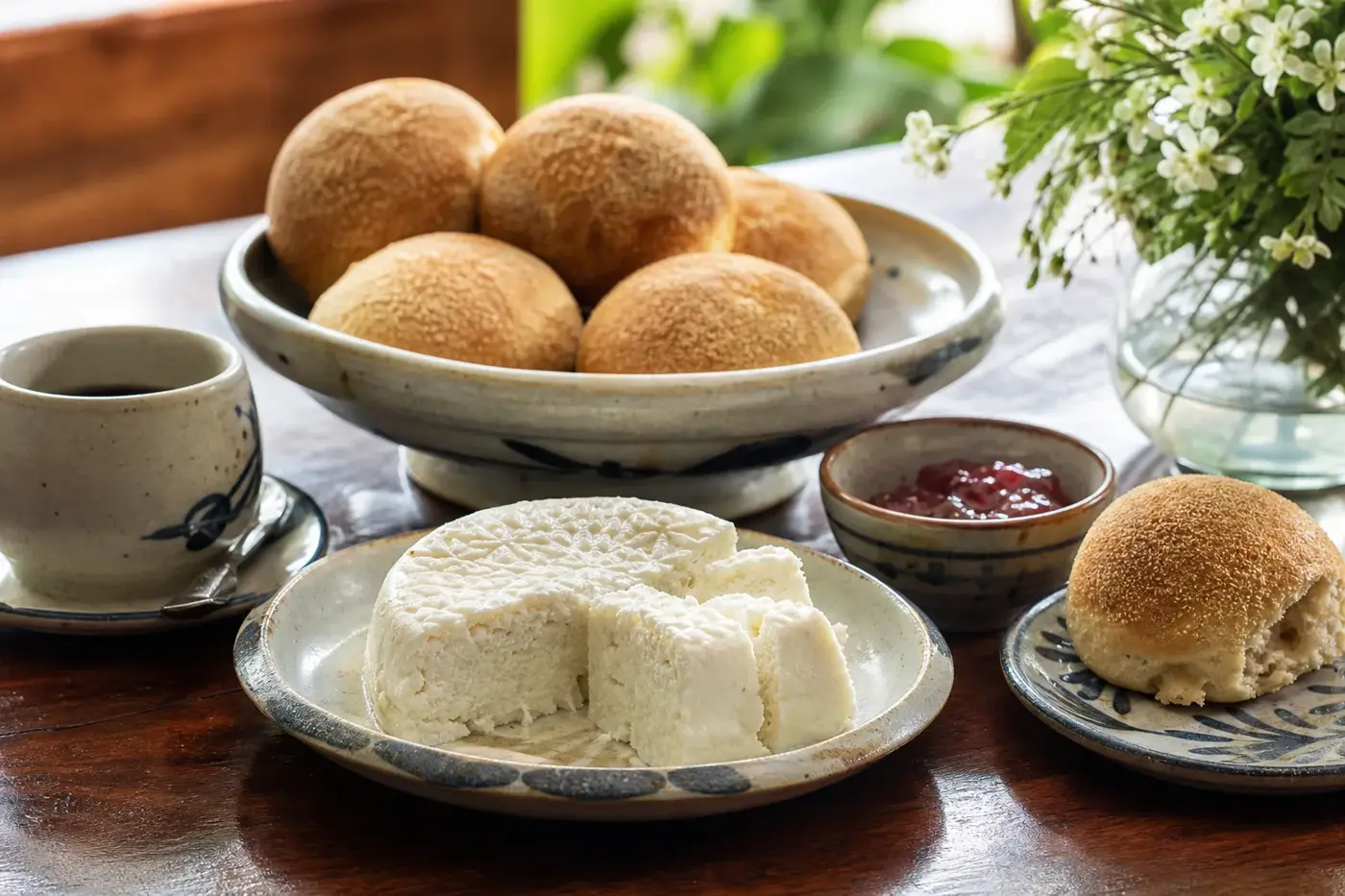
Put kesong puti beside pan de sal, the Filipino bread roll, and you have a straightforward introduction to this fresh, soft white cheese. The Philippine Carabao Center describes it as made from water buffalo milk. Its training material recommends the bread pairing and also suggests kesong puti for vegetable salads.[6][7]
How the milk is set makes a difference to what you eat. The centre's technical leaflet records vinegar coagulation, which produces a slightly sour, less firm cheese, and rennet, which gives a firmer version. Both are established approaches within the food's documented practice.[6]
In the training account, rennet-set curds are drained, sliced and wrapped in plastic sachets or banana leaves. For your first taste, keep things simple with bread and cheese. That leaves your attention on the fresh curd, rather than elaborate additions.[7]
Korean corn cheese: arrive while it is bubbling
Hot mozzarella melting over sweetcorn is the heart of Korean corn cheese. A published Korean cookery recipe combines canned sweetcorn with butter, mayonnaise, sugar and mozzarella, then adds chopped vegetables and optional rice cakes. The cook describes a savoury dish with a little sweetness, served bubbling in a small pan.[8]
Here, cheese is part of a prepared dish and a shared accompaniment, though sharing may test your resolve. The recipe places corn cheese among restaurant side dishes, showing how an ingredient can become familiar through a new combination. The pleasure is in the melted topping and the corn together; for a closer look at the melting cheese itself, see mozzarella.[8]
Japan: follow cheese from Hokkaidō to the everyday slice
Japan's modern cheese story takes you through experiments, factory production and imports. According to the dairy company Megmilk Snow Brand's historical account, experimental cheesemaking took place in Hokkaidō in 1875. The company records trial production by its predecessor in 1928, followed by fuller-scale Gouda production in 1933.[9]
The same account follows cheese into more familiar territory through post-war processed cheese, then foods including pizza and cheesecake. You did not need a separate cheese-course ritual to encounter it. A slice, a topping or a dessert could bring cheese into everyday eating.[9]
An official United States agricultural report published in 2022 documents Japan's established market for both processed and natural cheese. It includes individually wrapped portions and cheeses used in food service, while its historical consumption chart records growth in natural cheese consumption between 2016 and 2019. These different routes to the table tell you more than a simple division between people who eat cheese and people who do not.[10]
Lactose digestion: keep the individual in view
A national label tells you little about an individual's digestion. Lactase persistence means continued production, into adulthood, of the enzyme that digests milk sugar. A 2020 genetic study sampled 963 people across 30 Central Asian populations and found substantial differences between groups, including populations within the same ethnic group.[11]
Mongolia makes the distinction between dairy culture and lactase persistence particularly clear. A field study published in 1993 used breath hydrogen testing to investigate adult lactose absorption and found a relatively low frequency of absorbers in its Mongolian sample, despite the country's dairy traditions. What a community makes and what individuals can digest are related, but they are not the same question.[12]
You may also want to know how much lactose a particular cheese contains. That is a separate question, explored in lactose in cheese.
Give each food its own place at the table
Begin where the food belongs: paneer as part of a meal, a Bengali sweet afterwards, or kesong puti with bread. With Himalayan or Mongolian dried curds, ask which form you are being offered and how it is customarily eaten. A name becomes much more useful when it leads you into that conversation.[1][3][4][7]
Rather than putting everything on one board, explore contrasting methods. Compare soft chhurpi in a meal with hard chhurpi for chewing, or fresh Yunnan curds with cooked rushan. Corn cheese takes you somewhere else again, bringing a melted topping together with sweetcorn.[1][2][5][8]
Keep fermented tofu separate when you read menus. It is made from soya, so comparisons with cheese describe a culinary resemblance, not its ingredient. Ask whether a food starts with animal milk or soya to clear up the ambiguity; for broader comparisons, the guide to cheese styles helps you distinguish milk, texture and method.
Questions people ask
How is Himalayan chhurpi eaten?
Hard chhurpi is chewed, with one review comparing the experience to chewing gum. Softer chhurpi goes into curries and thick soups served with cooked rice.
What is the difference between paneer and chhana?
Both are fresh curds made by coagulating milk with acid and draining the whey. Paneer is pressed, while chhana is kept softer and worked into Bengali sweets such as sandesh and rosogolla.
What is kesong puti made from, and how is it served?
The Philippine Carabao Center describes kesong puti as a fresh, soft white cheese made from water buffalo milk. Its training material recommends serving it with bread and also suggests it for vegetable salads.
What is Korean corn cheese?
Korean corn cheese combines sweetcorn with melted mozzarella. One published recipe also uses butter, mayonnaise, sugar and chopped vegetables, with optional rice cakes.
Is fermented tofu a cheese?
Fermented tofu is made from soya. Comparisons with cheese describe a culinary resemblance, not its ingredient.
Sources
-
CSIR-Institute of Himalayan Bioresource Technology research, “Characterization of ACE inhibitory and antioxidant peptides in yak and cow milk hard chhurpi cheese of the Sikkim Himalayan region”, 2022. Introduction, sections 1 and 2. Full text.
-
Journal of Ethnic Foods, “Dietary culture and antiquity of the Himalayan fermented foods and alcoholic fermented beverages”, 2022. Section on Himalayan fermented milk products. Full text.
-
Australian National University, Mongolia Institute, “White Foods”, undated field account. Section on aaruul and accompanying field photographs. Field account.
-
ICAR-National Dairy Research Institute research, “Modelling and optimization of process parameters for production of desiccated Chhana-murki (Indian cottage cheese-based dessert)”, 2021. Abstract and indexed extracts retrieved; full-text access was unsuccessful. Article record.
-
Shanghai Municipal Government Information Office, “Rushan a key ingredient in Bai people’s tea ceremony”, 23 February 2018. Cultural account covering rushan and rubing. Published account.
-
Department of Agriculture, Philippine Carabao Center, “Factors affecting the yield recovery and quality of kesong puti”, Series B-02-2017, 2017. Opening description and comparison of coagulants. Technical leaflet.
-
Philippine Carabao Center, Facilitators’ Guide to Farmer Livestock School on Dairy Buffalo Production, technical handouts file, 2020. “Kesong Puti”, printed page 192. Training material.
-
Maangchi.com, “Corn cheese”, updated 11 August 2021. Recipe introduction and ingredient list. Published recipe.
-
Megmilk Snow Brand, “日本のチーズの歴史” [History of cheese in Japan], undated. Company account of production history and post-war consumption. The publisher is a commercial dairy company. Company history.
-
United States Department of Agriculture, Foreign Agricultural Service, “Japan Cheese Consumption Remains Stable Despite Pandemic Disruptions”, 2022. Market description and historical consumption charts. Report.
-
PLOS Biology, “Why and when was lactase persistence selected for? Insights from Central Asian herders and ancient DNA”, 2020. Original genotyping analysis and Figure 1. Full text.
-
Anthropological Society of Nippon, “A Case Study of Human Adult Lactose Absorption in Mongolia”, Anthropological Science, volume 101, issue 3, pages 301 to 306, 1993. Published abstract. Article record.
This desk-researched draft brings together dairy research, a university field account, agricultural publications and attributed cultural and cookery accounts; outstanding verification is recorded below.
Last checked: November 2026
Last checked November 2026.
The editors suggest you read next
Cheese Around the World: How Different Countries Eat It
Curds dry in the Mongolian sun, on their way to becoming aaruul, a portable food suited to nomadic life.