How Cheesemaking Moved from Farms to Factories
Milk arrives from two dairies in Rome, Oneida County, New York.
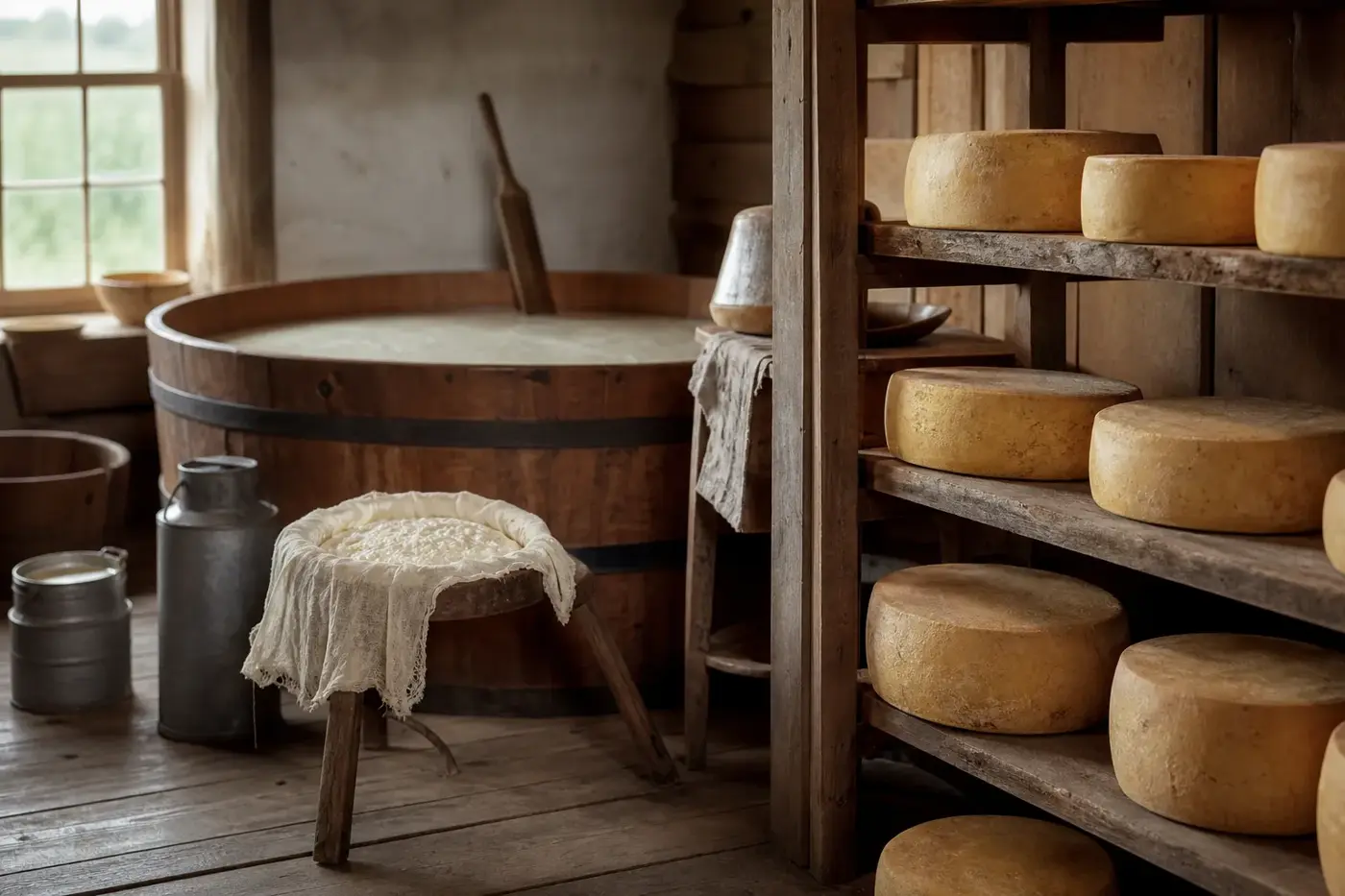
Milk arrives from two dairies in Rome, Oneida County, New York. It is 1851, and Jesse Williams is bringing those supplies together in an arrangement that will become an influential American model. Farmers provide the milk; a central maker turns it into cheese. The breakthrough is a new way of organising work, not a modern production line. [4]
Follow that milk and a much bigger story unfolds. Larger equipment, organised collection and wider markets drew cheesemaking beyond individual farms. Britain, continental Europe and North America took different paths, while farmhouse makers carried on alongside factories, sometimes using the same scientific tools. [1][2][3]
Three things to know before you step inside
- Shared dairies and factory dairies did not necessarily have the same ownership arrangements. [2][3]
- A United States census compilation recorded both factory and farm cheese output for 1899. [6]
- Pasteurisation came after the Williams factory was established. It did not create it. [2][4]
When cows and seasons ran the dairy
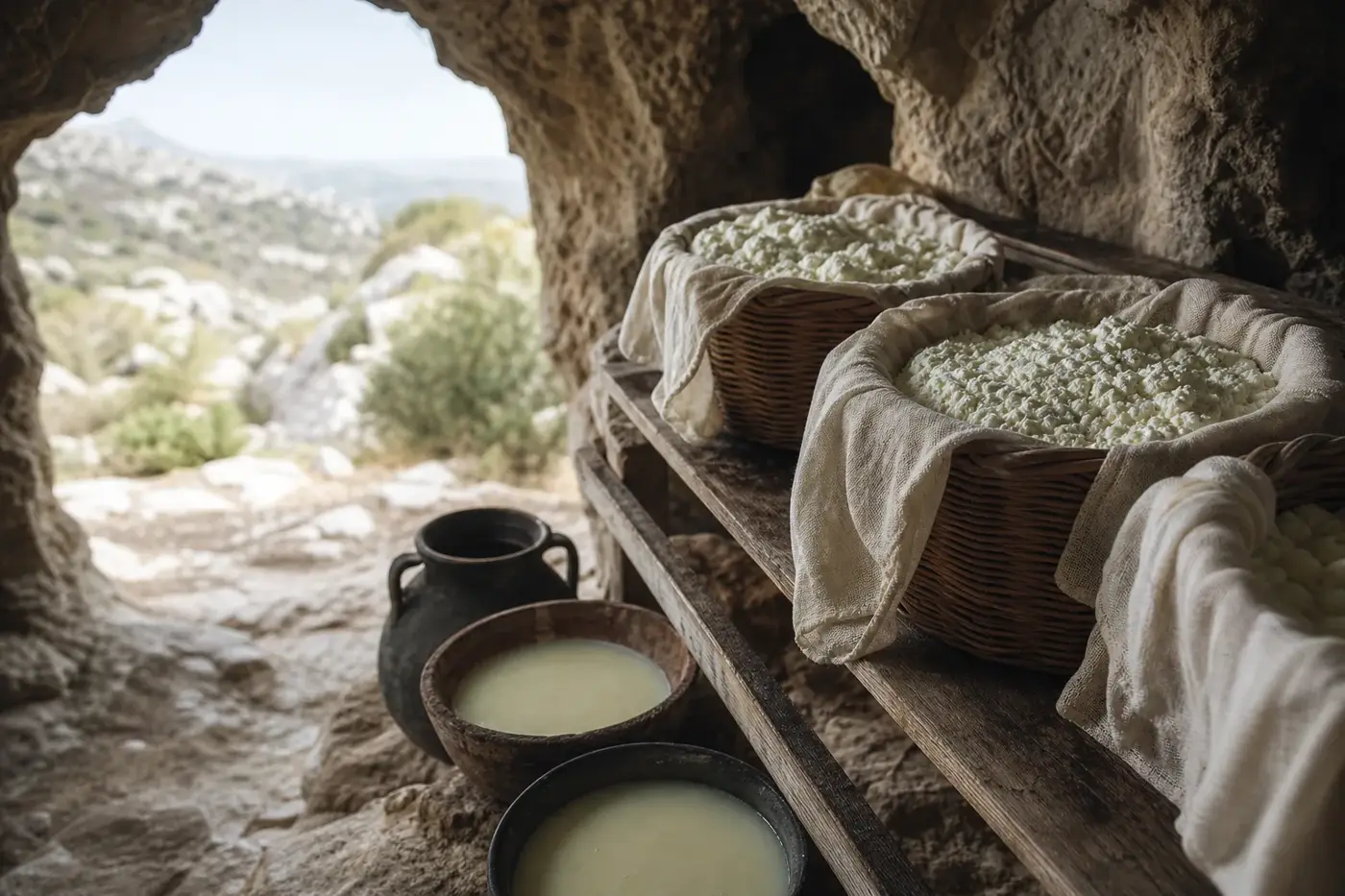
On a Cheshire farm, summer grass brought abundant milk. Winter brought much less. Nantwich Museum describes cheesemaking as an answer to that seasonal surplus: a perishable daily supply became something that could mature, stay in store and travel to market. Before factories organised collection, cows and seasons set the working day. [1]
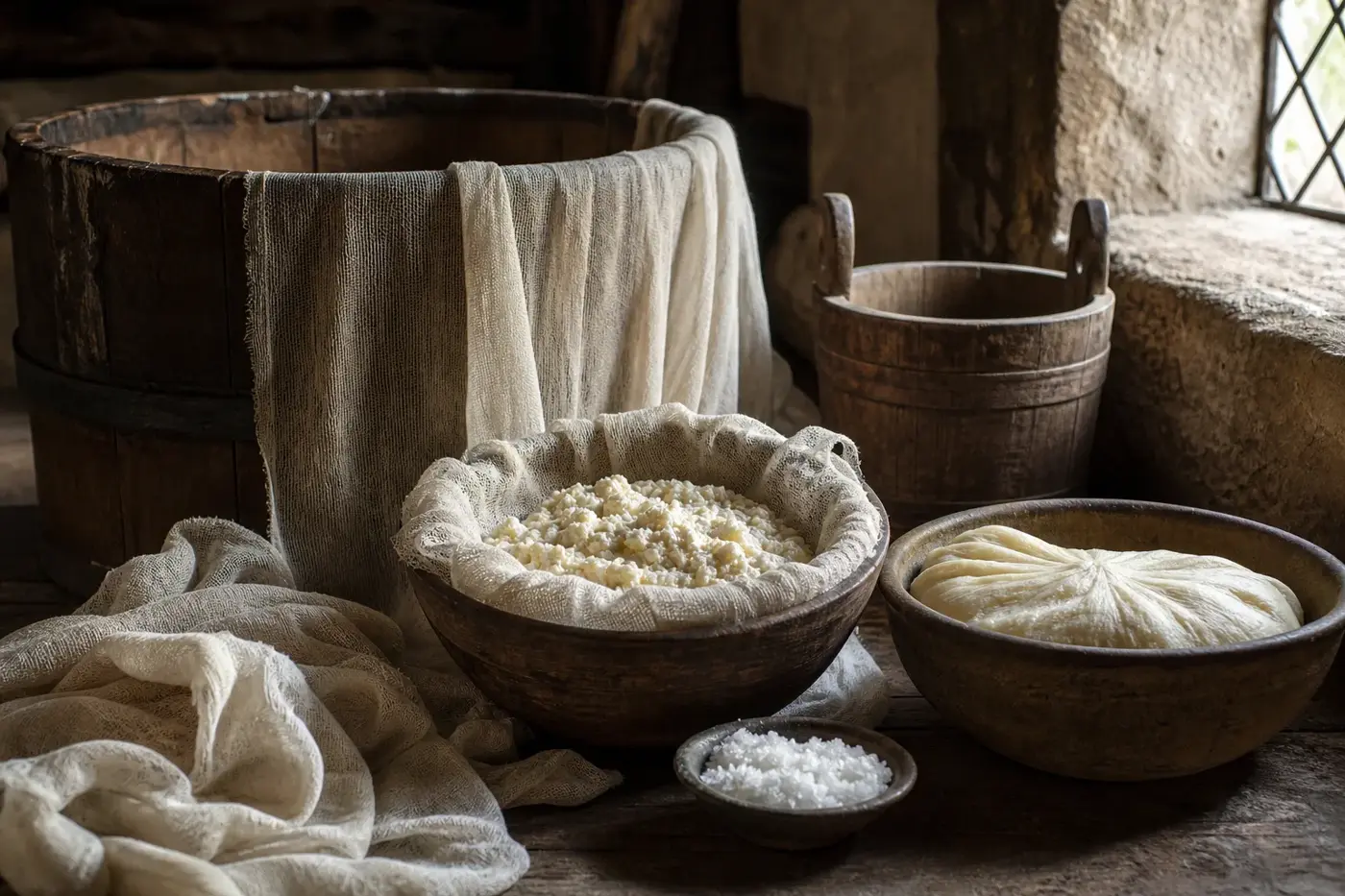
There was plenty to do between milkings. Milk needed handling, equipment needed cleaning, curd needed working and yesterday’s cheeses still wanted attention. If you are picturing the tub, curd is the coagulated portion of milk from which cheese develops; whey is the liquid separated from it. You can follow the basic sequence in how cheese is made. [2]
Even the most capable farm maker had limits. Milk supply dictated the size and frequency of batches, while rooms and equipment constrained heating, cooling and storage. In their 1918 The Book of Cheese, Charles Thom and Walter Warner Fisk described an earlier American routine: cool the evening milk, then combine it with the following morning’s supply. [2]
The milk, inconveniently, had no interest in waiting for a quieter moment. Temperature, cleanliness and developing acidity all shaped what happened in the tub. Making more cheese took more than another cow or a bigger vessel. Milk, labour and equipment had to come together at the right moment, within a daily routine that worked. [2]
In the Jura, neighbours were already sharing milk
Look towards the Jura and the story stretches back beyond the familiar image of a large industrial dairy. Its fruitières brought farmers’ milk together long before that image took hold. The Comté interprofession places these shared dairies within a continental tradition of collective rural production. Nineteenth-century America did not invent pooling milk. [3]
Bring several holdings’ milk into one place and a different scale of cheese becomes possible. Farmers supplied the raw material; a specialist maker took charge of its transformation. Instead of making cheese in scattered households, the work could happen centrally. Each household no longer needed a complete cheesemaking operation of its own. [3]
Sharing the making, though, did not necessarily mean sharing the business. Thom and Fisk distinguished proprietary factories, owned by an individual or company, from cooperative factories, whose supplying farmers were also owners. In their account, “factory” meant a place and system of manufacture. It did not tell you who owned it. [2]
A village dairy could therefore count as a factory in the contemporary sense and still remain closely tied to its farms. Equally, putting local milk under one roof did not automatically put farmers in charge. To understand who benefited, you need to separate organisation, ownership and physical scale. Each mattered differently to the people involved. [2]
Jesse Williams gave other makers a model to follow
Williams’s achievement was to make central production repeatable. An 1878 history of Oneida County reports that he began in 1851 with milk from two dairies. It also reproduces an address delivered to cheese manufacturers in January 1865, crediting him with spreading the associated-dairy system. [4]
That address lets you hear what his contemporaries admired. Milk came together, cheese was made centrally, and practical improvements were passed on. Williams was praised for freely advising other makers. His influence reached beyond the original establishment because others could copy the organisation as well as the making. [4]
This was an industry celebrating an important figure, and the account carries that enthusiasm. It presents Williams’s undertaking as a recognised model for American factory cheesemaking, not the worldwide beginning of shared production. For that, you have already encountered an older story among the Jura’s collective dairies. [3][4]
Nothing resembling a modern production line was needed for this to be a substantial change. Farmers could keep producing milk while someone else took responsibility for the vat, the making and the finished cheese. Tasks once gathered within a farm dairy were being separated. Suppliers supplied; the central maker made. [2][4]
Railways brought buyers closer, then tempted milk away
From Allen Welton’s operation in Ohio’s Cuyahoga Valley, cheese travelled to merchants in Cleveland, New York, Boston and Philadelphia. It also reached markets in England and Scotland. Correspondence cited by the National Park Service traces those connections. A rural cheesemaking business could reach far beyond its immediate neighbourhood. [5]
With a distant buyer, repeatable consignments, transport and keeping quality mattered. Your cheese might be heading much further than a nearby household or market stall. Commission merchants and wider commercial networks connected rural milk production with growing urban demand. Those connections gave makers outlets for larger batches of cheese. [5]
Yet better transport could also draw milk away from cheese. The same National Park Service account links the Coonrad cheese factory’s closure in 1879 to easier access to Cleveland’s markets after the Valley Railway’s completion. A railway could carry cheese towards buyers while making other outlets more attractive to milk suppliers. A useful service, though not necessarily to the cheesemaker. [5]
Census evidence gives you a sense of the American shift. A 1903 United States Department of Agriculture compilation reported approximately 128,000 tonnes of factory cheese against 7,400 tonnes made on farms for the production year covered by the 1900 census. Factories dominated that national comparison. Farm production, though, remained a measurable part of it. [6]
Inside the factory, tools still needed skilled hands
Step into Thom and Fisk’s 1918 factory equipment list and you find a milk-can hoist, weighing equipment, thermometers and acidity-testing apparatus. Vats, presses and a curd mill joined them. Their plans gave receiving, manufacture, testing and storage an organised working layout. The factory gathered tools as well as milk, with a place for each stage. [2]
Every tool had its part to play. Weighing equipment recorded deliveries, while thermometers made heating more repeatable. A curd mill divided curd mechanically, and presses consolidated the cheeses. Together, they supported coordinated work across batches rather than a routine shaped entirely by one household’s milk supply. [2]
Do not picture the hands disappearing. Makers still handled curd, filled moulds, moved cheeses and cleaned equipment. A boiler or mechanical mill could not recognise every important change in milk and curd for them. Equipment altered the work and its scale; practical judgement remained essential. [2]
Nor did every cheese call for the same equipment. Thom and Fisk described American makers of Swiss-style cheese using kettles instead of the vats employed for other types. Concentrated milk handling, shared premises and commercial organisation could coexist with distinctive working methods. Industrialisation did not send every cheese through identical apparatus. [2]
Rennet and cultures brought more order to the day
Imagine planning a batch when you could not count on your rennet’s strength. Thom and Fisk described an earlier practice in which makers prepared their own extracts and milk suppliers contributed animal stomachs. By 1918, they could contrast those preparations with commercially standardised extracts made outside the dairy. Rennet is the enzyme preparation used to coagulate milk. [2]
More consistent strength made the working day easier to judge. Homemade preparations could differ between batches; a standardised extract helped makers decide how much to use and organise the stages that followed. Another part of cheesemaking had moved into specialist manufacture. You can explore the different coagulants in rennet explained. [2]
Starter cultures brought greater control to another stage. These microorganisms guide fermentation, particularly the production of lactic acid from milk sugar. By 1918, Thom and Fisk described commercial cultures and manufacturers’ directions. They also described propagating small starter quantities into the larger amounts needed for a vat. [2]
Buying a culture did not remove the need for judgement. Makers still had to assess its activity and adapt their work to local conditions, rather than follow a fixed recipe regardless of the milk. More dependable starting materials brought a fresh responsibility. The culture helping to organise the day’s production needed maintaining. [2]
When the making moved, authority went with it
Earlier American cheesemaking in the Cheddar family was usually women’s work, according to Thom and Fisk’s historical account. Their description establishes that household role. It does not trace how women’s employment changed as factory production developed. [2]
Moving the making elsewhere meant more than freeing up time. Cheesemaking carried accumulated knowledge, control of equipment and responsibility for a finished product. When a household became a milk supplier, decisions about manufacture and ripening left its dairy. Authority travelled with the work, changing the household’s relationship with its own milk. [2]
A different set of occupations gathered around the factory. Deliveries needed receiving and recording; cheese needed making; milk needed testing; equipment needed maintaining; the business needed managing. In the 1918 plans, a desk and testing apparatus had identifiable places beside vats and presses. Administration had become part of the dairy’s daily working space. [2]
For farmers, ownership made a real difference. A cooperative supplier could participate as an owner, while someone supplying a proprietary factory held a different position. You cannot understand this shift simply as a move to different premises. Labour and decision-making were being rearranged, with consequences shaped by whoever controlled the undertaking. [2]
Whose milk reached the vat? The records mattered
Whose milk had arrived, how much was there, and what would it contribute to the cheese? With several farms supplying one dairy, the accounts needed answers just as much as the maker did. Weighing, sampling and testing connected each delivery to factory production. They also connected it to the commercial arrangements. [2]
Thom and Fisk described the Babcock test for measuring milk fat and discussed its relationship to payment. Their equipment lists placed sample bottles and testing apparatus beside receiving equipment. Milk composition had become something suppliers and dairies could measure. Those measurements could help determine what a delivery was worth. [2]
Quantity and composition did not tell the whole story. Milk could provide useful solids yet also bring unwanted flavours or fermentation problems. Examining deliveries before they entered the common batch became increasingly important. One supplier’s handling could affect cheese made with milk from several farms. [2]
An explicit transaction now connected farmer and cheesemaker. The farmer supplied an assessed raw material; the dairy took responsibility for turning it into cheese. Cooperative ownership could keep both roles within a shared organisation. Even then, milk needed measuring, and everyone needed agreed procedures for receiving and handling it. [2]
More predictable cheese did not mean one flavour
What happened in the ripening room could change what you eventually ate. In his early twentieth-century Outlines of Dairy Bacteriology, H. L. Russell described experiments linking ripening conditions to texture, flavour and keeping quality. Compared with excessively warm curing, more controlled conditions produced firmer, less open cheese. [7]
The appeal went beyond making cheeses look alike. Better temperature control and fermentation management could reduce defects capable of spoiling a whole batch. Predictable maturation mattered to makers and buyers alike. So did cheese that could withstand the journey and remain suitable for the market at the other end. [2][7]
Pooling milk and adopting similar processes could narrow variation. Yet factories still made distinct cheese families, as the 1918 record shows. Milk, cultures, moisture, method and ripening continued to shape flavour and texture. Factory scale did not dictate a single character: how you made and matured the cheese still mattered. [2]
Pasteurisation came later, while farm dairies kept going
The first American cheese factories did not begin with pasteurisation. Williams’s operation dates to 1851; Thom and Fisk discussed adaptations for making Cheddar from pasteurised milk in 1918. Their account describes those adaptations. It does not establish when pasteurisation became common or whether its use was required. [2][4]
Disease concerns were among the reasons Thom and Fisk recorded for investigating heat treatment. That discussion does not justify a blanket verdict that factory cheese was safe and farmhouse cheese unsafe. If you want to explore the treatment methods themselves, see raw milk, thermised and pasteurised cheese. [2]
Meanwhile, farmhouse production continued alongside factory manufacture. There was no tidy handover in which one kind of cheesemaking vanished as another arrived. The two forms carried on together. [1][2]
Follow the milk to see the different paths
Cheshire’s seasonal farm dairies, the Jura’s collective dairies and New York’s associated dairies offer different ways of organising milk and labour. Together, they illuminate important parts of the transition. They are not a complete regional chronology, but they help you see why there was no single route from farm to factory. [1][3][4]
| Place and historical setting | How the dairy worked | What it tells you |
|---|---|---|
| Cheshire, Britain | Seasonal farm cheesemaking supplied regional markets | Farm production could already reach distant buyers. [1] |
| Jura, continental Europe | Farmers pooled milk through fruitières | Collective manufacture came before the large corporate dairy. [3] |
| New York, nineteenth century | Williams’s associated dairy brought making together | Central manufacture could spread as a model for organising work. [4] |
| United States, 1899 production | Factory output greatly exceeded farm output | National dominance did not mean farm production disappeared. [6] |
Often, the decisive change happened before milk reached a vat: several farms were now supplying one making room. What happened inside depended on who owned the dairy, which cheese it made and the market it served. Follow those questions and you find the people behind the factory, not just the equipment. [2]
Questions people ask
Who established an influential American cheese factory model?
Jesse Williams began his cheesemaking operation in 1851 at Rome, in Oneida County, New York, using milk from two dairies. Farmers supplied the milk while a central maker turned it into cheese.
Were shared dairies invented in America?
No. The Jura’s fruitières brought farmers’ milk together long before the large industrial dairy became the familiar image of centralised cheesemaking. They were part of a continental tradition of collective rural production.
Did farmers own cheese factories?
Some did, but ownership arrangements varied. In cooperative factories, supplying farmers were also owners, while proprietary factories belonged to an individual or company.
How much cheese did American factories produce compared with farms?
A United States Department of Agriculture compilation reported approximately 128,000 tonnes of factory cheese and 7,400 tonnes of farm cheese for the production year covered by the 1900 census. Factory manufacture dominated the comparison, but farm production remained measurable.
Did pasteurisation make the first American cheese factories possible?
No. Williams’s operation began in 1851, while Thom and Fisk discussed adaptations for making Cheddar from pasteurised milk in 1918. Their account does not establish when pasteurisation became common or whether its use was required.
Sources
-
Nantwich Museum, Cheese and Dairy Industry, undated collection interpretation.
Read at nantwichmuseum.org.uk -
Charles Thom and Walter Warner Fisk, The Book of Cheese, Macmillan, 1918, especially sections 45 to 46, the starter-culture chapter, and chapters XVII to XIX. Public-domain transcription.
Read at gutenberg.org -
Comité Interprofessionnel de Gestion du Comté, Une tradition millénaire, undated industry account. The interprofession represents the production sector.
Read at comte.com -
Samuel W. Durant, History of Oneida County, New York, 1667-1878, 1878, pages 249 to 250, including the reproduced address delivered by X. A. Willard on 12 January 1865. Retrieved transcription.
Read at ldsgenealogy.com -
United States National Park Service, When Cheese Was King, undated collection-based historical interpretation.
Read at home.nps.gov -
Henry E. Alvord, United States Department of Agriculture, Bureau of Animal Industry Bulletin No. 55, Statistics of the Dairy, 1903, particularly Tables X and XI and their explanatory notes. Retrieved archival scan.
Read at upload.wikimedia.orgcompiled_from_the_United_States_census_for_1900%2C_and_from_other_reliable_sources%2C_with_explanatory_notes%28IA_bullbai055%29.pdf -
H. L. Russell, Outlines of Dairy Bacteriology, eighth edition, publication year not verified in this session, chapter VIII, especially the discussion of curing temperature. Public-domain transcription.
Read at gutenberg.org -
Cheese; a short treatise on the manufacture of various kinds of domestic and foreign cheese, 1918, page reproduced by Internet Archive Book Images. Publisher and complete edition details require confirmation.
Read at flickr.com
This desk-researched article compares contemporary technical accounts, historical agricultural statistics and institutional collections, distinguishing documented developments from retrospective claims of priority.
Last checked: November 2026
Last checked November 2026.
The editors suggest you read next
A History of Cheese: From the First Curds to Global Food
Picture cheese lying beside Bronze Age burials in China's Tarim Basin, surviving for approximately 3,500 years.