Kapiti Kikorangi
Slide your knife into Kāpiti Kikorangi and gold gives way to blue.
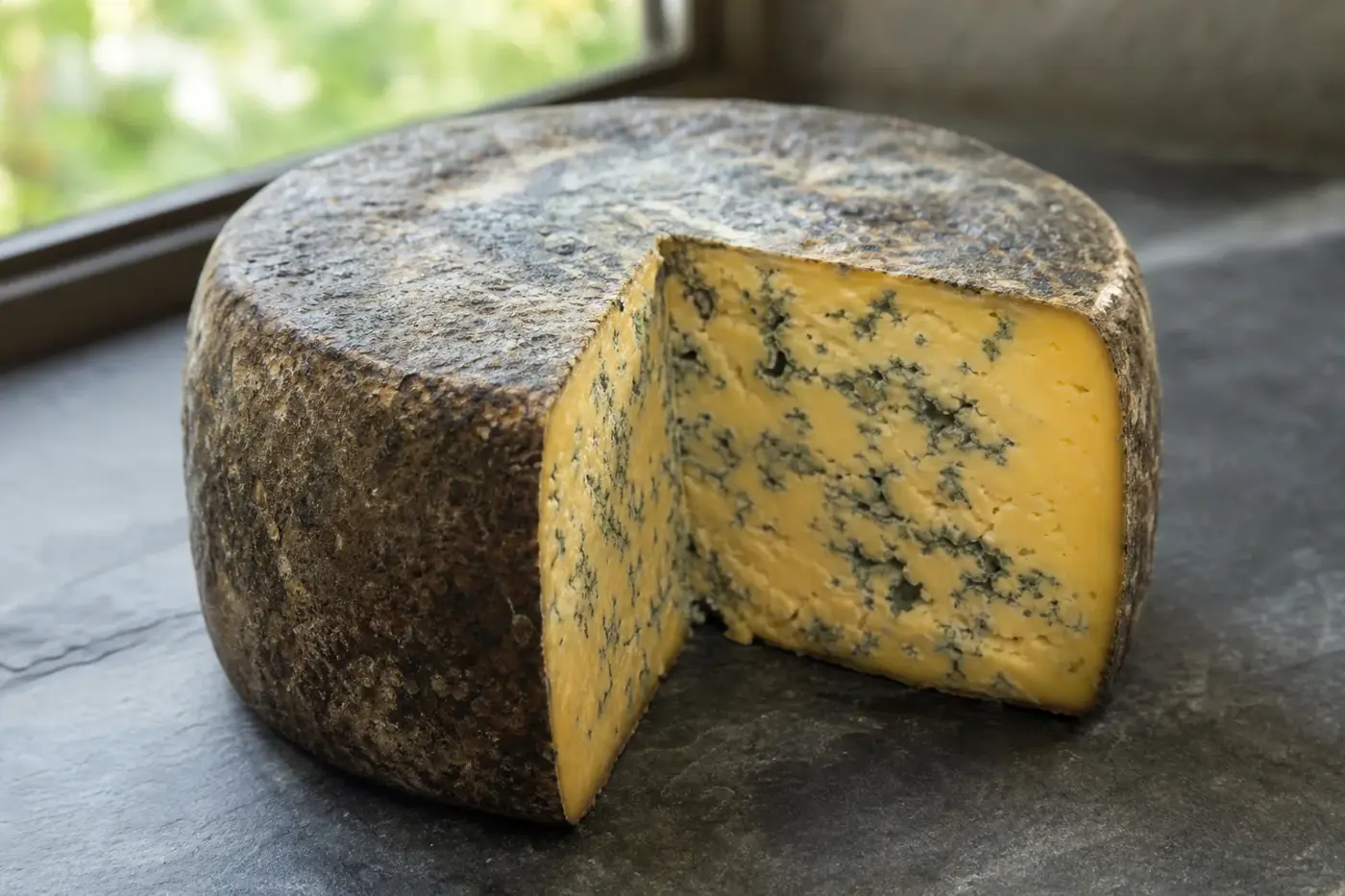
Slide your knife into Kāpiti Kikorangi and gold gives way to blue. Beneath the rind, the cream-enriched interior is densely marbled and, in the producer’s words, smooth and buttery. This cheese from New Zealand’s Taranaki region brings sweet milk notes, balancing acidity and a blue finish that grows stronger with age. If you are finding your way into blue cheese, it offers an inviting place to start. [1, 5]
| What you might ask | The details |
|---|---|
| What name should you look for? | Kāpiti Kikorangi Triple Cream Blue. [1] |
| Where does it come from? | New Zealand; Taranaki. [1] |
| Which milk, and is there cream? | Cow’s milk with added cream; the current ingredients specify pasteurised milk. [1, 5] |
| What rennet is listed? | Non-animal rennet. [1] |
| What about the cultures? | Listed as “cultures”; individual organisms and strains unspecified. [1] |
| How much cream? | Cream percentage unspecified. |
| What will you see? | Golden paste with blue veining; the producer’s 2019 bulletin documents a dark natural rind. [1, 4] |
| What is the pregnancy guidance? | UK: see NHS advice on soft blue-veined cheeses; November 2026 guidance reference. [8] |
A little blue sky beneath the rind
“Sky blue” is Kāpiti’s translation of Kikorangi. Te Aka Māori Dictionary records kikorangi as blue in colour and, as a noun, deep blue sky. Unlike Kāpiti, the word has no macron. [1, 3]
Cut a piece and the name starts to make sense. Blue runs through the golden body rather than forming an outer coating, and the producer describes the interior as densely marbled. Think of the name as a glimpse beneath the rind, rather than a technical puzzle waiting to be solved. [1]
If blue cheese makes you hesitate, try a small piece on plain bread. Give it a little space on your palate. You can find out how much blue flavour you enjoy before sweeter or sharper accompaniments join the plate.
Follow the story from the lower North Island to Taranaki
Kāpiti dates its speciality cheese range to 1984, placing the brand’s beginnings in New Zealand’s lower North Island. Kikorangi’s creator, creation date and original production site are less certain parts of the story. [2]
Today, the Kikorangi product page names Taranaki as its production region. Keep those two places distinct as you follow the cheese’s story. The lower North Island belongs to the brand’s beginnings; Taranaki belongs to Kikorangi’s present production. [1, 2]
Kikorangi has its place in that modern New Zealand speciality cheese tradition. Its identity rests on a named producer and a recognisable combination of added cream, golden paste and blue developing inside. Ask for the full product name: “New Zealand blue” covers a much broader category and does not guarantee you are getting Kikorangi. [1, 5]
Yes, the cream is doing real work
Cream is an ingredient here, not just a tasting note getting carried away. The current New Zealand product page lists pasteurised milk, cream, cultures, salt and an enzyme identified as non-animal rennet. The producer calls the cheese Triple Cream Blue. [1]
The publicly available 2019 foodservice bulletin lists milk, cream, cultures, salt and enzymes. Its description is of a medium-strength cheese with a uniformly creamy texture and a thick natural moulded rind. Those specifications belong to that edition of the bulletin. [4]
Rennet helps milk form curd: it is the coagulant. If you would like to untangle the different kinds, see rennet explained.
When you read the label, separate three things: what is in the current pack, what the maker calls the style, and what a technical specification measures. “Triple cream” is the product description, while the ingredients confirm added cream. The amount added is unspecified here, so the name alone does not give you a cream percentage.
Inside the blue marbling
Those blue markings have a job beyond looking handsome on your plate. Blue mould develops inside cheese during ripening, helping shape its aroma, texture and character. Scientific literature identifies Penicillium roqueforti as a characteristic blue-cheese ripening mould, associated with blue-green areas and the development of aroma and texture. [6]
What you see and what you taste are connected parts of that process. In blue cheese generally, the mould contributes much more than colour. [6]
For Kikorangi, Kāpiti’s current ingredient declaration simply says “cultures”. The particular mould species, piercing method and complete manufacturing process are unspecified, so the science above describes blue cheese generally. For this cheese specifically, the maker’s description gives you a golden body, internal blue marbling and a rich texture. [1]
Find the wedge that suits your appetite
The producer’s foodservice bulletin describes yellow cheese threaded with blue veins beneath a dark natural rind. The factory-associated Eltham Cheese Bar refers to Kikorangi wheels and sells cuts from near their surface. It describes rind colours ranging through brownish, grey and blue. [4, 9]
Before you choose a portion, take a moment with the cut face. Look at the balance of pale or golden paste and blue, then notice how much rind comes with it. A shallow surface cut gives you a different balance from a deeper wedge, and Eltham Cheese Bar says its surface cuts can be more intense in blue flavour and saltiness. [9]
That helps explain why two pieces called Kikorangi need not eat alike. A portion with plenty of rind and a piece from the centre can offer different balances of flavour. You are choosing a position in the cheese as well as a name.
Sweet milk first, blue on the finish
The producer describes sweet milk notes, balancing acidity and a blue finish, with an earthy contribution from the rind. The 2019 foodservice bulletin calls Kikorangi “mellow blue”. Together, those descriptions give you a fuller picture than a single mark on a scale from mild to strong. [4, 5]
Eltham Cheese Bar describes its cuts as semi-soft, with medium, fruity blue flavours. It also notes a stronger character at the surface and possible ammonia notes around the rind. If you want a gentler introduction, choose plenty of interior paste rather than a portion dominated by the surface. [9]
Age has a say in your mouthful, too. The producer says the flavour intensifies as the cheese matures, so ask your cheesemonger about the wheel being cut now. Your last purchase is a useful reference, but both age and the position of the cut help explain why portions vary. [5, 9]
Three good questions at the cheese counter
Start with the full name, the pack’s condition and its label. Read the storage instructions, date marking and ingredients, particularly if vegetarian suitability or an allergen matters in your household. The current producer listing declares non-animal rennet; the foodservice bulletin identifies milk as an allergen. [1, 4]
If your cheese is being cut from a wheel, ask:
- Is this a central wedge or a cut close to the rind?
- How assertive is this wheel at present?
- What refrigeration and after-opening instructions come with this portion?
The first two questions help you explore the variation described by the producer and its factory shop. The third gives you storage advice for the actual piece you are taking home, rather than leaving you to rely on general guidance alone. [5, 7, 9]
Need a hand with the wording on the pack? See how to read a cheese label. Follow the instructions supplied with your cheese, including any shorter limit after opening. [7]
From the fridge to your table
Kāpiti recommends storing Kikorangi at 4 °C (39 °F). Once opened, the maker instructs you to rewrap it in cling film or aluminium foil and place it in an airtight container. This protects it from drying and cross-contamination. [1]
For households in England, Northern Ireland and Wales, the Food Standards Agency recommends a fridge range of 0 to 5 °C (32 to 41 °F). Use a fridge thermometer. Follow the food’s storage instructions and date marking. [7]
For serving, Kāpiti recommends taking Kikorangi out about an hour beforehand and covering it with a clean damp cloth. Set out only what you expect to eat. The FSA advises keeping chilled food out for the shortest possible time, with a maximum of four hours during preparation, so include that warming period in the total time outside the fridge. [1, 7]
For help with the rest of your household routine, see how to store cheese at home.
Bring bread, fruit and a little restraint
Start with plain crusty bread or an unsweetened cracker, then try a slice of pear. Bread keeps the cheese in the foreground; fruit gives you a contrasting mouthful. Eltham Cheese Bar recommends crusty breads and fresh or dried fruit, while the producer’s pairing guide names pears, apples, figs and dried apricots. [5, 9]
Fancy taking things in a sweeter direction? Kāpiti suggests panforte, the dense fruit-and-nut confection. Keep the accompaniments separate so you can explore a different balance with each mouthful, without committing your entire wedge to the first promising relationship. [1]
For a simple alcohol free accompaniment, pour still or sparkling water. You can let the cheese hold your attention without every last thing on the table competing for it.
Make room for Kikorangi in a mushroom sauce
Mushroom ragout appears among Kikorangi’s savoury companions in the producer’s pairing guide. Bring that pairing into your kitchen with a mushroom sauce for pasta, or spoon the sauce over a baked potato. Taste what the cheese contributes before deciding whether you need more salt. [5]
Where thorough cooking is required, melted is not the same as ready. Follow the relevant official advice and heat the dish until steaming hot throughout. The NHS specifies this endpoint for soft blue cheese during pregnancy; the FSA also advises checking that cooked food is steaming hot. [8, 10]
This page summarises published guidance from the official sources it cites. It is not medical advice. Guidance differs between countries and changes over time, so check the current source for where you live, and ask your doctor, midwife, pharmacist or dietitian about your own circumstances.
Your questions on rind, vegetarian diets and pregnancy
You can eat the natural rind: Eltham Cheese Bar says so explicitly for its Kikorangi cuts. Remove the wrapping, then decide whether you enjoy that stronger character. You can leave the rind if you prefer. [9]
The current Kāpiti ingredient list declares non-animal rennet. The producer’s 2019 bulletin also classifies that product as suitable for ovo-lacto vegetarians. Check the declaration on the pack you buy. [1, 4]
For pregnancy in the UK, the NHS advises eating soft blue cheeses such as Danish blue and Gorgonzola only when cooked until steaming hot all the way through. This applies whether the milk is pasteurised or unpasteurised. For the November 2026 guidance reference, see [8]; check the current NHS advice and ask your midwife about your circumstances.
Questions people ask
Where is Kāpiti Kikorangi made?
Kāpiti Kikorangi is made in the Taranaki region of New Zealand. The cheese’s creator, creation date and original production site remain unverified.
What does Kāpiti Kikorangi taste like?
The producer describes sweet milk notes, balancing acidity and a blue finish, with an earthy contribution from the rind. It says the flavour intensifies as the cheese matures.
Is Kāpiti Kikorangi suitable for vegetarians?
The current ingredient list declares rennet that is not derived from animals. The producer’s 2019 bulletin classifies the cheese as suitable for vegetarians who eat eggs and dairy, but check the declaration on the pack you buy.
How should I store Kāpiti Kikorangi?
Kāpiti recommends storing it at 4 °C. Once opened, the maker says to rewrap it in cling film or aluminium foil and put it in an airtight container.
Can I eat Kāpiti Kikorangi during pregnancy?
The NHS advises eating soft blue cheeses only when cooked until steaming hot all the way through, whether the milk is pasteurised or unpasteurised. Check the current NHS guidance and ask your midwife about your circumstances.
Sources
- Kāpiti. Kāpiti Kikorangi Triple Cream Blue. Current undated product page, retrieved November 2026. Ingredients, production region, appearance, pairing and handling instructions.
- Kāpiti. Our Story. Undated company history, retrieved November 2026.
- Te Aka Māori Dictionary. Kikorangi. Online dictionary entry, retrieved November 2026.
- Fonterra New Zealand Ltd. Kapiti Speciality Cheese Kikorangi 1kg Carton. Product bulletin 115235, version 1, 17 January 2019.
- Anchor Food Professionals. Kapiti Kikorangi Blue Cheese: Pairing guide. Undated producer foodservice sheet, retrieved November 2026. Commercial source for its tasting descriptions and pairing suggestions.
- Toxins. Secondary Metabolites Produced by the Blue-Cheese Ripening Mold Penicillium roqueforti; Biosynthesis and Regulation Mechanisms. 2023. Retrieved abstract extract; full-text access was blocked during research.
- Food Standards Agency. How to chill, freeze and defrost food safely. Published 2017; current retrieved text, November 2026. Applies to England, Northern Ireland and Wales.
- NHS. Foods to avoid in pregnancy. Current retrieved guidance, November 2026.
- Eltham Cheese Bar. Kikorangi Blue Caps. Undated factory-shop product account, retrieved November 2026.
- Food Standards Agency. Cooking your food. Published 2017; current retrieved text, November 2026. Applies to England, Northern Ireland and Wales.
Researched from the producer’s product information and dated bulletin, its factory-shop account, an authoritative Māori dictionary, scientific literature and official UK food guidance; serving preferences are identified as editorial suggestions.
Last checked: November 2026
Last checked November 2026.
The editors suggest you read next