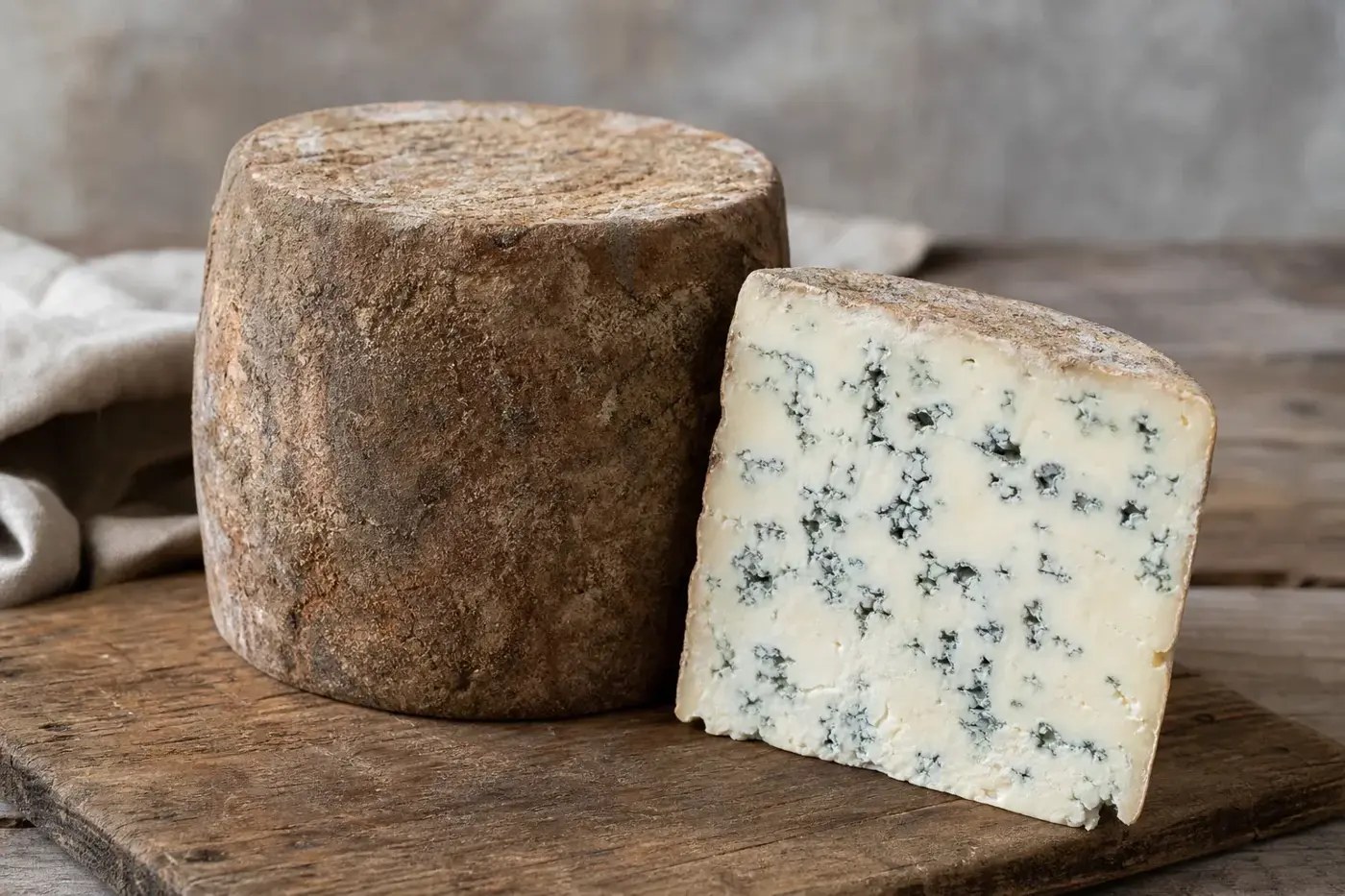
Lincolnshire Poacher
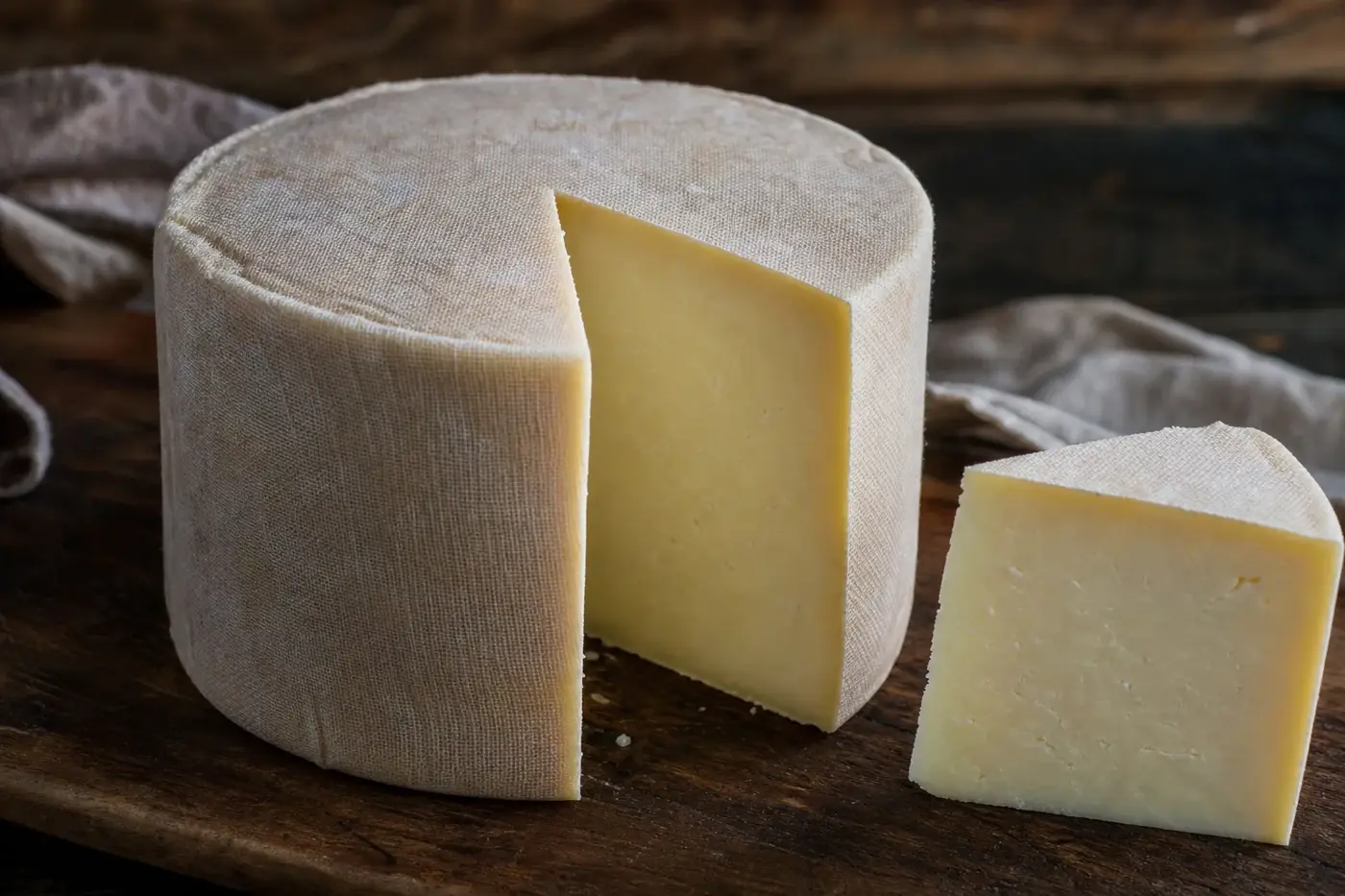
Before you cut the first piece, take in the whole Lincolnshire Poacher: approximately 20 kg of hard cheese, its pale yellow heart tucked beneath a brown exterior.
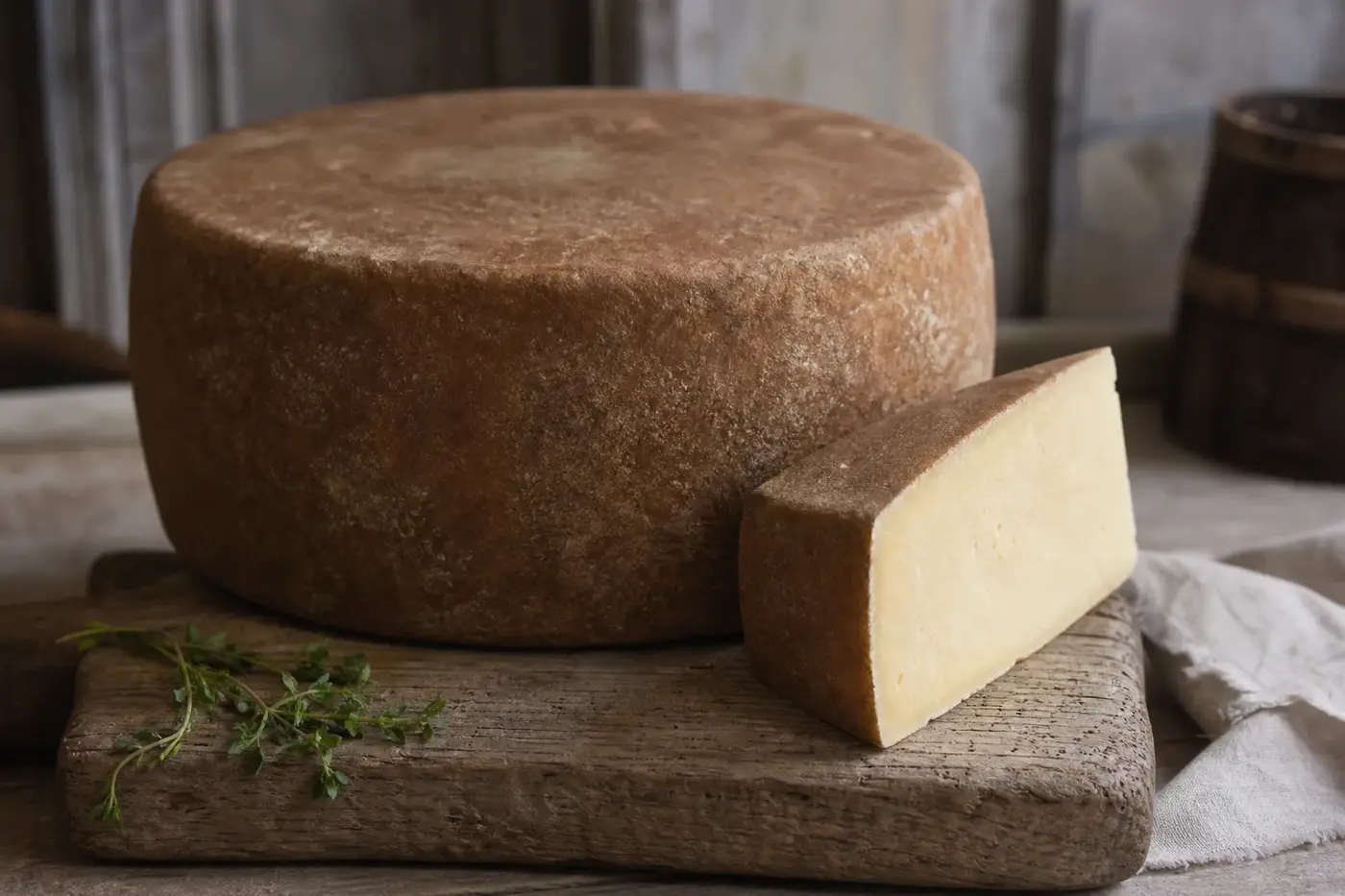
Before you cut the first piece, take in the whole Lincolnshire Poacher: approximately 20 kg of hard cheese, its pale yellow heart tucked beneath a brown exterior. This is not a cheese that slips quietly onto the board. It comes from Ulceby Grange Farm, on the eastern edge of the Lincolnshire Wolds, where the Jones family makes cheese from its own herd's raw cows' milk. [1][3]
The producer describes a recipe that brings West Country Cheddar together with continental mountain cheesemaking. After its usual 14 to 16 months of maturation, the original is a firm farmhouse cheese with both British and Alpine influences. You can enjoy the meeting without choosing a side. [2][6]
Get to know your Lincolnshire Poacher
| What you want to know | The details |
|---|---|
| The name to ask for | Lincolnshire Poacher. [3] |
| Where it comes from | Ulceby Grange Farm, near Alford, Lincolnshire, England. [1][7] |
| The milk | Raw cows' milk from the farm's own herd. [1][8] |
| The rennet | Animal rennet. [1][2] |
| Age of the original | Typically 14 to 16 months, according to the producer. [6] |
| Other versions to try | Vintage Lincolnshire Poacher and Double Barrel. [4][5] |
| The whole cheese | Approximately 20 kg. [1] |
| What covers the rind | Plastic coating, recorded by the Academy of Cheese. [1] |
| Milk allergen | Contains cows' milk. [6] |
| Pregnancy guidance | UK NHS guidance, November 2026. [10] |
A family farm gives its milk a new direction
Milk came first. Dairying began at the farm in 1970, according to its published history. Cheesemaking followed when the next generation returned from agricultural college and began exploring cheese production on a small scale. [7]
Lincolnshire Poacher grew from that established dairy farm and the ambition to give its milk a distinctive expression. The makers drew on different traditions rather than fitting their cheese neatly into an existing category. That is where the British and continental influences join the story. [2][7][8]
Here, “farmhouse” gives you a useful picture of how things fit together. The herd, its milk and the cheesemaking all belong to the same farm. There is a close connection behind the word on the label. [1][8]
Meet the herd behind your slice
The farm's Holstein Friesians provide the milk for Lincolnshire Poacher. The Academy of Cheese names the breed and records both the farm's own herd and its use of unpasteurised milk. The producer's product information also specifies raw cows' milk and traditional animal rennet. [1][6][8]
Each detail tells you something different about your cheese. The herd tells you where the milk comes from, while leaving it unpasteurised is a production choice. Animal rennet helps the milk set into a gel, ready to be cut into curds: the solid material that becomes cheese. [2]
At the counter, those details offer more than a broad description such as “traditional cheese”. Ask which version you are looking at and how old it is. The same farm's milk can become original Poacher or a cheese selected for considerably longer maturation, so the name is just your starting point. [4][5][6]
Milk terminology can take a little untangling. You'll find a guide in raw, thermised and pasteurised cheese.
Where Cheddar meets the mountain cheeses
Cheddaring appears in the producer's published method, and Comté is explicitly named as a continental reference. Those details explain the comparison with West Country Cheddar and Alpine cheese. They help you understand the recipe without making Lincolnshire Poacher simply another version of either. [2]
For the detailed production sequence, turn to the producer's complete account. If you want to follow the wider journey from milk through curds to finished cheese, start with how cheese is made.
Look beneath that brown exterior
The Academy of Cheese's illustrated reference shows a pale yellow interior beneath a brown exterior. It classifies Lincolnshire Poacher as a hard cheese and records a whole cheese at approximately 20 kg. The piece on your board began as part of something substantial. [1]
The Academy also records a plastic coating. Ask the producer or cheesemonger about the rind, and remove any plastic coating before serving. [1]
When you choose your piece, give the cut face as much attention as the outside. Taste a small piece from the interior, then try the cheese nearer its edge. Leave bread, fruit and drinks aside for this first comparison, so you can get to know it on its own.
Follow the bite, the sweetness and the seasons
The original usually matures for 14 to 16 months, developing immediate flavour and a good bite, according to the producer. Vintage moves towards nutty sweetness, greater depth and a long, clean finish. Double Barrel brings a stronger, savoury character into the picture. [4][5][6]
Season adds another layer to explore. In its account of Double Barrel, the Academy of Cheese describes summer cheeses through pineapple and toasted almonds. For winter cheeses, it describes meaty, broth-like notes. [8]
Those details give you more to look for than “nutty and savoury” alone. Sweetness, toasted flavours and deeper, stock-like notes all feature in the published flavour descriptions. Keep them in mind as you taste, rather than trying to find everything in your first mouthful. [8]
Ask about age, but remember that the calendar tells only part of the story. The producer explicitly describes Vintage as taste-selected. If samples are available, compare the original's bite, Vintage's sweeter notes and Double Barrel's savoury strength to find your preference. [4][5][6]
Choose your Original, Vintage or Double Barrel
The producer distinguishes three versions. Maturation and selection shape the character you can expect from each, giving you a useful starting point at the cheese counter.
| Your choice | Producer's stated maturation | What the producer describes |
|---|---|---|
| Lincolnshire Poacher | Typically 14 to 16 months | Upfront flavour and a good bite. [6] |
| Vintage Lincolnshire Poacher | 18 to 22 months | Taste-selected, with nutty sweetness and a long, clean finish. [4] |
| Double Barrel | 2 to 3 years | Selected for a strong, savoury taste. [5] |
All three product descriptions declare unpasteurised cows' milk and traditional rennet. The producer's cheesemaking account identifies that traditional rennet as animal rennet. [2][4][5][6]
Start with the original to get acquainted. Try Vintage for the maker's sweeter, nutty description, or Double Barrel when you want a more forceful savoury cheese at the centre of your board. Tasting them together makes those differences easier to appreciate.
Pull up a chair for Cheddar and Comté
Cheddar and Comté are useful companions for a tasting. The producer documents cheddaring in the make and names Comté when explaining the recipe's Alpine influence. Together, they give you two reference points for exploring Poacher's own character. [2]
Place a small piece beside Cheddar and Comté. Taste each alone, then come back to Poacher. Notice which breaks most readily and which feels most supple.
Where do you find sweetness? Which cheese leaves the longest savoury finish? Keep your first round simple, with plain accompaniments that leave room for texture and flavour. The strong chutney can wait for its invitation.
Make room on your board and in your kitchen
Begin with bread or an unsalted cracker, then try a slice of apple or pear. Add one accompaniment at a time. You can then decide what each brings, rather than covering the cheese from your first mouthful.
On a mixed board, give original Poacher room to stand on its own. If you are serving several ages, taste from the original through Vintage to Double Barrel. That follows the producer's progression towards stronger flavour. [4][5][6]
For a drink, try alcohol free cider, sparkling apple juice diluted with water, or sparkling water. Taste the cheese first, then take a sip. Compare the two impressions and decide what the drink changes for you.
In the kitchen, try grated Poacher on toast, over baked potatoes or in a vegetable gratin. Begin with the original as you explore how you like it cooked. Keep a little uncooked cheese beside the dish, so you can compare its character on the board with the finished food.
Choose your piece and keep it well
Ask for the version by name, and look for the age where the seller provides it. “Poacher” still leaves you with a choice: original, Vintage or Double Barrel. Keep the label or your cheesemonger's storage instructions with your piece.
At home, follow the Food Standards Agency's guidance for England, Wales and Northern Ireland: refrigerate dairy products, follow packaging instructions and keep your fridge between 0 and 5 °C. Use a fridge thermometer rather than judging the temperature by touch. [9]
When serving, follow the current Food Standards Agency guidance on keeping chilled food out of the fridge. Return the remaining cheese promptly to its instructed storage conditions. [9]
For more help with looking after your piece, see how to store cheese at home.
Put raw milk cheese guidance in context
UK NHS pregnancy guidance includes pasteurised and unpasteurised hard cheeses among foods that can be eaten during pregnancy. It names Cheddar, Gruyère and Parmesan as examples. Its advice differs for soft mould-ripened and soft blue cheeses, so consult the current guidance when choosing cheese during pregnancy. [10]
The NHS identifies pregnant people, newborn babies, people with weakened immunity and older people as groups at greater risk of serious illness from listeriosis. Use that guidance when considering your circumstances, alongside advice from a doctor, midwife or dietitian. [11]
November 2026 is the reference date for these UK sources. If you live elsewhere, consult your national food safety authority, because advice differs between countries.
General information only, not medical advice: follow the official guidance where you live.
Questions people ask
Is Lincolnshire Poacher made with raw milk?
Yes. The Jones family makes it at Ulceby Grange Farm using raw cows' milk from its own Holstein Friesian herd.
Is Lincolnshire Poacher vegetarian?
Lincolnshire Poacher is made with animal rennet. The producer identifies this as the traditional rennet used in all three verified versions.
What is the difference between Original, Vintage and Double Barrel?
The original typically matures for 14 to 16 months and has a good bite. Vintage matures for 18 to 22 months and has nutty sweetness, while Double Barrel matures for two to three years and is selected for a strong, savoury taste.
Can you eat Lincolnshire Poacher during pregnancy?
UK NHS guidance includes unpasteurised hard cheeses among foods that can be eaten during pregnancy. Check the current NHS pregnancy guidance, as advice can change and differs between countries.
How should Lincolnshire Poacher be stored?
The Food Standards Agency advises refrigerating dairy products, following packaging instructions and keeping the fridge between 0 and 5 °C. Its guidance applies to England, Wales and Northern Ireland.
Sources
- Academy of Cheese, Lincolnshire Poacher, cheese reference sheet, February 2022 edition, published online in 2023. Includes classification, herd, milk, rennet, format and coating information. Reference PDF.
- Lincolnshire Poacher Cheese, Cheese making, undated producer account, retrieved November 2026. Producer's method.
- Lincolnshire Poacher Cheese, Lincolnshire Poacher, undated producer description, retrieved November 2026. Cheese description.
- Lincolnshire Poacher Cheese, Vintage Lincolnshire Poacher, undated product description, checked November 2026. Vintage description.
- Lincolnshire Poacher Cheese, Double Barrel, undated product description, checked November 2026. Double Barrel description.
- Lincolnshire Poacher Cheese, Lincolnshire Poacher, undated original product description, retrieved November 2026. Original cheese description.
- Lincolnshire Poacher Cheese, Our produce, undated page with farm history summary and business address, checked November 2026. Producer record.
- Academy of Cheese, Double Barrel, undated cheese reference sheet, retrieved November 2026. Includes development history, farm milk source and attributed flavour descriptions. Reference PDF.
- Food Standards Agency, How to chill, freeze and defrost food safely, published 18 December 2017, current page checked November 2026. Applies to England, Wales and Northern Ireland. Official storage guidance.
- NHS, Foods to avoid in pregnancy, current online guidance checked November 2026. Official pregnancy guidance.
- NHS, Listeriosis, reviewed 10 November 2023, current page checked November 2026. Official listeriosis guidance.
- Food Standards Agency, Alerts, live official alert index, inspected November 2026. Official alerts.
This piece combines desk research from producer descriptions, published cheese reference sheets and official UK food safety guidance; serving suggestions are editorial recommendations.
Last checked: November 2026
Last checked November 2026.
The editors suggest you read next
West Country Farmhouse Cheddar Cheese
Large pieces of curd turn and stack under the cheesemaker’s hands.