Livarot
Lean towards the orange rind and Livarot announces itself before you take a bite.
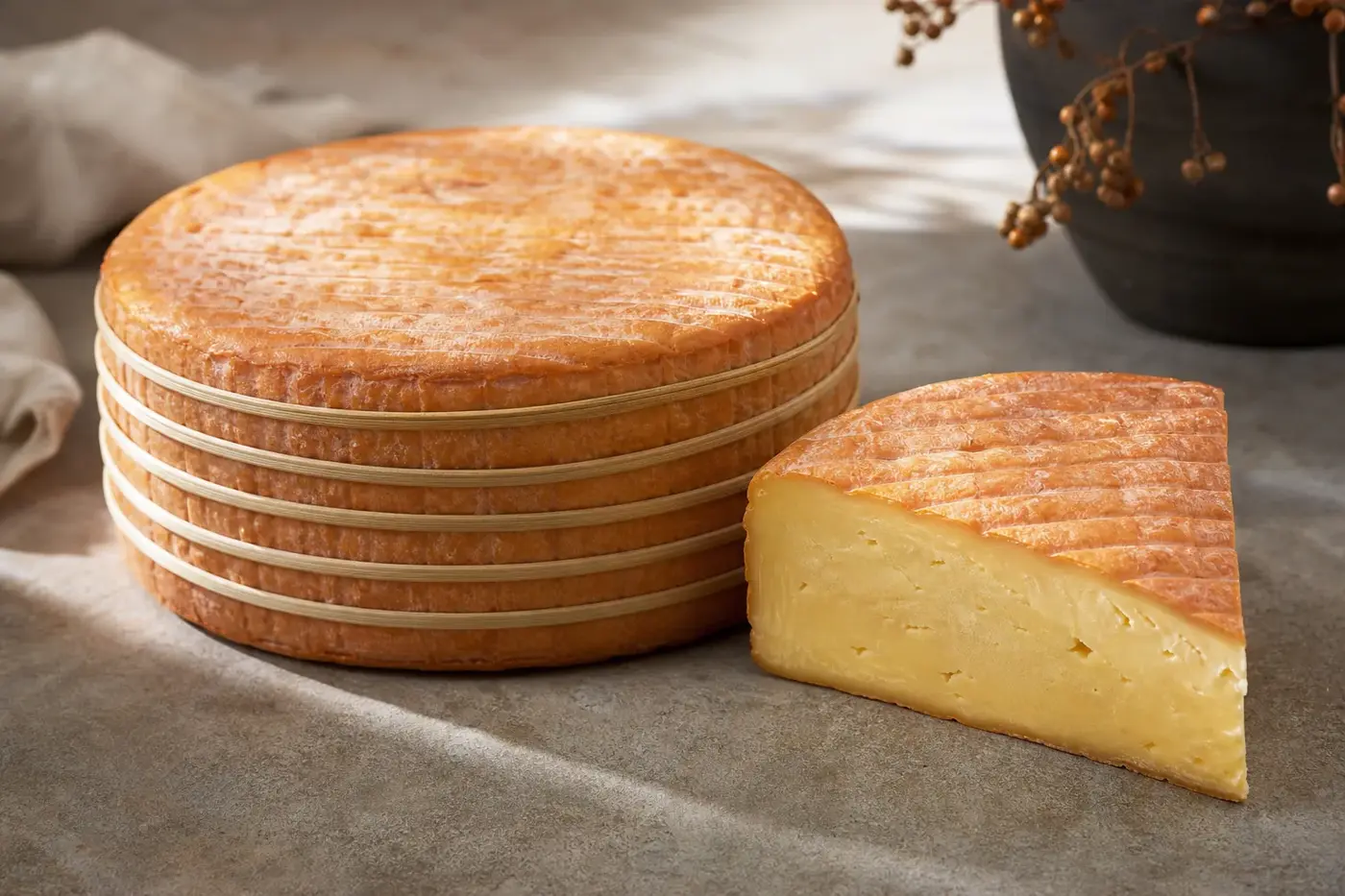
Lean towards the orange rind and Livarot announces itself before you take a bite. Five bands circle this supple cow’s milk cheese, giving Normandy’s “Colonel” its unmistakable outline. Beneath the stripes, the Pays d’Auge’s dairy tradition and repeated washing during ripening build a savoury character and an aroma that stays with you.[1,5]
Meet Livarot at a glance
| What you might wonder | What to know |
|---|---|
| Familiar and registered name | Livarot.[1,3] |
| Registration authorities | European Commission, EU; Defra, Great Britain.[1,3] |
| EU status | PDO; recorded by INAO, November 2026.[1] |
| Great Britain status | Registered PDO since 31 December 2020, November 2026.[3] |
| Binding amendment | Commission Implementing Regulation (EU) No 954/2014, Articles 1 and 2.[4] |
| Legally defined production area | Listed communes in Calvados, Orne and Eure, Normandy, France.[1,2] |
| Milk | Cow’s milk; raw, thermised or pasteurised permitted.[2,5] |
| Rind and paste | Washed rind; soft, supple yellow paste.[1] |
| Allergen | Milk.[2] |
Follow the grass back to the Pays d’Auge
Picture grass, clay-rich soils and an oceanic climate. These are the features INAO draws out in its account of the Pays d’Auge, Livarot’s home. The cheese takes its name from the Normandy town south of Lisieux, sharing the area’s soft cheese tradition with Pont l’Évêque and Camembert de Normandie.[1,5]
Its story was already under way long before the railway arrived. Written mentions reach the seventeenth century, according to the product specification; popular success followed in the second half of the nineteenth, when trains carried Livarot to urban markets. France’s agriculture ministry records national AOC recognition in 1975 and European PDO recognition in 1996.[2,6]
The Colonel’s stripes had a job to do
Those bands were not a matter of dressing for dinner. They helped stop Livarot slumping as it ripened. Lisieux’s tourist office describes dried strips of massette, or reedmace, wrapped around the rounds.[5]
Known as laîches, a traditional name for strips from wetland plants, five parallel bands resemble a colonel’s five rank stripes. That gives you both the nickname and the familiar outline. The specification allows three to five turns; since 1 May 2017, vegetable laîches have been compulsory for the standard 4/4 format, though not for every size.[2,5]
A Norman name with a precise address
When you choose Livarot, the name ties your cheese to a particular place, not simply to a recipe. Its appellation d’origine protégée, the French term for a protected designation of origin, or PDO, requires milk production, cheesemaking, ripening and banding within the specified area. The boundary follows a list of communes, rather than covering all of Normandy.[2]
Great Britain’s register separately records Livarot as a registered PDO, with UK scheme registration on 31 December 2020. To untangle a geographical name from a method or style, turn to protected names explained.[3]
Before the dairy, meet the Normande cows
Livarot begins with cows that are exclusively Normande, INAO specifies. Their feeding rules require at least six months’ grazing. At least 80% of the basal ration, measured as dry matter, must come from the farm’s land within the area, with hay available daily outside the grazing season.[1,2]
The milk may be raw, thermised or pasteurised. Look at the label, or ask your cheesemonger or producer which treatment was used for the piece you are buying. Thermisation is a heat treatment distinct from pasteurisation; milk treatments explains the differences.[2,5]
Inside the dairy, the agriculture ministry describes partially skimmed milk being coagulated before the curd is cut and moulded. Rennet sets the milk into curd, the solid portion; whey is the liquid released during draining. The specification requires a 24-hour draining stage before salting and ripening.[2,6]
How washing brings the rind to life
That lingering aroma takes attention. Repeated washing helps develop it, according to INAO. During affinage, the controlled maturation of the cheese, the rounds receive at least three washes under the specification, which also permits brushing.[1,2]
The wash is based on salt water, with cultures and annatto, called rocou in French, allowed as additions. Annatto is a colouring ingredient, so the orange tone can come from both ripening and an authorised addition to the wash. Look for a slightly tacky rind, not a dry, powdery one; the specification describes a surface ranging from yellow to reddish.[2,6]
Lean closer for straw, hay and smoke
Straw, hay, animal and smoke: INAO’s tasting description gives you fair warning that Livarot is not the shy guest at the table. Its aromas are powerful and persistent. Inside, you find a supple, lightly salted paste that yields in the mouth, with savoury character and an aromatic finish.[1]
Choosing your piece takes more than spotting a soft cheese in an orange coat. If you compare a younger round with a more mature one, keep the maker’s description handy. Notice the centre’s firmness, the rind’s intensity and how long the finish lasts; greater age need not be your goal.
Find the size that suits your table
Livarot comes in four authorised formats, each with defined dimensions, packaged net weights and minimum ripening periods. The clock starts at renneting. Larger formats have a longer legal minimum, so size matters well before you reach for a knife.[2]
Four formats, from petit to grand
| Format | Diameter | Packaged net weight | Minimum ripening time |
|---|---|---|---|
| Petit | 80 to 94 mm | 200 to 270 g | 21 days |
| 3/4 | 107 to 115 mm | 330 to 350 g | 21 days |
| 4/4 | 120 to 128 mm | 450 to 500 g | 35 days |
| Grand | 190 to 210 mm | 1,200 to 1,500 g | 35 days |
Source: Livarot product specification, sections 2 and 5.6, November 2026.[2]
For a small household, try a petit or a freshly cut piece from a larger round. The standard 4/4 gives you a whole cheese to cut into wedges when several people are sharing. Choose what you expect to eat within the label’s storage instructions; an impressive big round can be very persuasive.
Ask to see the cut face where possible, and find out how the cheese has been kept. A slightly tacky rind fits the official description; a dry, neglected-looking cut surface is your cue to request another piece. Keep the packaging or counter label for the milk treatment, date and storage directions.[2,7]
Give your serving an hour, keep the rest chilled
France’s agriculture ministry recommends refrigerating Livarot in its original wrapping and taking it out an hour before tasting. For household handling, follow UK NHS advice: keep chilled ready-to-eat foods at 5 °C or below, and eat them within four hours of removal.[6,7]
Bring out only what you intend to serve, leaving the rest chilled. The NHS also advises following label storage instructions and using opened food within two days unless the packaging says otherwise. Before planning another serving, look at the use-by date.[7]
Remove the bands before cutting. Ask the maker or cheesemonger whether that particular cheese’s rind is intended to be eaten, and follow the pack directions. If it is edible, taste a little paste alone, then with rind, to discover how much of that rind flavour you enjoy.
For help with wrapping and arranging your fridge, turn to how to store cheese at home.
Bring bread, orchard fruit and a glass
Start with plain country bread and slices of apple or pear. Taste the cheese first, then add the fruit and explore its contrast with the straw, smoky and animal notes in INAO’s description. Let Livarot have a moment to itself before you introduce heavily seasoned accompaniments.[1]
Dry Normandy cider offers a regional pairing to explore. Or try a small glass of aromatic white wine: a powerful cheese need not lead you straight to a heavy red. These are starting points for Livarot’s persistent flavour, while sparkling apple juice, an alcohol-free cider or water gives you an alcohol-free option.
Alcoholic pairings are for adults of legal drinking age, in small servings. People who are pregnant, driving, taking medicines that interact with alcohol, or recovering from alcohol dependence should not drink. For more on following flavour rather than habit, see cheese and wine pairing.
Invite Pont l’Évêque and Époisses to the tasting
Put Livarot beside its Norman neighbour Pont l’Évêque and begin with their shapes. Lisieux’s tourist office identifies both as soft washed-rind cheeses, but Pont l’Évêque is square; Livarot is round and banded. That tells you more about identity than rind colour alone, especially after different ripening journeys to the counter.[5]
If you are adding Époisses, ask the cheesemonger for pieces ready to eat on the same day. Compare the centre’s firmness, the proportion of rind in each bite, the aroma before tasting and the finish afterwards.
Record each cheese and its maker separately. Your notes will then capture the particular pieces you tasted, rather than pinning every example to a fixed spot on a strength scale.
This page summarises published guidance from the official sources it cites. It is not medical advice. Guidance differs between countries and changes over time, so check the current source for where you live, and ask your doctor, midwife, pharmacist or dietitian about your own circumstances.
Choosing Livarot during pregnancy or at higher risk
For UK pregnancy advice, consult current NHS guidance on soft cheeses and cooking, then match it to the particular Livarot’s label. Ask your midwife or doctor about your circumstances.[7,8]
The NHS identifies newborn babies, people with weakened immunity and older people as groups at increased risk of serious listeriosis. Before choosing a soft cheese for someone at higher risk, consult the dated UK sources below, with November 2026 as the reference date, or your country’s food safety authority. You can find further context in the cheese food safety guide.[7,8]
Questions people ask
Where does Livarot come from?
Livarot takes its name from a Normandy town south of Lisieux. Its protected production area consists of listed communes in Calvados, Orne and Eure.
What does Livarot taste and smell like?
Livarot has a savoury character and a supple, lightly salted paste that yields in the mouth. INAO describes powerful, persistent aromas of straw, hay, animal and smoke.
Is Livarot made with pasteurised milk?
Livarot can be made with raw, thermised or pasteurised cow’s milk. Check the label or ask the cheesemonger or producer which treatment was used.
How long is Livarot ripened?
The minimum ripening period is 21 days for petit and 3/4 formats, and 35 days for 4/4 and grand formats. The clock starts at renneting.
How should I store and serve Livarot?
France’s agriculture ministry recommends refrigerating it in its original wrapping and taking it out an hour before tasting. The NHS advises keeping chilled food at 5 °C or below and eating it within four hours of removal. Remove the bands before cutting, and ask the maker or cheesemonger whether the rind is intended to be eaten.
Sources
- Institut national de l’origine et de la qualité: Livarot, official product record, undated, accessed November 2026. Product identity, sensory description, geographical context and links to the specification.
- French Ministry of Agriculture: Cahier des charges de l’appellation d’origine « Livarot », associated with notice AGRT1421335V, Bulletin officiel No 39, 25 September 2014. Official specification linked by INAO.
- Department for Environment, Food & Rural Affairs: Livarot, Great Britain protected food names register, published 4 January 2021, accessed November 2026.
- European Commission: Commission Implementing Regulation (EU) No 954/2014, adopted 4 September 2014, published 9 September 2014, approving amendments to the Livarot specification. EUR-Lex records the act as in force.
- Lisieux Normandie tourist office: Le livarot, fromage AOP du pays d’Auge, undated, accessed November 2026. Used for local heritage, the Colonel nickname and the comparison with Pont l’Évêque.
- French Ministry of Agriculture: Le Livarot AOP, le fromage orangé du Pays d’Auge, 19 September 2025. Used for recognition dates, an overview of manufacture and attributed serving advice.
- NHS: Listeriosis, last reviewed 10 November 2023, accessed November 2026. UK household storage guidance, higher-risk groups and pregnancy advice.
- NHS: Foods to avoid in pregnancy, current online version accessed November 2026. UK advice distinguishing cheese categories and milk treatments.
- Food Standards Agency: Alerts, live alert index accessed November 2026. Consulted for the editorial recall check, with the limitations recorded below.
This piece was researched from official designation documents, government and local heritage accounts, and NHS guidance, with editorial serving suggestions identified separately.
Last checked: November 2026
Last checked November 2026.
The editors suggest you read next