Maasdam
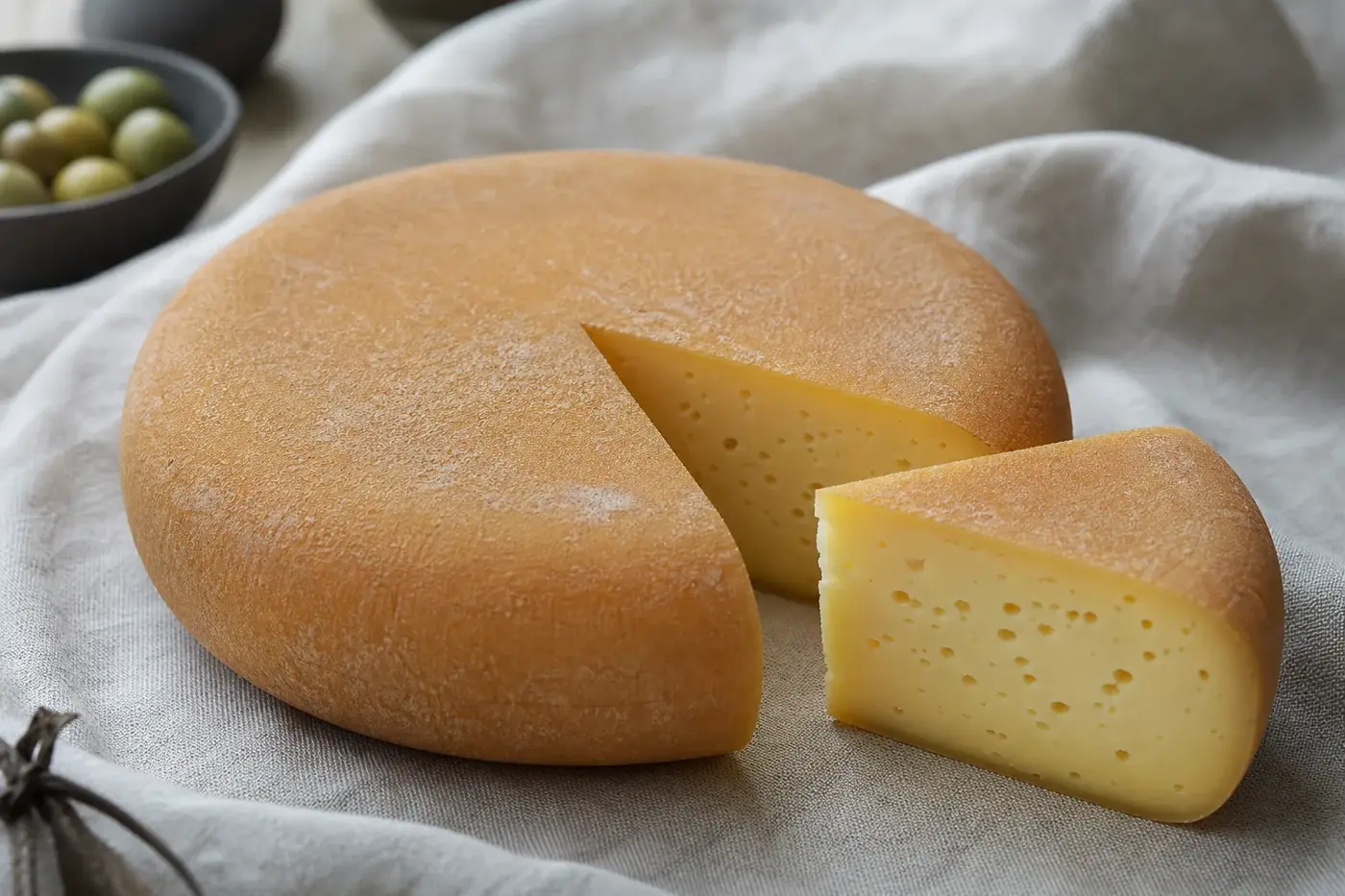
Cut into a wheel of Maasdam and those great rounded holes stop you mid-slice.
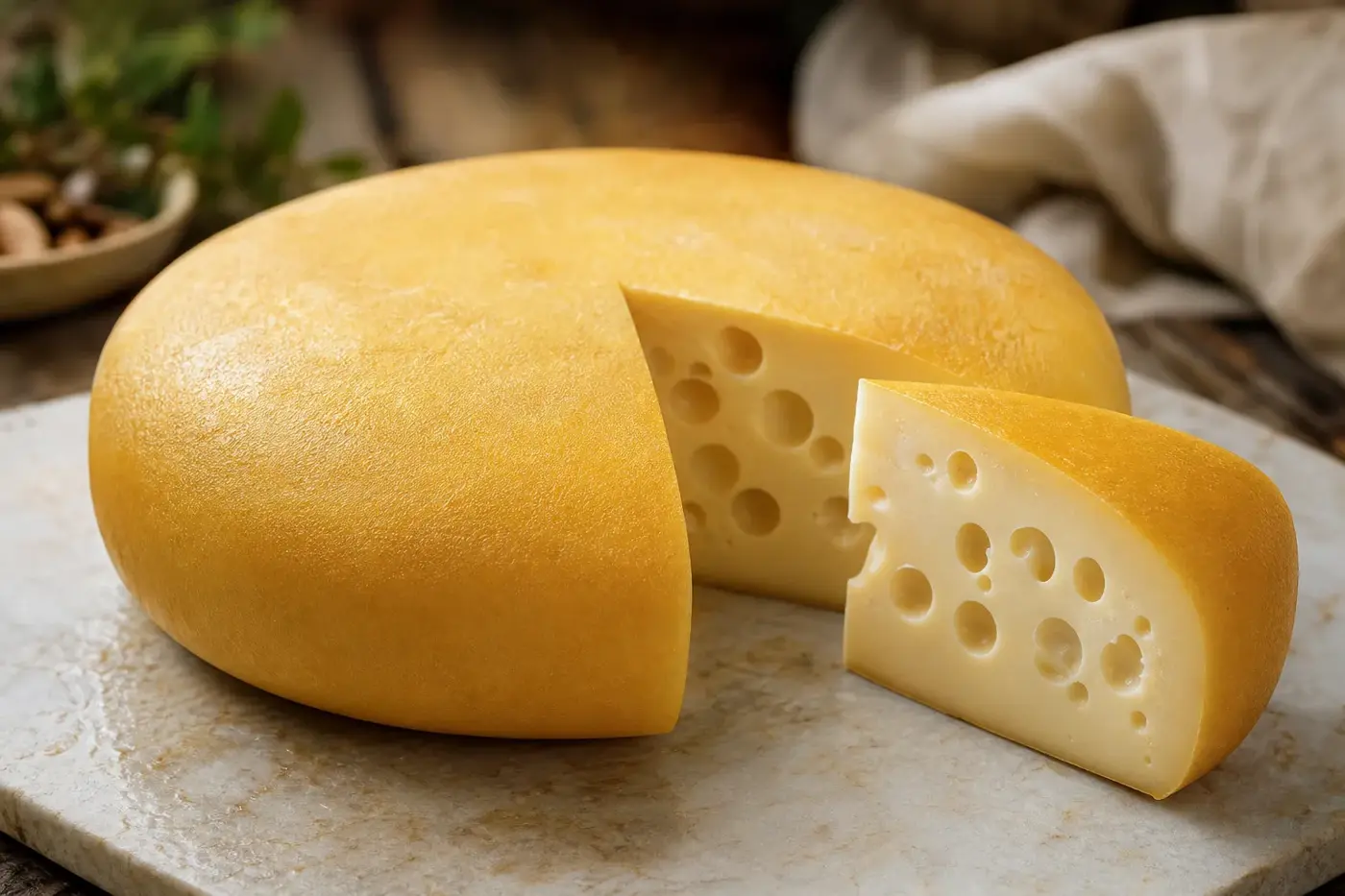
Cut into a wheel of Maasdam and those great rounded holes stop you mid-slice. Around them sits a supple, pale cheese, stretched as bacteria produce gas inside it. The same fermentation helps give this Dutch cows’ milk cheese its sweet, nutty flavour, bringing together elements of Gouda making and the propionic fermentation associated with Swiss Emmental. Cheesemakers call the holes eyes, which seems fair: they do rather demand your attention.[1,4]
Your quick introduction to Maasdam
| What you want to know | The details |
|---|---|
| Name | Maasdam; also Maasdammer.[3] |
| Home | Netherlands.[1,2] |
| Milk | Cows’ milk; pasteurised in the documented research manufacture.[4] |
| Style | Semi-hard, washed-curd, brine-salted cheese.[4] |
| Cultures doing the work | Lactic acid bacteria and propionic acid bacteria.[4] |
| One maker’s ripening time | Seven weeks for Veldhuyzen’s Maasdam.[1] |
| Shapes you will find | Flattened wheel; blocks and slices also sold.[3,8] |
| EU registered name and register ID | Not established here |
| EU protection status | Not established here |
| Legal minimum ageing | Not established here |
A Dutch cheese with Swiss connections
Those holes offer your first clue to Maasdam’s Swiss connection. Dutch dairy research describes a cheese combining Gouda’s mixed starter cultures with Emmental’s propionic bacteria. The result belongs among Swiss-type cheeses, but its approach is distinctly Dutch.[4]
By 2 January 1991, when a Campina patent application was published, Maasdammer was already described as an established cheese related to both Emmentaler and Gouda. Its makers faced a wonderfully practical question: how do you keep a wheel in shape when gas is expanding inside a relatively yielding cheese? That contemporary industrial record places Maasdam firmly in Dutch cheese development by the early 1990s.[3]
Look beyond the holes
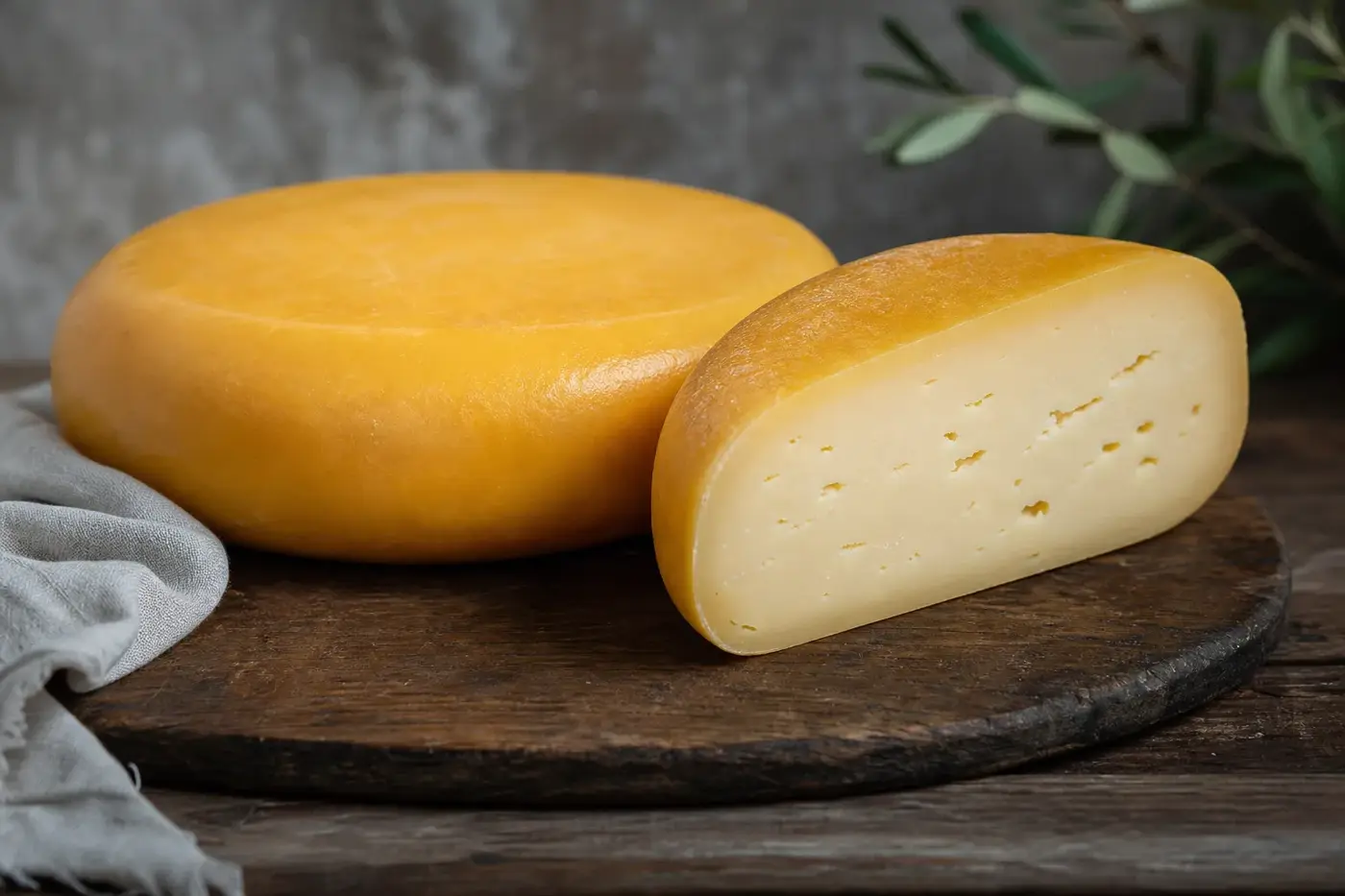
A classic Maasdam wheel is a flattened cylinder, sometimes with a gently swollen top as its eyes develop. In Veldhuyzen’s published product photograph, you can see a yellow exterior around a paler yellow paste, dotted with rounded cavities of noticeably different sizes. “Paste” is simply the cheesemaker’s word for the body beneath the exterior.[3,9]
This is cheese for slicing, not crumbling. The smooth-looking cut face and supple body belong to the same story as those eyes. Research on eye-forming cheeses explains why: the cheese must stretch around growing gas pockets without splitting. Without elasticity, you do not get neatly rounded holes.[1,5]
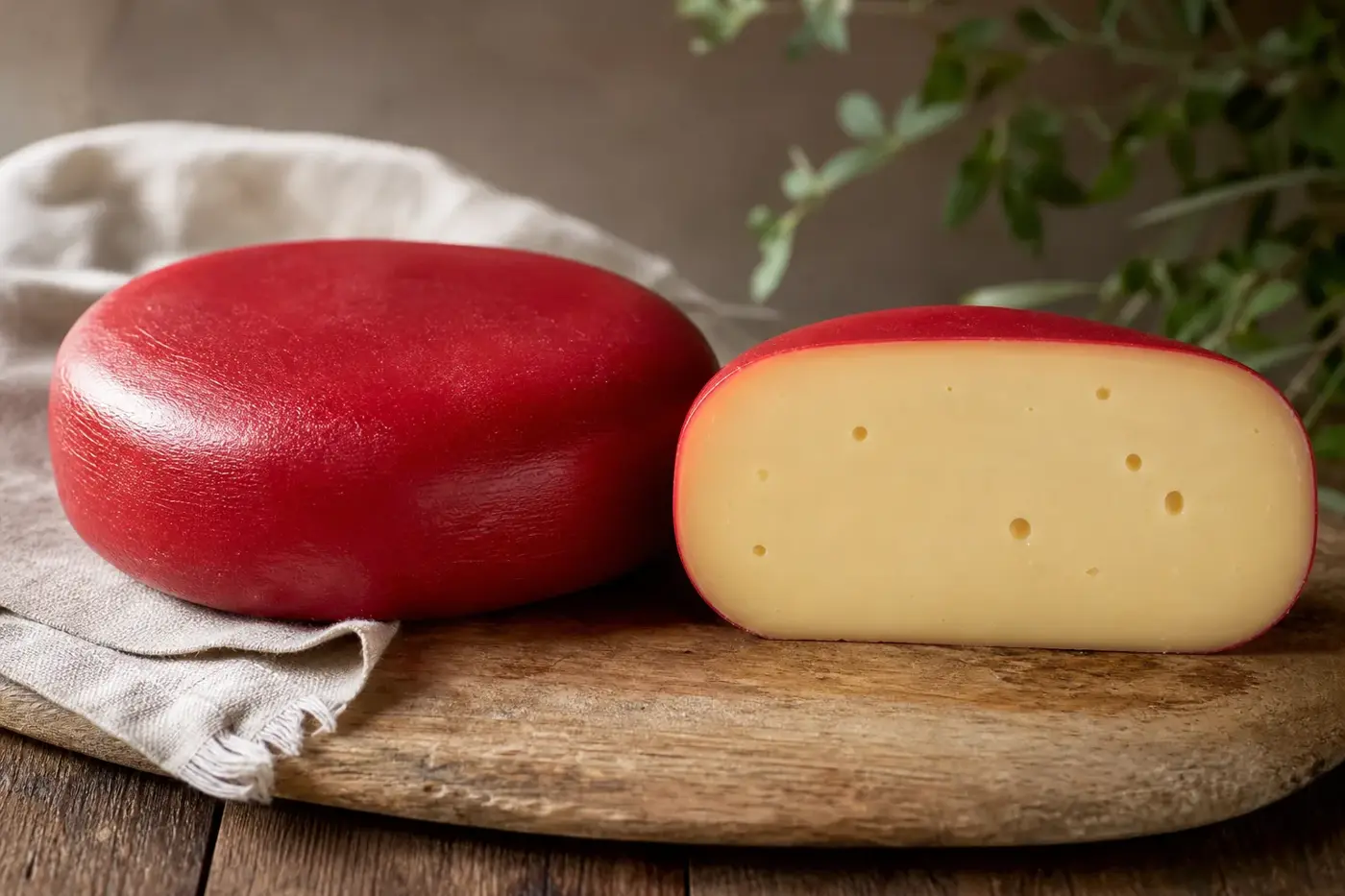
Give the outside its own moment of attention. A yellow covering may include a protective coating, and colour alone cannot tell you whether it is edible. Dutch supplier Kaas.nl explicitly describes its Maasdam rind as inedible.[2]
The quiet work behind those eyes
Two groups of bacteria share the job. First, starter cultures, the selected microorganisms added to guide fermentation, turn milk sugar into lactic acid. Later, propionic bacteria use lactate to produce propionic acid, acetic acid and carbon dioxide. The acids contribute flavour, the gas helps create eyes, and a warm ripening stage encourages this second fermentation.[3,4,5]
Making gas is only the start. Carbon dioxide dissolves in the cheese and travels through it, gathering at small sites where cavities can begin. As pressure builds, the cheese around them must stretch. Research identifies three interacting factors: gas behaviour, the cheese’s structure and the availability of those starting sites.[5]
Busy bacteria alone cannot promise handsome eyes. A wheel can develop unwanted slits instead, with culture strains, salt, moisture and ripening temperature all influencing the result. When you are at the counter, look for the difference between smooth, rounded eyes and a broken-looking network of cracks.[5]
From the vat to the warm room
Maasdam begins with milk preparation, followed by coagulation, curd handling, pressing, brining and ripening. Coagulation turns milk into a gel; curd is the solid material separated from the liquid whey. The documented processes use pasteurised milk and rennet, the coagulant that sets it.[3,4]
Once the milk has set, the curd is cut and worked to release whey. Some whey is replaced with water, making Maasdam a washed-curd cheese. Shaping, pressing and salting in brine follow. These steps establish the moisture, salt and structure within which the ripening cultures will work.[3,4,5]
Then comes a change of climate. Campina’s historical process describes an initial cool period, followed by warmth to encourage propionic fermentation. A 2021 dairy study records a Maasdam warm-room phase at 22 °C for 30 to 40 days. Those figures belong to that manufacturing example, not every maker’s temperatures or timetable.[3,6]
For a useful buying reference, Veldhuyzen says its Maasdam reaches the intended balance of eyes and flavour after seven weeks. Ask about the particular cheese in front of you rather than treating seven weeks as a fixed rule. You can follow the broader journey in how cheese is made.[1]
Sweet and nutty, with plenty beneath the surface
Sweet and nutty is Veldhuyzen’s description of its Maasdam. Kaas.nl also emphasises a pleasantly sweet flavour. Those inviting words describe the work of a mixture of flavour compounds, not one magic ingredient responsible for a nut-like taste.[1,2,7]
In a 2018 experiment, researchers made three Maasdam variants in three replicate trials, then analysed their microbial populations and volatile compounds. At 140 days of ripening, they identified 28 major volatiles. Propionic fermentation contributes characteristic notes alongside compounds associated with malty, fruity and buttery aromas. There is plenty going on behind that friendly sweetness.[4]
Time changes the texture, too. Research on Maasdam followed the breakdown of casein, its principal milk protein, during maturation. Called proteolysis, this process helps explain why both time and ripening temperature affect texture. That study did not establish how flavour changes with age.[6]
Get to know the family: Gouda and Emmentaler
If you find yourself thinking of both Gouda and Emmental, you are following the right trail. Gouda supplies the washed-curd connection and mixed lactic starter approach; Emmental supplies the model of propionic fermentation and large eyes. Maasdam brings those ideas together in its own make, rather than simply dressing up as a relative.[3,4]
| What to compare | Maasdam | Gouda | Emmental-style cheese |
|---|---|---|---|
| The eyes | Large and rounded | Generally smaller | Large, linked to propionic fermentation.[3,4] |
| How the curd is handled | Washed curd | Washed curd | Different make; higher scalding temperatures in the research comparison.[4,6] |
| Fermentation connection | Lactic and propionic | Lactic starter comparison | Propionic fermentation model.[4] |
Temperature matters here, too. In the 2021 study, lower curd scalding temperatures in the Maasdam examples allowed residual coagulant to remain active during ripening, unlike the higher-temperature Emmental comparison. You might swap these cheeses in a sandwich, but their structures and maturation histories differ. For a closer acquaintance with the Dutch relative, see Gouda.[6]
A few good questions for the cheese counter
Start with what you can see: rounded eyes, a freshly cut appearance and no dried edges. Ask when the wheel was opened and how the seller recommends storing your portion. If you are offered a taste, consider sweetness, aroma and texture together.
Treat the origin statement, maker’s name and product information as separate clues. Veldhuyzen identifies its Maasdam as made in the Netherlands and sells both wheel-cut cheese and packaged slices. The format tells you little about maturation. If age matters to your choice, ask for an age or maturation description.[1,8]
For milk treatment and rennet, read the individual product’s label or ask for the supplier’s specification. Kaas.nl declares its Maasdam vegetarian and made without raw milk. If the coagulant’s origin matters to you, ask explicitly whether it is animal, microbial or fermentation-produced. The rennet guide explains the differences.[2]
Give those slices somewhere delicious to go
On a cheeseboard, slices or small pieces let you show off Maasdam’s eyes. Try crisp apple or pear with plain bread: the fruit brings freshness, while the bread gives the cheese’s sweet notes room. For something more savoury, reach for radishes, a little mustard and rye bread. These suggestions build on the suppliers’ descriptions of sweetness.[1,2]
That sliceable texture makes Maasdam a natural sandwich cheese. Try thin slices with cucumber and mustard, or a toasted sandwich with cooked mushrooms. Kaas.nl recommends it on bread and in a Dutch fondue. You could also use it to top baked potatoes or add a modest amount to a vegetable gratin.[1,2]
In your glass, try sparkling water or an alcohol free apple drink for freshness against those sweet notes. Apart from the uses attributed to Kaas.nl, these serving and pairing ideas are editorial suggestions rather than results from a site tasting.
Keep it cool, then serve a little
Follow the packet’s storage instructions and directions for use after opening, and keep the original label with your cheese.[11] In England, Wales and Northern Ireland, the Food Standards Agency advises a domestic fridge temperature between 0 and 5 °C. United States FDA advice is 4 °C (40 °F) or below. Use a fridge thermometer to see the temperature.[10,11]
For more on wrapping, turn to the cheese storage guide. Keep the product’s own instructions to hand, so its storage and opening guidance stays with the portion you are keeping.[11]
Serve a small portion and leave the rest refrigerated. To take the chill off, let that portion warm briefly rather than leaving the whole wedge out throughout the meal. The US FDA limits foods requiring refrigeration to two hours at room temperature, or one hour above 32 °C (90 °F). Count preparation and serving time together.[11]
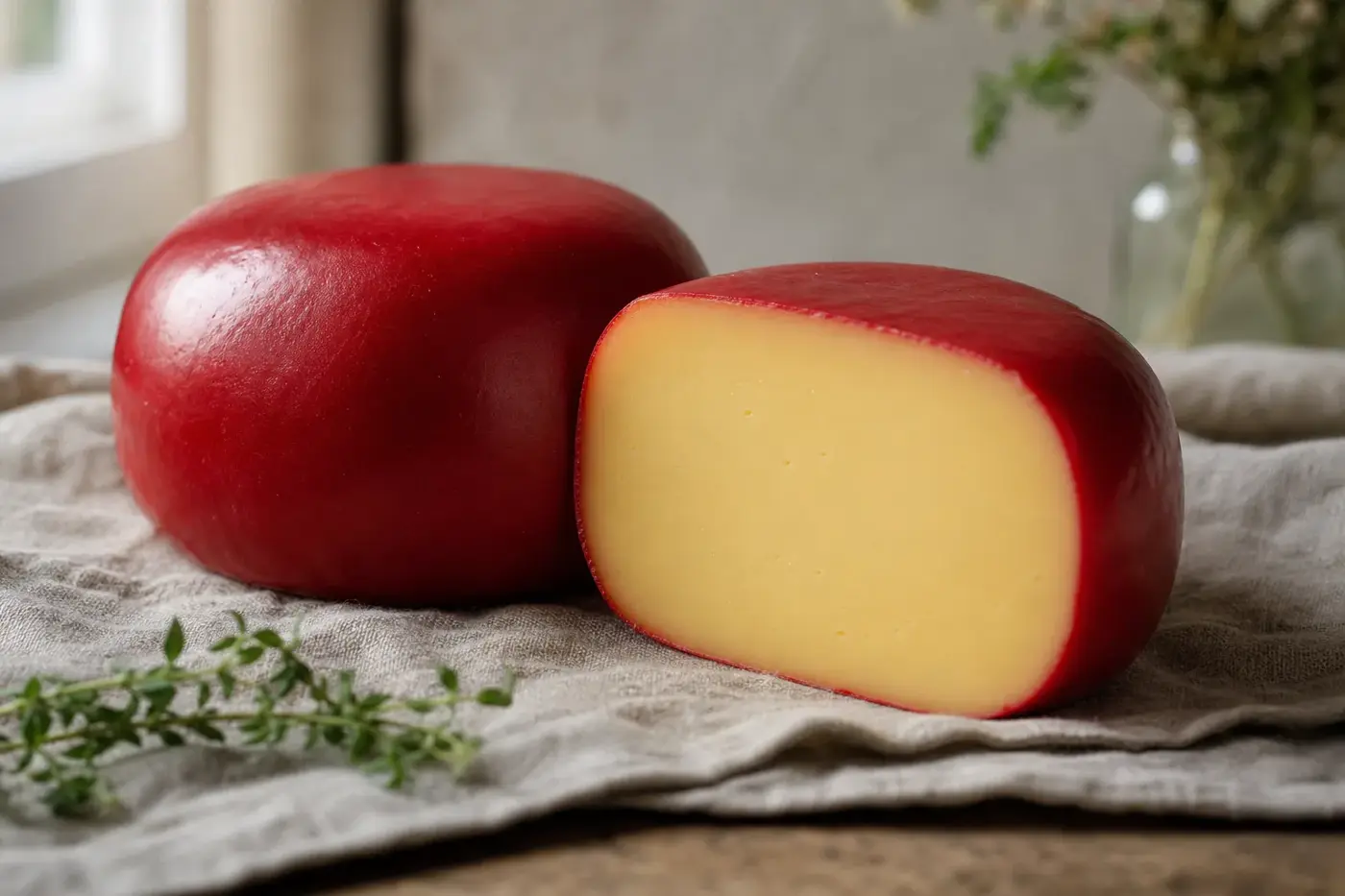
Before you slice or cook, remove any wax or plastic coating: it is packaging, not food. Follow the maker’s directions for the rind underneath; the Kaas.nl product has an inedible rind. Cut away the covering rather than grating it into your dish, and keep it separate from the portions you serve.[2]
General information only, not medical advice: follow the official guidance where you live.
Questions people ask
Why does Maasdam have holes?
Propionic bacteria produce carbon dioxide during ripening. The gas gathers in pockets, and the supple cheese stretches around them to form rounded holes called eyes.
What does Maasdam taste like?
Veldhuyzen describes its Maasdam as sweet and nutty, while Kaas.nl emphasises its pleasantly sweet flavour. Propionic fermentation contributes characteristic notes alongside other flavour compounds.
Is Maasdam vegetarian?
Kaas.nl declares its Maasdam vegetarian. For another product, check the label or ask the supplier about the origin of the coagulant.
Can you eat the rind of Maasdam?
Kaas.nl describes the rind of its Maasdam as inedible. Follow the maker’s directions for the rind, and remove any wax or plastic coating before serving or cooking.
How should Maasdam be stored?
The Food Standards Agency advises a domestic fridge temperature between 0 and 5 °C in England, Wales and Northern Ireland. Check the agency’s current guidance and follow the packet’s storage instructions and directions for use after opening.
Sources
- Veldhuyzen Kaas, Veldhuyzen Maasdam Cheese, undated product page, retrieved November 2026. Supplier’s account of Dutch manufacture, flavour, eye formation, seven-week maturation and slicing formats. Source.
- Kaas.nl, Maasdam, undated product listing, retrieved November 2026. Product-specific declarations covering cows’ milk, non-raw manufacture, vegetarian suitability, inedible rind, flavour and suggested uses. Source.
- Campina, Process for the preparation of cheese and so prepared cheese, European patent application EP0405692A1, published 2 January 1991. Historical manufacturing description, reproduced by Google Patents; used as an industrial primary record, not as current food legislation. Source.
- Teagasc and University College Cork, Effect of milk centrifugation and incorporation of high heat-treated centrifugate on the microbial composition and levels of volatile organic compounds of Maasdam cheese, Journal of Dairy Science, volume 101, pages 5738 to 5750, 2018. DOI: 10.3168/jds.2017-14180. Open research paper.
- University College Cork, Influence of milk pre-treatment, and changes in cheese structure and carbon dioxide solubility on the development of split defects in cheese, doctoral thesis, October 2019. Sections on cheese structure, elasticity, carbon dioxide and eye formation. Open thesis.
- International Journal of Dairy Technology, Validation of a reversed-phase high-performance liquid chromatographic method for the quantification of primary proteolysis during cheese maturation, 2021. DOI: 10.1111/1471-0307.12765. Research comparing protein breakdown during maturation, including Maasdam examples. Research paper.
- Agroscope, NIZO and collaborating research institutions, Swiss-Type Cheeses (Propionic Acid Cheeses), chapter in Global Cheesemaking Technology, first published 27 October 2017. Retrieved chapter summary covering Maasdam’s Swiss-type relationship and characteristic flavour compounds. Source.
- Veldhuyzen Kaas, cheese assortment brochure, 2025/2026. Maasdam wheel, slice and block listings. Brochure.
- Veldhuyzen Kaas, Maasdam product photograph accompanying its product page, undated. Used to verify the appearance of the illustrated product. Image.
- Food Standards Agency, How to chill, freeze and defrost food safely, published 18 December 2017, current online guidance retrieved November 2026. Applies to England, Wales and Northern Ireland. Official guidance.
- US Food and Drug Administration, Are You Storing Food Safely?, current online consumer guidance retrieved November 2026. Refrigeration, following storage labels and limits for foods requiring refrigeration. Official guidance.
This piece was researched from published dairy experiments, a contemporary industrial patent record, supplier documentation and official food-storage guidance, with editorial serving suggestions identified separately.
Last checked: November 2026
Last checked November 2026.
The editors suggest you read next