Minger
Before you reach the cheeseboard, Minger may already have introduced itself.
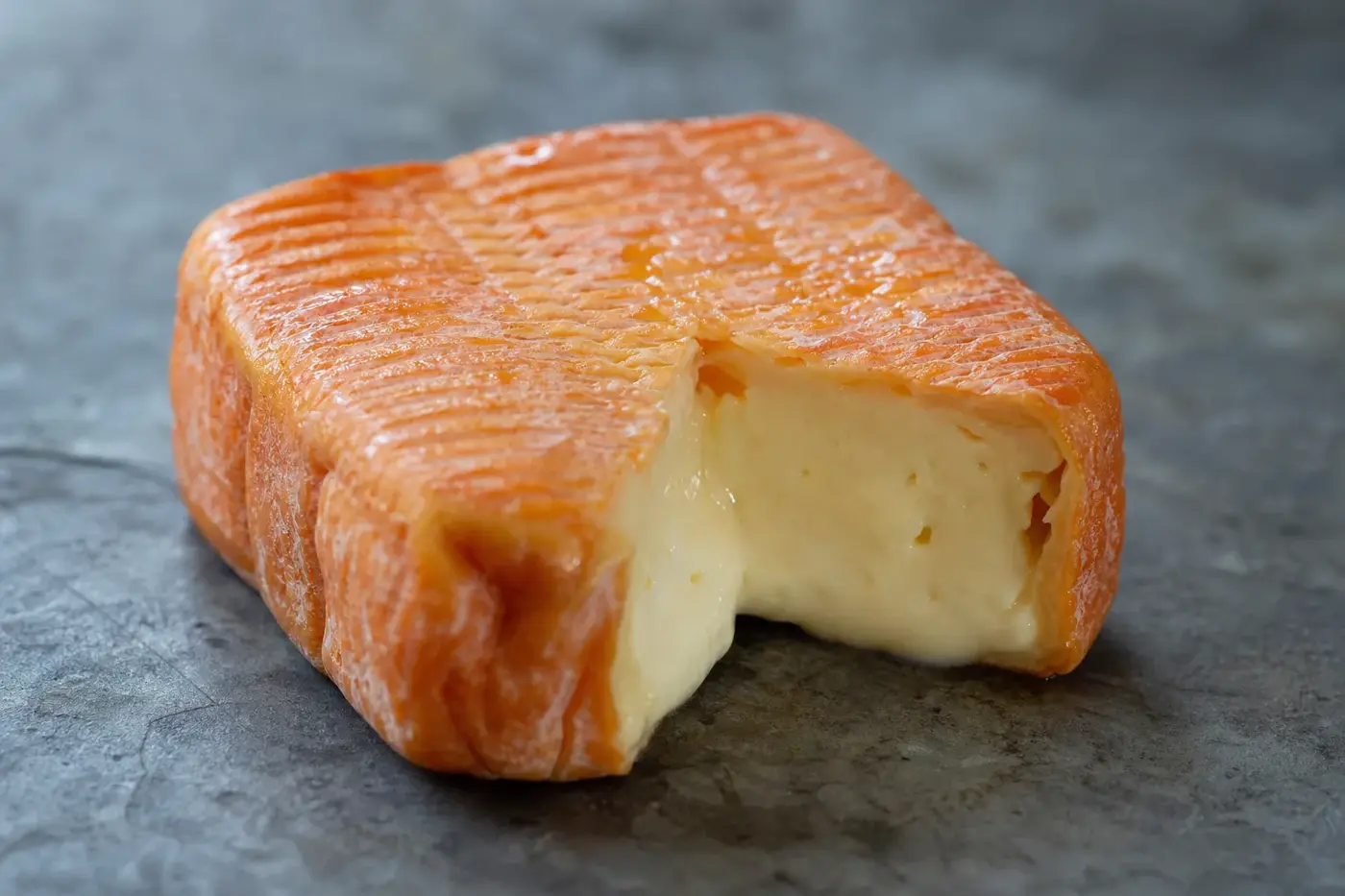
Before you reach the cheeseboard, Minger may already have introduced itself. Its bold smell inspired the name, but beneath that pungent rind waits a yielding centre. At Highland Fine Cheeses in Tain, this soft Scottish cow’s milk cheese gets a wash of salt brine and annatto every other day, building its distinctive exterior. [1, 2]
| Meet Minger | The details |
|---|---|
| Maker | Highland Fine Cheeses. [1] |
| Made in | Tain, Scotland. [1] |
| Milk | Pasteurised cow’s milk. [2] |
| Style | Soft, washed rind. [1] |
| Rind wash | Salt brine and annatto. [1] |
| Maker’s stated size and shape | 250 g square. [1] |
Get acquainted with that orange rind
Minger is not a name chosen to suggest restraint. Highland Fine Cheeses deliberately named it after its smell, drawing on the Scottish use of “ming” for an unpleasant odour. This is the maker’s account of the cheese’s name, rather than a separate history of the word. [1]
Much of Minger’s character begins at the surface. It belongs to the soft washed-rind family, where treatment during ripening helps shape the finished cheese. To explore those family resemblances, take a look at how to tell cheese styles apart.
Cheesemonger George Mewes describes a sticky orange exterior with a soft, silky texture underneath. Keep that contrast in mind: a conspicuous rind followed by yielding paste, rather than a centre necessarily as forceful as the smell suggests. These descriptions of appearance and texture come from the cheesemonger, rather than the maker. [6]
If washed-rind cheese is new to you, think discovery rather than endurance test. Look at the surface, notice the aroma, then give texture and flavour their turn. The smell gets the first word, but you need not let it have the last.
Step inside the dairy in Tain
Follow Minger home and you arrive at Blarliath Farm in Tain, in north-east Scotland. Highland Fine Cheeses describes its home as the southern shores of the Dornoch Firth. This setting in Ross and Cromarty gives the cheese its Highland identity. [3, 5]
The business began as a family microdairy making Crowdie. Its story then moves towards mould-ripened cheeses, including blue, Brie-style and washed-rind varieties. Minger comes from a dairy familiar with developing character both on the surface of a cheese and deep inside it. [3]
The farm address does not tell you the whole story. According to Highland Fine Cheeses, the former smallholding is now an industrial estate, with cheesemaking continuing in the old buildings. The interest lies inside this working dairy, rather than in the pastoral scene you might picture from its address. [3]
Crowdie, Caboc, Morangie Brie, Strathdon Blue and Minger all belong to the range. Together, they give you a sense of the dairy’s breadth. In that company, Minger stands apart for its washed rind, not simply for its place on a Scottish cheeseboard. [3]
Meet the milk behind Minger
For the milk, the dairy’s FAQ gives you a straightforward answer. Highland Fine Cheeses uses only pasteurised cow’s milk for its cheeses, making the producer the direct source for both Minger’s milk species and its treatment. [2]
Most of the dairy’s milk comes from Rootfield Farm on the Black Isle, according to the company. That tells you about the overall supply. It does not mean every batch of Minger contains milk exclusively from that farm. [3]
Pasteurisation and rind washing have different jobs, at different stages. Pasteurisation treats the milk before cheesemaking; washing treats the developing cheese. Keep that distinction handy when reading a label, and explore raw milk, thermised and pasteurised cheese for more on milk treatments.
Follow the wash, from brine to rind
Every other day, Minger gets its wash of salt-and-annatto brine. The maker describes 13 days of maturation with these repeated washes, followed by wrapping and another week of maturation. This is the dairy’s production schedule, not a legal minimum ageing requirement. [1]
First, though, milk must become curd. The maker’s general production guide follows the steps of preparing milk, adding cultures, forming curd, draining and shaping, then maturation. Cultures begin fermentation; rennet causes coagulation, setting milk into curd, while the liquid separated from it is whey. [9]
Even the size of those curd pieces helps shape the mouthful you eventually taste. Highland Fine Cheeses explains that cutting affects moisture retention, while moulds give the developing cheese its shape. Cutting and draining help determine texture, which is why cheeses made from the same milk species can feel so different. [9]
Then comes Minger’s distinctive wash. Its annatto comes from achiote seeds and supplies orange-red colour. The maker names it as an ingredient in the wash, bringing that colour into the rind-making process. [1]
You can follow the journey beyond Minger, too. How cheese is made explores how milk, cultures, curd, whey and ripening work together.
Let the flavour have its say
“Strong” is a small word doing rather too much work on a cheeseboard. George Mewes’s published tasting description gives you more to look for: mild nuttiness, lemon and farmyard notes. The cheesemonger also describes paste that becomes runnier as it ripens. [6]
Connage Highland Dairy, another retailer of Minger, describes a similar contrast. An assertive washed-rind aroma meets a soft, fresh-tasting centre. Taken together, those accounts give you three separate things to explore: aroma, flavour and texture. [7]
“Pungent” describes an aromatic impression, while “lemony” suggests a flavour association. “Silky” tells you how the paste feels. A challenging smell and an enjoyable mouthful can happily coexist, and you do not have to agree with every tasting note to find those distinctions useful.
Before adding an accompaniment, try making one observation in each category. The dairy’s general tasting guide recommends looking, smelling, assessing texture and then considering how flavour develops. Give each stage a moment, rather than allowing the aroma to make every decision. [9]
Try that sequence with Minger:
- Look at the rind and the cut face.
- Notice the aroma without deciding how strong the flavour must be.
- Taste a small piece of paste on its own.
- Describe its texture separately from its flavour.
- Add bread or fruit and decide which combination you prefer.
Your response is what matters here. You are finding out what this cheese does for you, not trying to match somebody else’s description.
Make room for Minger at the table
Highland Fine Cheeses recommends giving its soft cheeses about an hour out of refrigeration before serving. For household handling in England, Wales and Northern Ireland, the Food Standards Agency advises keeping chilled food out for the shortest possible time, with a maximum of four hours during preparation. Count both warming and serving within that limit. [4, 8]
Set out the portion you intend to eat and keep the rest refrigerated. A small plate beside the main board gives the soft paste somewhere to settle. It also helps you keep the serving area manageable.
Give each cheese its own knife, as the maker recommends. This is especially useful when you are comparing Minger with something milder. You can taste each cheese’s character without carrying rind or paste from one to the other. [4]
Keep your first accompaniments simple. Bread, a plain cracker and one fruit give you several ways to try Minger without obscuring its character. Taste it alone first, then notice what changes with each addition.
Find your favourite bread and fruit pairing
Thin baguette slices and water crackers are the dairy’s suggested partners for soft cheeses. Its cheeseboard guide also names apples, grapes and figs as fruit accompaniments. These are Highland Fine Cheeses’ general pairing recommendations, giving you an easy place to begin. [4]
| Try it with | What it brings to your plate |
|---|---|
| Thin baguette slices | The maker’s suggested support for soft cheese. [4] |
| Water crackers | A relatively plain base recommended by the maker. [4] |
| Apple, grapes or figs | The dairy’s suggestions for sweetness and balance. [4] |
| Water or sparkling water | An alcohol-free option that keeps attention on the cheese. |
Start with plain bread or a cracker, then try fruit. Do you prefer Minger’s savoury character by itself, or with something sweeter alongside? You do not need a board so crowded that the crackers require planning permission to find out.
The bread and fruit choices here come from the maker’s guide, rather than a recorded fromage.co.uk tasting. Water or sparkling water is a straightforward serving suggestion. Either gives you an alcohol-free accompaniment while keeping the focus on the cheese.
Look after your cheese, then consider the rind
Begin with the current pack. Read its storage instructions and check the use-by date before planning your next serving. [1, 8]
Keep the original wrapping, too. Highland Fine Cheeses recommends leaving the paper around soft cheeses. If the aroma becomes intrusive in your fridge, its storage guide suggests putting the wrapped cheese in a zip-lock bag, leaving some air inside rather than pressing the bag tightly around it. [4]
For household storage in England, Wales and Northern Ireland, the FSA recommends a fridge temperature between 0 and 5 °C. Use a thermometer to check it. Follow the packaging instructions and use-by dates as well. [8]
For instructions on eating Minger’s rind, consult the current pack or ask the dairy. If you prefer the paste alone, cut it away from the exterior on your plate. Remove all wrapping before serving.
If Minger shares fridge space with other cheeses, give each the care it needs. How to store cheese at home covers the broader business of keeping them well.
General information only, not medical advice: follow the official guidance where you live.
Questions people ask
What milk is Minger made from?
Minger is made from pasteurised cow’s milk. Highland Fine Cheeses says it uses only pasteurised cow’s milk for its cheeses.
What does Minger taste like?
Cheesemonger George Mewes describes mild nuttiness, lemon and farmyard notes. He says the soft paste becomes runnier as it ripens.
Can you eat Minger’s rind?
For instructions about eating the rind, consult the current pack or ask the dairy. If you prefer the paste alone, you can cut it away from the exterior.
How should you serve Minger?
Highland Fine Cheeses recommends allowing its soft cheeses about an hour out of refrigeration before serving. Its suggested accompaniments include thin baguette slices, water crackers, apples, grapes and figs.
How should you store Minger?
Highland Fine Cheeses recommends keeping the paper around soft cheeses. For households in England, Wales and Northern Ireland, the Food Standards Agency advises a fridge temperature between 0 and 5 °C and following the packaging instructions and date. Check the Food Standards Agency’s current guidance.
Sources
[1] Highland Fine Cheeses, Minger, undated product page, retrieved November 2026. Maker’s description, naming explanation, format, annatto wash, maturation schedule and product handling instructions. Read at hf-cheeses.com
[2] Highland Fine Cheeses, FAQ’s, undated, retrieved November 2026. Milk species and pasteurisation statement. Read at hf-cheeses.com
[3] Highland Fine Cheeses, About Us, undated, retrieved November 2026. Dairy location, company history, production focus and milk supply statement. Read at hf-cheeses.com
[4] Highland Fine Cheeses, The Ultimate Guide to Creating the Perfect Cheese Board, 27 February 2025. Commercial maker’s guidance on wrapping, serving and accompaniments. Read at hf-cheeses.com
[5] Highland Fine Cheeses, Shaking It Up a Little, 2 December 2022. Maker-published account locating the dairy beside the Dornoch Firth. Read at hf-cheeses.com
[6] George Mewes Cheese, Minger, undated product description, retrieved November 2026. Commercial cheesemonger’s sensory description. Read at georgemewescheese.co.uk
[7] Connage Highland Dairy, Minger, undated product description, retrieved November 2026. Commercial retailer’s description of aroma and centre. Read at connage.co.uk
[8] Food Standards Agency, How to chill, freeze and defrost food safely, published 18 December 2017, retrieved November 2026. Guidance expressly applicable to England, Northern Ireland and Wales. Read at gov.uk
[9] Highland Fine Cheeses, Artisan Cheese: Guide to Craftsmanship, Flavours, and Pairings, 27 February 2025. Maker’s general production and tasting explanations. Read at hf-cheeses.com
This desk-researched article brings together the maker’s product and production accounts, attributed cheesemonger descriptions and jurisdiction-specific official handling guidance.
Last checked: November 2026
Last checked November 2026.
The editors suggest you read next
Shropshire Blue
Cut into Shropshire Blue and you get quite a colour scheme: orange crossed by blue-green veins.