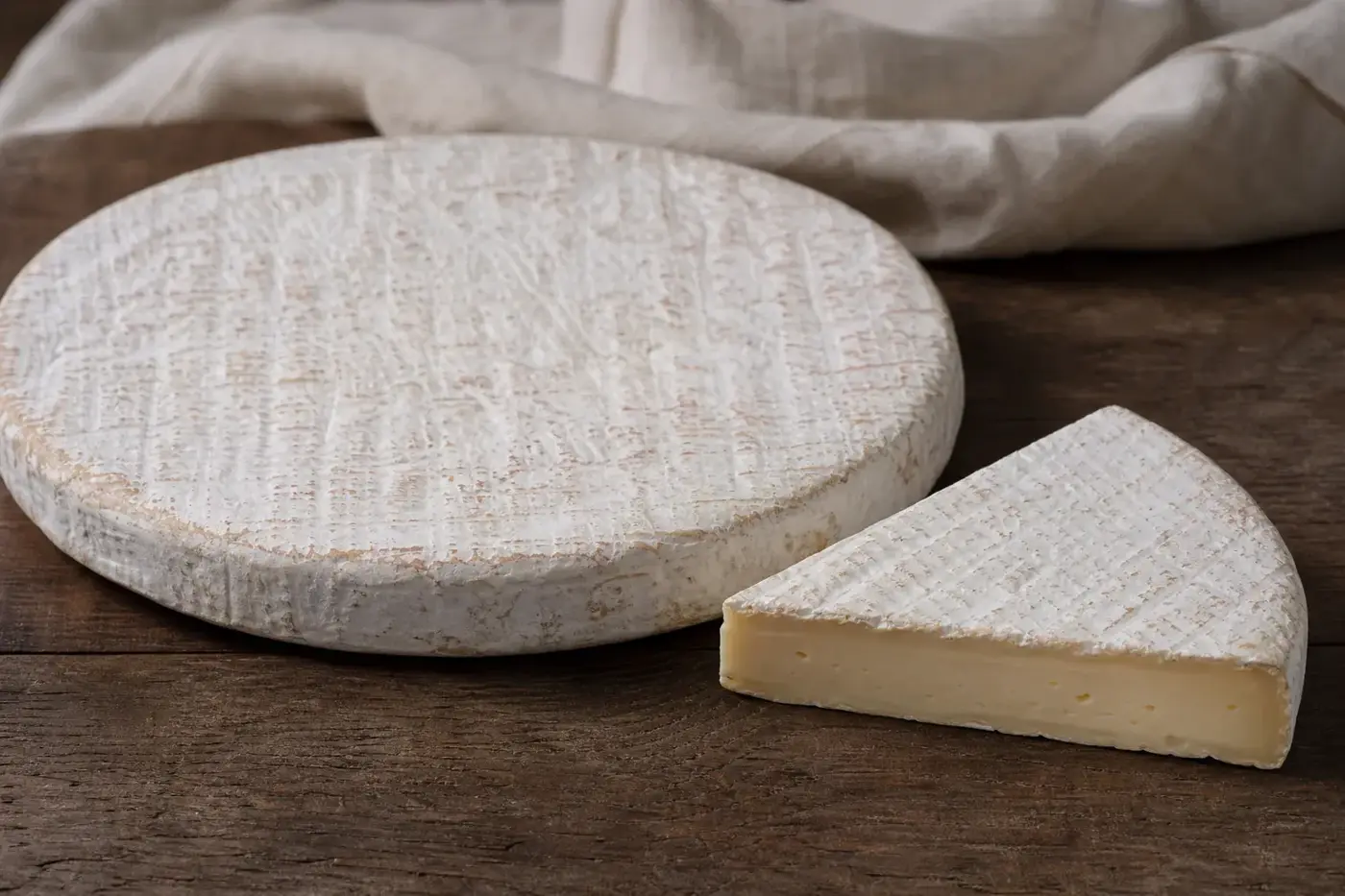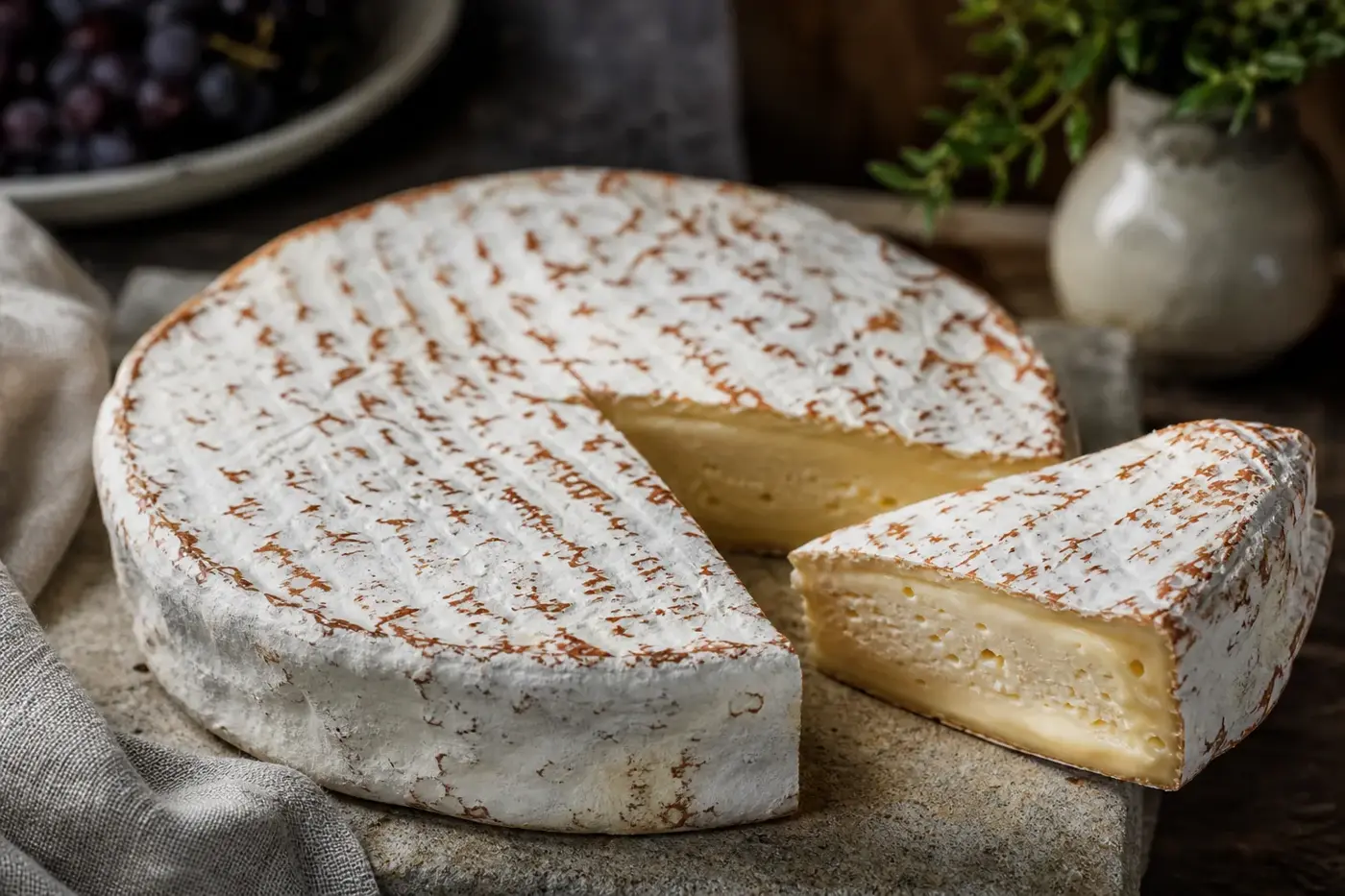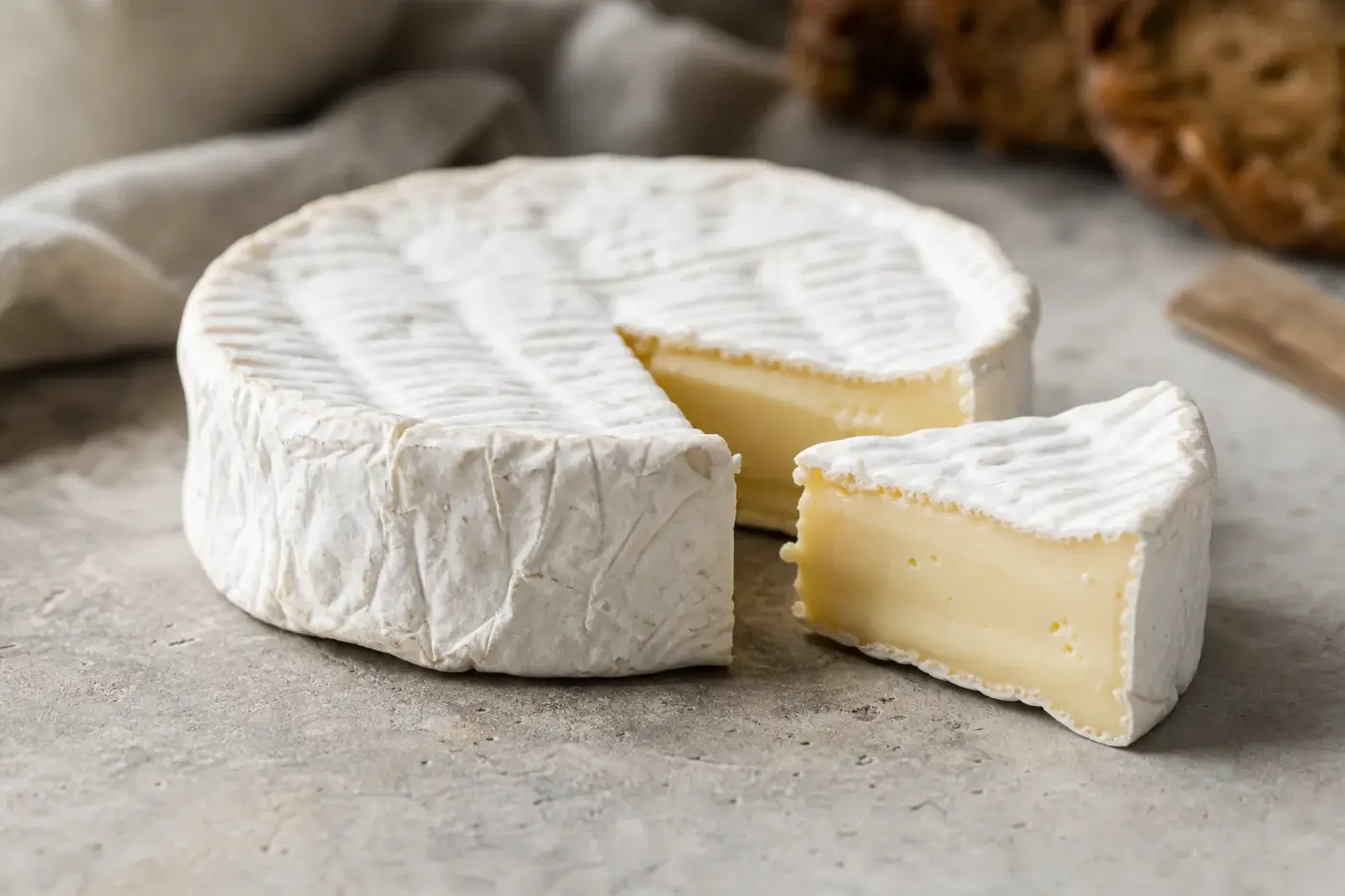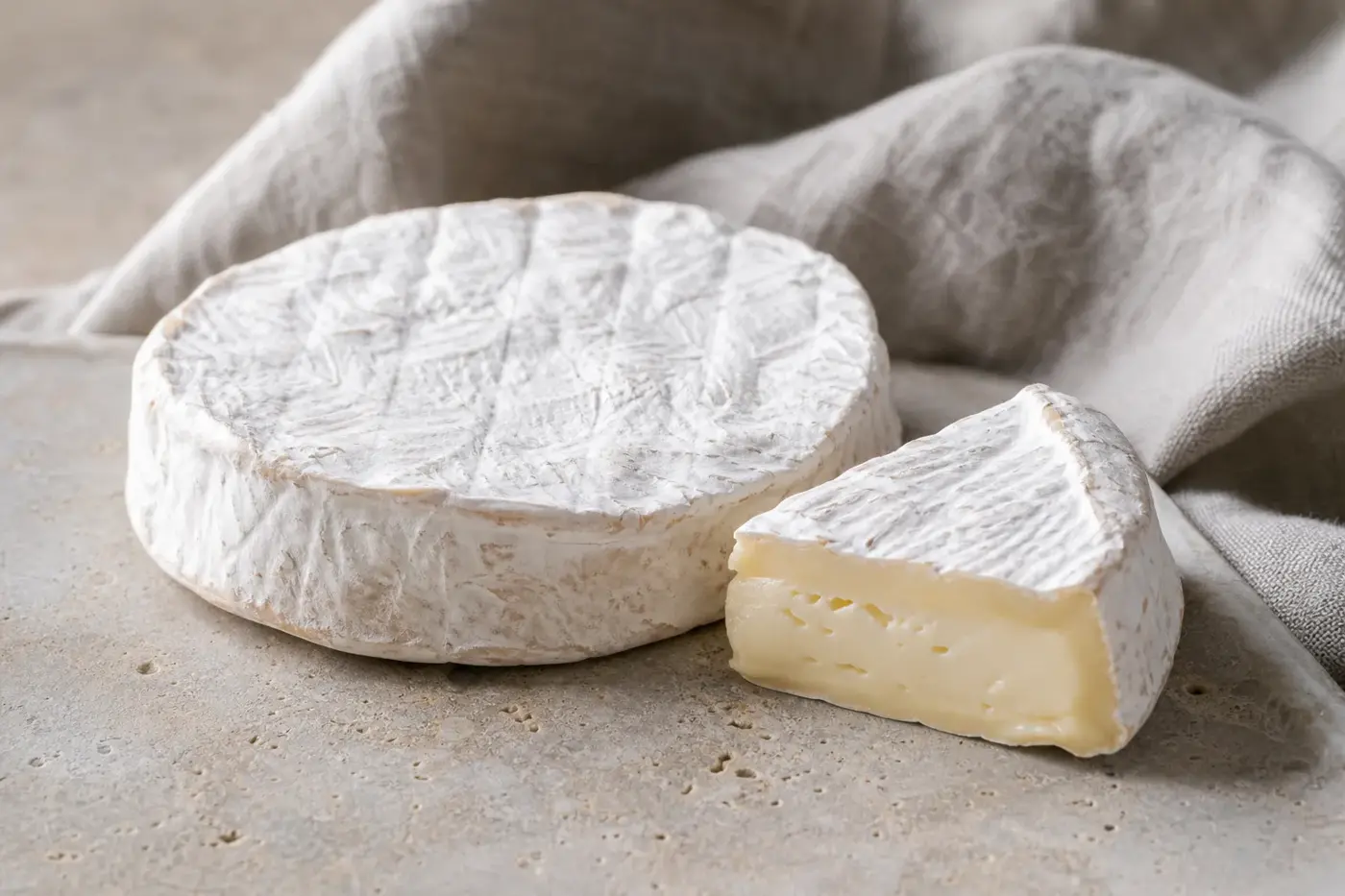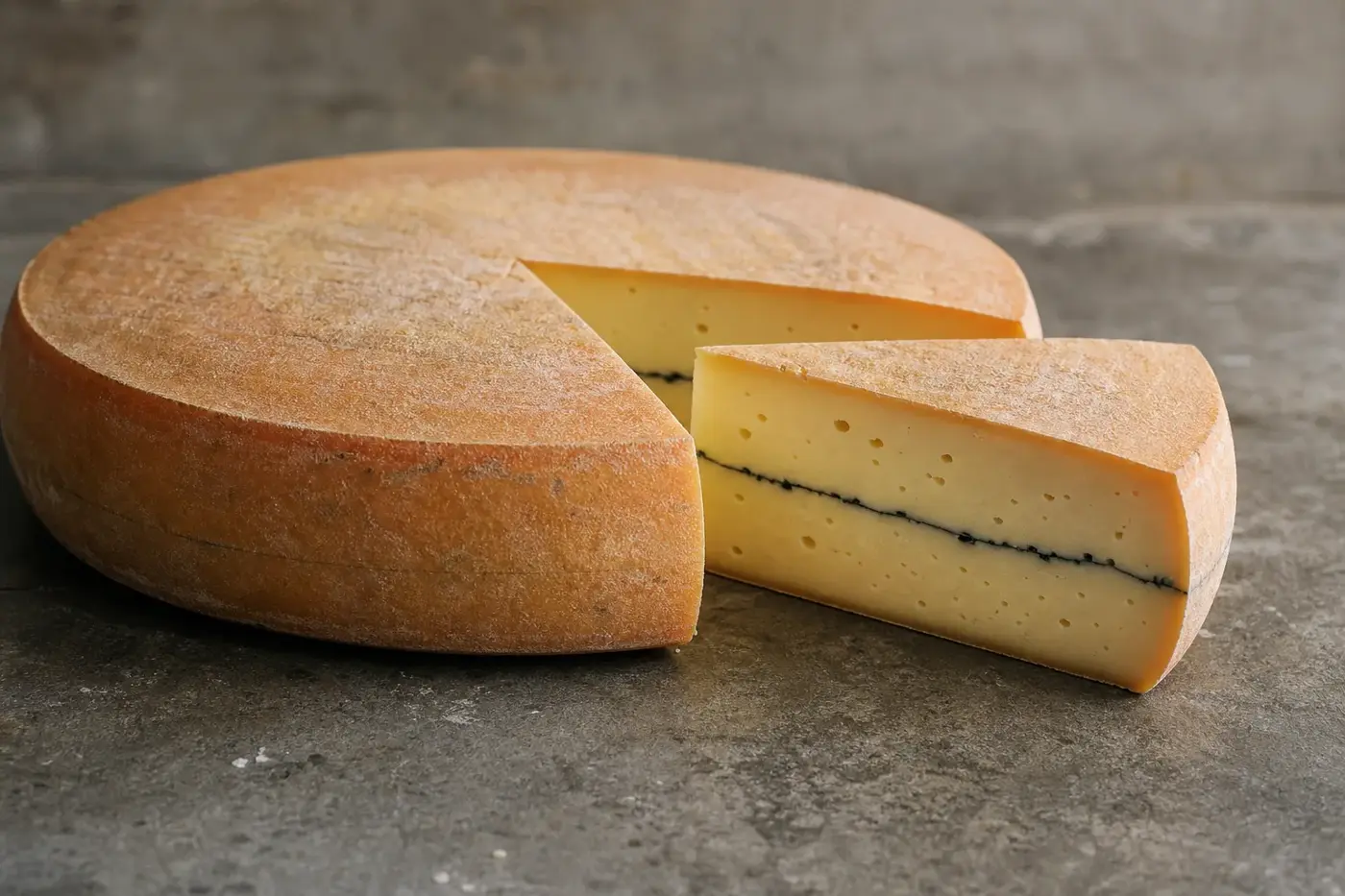
Across the pale, supple face of your Morbier runs a dark line. Follow it back and you reach Jura farmers, evening milk and ash spread over waiting curd.[5] Today, cheesemakers draw that unmistakable stripe with vegetable charcoal. The cheese around it is French, made with raw cow’s milk and protected as a designation of origin in both the EU and Great Britain.[1][2][3][4]
| What to know | The details |
|---|---|
| Name to look for | Morbier.[1][2] |
| EU protection | PDO; standard amendment published 8 May 2026. Status as at November 2026.[2] |
| EU register identifier | Unconfirmed. The 2026 amendment reference is PDO-FR-0179-AM04.[2] |
| Great Britain protection | Registered PDO; UK scheme registration dated 31 December 2020. Status as at November 2026.[3] |
| Where it must be made | Doubs, most of Jura, and specified communes in Ain and Saône-et-Loire, France.[1] |
| Milk and cattle | Raw cow’s milk from Montbéliarde, Simmental française or certified crosses between those breeds.[1] |
| Cheese family | Uncooked pressed cheese.[1] |
| The stripe through the middle | Vegetable charcoal, applied manually before pressing.[1] |
| Size of a wheel | Diameter 30 to 40 cm; height 5 to 8 cm; weight 5 to 8 kg.[1] |
| Minimum cellar time | 45 days.[6] |
| Rind to look for | Natural, rubbed rind, beige to orange, sometimes with pink or brown-orange shades.[2] |
Follow the black line back to the farm
The familiar story begins with a practical problem: not enough milk for a large cheese. In the history published by Morbier’s producers’ organisation, farmers kept curd from an evening milking and covered it with soot or ash from beneath the cauldron. Fresh curd went on top the next morning. The dark layer marked where the two met.[5]
These farms normally sent their milk to a village fruitière, a communal cheesemaking dairy. When bad weather interrupted deliveries, the organisation explains, farmers made smaller cheeses themselves. This is its traditional account, rather than an independently established moment of invention.[5]
Today, that line has a different purpose. Cheesemakers deliberately spread food-grade vegetable charcoal over the curd, then assemble and press the two halves. The protective layer of the old story is no longer needed.[6]
Look closely at your piece and you can see how precisely that inheritance is defined. The specification requires a continuous horizontal line, with the paste joined around it. The stripe should run through the cheese, not divide it into separate layers.[1]
Meet the broad wheel with the yielding centre
Morbier is broad and relatively shallow, with flat faces and a slightly convex outer edge. Its natural rind may still show the mould’s pattern. Inside, you will find ivory to pale yellow paste, dotted with a few openings that the official description likens to small flattened bubbles.[2]
Give that contrast a moment. Outside sits a rubbed, developed rind; inside is the smooth, fine structure described in the specification. The black line travels horizontally across the pale face, rather than branching through it.[2]
You may hear Morbier called “uncooked pressed”. The curd is pressed, but this production family is distinct from cooked pressed cheeses. It is a useful bit of vocabulary, connecting the cheese in front of you with the way it was made. For more on rind, texture and manufacture, explore how to tell cheese styles apart.[1]
Find the Jura landscape in your slice
Morbier’s place of origin is more than a detail on its label. Milk production, cheesemaking and ripening must all take place within its legally defined area. That covers the whole department of Doubs, most of neighbouring Jura and listed communes in Ain and Saône-et-Loire.[1]
INAO, the French body responsible for official origin and quality schemes, places Morbier on the plateaux of the Jura mountains. Its account connects the cheese with the region’s grassland and dairy farming. There is a landscape behind that stripe, not just a clever bit of cheesemaking.[4]
The cattle must be Montbéliarde, Simmental française or crosses between the two with certified parentage. Under the published 2026 specification, their forage ration is based on grassland and other forage grown within the geographical area. Fermented feed is restricted, and grazing is required when snow cover and ground conditions allow.[1]
The milk must be raw, too. To untangle that term from other treatments, turn to raw milk, thermised and pasteurised cheese. These rules belong specifically to Morbier; they are not requirements for every cheese made in the Jura.[1]
Into the vat, then a careful layer of charcoal
The producers’ organisation describes milk collected daily and transferred to the cheesemaking vat. Added lactic cultures help acidification. Rennet then coagulates the milk into curd, the solid portion, with liquid whey around it.[6]
Next, the cheesemaker cuts and stirs the curd to encourage drainage. Part of the whey is replaced with water, a step called curd washing, or délactosage. The organisation connects this stage with the finished cheese’s smooth, fine texture.[6]
After preliminary pressing, the curd blocks are divided into halves. Vegetable charcoal is spread over the face of one half before the cheese is put back together and pressed again. This remains hands-on work: the current specification expressly requires the charcoal to be applied manually.[1][6]
The producers’ illustrated account places that application between preliminary and final pressing. Today’s stripe is therefore made on prepared curd during a single manufacturing sequence. It does not come from keeping one milking’s curd beneath ash until the next arrives.[6]
That deliberate step gives modern Morbier its familiar appearance.[6] If you would like to follow coagulation, drainage and pressing through other cheese families, take a look at how cheese is made.
Down to the cellar to tend the rind
Morbier spends at least 45 days in the cellar. The producers’ organisation gives ripening temperatures of 7 to 15 °C (45 to 59 °F). Rubbing with salt water, brining, or both develops the rind. This controlled ripening and care is called affinage.[6]
As the cheese matures, its natural surface needs tending. Beige, orange and pinkish tones belong to its official description, along with an evenly developed, rubbed appearance. Give the rind some attention when you look at a piece; the stripe has had quite enough publicity.[2]
Some wheels linger longer. The producers’ production information mentions Morbier aged for two, three or four months. All go beyond the compulsory minimum of 45 days.[7]
At the counter, ask how old the cheese actually is. Then ask about its affineur, the person or business responsible for ripening. Those details tell you more about the character of that particular wheel than its black line can.
Taste your way past “mild” and “strong”
Lactic, caramel, vanilla and fruit notes lead INAO’s description of Morbier. Ageing brings roasted, spicy and vegetal nuances. If “mild” and “strong” are your usual cheese vocabulary, here is a chance to give them the afternoon off.[4]
The producers’ organisation makes those aromas especially easy to imagine. Its published palette includes plain yoghurt, quince jelly, milk caramel, toasted bread, infused hay and woodland mushrooms. You are looking for reminders of those things, not ingredients added during manufacture.[8]
Give texture just as much attention. The official description calls for supple, smooth, fine paste, with little stickiness in the mouth. Your piece should yield readily rather than break into a crumbly structure.[2]
Age points towards INAO’s roasted, spicy and vegetal notes. Ask the cheesemonger about the wheel in front of you, and compare samples where offered. Does your first impression suggest fresh yoghurt, fruit, or something more developed and savoury? Notice how that flavour sits alongside the yielding texture.[4][8]
Make room for the Jura neighbours
Comté is the historical neighbour you cannot leave out. Morbier’s specification links its development to occasions when there was too little milk for a Comté wheel. The two share a regional dairy history, but Morbier has its own manufacturing requirements and recognisable form.[1]
Try Morbier alongside Comté on your cheeseboard. Notice the resistance each piece offers, how it breaks and which aromas linger after swallowing. You are tasting two individual cheeses, not asking one to do the other’s job.
French Mont d’Or offers another regional contrast. Its producers’ organisation describes a seasonal raw-milk cheese encircled by a spruce band, matured on spruce boards and presented in a wooden box. Morbier’s defining visual feature lies inside; Mont d’Or draws your eye to the wood around it.[11]
Together, these neighbours bring different structures and identities to a regional board. In the kitchen, choose a substitute for the texture and melting behaviour your dish needs. A shared corner of France is not enough to tell you how a cheese will cook.
At the counter, look beyond the stripe
Start with the name Morbier and the origin designation on the label or counter ticket. The name is registered as a PDO in the EU and Great Britain. The GB register records its original EU registration date as 11 July 2002.[2][3]
Then ask who made it, who matured it and how long it has ripened. An ageing statement is optional under the EU’s published 2026 amendment. If one appears, it must give the minimum number of days spent with an authorised Morbier ripening business.[2]
For a cut piece, use the official description to guide your eye. Look for pale paste, a continuous central line and a natural beige-to-orange rind. Once you have taken those in, ask the seller what distinguishes this particular wheel from another.[2]
Keep the packaging or counter label until you have finished the cheese, so its product and batch information remain to hand. France’s official RappelConso service and the UK Food Standards Agency publish recall notices identifying affected products. The label provides the details you need to consult them.[12][13]
Home to the fridge, with the label to hand
Follow the storage instructions supplied with your cheese, including any use-by date and directions after opening. For households in England, Wales and Northern Ireland, the Food Standards Agency advises refrigerating dairy products and keeping the fridge between 0 and 5 °C. Read that advice alongside the instructions for your particular piece.[9]
Before bringing Morbier to temperature, consult the current Food Standards Agency guidance for England, Wales and Northern Ireland on keeping chilled food outside the fridge.[9][10] For practical help with wrapping, fridge organisation and handling cut cheese, turn to how to store cheese at home.
Give Morbier its moment on the board
Plain bread, fresh pear and a few walnuts make a good starting point for your Morbier board. Serve them separately, so you can taste the cheese on its own. Cut portions across the central line, giving each piece pale paste and that dark dividing layer.
For a drink, try lightly brewed black tea or still water. These are starting points for comparison, not rules to follow. Let the cheese’s documented lactic, fruity and more developed roasted notes guide what you notice.[4]
Morbier belongs in the kitchen, too. Its producers’ organisation recommends gratins, pizza and raclette-style meals, describing a cheese that melts readily. Try thin slices over potatoes, or pieces added to a baked vegetable dish, to explore that quality.[8]
Let the piece you have lead the way. A simple potato gratin makes a useful first experiment. Morbier supplies the cheese flavour, with no second cheese to obscure it.
General information only, not medical advice: follow the official guidance where you live.
Questions people ask
What is the black line in Morbier made from?
It is made from food grade vegetable charcoal, applied manually to the curd before the cheese is pressed. The line should be continuous, with the cheese joined together around it.
Where is Morbier made?
Milk production, cheesemaking and ripening must all take place within its legally defined area in France. This covers Doubs, most of Jura and specified communes in Ain and Saône et Loire.
Is Morbier made with raw milk?
Yes, Morbier must be made with raw cow’s milk. The permitted cattle are Montbéliarde, Simmental française and certified crosses between those breeds.
What does Morbier taste like?
INAO describes lactic, caramel, vanilla and fruit notes. With ageing, roasted, spicy and vegetal nuances appear.
How should I store Morbier?
Follow the storage instructions supplied with the cheese, including any use by date and directions after opening. For households in England, Wales and Northern Ireland, the Food Standards Agency advises refrigerating dairy products and keeping the fridge between 0 and 5 °C; check its current guidance.
Sources
- INAO and the French Ministry of Agriculture. Cahier des charges de l’appellation d’origine « Morbier », approved by the national committee on 19 November 2025, homologated by the order of 18 December 2025 and published in Bulletin officiel no. 02, 8 January 2026. Product description, geographical area, cattle, feeding and manufacturing requirements.
- European Commission. Publication de la communication d’une modification standard approuvée du cahier des charges d’une indication géographique, Official Journal C/2026/2638, 8 May 2026. Includes Morbier single document, reference PDO-FR-0179-AM04.
- Department for Environment, Food & Rural Affairs. Morbier, protected food and drink names register, published 4 January 2021; live entry checked November 2026.
- INAO. Morbier, official product profile, undated; accessed November 2026. Geographical overview, sensory description and traditional account.
- Syndicat interprofessionnel de défense du Morbier. Histoire du Morbier, undated; accessed November 2026. The producers’ organisation’s historical account.
- Syndicat interprofessionnel de défense du Morbier. Fabrication du Morbier, undated; accessed November 2026. Illustrated manufacturing sequence and ripening description.
- Syndicat interprofessionnel de défense du Morbier. Production conditions, undated; accessed November 2026. Examples of longer ripening. Some farming information predates the revised specification and has not been used here.
- Syndicat interprofessionnel de défense du Morbier. Le Morbier, press dossier, 2022. Serving suggestions, cooking uses and aromatic palette. This is promotional material from the producers’ organisation.
- Food Standards Agency. How to chill, freeze and defrost food safely, published 18 December 2017, live guidance accessed November 2026. Applies to England, Northern Ireland and Wales.
- Food Standards Agency. Food safety in a heatwave: advice for consumers, published 27 June 2024, live guidance accessed November 2026. Applies to England, Northern Ireland and Wales.
- Mont d’Or producers’ organisation. L’AOP Mont d’Or, official website, undated; accessed November 2026. Raw milk, seasonality and spruce presentation.
- French government, RappelConso. Morbier search results, live recall listings accessed November 2026.
- Food Standards Agency. Alerts, live official recall and allergy alert service, accessed November 2026.
Researched from the published French specification, the EU amendment document, the GB register, official food safety guidance and attributed producers’ organisation material; serving combinations are identified as editorial suggestions.
Last checked: November 2026
Last checked November 2026.
The editors suggest you read next