Mothais sur Feuille
Turn over a Mothais sur Feuille and a little woodland impression comes into view.
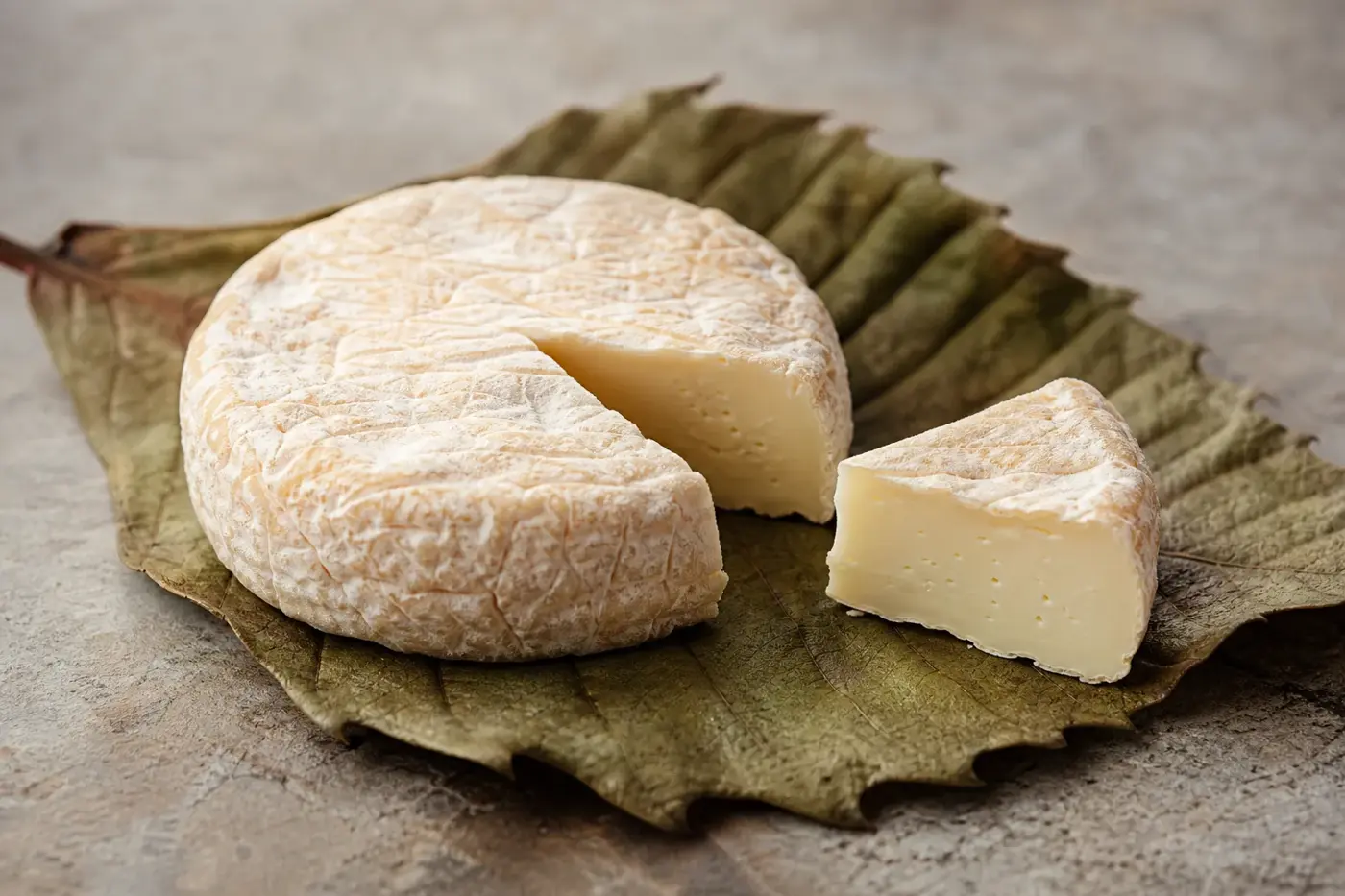
Turn over a Mothais sur Feuille and a little woodland impression comes into view. The chestnut leaf beneath it has left its mark, quietly regulating moisture while this small goat’s cheese matures. Rooted in the rural traditions of southern Poitou, Mothais has a finely wrinkled rind, a supple, ivory centre and aromas that lead you from milk and yeast towards woodland and dried nuts.[2][3][5]
| What you might wonder | What to know |
|---|---|
| Familiar name | Mothais sur Feuille.[2] |
| Exact registered name | Mothais sur feuille.[1] |
| Registration authority and identifier | European Commission, PDO-FR-03397.[1] |
| EU protection | PDO, registered and in force; Regulation (EU) 2026/1276 entered into force on 1 July 2026. Status as at November 2026.[1] |
| Where it must be made | Specified communes in southern Poitou, across Deux-Sèvres, Vienne, Charente, Charente-Maritime and Vendée.[1] |
| Milk required by the PDO specification | Whole, raw goat’s milk; a named operator has transitional permission to continue using the name.[1][3] |
| The leaf underneath | Chestnut.[3] |
| A typical size | About 10 cm across and 3 cm thick, according to the producers’ association.[2] |
| Minimum weight | 180 g after minimum maturation, excluding the leaf.[3] |
| Minimum maturation | 12 days from the addition of rennet, according to INAO.[10] |
| Rind and centre | Wrinkled, white to ivory rind; white to ivory, fine-textured paste.[3] |
Take a turn through Mothais country
“Mothais” takes its name from La Mothe-Saint-Héray, in Deux-Sèvres. The producers’ association places it within the surrounding pays mothais, a cultural territory shaped by keeping goats, making cheese from their milk and eating the results. You are tasting a history of rural work and food, not merely finding a town on the map.[4]
The registered production area stretches beyond La Mothe-Saint-Héray. Its specified communes include Melle and parts of five departments, with milk production, cheesemaking and maturation all kept inside the defined area. The registration document places this territory between the limestone plains of Poitou and the hedged countryside towards Vendée.[1]
The chestnut leaf brings a piece of that landscape into the dairy. The association documents leaf gathering in the woods of the Pays Mellois, including a partnership with agricultural students in Melle. Gathered locally, the leaf has work to do during maturation, as well as giving the cheese its most recognisable feature.[5]
That chestnut leaf has a proper job
Look closely and you will see that the leaf sits beneath the cheese, rather than wrapping around it. As maturation progresses, it leaves an impression in the lower surface. Chestnut is specified in the registered description; traditional use of plane tree leaves remains uncertain.[3]
According to the producers’ association, the leaf helps drainage while also retaining moisture. Calling it something that simply “dries the cheese” tells only half the story. Its role is to help regulate moisture while the paste develops that characteristic suppleness, rather more responsibility than the average garnish.[5]
You can see its effect when you turn the cheese over. The registered description records much less rind development where it rests on the leaf. The two surfaces develop under different conditions during the same maturation.[3]
Fromagerie des Gors is among the producers that attribute woody and vegetal flavours directly to the leaf. That producer’s account is distinct from the leaf’s documented physical role and the aromas described for the matured cheese as a whole. Milk, cultures and maturation all contribute to what you taste.[7]
Get to know those fine wrinkles
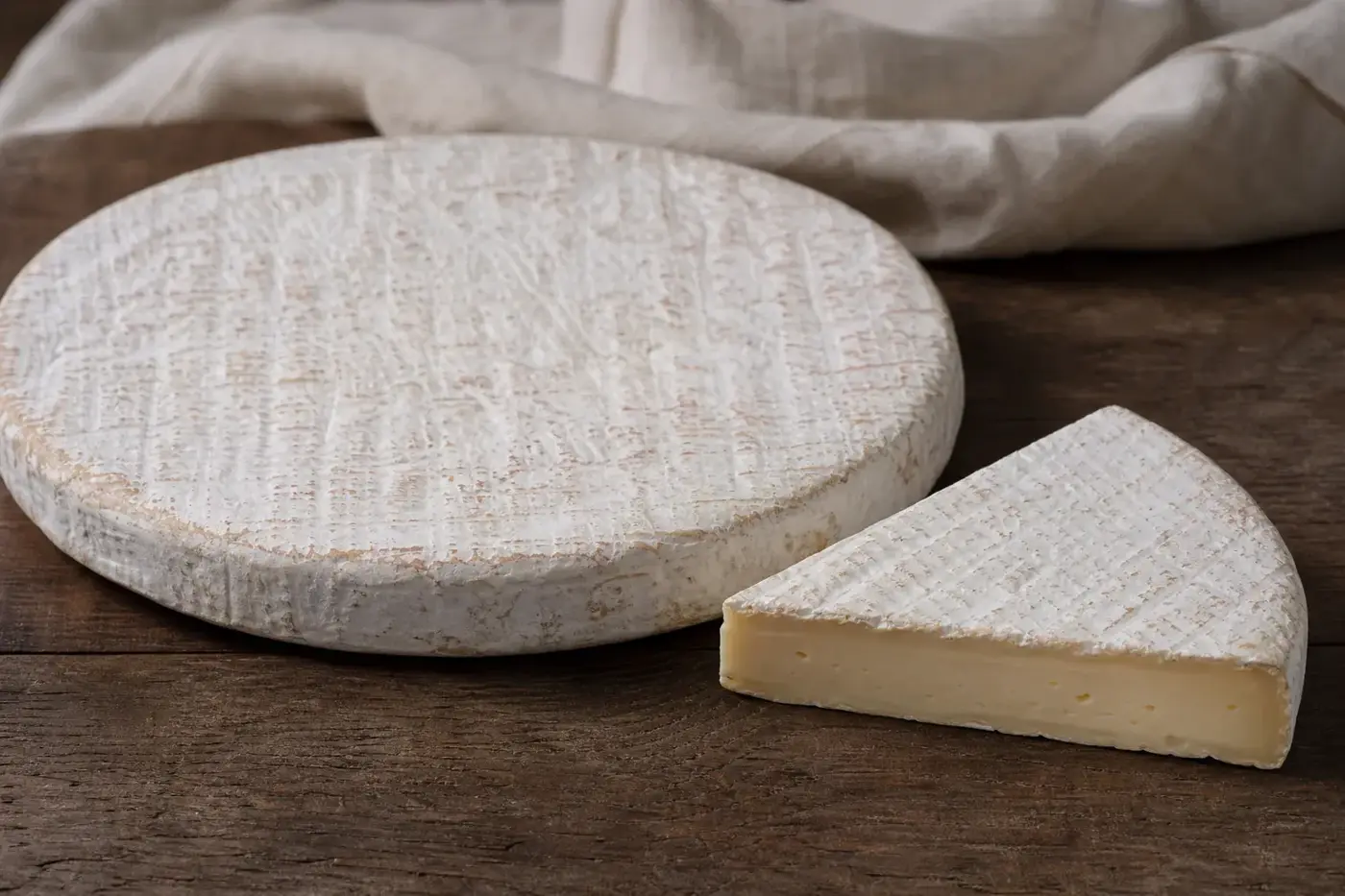
Mothais is a low, flat cylinder with gently rounded edges, sometimes tapering slightly. The association’s representative dimensions help you picture its size. The registered description sets a minimum finished weight, rather than requiring every cheese to have an identical shape.[2][3]
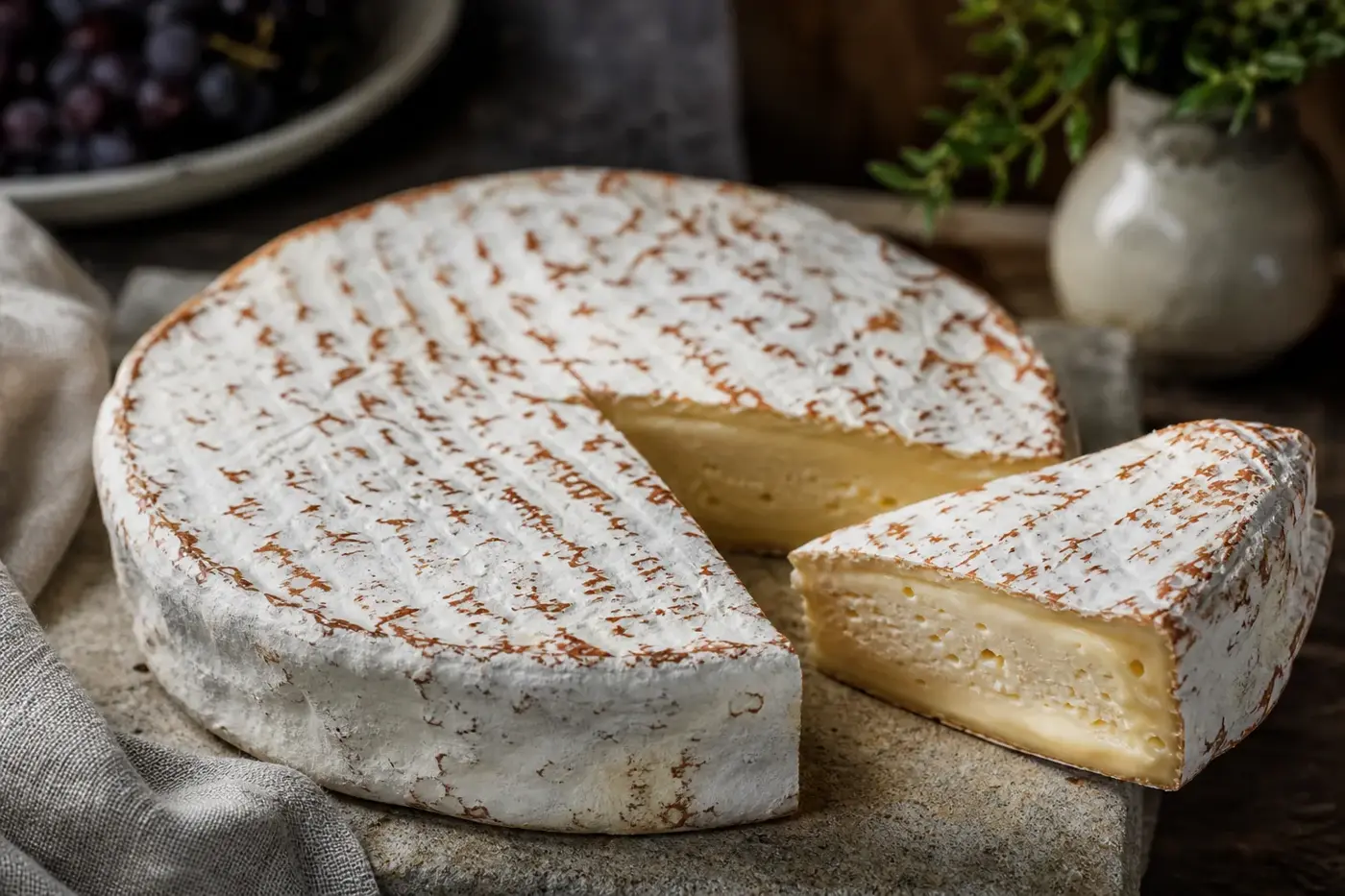
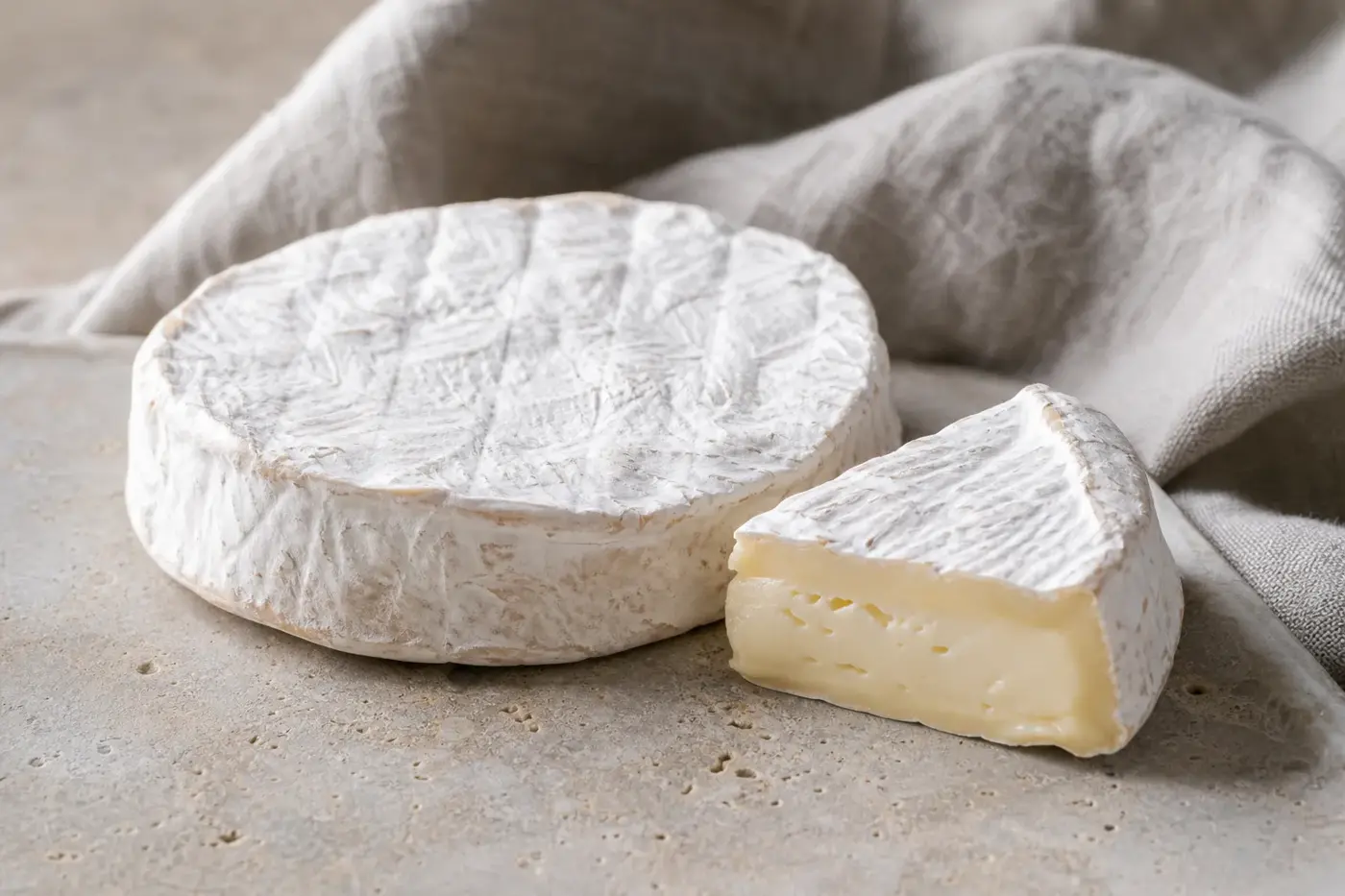
Fine wrinkles mark the pale rind, sometimes forming what are described as worm-like folds. The registered description also allows blue, grey-blue, white or red spots to develop naturally during maturation. An older cheese can look considerably more varied than the uniformly pale surface you might expect.[3]
Inside, the paste is white to ivory, with a very fine grain. The association describes it as smooth and supple, while its sensory account records a tendency to become more compact during maturation without losing flexibility. Ask about the age and texture of the cheese in front of you: rind colour alone cannot tell you which ripeness you will enjoy.[2][6]
Follow the milk, slowly
Mothais belongs to the lactic family of cheeses, where acidification is central to setting the milk. Rennet, the enzyme preparation that helps milk coagulate, also plays a part. Coagulation creates the curd, the gel that becomes cheese; the liquid released as it drains is whey.[7][8]
At Fromagerie des Gors, the published process begins with daily milk collection and a slow set lasting at least 20 hours. The curd is ladled into perforated moulds in three passes, then left to drain for another 36 to 48 hours. Patience is very much on the equipment list.[7]
The equipment specialist Avedemil likewise describes slow, spontaneous drainage, turning during drainage and dry surface salting. Its account draws your attention back to the ladling itself. Uneven quantities of curd can leave cheeses with different heights and cause uneven drainage.[8]
After unmoulding, the cheeses take their places on chestnut leaves to mature. INAO specifies a minimum of 12 days from renneting. That clock starts when rennet goes in, not when the cheese reaches its leaf, a useful distinction when you compare published maturation times.[10]
Meet the producers and the raw-milk rule
Whole, raw goat’s milk is required by the EU PDO specification. It is part of the registered cheese’s definition, rather than a milk treatment each PDO producer can choose to change.[1][3]
There is one specific transitional exception. Article 2 of the registration regulation allows Poitou Chèvre to continue using the name until 31 December 2029. The recitals identify non-compliance particularly concerning the raw-milk requirement, so look at the individual product’s milk declaration and PDO identification when you buy.[1]
The association documents farmhouse producers, artisans and dairy production within the raw-milk tradition. Fromagerie des Gors, for example, describes its own arrangements for collecting milk and ladling curd. Knowing the producer tells you more than assuming every cheese bearing the name follows the same daily routine.[2][7]
If you want to untangle the milk treatments, start with raw, thermised and pasteurised milk. It explains the wider distinction.
Taste your way from cream to woodland
Think cream and kneaded dough before you think sharply sour. Those are among the references in the association’s sensory account, which describes moderate lactic acidity and aromas associated with milk, fermentation and breadmaking. It is a helpful starting point if you expect every young goat’s cheese to greet you with a sharp tang.[6]
With further maturation, that account describes growing aromatic complexity, including animal, woody and dried-nut notes. The association’s broader description adds woodland floor, fresh straw, mushroom and hazelnut as possibilities after several weeks. Treat these as clues to its developing range, not a checklist you must complete with every mouthful.[2][6]
Texture changes alongside aroma. The sensory account describes a fine, smooth grain and a paste that can become more compact with age. Ask your cheesemonger whether the cheese available is still particularly moist and supple or has developed a firmer body.[6]
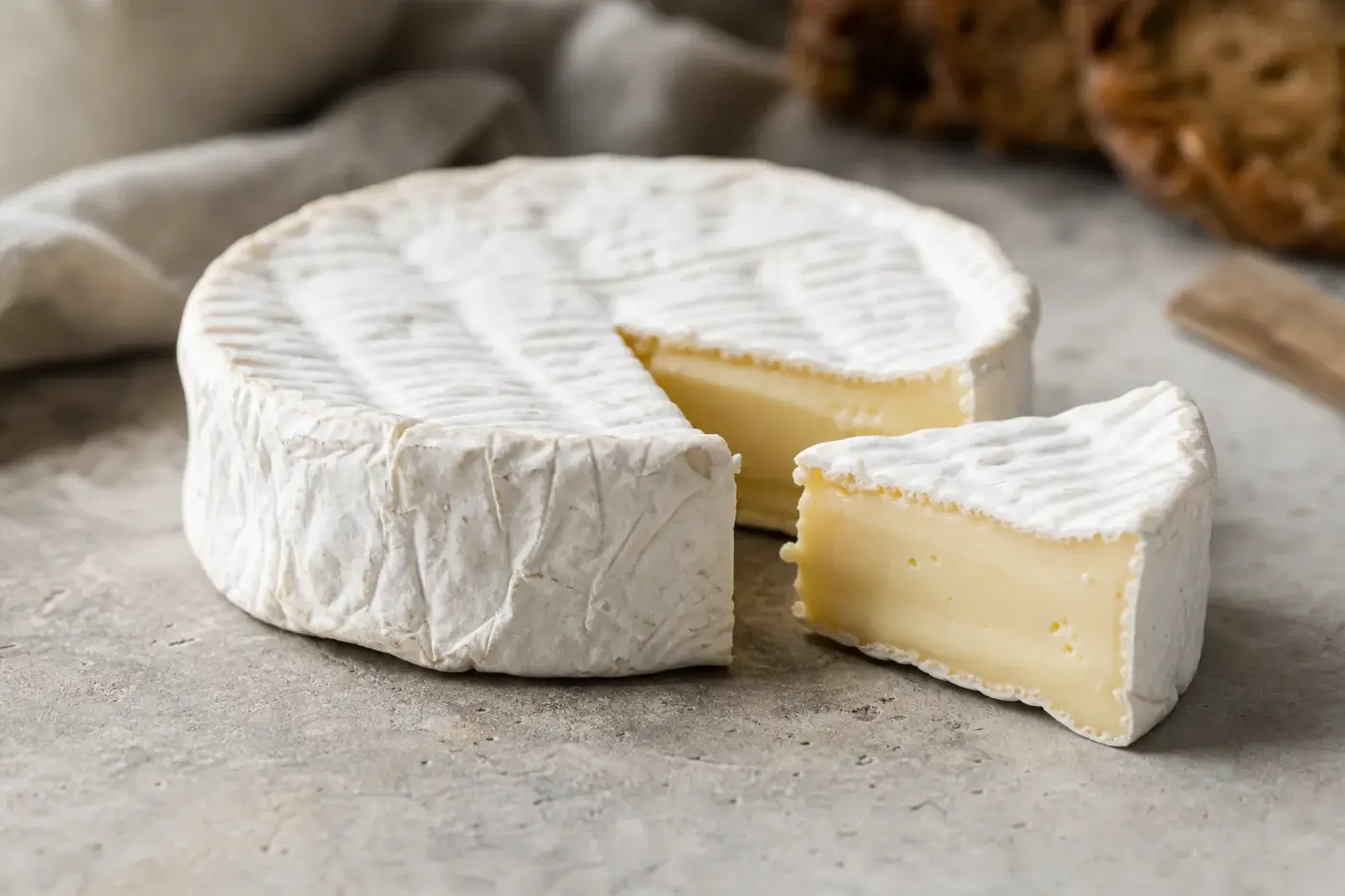
You might enjoy comparing it with Brie and Camembert, which are generally made from cow’s milk. Mothais uses goat’s milk and matures on a chestnut leaf, with less rind developing underneath.[3] Compare aromas, acidity and textures, but keep each cheese’s age in mind.
What EU protection means for the name
Mothais sur feuille is an EU protected designation of origin, or PDO, known as AOP in French. Its application stage has ended. Commission Implementing Regulation (EU) 2026/1276 was adopted on 4 June 2026, published on 11 June and entered into force on 1 July 2026.[1]
The regulation also includes transitional provisions for specified operators, alongside the registration’s requirements. The EU status given here is as at November 2026. Great Britain has a separate registration system; you will find its status for this cheese in the fact box.[1]
For a guide to what the different schemes mean, see PDO, PGI and TSG protection. It sets out the distinction between them.
Ask at the counter, care for it at home
At the counter, ask three questions: who made it, how long has it matured, and what texture does this particular cheese have? Those answers turn an unfamiliar name into a choice you can feel comfortable making. If you are buying ahead, tell the cheesemonger when you plan to serve it.
At home, follow the product’s storage instructions and use-by date. Food Standards Agency guidance for England, Wales and Northern Ireland recommends a fridge between 0 and 5 °C and says dairy products should be refrigerated. It also advises keeping chilled food out for the shortest possible time during preparation, with a maximum of four hours.[9]
Shortly before the meal, bring out only the portion you intend to eat, rather than warming the whole cheese for hours. Stay within the FSA limit above and any stricter product instructions. For the broader routine, see storing cheese at home.[9]
For pregnancy, the UK NHS advises against mould ripened soft cheeses such as brie, camembert and chèvre unless cooked until steaming hot. It also advises against soft cheeses made from unpasteurised milk unless cooked until steaming hot. Check the current NHS guidance and ask your midwife or doctor about your circumstances. Guidance reference: November 2026.[11]
Bring bread and let the cheese speak
Country bread is Fromagerie des Gors’ recommendation.[7] Start with plain bread and an unadorned piece of cheese. Give yourself time to enjoy its texture and aromas before bringing other flavours into the picture.
Then try a slice of pear or apple for a contrasting mouthful. Keep stronger preserves separate so you can judge whether their sweetness suits the cheese at its particular stage of ripeness.
Keep the drink simple, too. Try still water or a small glass of unsweetened apple juice alongside the food.
General information only, not medical advice: follow the official guidance where you live.
Questions people ask
Where does Mothais sur Feuille come from?
It comes from southern Poitou, where specified communes form its legally defined production area. Milk production, cheesemaking and maturation all take place within that area.
Why is Mothais sur Feuille placed on a chestnut leaf?
The leaf helps regulate moisture as the cheese matures, aiding drainage while also retaining moisture. It leaves an impression underneath, where less rind develops than on the exposed surface.
Is Mothais sur Feuille made from raw goat’s milk?
Whole, raw goat’s milk is required by the EU PDO specification. A transitional exception allows Poitou Chèvre to continue using the name until 31 December 2029.
How long is Mothais sur Feuille matured?
INAO specifies a minimum of 12 days from the addition of rennet. The clock does not start when the cheese is placed on its leaf.
Can I eat Mothais sur Feuille during pregnancy?
The UK NHS advises against mould ripened soft cheeses such as chèvre and soft cheeses made from unpasteurised milk unless cooked until steaming hot. Check the [current NHS guidance on foods to avoid in pregnancy](https://www.nhs.uk/pregnancy/keeping%2Dwell/foods%2Dto%2Davoid/) and ask your midwife or doctor about your circumstances.
Sources
- European Commission. Commission Implementing Regulation (EU) 2026/1276 of 4 June 2026 entering the geographical indication Mothais sur feuille (PDO) in the Union register of geographical indications. Official Journal, 11 June 2026. Articles 1 to 5, recitals and consolidated single document. Official legal text.
- Syndicat de défense du Mothais sur feuille, through Terre des Chèvres. Le Mothais sur Feuille. Undated producer-association description. Product account.
- European Commission. Publication of an application for registration pursuant to Article 15(4) of Regulation (EU) 2024/1143. C/2026/688, 29 January 2026, single document, sections 4.2 and 5. Read as the published application document, with subsequent registration established separately by source 1. Published document.
- Syndicat de défense du Mothais sur feuille, through Terre des Chèvres. La dénomination du terme « Mothais » identifie un « pays Mothais ». Undated. Geographical account.
- Syndicat de défense du Mothais sur feuille, through Terre des Chèvres. La feuille de chataignier, marqueur du Mothais sur Feuille. Undated. Leaf and gathering account.
- Syndicat de défense du Mothais sur feuille, through Terre des Chèvres. Les descripteurs aromatiques du Mothais sur Feuille. Undated. Sensory description.
- Fromagerie des Gors. Mothais sur feuille. Undated producer account of manufacture, maturation and serving. Commercial producer source. Producer account.
- Avedemil. Mothais sur feuille. Undated equipment supplier’s technical account. Used for its process description, not its outdated application-status statement. Technical account.
- Food Standards Agency. How to chill, freeze and defrost food safely. Published 18 December 2017, live guidance retrieved November 2026. Applies to England, Wales and Northern Ireland. Official storage guidance.
- INAO. La dénomination “Mothais sur feuille” enregistrée en AOP. 12 June 2026. Retrieved search extract describing raw milk, chestnut leaves and minimum maturation. Official recognition account.
- NHS. Foods to avoid in pregnancy. Live guidance retrieved November 2026, section “Cheese, milk and other dairy”. Official pregnancy guidance.
Researched through desk research using official registration documents, producer-association descriptions, a cheesemaker’s published methods and official food guidance; pairing suggestions identified as editorial were not independently tested.
Last checked: November 2026.
Last checked November 2026.
The editors suggest you read next