Obatzda (Obazda)
Tear a pretzel, reach past the radishes and scoop up a little orange cheese spread.
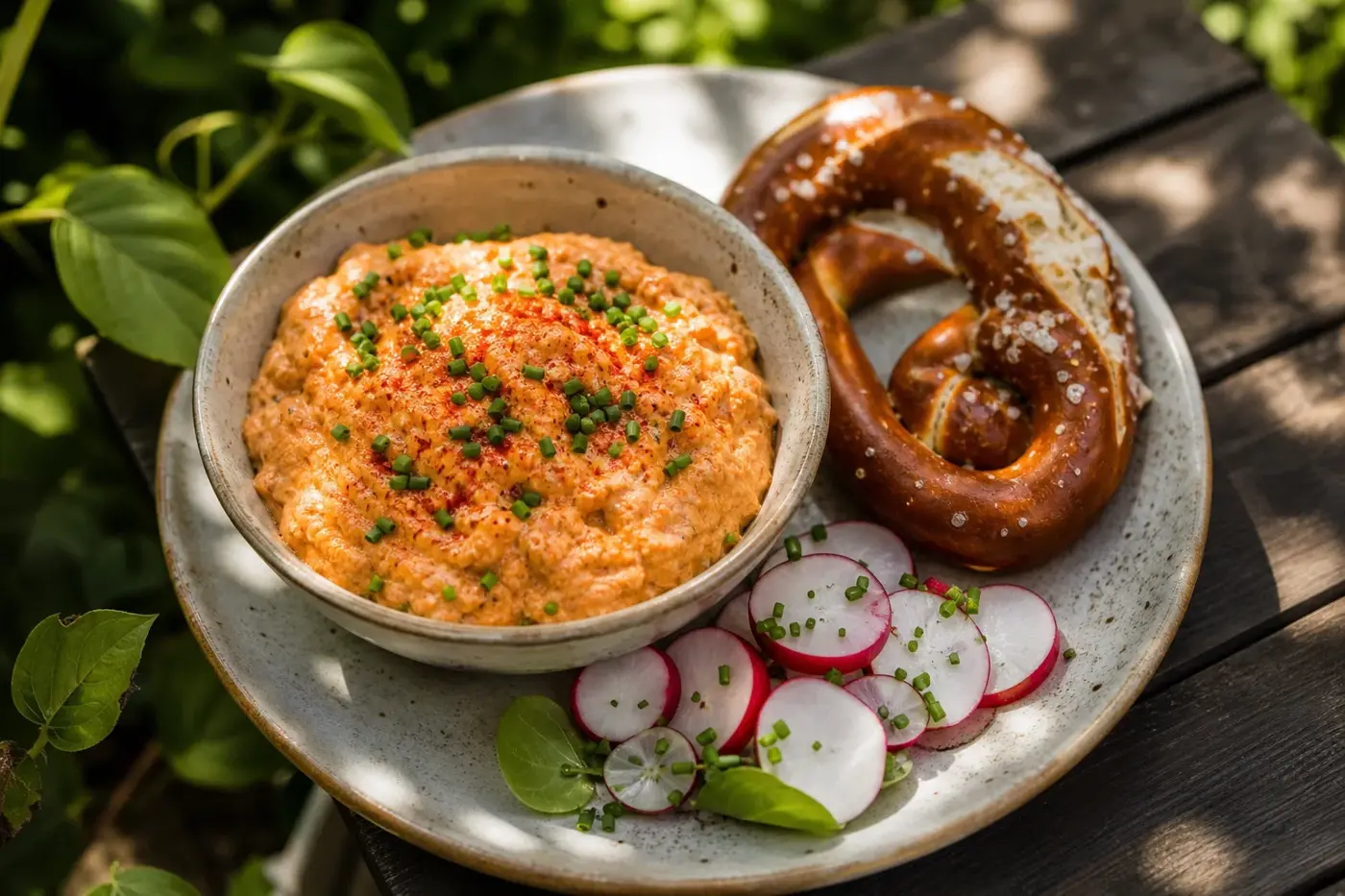
Tear a pretzel, reach past the radishes and scoop up a little orange cheese spread. You are in Obatzda territory: a Bavarian beer garden, with ripe Camembert or Brie mashed into butter and paprika lending its unmistakable colour. The pretzel has found its purpose. [1,2]
Pull up a chair in Bavaria
Obatzda belongs to Brotzeit, Bavaria's bread-based snack or light meal. Bavaria's official food heritage account roots it firmly in beer garden culture, where visitors may bring their own food. It describes the spread as a way to use strongly ripened Camembert or Brie. [1]
There is something appealingly practical about that transformation. Your cheese becomes something to share with bread, rather than something to slice. Choose it using the modern storage advice below, keeping within use-by dates and any shorter instructions after opening. [5,6]
Three spellings, all roads to Bavaria
You will encounter Obatzda, Obazda and Obatzter. The exact registered EU names are Obazda / Obatzter; Obatzda is a familiar recipe spelling, including in German broadcasting. The Bavarian agriculture authority identifies Obazda / Obatzter as a protected geographical indication, or PGI: protection linked to geographical origin. [2,3,10]
| Protected name details, November 2026 | Your quick guide |
|---|---|
| Registered names | Obazda / Obatzter. [2,3] |
| Responsible authority and jurisdiction | European Commission, European Union. [1,2] |
| EU register reference | Not specified here. |
| Where it is made | Bavaria, Germany: all processing takes place there; ingredients may come from elsewhere. [2,3] |
For the registered preparation, Camembert and/or Brie must make up at least 40% of the finished product. Total cheese must reach at least 50%, with butter, paprika powder or extract, and salt all required. According to the authority's guidance, onion and beer together may account for no more than 15%. [2,3]
A regional recipe and a protected commercial designation are not quite the same thing. If you would like to untangle the distinction, turn to protected names explained.
Ripe cheese and that paprika glow
Picture a pale orange spread, with recognisable pieces of cheese and a spicy-aromatic character. That is the product specification's description. Camembert and Brie used in the preparation must have a soft consistency, giving you a straightforward shopping clue: choose ripe cheese, not a firm one with a chalky centre. [3]
Butter belongs in the mixture, rather than sitting on top as a garnish. Published regional recipes work it into the cheese, sometimes with fresh cheese or quark. The specification credits ripe cheese for the gently piquant flavour, moderated by butter and, where used, fresh cheese, cream or milk. [3,7,11]
Start with sweet paprika if you prefer a gentler spread. Bavaria's published recipe also allows hot paprika according to taste, so add it cautiously if you fancy more heat. Adjusting the paprika is simpler than burying the cheese beneath several extra seasonings. [4,7]
Bring Obatzda to your own table
This recipe is adapted from Bavaria's official food heritage recipe. You will find explicit seasoning quantities and a beer-free option informed by the Bavarian milk producers' association. [4,7]
Yield: 4 snack portions. Preparation: about 20 minutes, followed by at least 1 hour in the fridge. Equipment: scales, knife, chopping board, mixing bowl, fork and covered serving container. Cooking: none; no oven required. [4,7]
Gather the cheese and its companions
- 300 g ripe Camembert, or ripe Brie
- 80 g unsalted butter, soft enough to mash
- 40 g peeled onion, finely chopped
- 2 g sweet paprika, plus a little for finishing
- 0.5 g ground caraway, optional
- 15 ml beer, optional
- 5 g chopped chives
- Salt and black pepper, to taste
Mash, season, then give it a chill
- Wash your hands and clean the equipment. Cut the cheese into small pieces and put it in the bowl. Cut the butter into small pieces too. [4,7]
- Mash with a fork, pressing against the bowl, then fold everything back together. Continue until the butter is distributed and the cheese forms a cohesive spread. Leave small pieces visible. [7,11]
- Fold in the onion, paprika and optional caraway. If using beer, add it gradually and stop when the consistency suits you. Taste before adding salt and pepper. [4,11]
- Cover and refrigerate for at least 1 hour, as the regional recipe directs. Finish with chives and a light dusting of paprika. Keep the main batch refrigerated and put out a small serving bowl. [4,5]
For handling, follow FSA guidance for England, Wales and Northern Ireland. Keep your fridge at 0 to 5 °C (32 to 41 °F), and keep chilled ingredients out for the shortest possible time, with a maximum of four hours. [5]
Allergens: milk from the cheese and butter. Check beer, bread and pretzel labels for cereals containing gluten and any other allergens relevant to your guests. [12]
Leave a little character in the bowl
Think masher first, stirrer second. Press larger pieces against the side of your bowl, then fold them through the softer paste. The tourism board's published dairy recipe also suggests a potato masher and explicitly aims for a slightly chunky mixture. [11]
Stop when a spoonful holds together and spreads across bread. You are not chasing a perfectly smooth purée; a few pieces of cheese are allowed to keep their identity. Add any optional liquid only after mashing, when you can judge what the cheese needs with the butter worked in. [7,11]
Choose cheese that is ready to spread
You can replace Camembert with the same weight of ripe Brie, following the specification's allowance for either cheese. Less ripe cheese may demand more fork work, so look for softness rather than trying to persuade a resistant centre with lots of beer. Explore the cheeses in the guides to Camembert and Brie. [2,3]
Fresh cheese or quark appears in other published versions, so a milder variation has regional precedent. It shifts the balance towards fresh dairy and away from ripened cheese. Follow an attributed recipe for that version rather than assuming every soft dairy product does the same job. [2,10,11]
Cheeses differ in salt and moisture, so save your final seasoning until everything is mixed. Add beer only as needed. This is a cold preparation, with no melting step. [4,11]
Find your balance of onion, caraway and beer
The specification permits all three, but published recipes take different routes. The milk producers' association offers a version without beer, while Bavaria's food heritage recipe includes a splash. Another regional recipe uses wheat beer and quark. [2,4,7,11]
You can offer onion rings alongside, leaving each person to choose their share. Keep caraway optional too. For a version without beer, simply omit it: the published beer-free recipe establishes that no replacement liquid is essential. [7]
Make room for pretzels and radishes
Pretzels, rustic bread and radishes are established companions in the regional recipes. A pretzel gives you something to tear and spread; rye or farmhouse-style bread makes an easy base for a shared snack. The milk producers' recipe serves halved radishes, with onion rings over the cheese. [4,7,10]
My extra suggestions are cucumber batons, sliced crisp radish or sweet pepper strips. Set vegetables and bread on separate plates so everyone can build their own mouthful. Give the spread a clean serving spoon and replenish it from the refrigerated batch.
Pour a glass to suit your plate
My pairing suggestions are a small serving of pale lager or wheat beer for adults of legal drinking age. For an alcohol free drink, try sparkling water, an unsweetened apple spritzer or a clearly labelled 0.0% beer. Sparkling water stays neutral; apple spritzer offers a sharper, fruitier contrast, and either also suits the spread made without beer.
Remember that this recipe is uncooked, so any beer you add retains its alcohol. If alcohol needs to be excluded, leave the beer out of the spread and choose an appropriate drink. NHS pregnancy guidance advises avoiding alcohol during pregnancy. [8]
Keep the main bowl cool and covered
FSA guidance for England, Wales and Northern Ireland recommends a fridge at 0 to 5 °C (32 to 41 °F). Chilled food should stay out for the shortest possible time, with a four-hour maximum during preparation. Keep your covered spread refrigerated until serving and return it promptly after use. [5]
Make an amount you can finish promptly. The agency's general advice is to eat leftovers within 48 hours, but an earlier ingredient use-by date or shorter after-opening instruction takes priority. Adding butter and paprika does not extend the cheese's storage life. [5,6]
Before serving: when cold soft cheese is unsuitable
UK NHS pregnancy guidance says to avoid cold mould-ripened soft cheese with a white rind, including Brie and Camembert, whether pasteurised or unpasteurised. It permits these cheeses when cooked until steaming hot. Obatzda is served cold, so follow that advice when deciding what to serve. [8]
NHS guidance also advises infants and young children, people over 65, and people with a long-term medical condition or weakened immune system to avoid mould-ripened soft cheeses such as Brie and Camembert. Consult the official guidance for your country and discuss your circumstances with your healthcare professional. [9]
The official guidance referenced here is dated November 2026 for this page. For wider handling questions, turn to cheese food safety and how to store cheese at home.
General information only, not medical advice: follow the official guidance where you live.
Questions people ask
What is Obatzda made of?
Obatzda is a Bavarian spread made by mashing ripe soft cheese with butter. Camembert or Brie provides the cheese character, while paprika gives the spread its orange colour.
How do you make Obatzda?
Mash ripe Camembert or Brie with softened butter, leaving small pieces of cheese visible, then fold in chopped onion and paprika. Cover and refrigerate for at least one hour, then finish with chives and a little paprika.
Can you make Obatzda without beer?
Yes. The Bavarian milk producers' association publishes a version without beer, and no replacement liquid is essential.
How long can you keep Obatzda in the fridge?
The FSA advises keeping the fridge at 0 to 5 °C and eating leftovers within 48 hours. An earlier use by date or shorter instruction after opening on an ingredient takes priority.
Can you eat Obatzda during pregnancy?
NHS pregnancy guidance advises avoiding cold mould ripened soft cheese with a white rind, including Brie and Camembert, whether pasteurised or unpasteurised. Obatzda is served cold, so check the NHS pregnancy guidance for its advice.
Sources
-
Bavarian State Ministry of Food, Agriculture, Forestry and Tourism, Obazda, Bayerisches GenussErbe, undated online edition, retrieved November 2026. Regional food heritage account and link to the EU register.
-
Bayerische Landesanstalt für Landwirtschaft, Fachinformation zur Herstellung von "Obazda/Obatzter" g.g.A. in der Gastronomie, undated online edition, retrieved November 2026. Current authority guidance on ingredients, geographical requirements and controls.
-
Deutsches Patent- und Markenamt, Obazda / Obatzter product specification, Markenblatt, issue 43, Part 7e, 24 October 2014, pages 22458 to 22459, file 305 99 004.7. This is the specification linked by the Bavarian agriculture authority.
-
Bavarian State Ministry of Food, Agriculture, Forestry and Tourism, Rezept Obazda, Bayerisches GenussErbe, undated online edition, retrieved November 2026. Principal recipe source.
-
Food Standards Agency, How to chill, freeze and defrost food safely, published 18 December 2017, online edition retrieved November 2026; applies to England, Wales and Northern Ireland.
-
Food Standards Agency, Understanding food labelling: Best before and use-by dates, undated online edition, retrieved November 2026.
-
Bayerischer Milchindustrie-Verband and Bayerischer Milcherzeuger-Verband recipe resource, Obazda Grundrezept, undated PDF, retrieved November 2026. Industry recipe source, representing dairy interests.
-
NHS, Foods to avoid in pregnancy, online edition retrieved November 2026.
-
NHS, Dairy and alternatives in your diet, online edition retrieved November 2026.
-
Westdeutscher Rundfunk, Obazda Original, Alles in Butter, undated recipe page, retrieved November 2026. Primary source for the broadcaster's recipe and spelling usage.
-
Bavaria Tourism, Obazda mit Bier, undated recipe supplied by Genusskäserei Hoimat, retrieved November 2026. Producer-supplied recipe published by a regional tourism body.
-
Food Standards Agency, Food allergy and intolerance advice for consumers, updated 7 August 2026, retrieved November 2026.
-
European Commission, eAmbrosia record EUGI00000014542, official register destination linked by source 1, retrieved November 2026.
This piece was researched from the published specification, regional recipe records and official food safety guidance, with the recipe adapted through desk research.
Last checked: November 2026
Last checked November 2026.
The editors suggest you read next