An earthy mushroom aroma rises as you unwrap Tunworth. Follow it back to a family kitchen in Hampshire, where this English interpretation of northern France’s soft cheeses began.[2][3] Beneath the thin, wrinkled rind, pasteurised whole cow’s milk becomes a paste that gradually softens as it ripens.[1][6] Patience has its rewards, although cheese lovers are not always famous for it.
| What you want to know | The essentials |
|---|---|
| Familiar name | Tunworth.[1] |
| Style | Soft, white-rinded, mould-ripened cow’s milk cheese.[1] |
| Where the story began | Hampshire, England.[2][3] |
| Current production location | Producer confirmation needed.[4] |
| Milk | Pasteurised whole cow’s milk.[1] |
| Named milk supplier | Producer confirmation needed. |
| Current coagulant | Producer confirmation needed. |
| Named culture strains | Producer confirmation needed. |
| Usual size and packaging | Round, in a poplar box, normally 250 g.[1] |
| Time to ripen | Hampshire Cheese Company gives 7 to 8 weeks for its cheeses; Neal’s Yard Dairy lists an average of 6 weeks for its Tunworth.[4][5] |
| Allergen | Milk.[4] |
| GI status and register ID | Confirmation needed for Great Britain, the EU and Northern Ireland; other jurisdictions outside this page’s scope. |
| UK pregnancy guidance | NHS advice on white-rinded, mould-ripened soft cheeses, November 2026.[11] |
From a Hampshire kitchen, with a little French guidance
Hampshire Cheese Company dates its foundation to 2005. Its story follows the first Tunworth prototype from the founder’s family kitchen into a small specialist dairy. The company credits its founding partnership with building the business, with one partner leading cheesemaking and operations.[2][3]
The French connection goes deeper than the rind. Hampshire Cheese Company describes French-style bassines, the small vessels associated with these delicate soft cheeses, and methods similar to those used in Normandy. Neal’s Yard Dairy helped develop Tunworth, recording visits with the cheesemakers to Camembert producers and experiments with maturation in London.[2][4][5]
That exchange helps explain the family resemblance you find on the plate. Tunworth’s British identity comes from adapting the method to a British dairy and its milk, rather than reproducing a French place of origin.
Hampshire belongs firmly in the origin story, but you need producer confirmation for the current production location. Hampshire Cheese Company’s website still describes its Hampshire operation, while Neal’s Yard Dairy’s current Tunworth listing places production in Lancashire.[2][4]
Morning milk, small vessels and patient hands
Tunworth is made by hand, right through to wrapping and boxing. The maker describes collecting pasteurised whole cow’s milk after the morning milking, then bringing it to the creamery for a slow, gentle make.[1][5]
None of the fat is removed before cheesemaking, according to Neal’s Yard Dairy. That whole milk helps explain the substantial, soft paste you encounter later. It does not work alone: acidification, drainage and ripening all help shape the finished texture.[4][6]
First, the milk must become curd. Cultures produce acid, while rennet or another suitable coagulant helps form a protein network. The solid portion becomes cheese; the liquid released as that network contracts is whey.[6] You can follow the wider sequence in how cheese is made.
Hampshire Cheese Company documents hand ladling and traditional production in small vessels. These details do more than paint a pretty dairy scene: handling and drainage determine how much moisture the curd keeps before ripening begins.[2][6] The company’s public pages used for this article leave its current culture strains and coagulant unnamed.
Neal’s Yard Dairy lists cheese cultures and vegetarian coagulant for the Tunworth it sells.[4] Current production details differ between sources, so read the declaration on your particular cheese if vegetarian suitability matters.
Follow the ripening from rind to centre
Tunworth’s bloomy rind has work to do. Research on this cheese family describes yeasts and moulds colonising the oxygen-rich outside and changing the chemistry beneath. White Penicillium moulds and the yeast-like fungus Geotrichum candidum are familiar members of that community, although their presence in a particular Tunworth batch needs producer confirmation.[6]
As ripening progresses, changes in acidity and the breakdown of proteins soften the paste. A yielding layer develops just beneath the rind, then advances towards the firmer centre.[6]
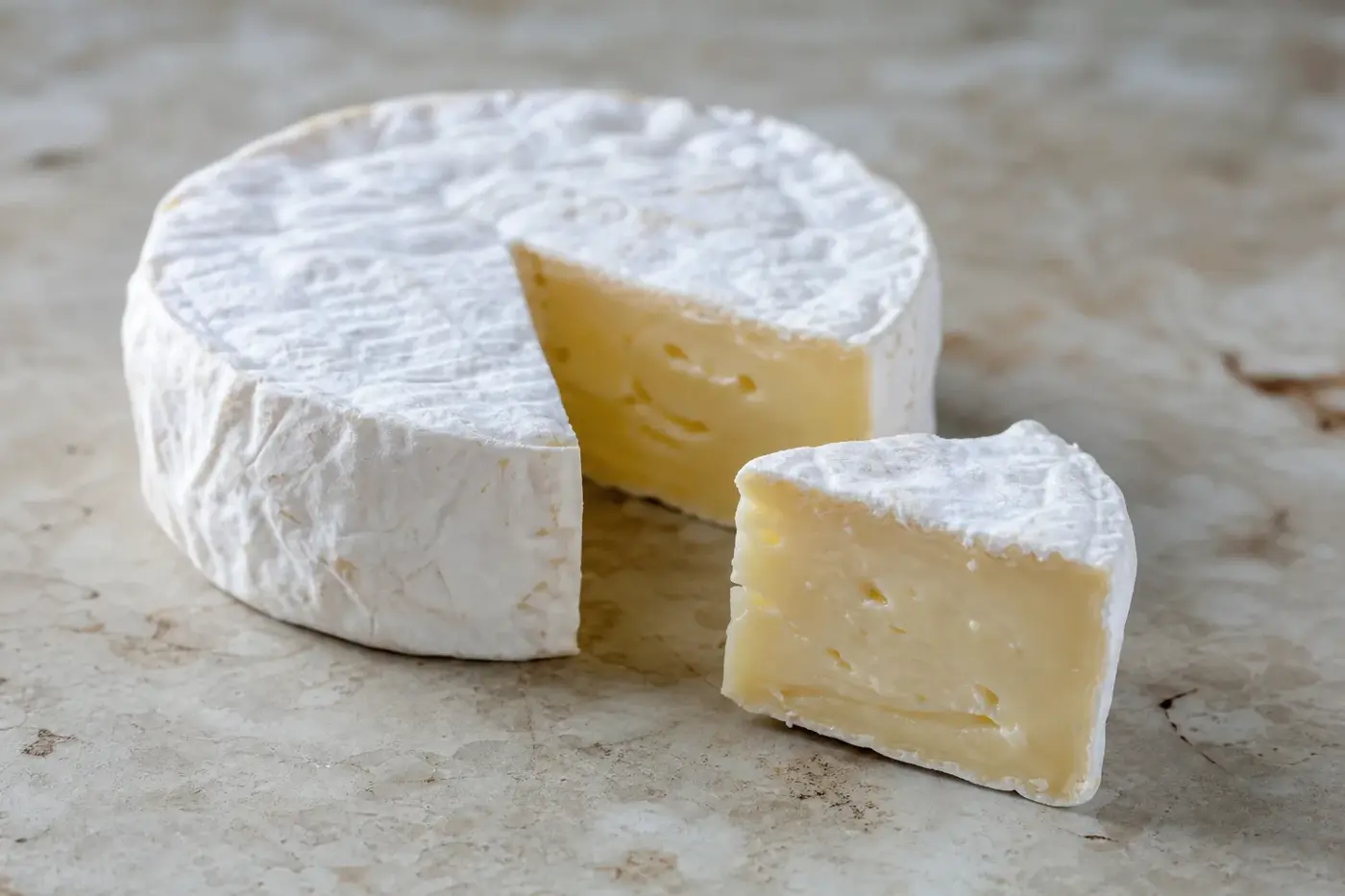
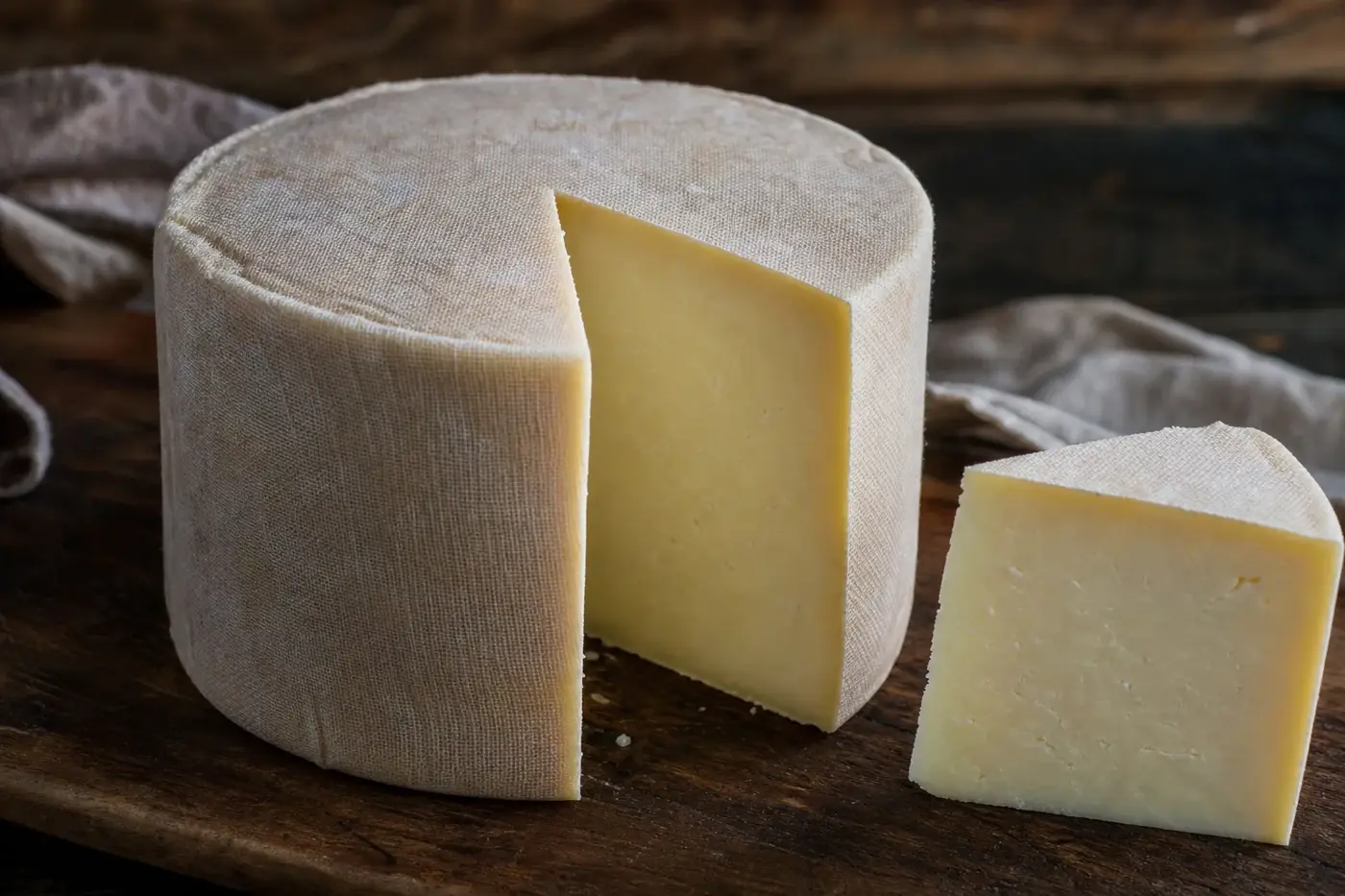
Cut into your cheese and that progress becomes visible. Soft outer paste and a firmer middle give you two textures in the same wedge. The contrast marks a stage of ripening, not automatically a faulty cheese.[6]
The maker’s readiness test is reassuringly straightforward: a ripe Tunworth gives beneath gentle pressure at its centre.[7] Age offers useful background. The condition of the cheese in front of you is the better guide to serving it.
Meet the mushroom aroma and yielding middle
Tunworth comes as a small round, normally sold whole in its box. Hampshire Cheese Company describes a thin, soft, wrinkled rind, an earthy mushroom fragrance and a lingering flavour that brings sweetness and nuttiness together.[1]
Neal’s Yard Dairy adds vegetal, cabbage-like flavours and a soft paste.[4] You have rather more to explore here than the word “mild” suggests. Mushroom and cabbage-like notes describe different parts of the cheese’s aromatic character.
With a younger, firmer cheese, you can usually see and feel the distinction between rind and centre more clearly. As the paste softens, wedges lose their sharp definition and the cheese spreads more readily. Individual cheeses move at different speeds, but that direction is characteristic of surface ripening.[6]
Choose your texture to suit the occasion. Ask for a firmer cheese for distinct wedges, or one ready to eat for a yielding centre to spread onto bread; the maker’s gentle-pressure test helps.[7] Mushroom and vegetal aromas belong to Tunworth’s documented character, but consider them alongside storage, dates and the cheese’s overall condition.[1][4]
Pull up a chair for Camembert and Baron Bigod
Camembert is the clearest stylistic reference: small, soft and white-rinded. Tunworth’s maker openly acknowledges the relationship while describing its own cheese as British.[1] If you want to explore distinctions within the French family, turn to camembert.
For another British comparison, try Baron Bigod. Its maker, Fen Farm Dairy, describes it as Brie de Meaux-style, with hand ladling, hand salting and a silky, softened layer of paste around a fresher centre.[8]
Taste for the relationship between rind and paste, rather than staging a contest in strength. Tunworth and Baron Bigod have separate recipes, makers and production histories. Their shared soft-ripened character makes them rewarding companions, while their differences earn each a distinct place on your board.[1][8]
Tell your cheesemonger when supper is
Begin with the day you plan to eat your Tunworth. Ask the cheesemonger whether the batch is still firm through the centre or already yielding, then read the pack’s milk, coagulant and storage declaration. Those details are particularly useful while current production information differs between sources.[4][7]
Keep Tunworth in its original packaging until serving, as Hampshire Cheese Company recommends. If you have some left, the maker advises waxed paper rather than clingfilm, followed by a sealed plastic box in the fridge.[7]
For England, Northern Ireland and Wales, the Food Standards Agency recommends a domestic fridge temperature of 0 to 5 °C (32 to 41 °F). Follow the pack’s storage instructions and date marking.[9] You will find broader wrapping advice in how to store cheese at home.
The maker suggests taking Tunworth out approximately one hour before serving.[7] Balance that with the FSA’s instruction to minimise time outside refrigeration, allowing a maximum of four hours during preparation in those jurisdictions. Warmer surroundings call for extra care, not more time on the table.[9]
Unwrap your cheese onto a plate or board. Cut wedges through the centre so everyone gets rind and paste, then taste a little of each separately before bringing them together. You will get a clearer sense of the aromatic surface and softer interior.
Good bread, crisp fruit and something to drink
Start simply with a baguette, lightly toasted sourdough or an unsweetened cracker. Taste the cheese before reaching for chutney. Its mushroom and vegetal notes deserve a little room before the condiments start making conversation.[1][4]
For contrasting texture and sweetness, you might choose crisp apple or pear in autumn, or fresh berries when locally in season. These are serving suggestions, not rules. Sliced apple and crusty bread also feature in the maker’s published baked serving.[10]
If you are an adult of legal drinking age and choose wine, Caviste’s pairing published by Hampshire Cheese Company suggests white Burgundy or Pinot Noir. The white wine pairing rests on gentle acidity and a nut-like character.[13] Keep the measure small; chilled alcohol-free apple juice diluted with sparkling water, or sparkling water alone, offers an alternative.
If you are pregnant, driving, taking medicines that interact with alcohol or recovering from alcohol dependence, do not drink. Consult current national health guidance.
Bring a whole baked Tunworth to supper
This alcohol-free adaptation follows the oven setting and basic method of The Fine Cheese Company recipe published by Hampshire Cheese Company.[10] You serve the whole cheese with bread and sliced apple.
Recipe status: no independent testing by this site.
Ingredients: one 250 g Tunworth, one sprig of rosemary, 100 g bread and 100 g sliced apple.
Equipment: a small ovenproof cheese baker with a lid, a baking tray and a knife.
Oven: 200 °C conventional, 180 °C fan (392 °F conventional, 356 °F fan).
- Remove all wrapping and the wooden box. Put the cheese in the ovenproof baker, then set it on the tray.
- Make small indentations in the top and insert pieces of rosemary.
- Cover and bake for approximately 20 minutes, following the source recipe, then check the centre. Continue cooking if necessary until steaming hot throughout.[10][11]
- Serve immediately with the bread and apple. Remember that both the baker and its lid are hot cookware.
Serves: two to four as part of a meal, an editorial serving suggestion.
Substitution: another whole, similarly sized white-rinded soft cheese may have different moisture, salt and flavour. Follow its own baking instructions.
Allergens: milk, plus any allergens in your accompaniments.
For leftovers, the FSA advises cooling food as quickly as possible, ideally within one to two hours. Then refrigerate it and eat it within 48 hours.[9]
This page summarises published guidance from the official sources it cites. It is not medical advice. Guidance differs between countries and changes over time, so check the current source for where you live, and ask your doctor, midwife, pharmacist or dietitian about your own circumstances.
Before you tuck in: milk and health guidance
Tunworth contains cow’s milk. Milk allergy and lactose intolerance are different conditions: the NHS describes the former as an immune reaction and the latter as difficulty digesting milk sugar.[12] Read your actual pack and seek individual advice where needed; Cheese allergy versus lactose intolerance explains the distinction.
If you are pregnant in the UK, the NHS advises against mould-ripened soft cheeses with a white coating unless cooked until steaming hot all the way through.[11] That applies to the centre as well as the outside.
For infants and young children, older adults, and people with a long-term condition or weakened immunity, consult current NHS guidance. Discuss individual circumstances with a healthcare professional.[12]
The UK guidance presented here dates from November 2026. If you live elsewhere, follow your own national authority’s current guidance. If you have an individual clinical restriction, discuss it with your healthcare professional.
Questions people ask
Where is Tunworth made?
Tunworth originated in Hampshire, England. Its current production location needs confirmation: Hampshire Cheese Company describes its Hampshire operation, while Neal’s Yard Dairy lists production in Lancashire.
Is Tunworth vegetarian?
Neal’s Yard Dairy lists vegetarian coagulant for the Tunworth it sells, but the current coagulant has not been verified. Check the declaration on the particular cheese if vegetarian suitability matters.
How can I tell when Tunworth is ripe?
The maker says a ripe Tunworth gives beneath gentle pressure at its centre. A cheese can be soft beneath the rind while still firm in the middle, which does not automatically mean it is faulty.
Can I eat Tunworth during pregnancy?
The NHS advises against mould ripened soft cheeses with a white coating during pregnancy unless they are cooked until steaming hot all the way through. Check current NHS guidance and ask your doctor or midwife about your circumstances.
How do I bake a whole Tunworth?
Remove the wrapping and wooden box, put the cheese in a lidded ovenproof cheese baker and insert pieces of rosemary into the top. Bake at 200 °C conventional or 180 °C fan for approximately 20 minutes, then check the centre and continue cooking if necessary until steaming hot throughout.
Sources
[1] Hampshire Cheese Company, Tunworth Cheese, undated product page, retrieved November 2026.
Read at hampshirecheesecompany.co.uk
[2] Hampshire Cheese Company, Our Story, undated company account, retrieved November 2026.
Read at hampshirecheesecompany.co.uk
[3] Hampshire Cheese Company, Celebrating our Female Led Team on International Womens Day, 7 March 2024.
Read at hampshirecheesecompany.co.uk
[4] Neal’s Yard Dairy, Tunworth, current product and maturation account, retrieved November 2026.
Read at nealsyarddairy.co.uk
[5] Hampshire Cheese Company, The Milk, undated production account, retrieved November 2026.
Read at hampshirecheesecompany.co.uk
[6] American Society for Microbiology, The Basics of Cheesemaking, Microbiology Spectrum, 2013, DOI 10.1128/microbiolspec.CM-0002-2012, particularly “Finishing (affinage)” and “Surface ripening”.
Read at journals.asm.org
[7] Hampshire Cheese Company, How to, undated storage and serving guidance, retrieved November 2026.
Read at hampshirecheesecompany.co.uk
[8] Fen Farm Dairy, Baron Bigod, current maker’s production and tasting account, retrieved November 2026.
Read at fenfarmdairy.co.uk
[9] Food Standards Agency, How to chill, freeze and defrost food safely, published 18 December 2017, current retrieved text, November 2026. Applies to England, Northern Ireland and Wales.
Read at gov.uk
[10] Hampshire Cheese Company, Baked Tunworth by The Fine Cheese Company, 11 February 2024. Commercial recipe source published by the cheese producer.
Read at hampshirecheesecompany.co.uk
[11] NHS, Foods to avoid in pregnancy, current retrieved guidance, November 2026.
Read at nhs.uk
[12] NHS, Dairy and alternatives in your diet, current retrieved guidance, November 2026.
Read at nhs.uk
[13] Hampshire Cheese Company with Caviste, Our Guide to Wine Pairings For Your Christmas Cheeses, 24 November 2023. Commercial pairing account, attributed as such.
Read at hampshirecheesecompany.co.uk
This article was researched from producer accounts, a cheesemonger’s direct maturation record, published cheese science and official UK food safety guidance.
Last checked: November 2026
Last checked November 2026.
The editors suggest you read next
West Country Farmhouse Cheddar Cheese
Large pieces of curd turn and stack under the cheesemaker’s hands.