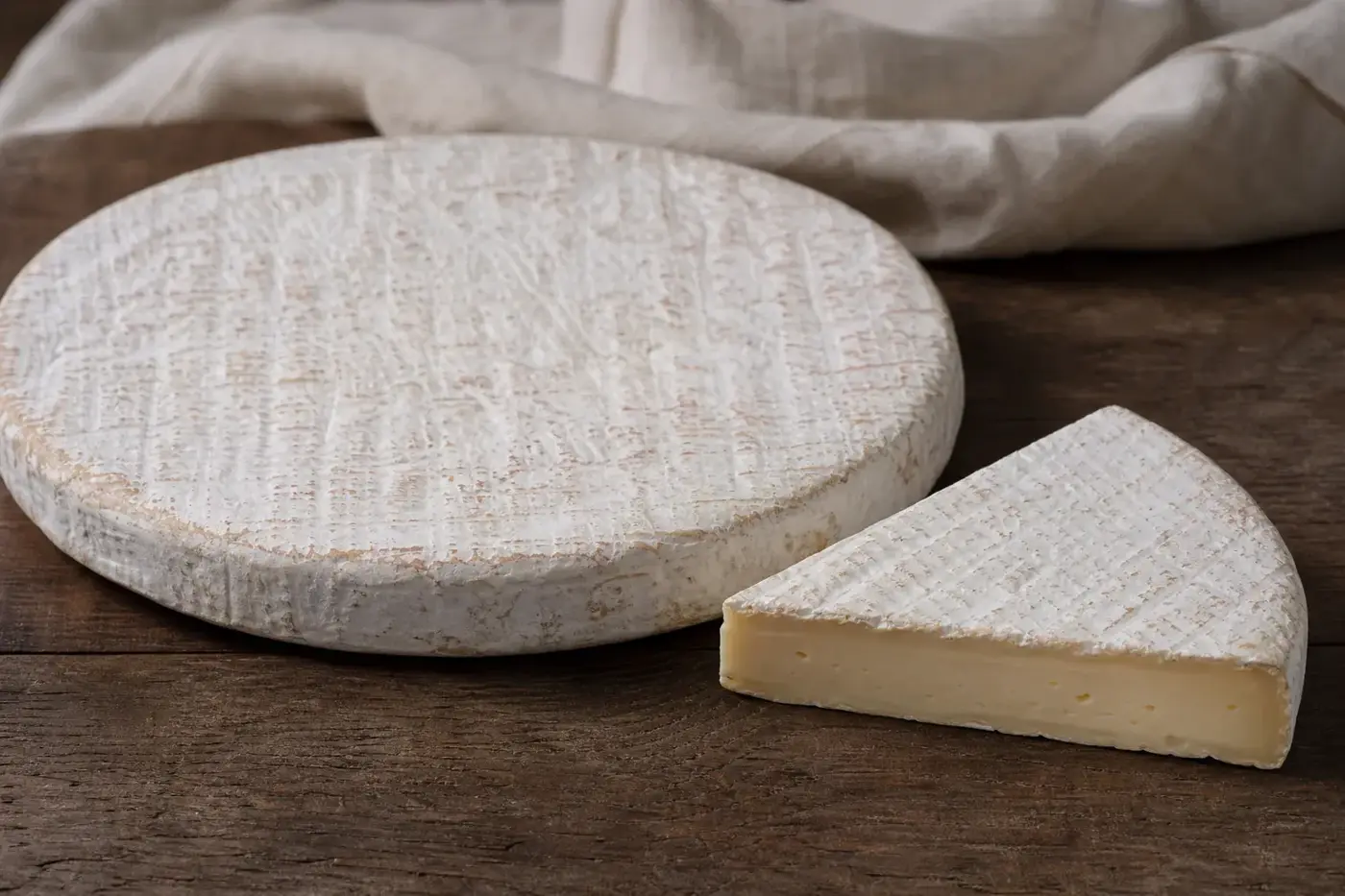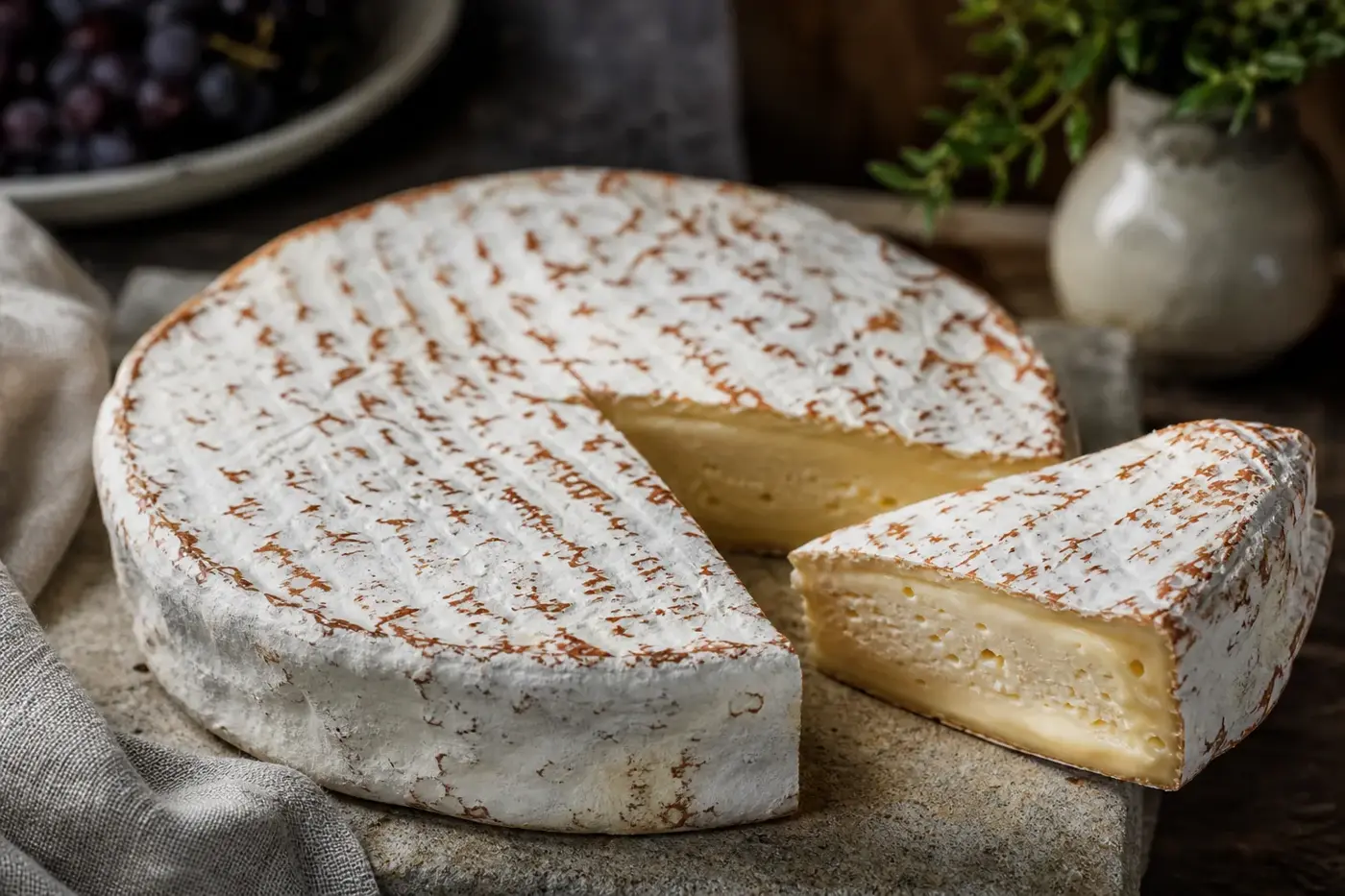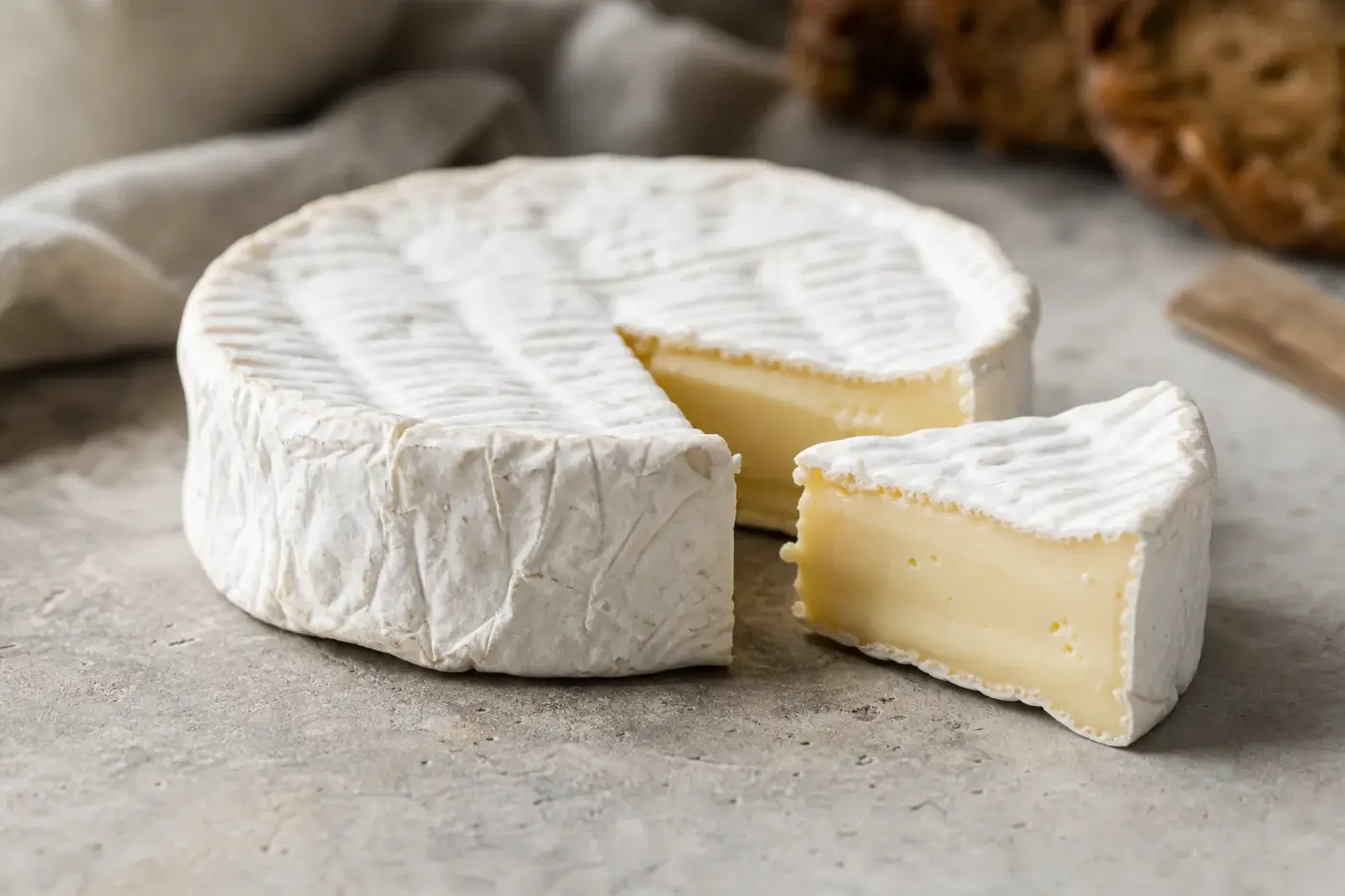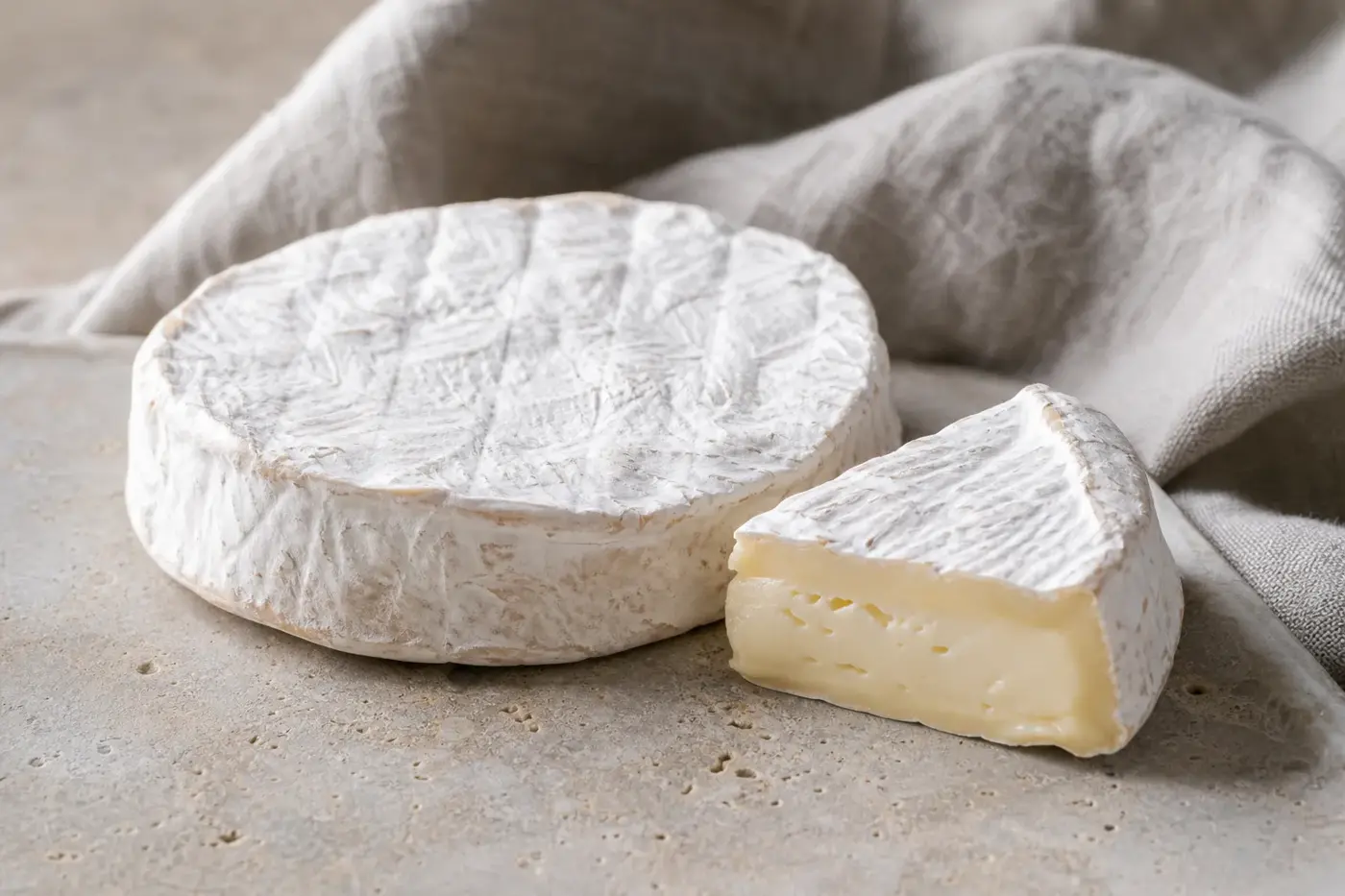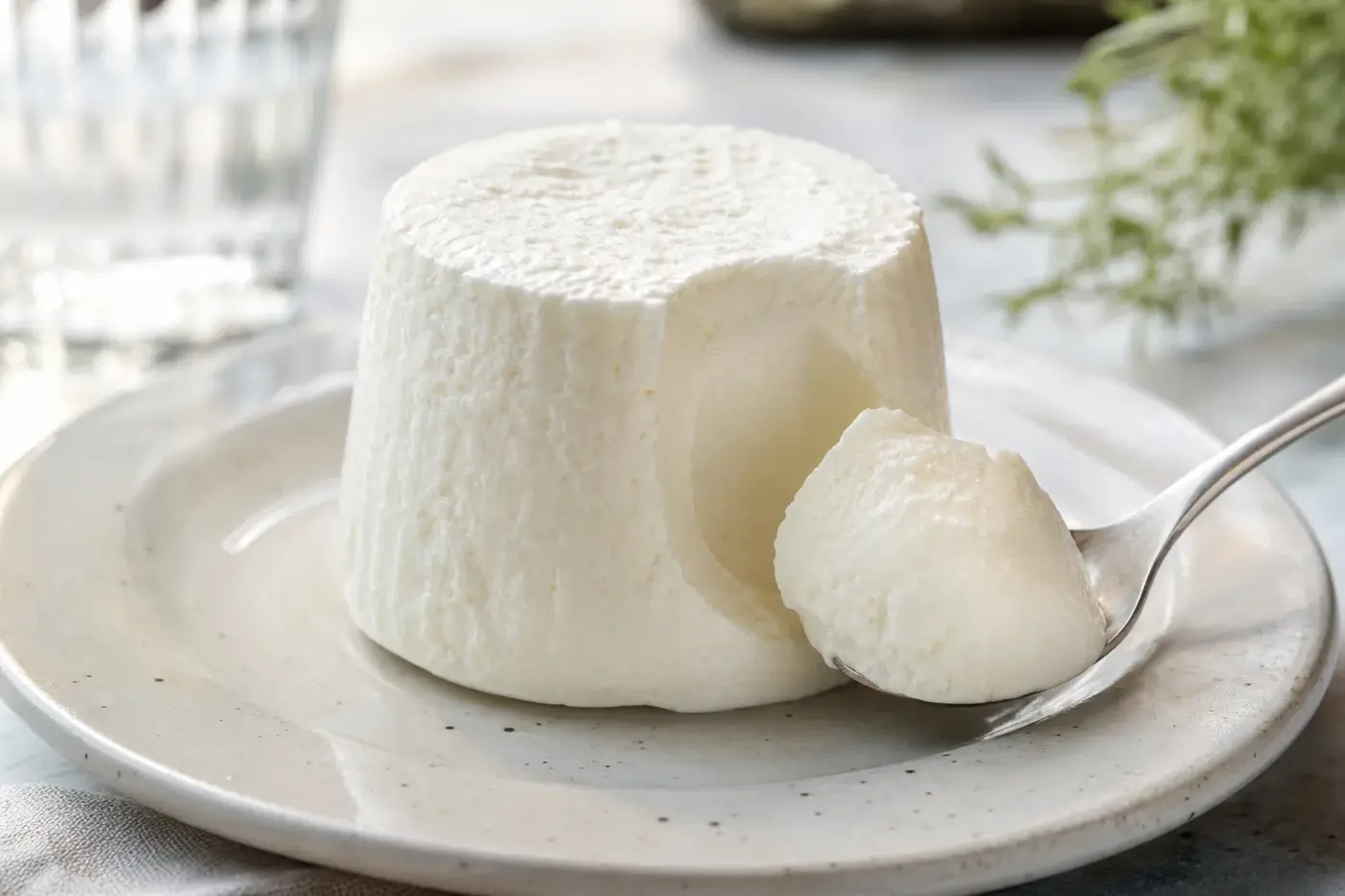
Your spoon nudges a little white cylinder. It holds for a moment, then yields: 30 g or 60 g of fresh cheese, with no rind and no maturing to wait for. Petit-Suisse sounds Swiss, but this unripened cow’s milk cheese belongs to France’s Pays de Bray, with cream enriching the familiar formulation. Its name has travelled further than its roots. [1][2][3]
| A quick introduction | What you’ll find |
|---|---|
| Familiar name | Petit-Suisse. [1] |
| French statutory denomination | Petit-suisse. [1] |
| Cheese family | Fresh fromage blanc, unripened. [1] |
| Historical home | Pays de Bray, particularly the account preserved by Ferrières-en-Bray. [3] |
| Milk and cream | Cow’s milk; cream added in the producer formulation described here. [1][2] |
| Milk treatment on the label | Alsace Lait declares pasteurised milk and pasteurised cream. [2] |
| Cultures | Alsace Lait declares lactic cultures, without naming strains. [2] |
| Shape and size | Cylindrical, 30 g or 60 g in the French statutory description. [1] |
| French legislation | Décret n°2007-628, Articles 2 and 6 and annex, consolidated text as of November 2026. [1] |
| Paper wrapping | Alsace Lait declares potassium sorbate in treated paper. [2] |
A little cylinder with a soft landing
That moment when Petit-Suisse gives way is much of its appeal. You get an even paste, not a firm cheese demanding a knife. The French specification calls the paste homogeneous; Alsace Lait describes its version as fresh and unsalted, made through smoothing and draining, and shows a white cheese without a developed rind. [1][2]
Fermentation helps build that fresh character. Lactic cultures turn lactose into lactic acid, while fat, retained water and acidity shape the finished cheese. What you feel on your spoon owes as much to the water left in the curd as to the cream added to the milk. [2][5]
If you are exploring fresh and ripened cheeses, how to tell cheese styles apart helps you find your bearings.
Follow that Swiss name into the Pays de Bray
“Little Swiss” is the name. The dairy story takes you somewhere else: the Pays de Bray. Ferrières-en-Bray’s municipal history traces the beginnings to a local farmer who mixed curd with fresh cream on the advice of a Swiss cowherd. [3]
In that telling, Swiss dairy knowledge helped shape a cheese made in France. The municipality preserves this as a local tradition, looking back rather than offering a contemporary account of the conversation or first batch. You can enjoy its regional significance without turning every detail into a recorded moment of invention. [3]
The account roots the cheese in its district and explains its name through the Swiss worker. It leaves you without a named inventor, an exact discovery date or a complete original recipe. The regional connection is clear in the municipal narrative; the precise circumstances of invention are less firmly documented. [3]
Charles Gervais takes the cheese to Paris
Charles Gervais enters the story with ambitions beyond the district. Ferrières-en-Bray’s account describes him taking the cheese to the Paris market, acquiring exploitation rights and expanding production. It dates the dairy’s installation at the ferme de l’Estre to 1869, followed by the inauguration of an industrial cheese dairy in 1873. [3]
Danone’s product sheet, created in February 2022, gives you a different ancestry. It describes Gervais Petit Suisse as inspired by a cheese created by Charles Gervais in 1852. The company account places Gervais at the centre; the municipal history also keeps the earlier farmer and Swiss worker in the picture. [3][4]
Together, the accounts offer a commercial lineage and a local tradition, rather than one neat founding moment. Gervais emerges as a developer and commercial organiser, central to bringing the cheese to a larger market. Giving him sole credit for invention would squeeze a complicated regional history into too small a mould. [3][4]
From milk and cream to your spoon
Behind the small cylinder are three important changes: fermentation, coagulation and water removal. Coagulation is the moment milk proteins form a gel. The curd holds water and fat, while the liquid that separates from it is whey. [5]
Lactic cultures turn lactose, milk’s sugar, into lactic acid. As acidity rises, the milk proteins become able to form a network. Tetra Pak’s technical handbook describes this route for fresh cheeses and distinguishes it from coagulation driven mainly by rennet, a preparation of enzymes that clot milk. [5]
Alsace Lait’s current formulation lists pasteurised milk, pasteurised cream and lactic cultures. Its production description puts smoothing before draining. The ingredients name neither individual culture strains nor a coagulant, so turn to your particular product’s information rather than making assumptions from the name Petit-Suisse. [2]
Each step earns its place. Cream adds milk fat; draining removes some of the watery phase and concentrates the mixture. Smoothing makes the paste even, and the manufacturer’s balance determines whether your spoonful feels firmer, softer or more substantial. [2][5]
For the bigger picture behind milk, curd and whey, turn to how cheese is made.
Unwrap your portion and enjoy it fresh
The cylinder is more than a familiar piece of presentation. Petit-Suisse’s French statutory description specifies that shape and the 30 g and 60 g formats. Your pack gives the quantity supplied: Danone’s February 2022 sheet, for example, describes twelve individual portions of 60 g each. [1][4]
Paper is another recognisable part of the ritual. Alsace Lait’s ingredient declaration identifies a preservative associated with its treated paper. If your portion comes wrapped, remove the paper completely before eating: it is packaging, not part of your spoonful. [2]
There is no cellar stage to wait for here. Petit-Suisse is an unripened fresh cheese, its character established through fermentation and draining without a later period of rind development or cellar maturation. You are choosing freshness, rather than a cheese intended to develop further in flavour and texture through ageing. [1][5]
Two fat figures? Start with the water
Two fat percentages can describe the same cheese and look surprisingly different. Before you compare them, ask one useful question. Does the calculation include the water?
Fat in the whole cheese includes water in the cheese’s weight. If a declaration says 10 g fat per 100 g cheese, fat accounts for one tenth of the finished product.
Fat in dry matter leaves water out of the calculation. It measures fat as a proportion of the solids left after drying. French cheese regulations use dry-matter measurements in composition requirements, while the nutrition declaration gives fat per 100 g of finished food. [1]
Try this deliberately hypothetical example. Your 100 g of cheese contains 25 g dry matter, including 10 g fat. That gives you:
- 10% fat in the whole cheese.
- 40% fat in its dry matter, because 10 divided by 25 equals 0.4.
Both figures are right; they simply answer different questions. One describes the cheese you eat. The other describes its solids, with the water taken out of the equation.
For a real product, Alsace Lait declares 10.4% fat in its finished Petit-Suisse. Compare that with another figure for finished cheese, not directly with a dry-matter percentage elsewhere on a label. [2]
If the wording leaves you puzzling, reading a cheese label separates composition terminology from the nutrition panel.
Meet the neighbours in the dairy aisle
Petit-Suisse, fromage blanc, cream cheese and yoghurt can all find their way to your breakfast table or dessert bowl. They may look like neighbours, but their names describe different products. A similar appearance does not make them interchangeable.
| Product | What makes it different |
|---|---|
| Petit-Suisse | A specifically described French fresh cheese with a homogeneous paste and small cylindrical format. [1] |
| Fromage blanc | The broader French category of unripened cheese that includes Petit-Suisse. [1] |
| Cream cheese | The United States standard requires at least 33% milk fat and no more than 55% moisture in the whole food. Standard as of November 2026. [6] |
| Yoghurt | A fermented dairy product listed separately from cheese in NHS dairy guidance. Sharing a serving occasion does not mean sharing a composition. [7] |
Before you swap one for another, think about the job it needs to do. A spoonable breakfast accompaniment gives you more freedom than a baked filling whose structure depends on a particular balance of water, fat and protein. Start with your recipe’s needs, then compare the products.
Cream cheese meeting the US standard contains substantially more fat than the Alsace Lait Petit-Suisse example. Substituting one for the other changes the mixture, not just the name on your ingredient list. White colour and a smooth appearance tell you less than the actual composition. [2][6]
Brown sugar first, then a little kitchen adventure
Turn Petit-Suisse into a bowl and add brown sugar or jam. Alsace Lait records this simple way to serve it, keeping the fresh cheese at the centre. Leave the topping separate for your first few spoonfuls, or stir it through. [2]
For something more substantial, the same producer publishes a Petit-Suisse cake with hazelnuts and chocolate. The cheese joins eggs, flour and butter in the batter. A recipe written for Petit-Suisse gives you a useful starting point, though this is a producer’s recipe promoting its own product. [8]
You can take a savoury route, too. Alsace Lait’s asparagus tartlet combines Petit-Suisse with eggs and milk in the filling. Here the cheese contributes to a moist filling bound by the other ingredients, rather than serving as a topping expected to form a crisp cheese crust. [9]
For a simpler plate, try a little with chopped herbs alongside cooked vegetables. Or season it as a cold accompaniment to potatoes. These are serving suggestions, not recipes tested by the site.
When you adapt a batter or filling, remember what accompanies the creaminess: water as well as fat. Assess the whole mixture before adding extra liquid. The producer’s cake and tartlet offer useful models because their other ingredients already allow for the fresh cheese’s contribution. [8][9]
Let your pack tell you the particulars
Start with the food’s name and ingredient list. Alsace Lait offers a concrete example: milk, cream, lactic cultures and a preservative associated with the paper. Formulations can differ, so read the declaration on the pack you have in front of you. [2]
Next, look for milk treatment, fat per 100 g, portion weight, storage instructions and date. These tell you how the milk was treated, what the cheese contains, how much you are getting and how to keep it. UK government labelling guidance also treats date information and allergen information as separate checks. [10]
Read those details together rather than choosing by the familiar cylinder alone. The name identifies the food. The rest of the label helps you choose, serve and store that particular pack.
For help with milk-treatment terms, see raw milk, thermised and pasteurised cheese.
Keep it fresh and give the dates their due
Following Food Standards Agency guidance for England, Wales and Northern Ireland means keeping your fridge between 0 °C and 5 °C (32 °F and 41 °F). The agency advises refrigerating dairy products and following their packaging’s storage instructions. Take the portion you need, then return the pack promptly to the fridge. [11]
A use-by date is a limit, not a suggestion. UK government guidance says not to eat food after it, and you should also follow any shorter instruction for an opened pack and its stated storage conditions. A best-before date does a different job: it concerns quality. [10]
If you are pregnant in the UK, NHS advice includes pasteurised soft cheeses, such as cream cheese and cottage cheese, among cheeses you can eat. It treats soft cheeses with a white rind and soft blue cheeses separately, including an exception when cooked until steaming hot. Read your product label alongside the current NHS pregnancy guidance, as of November 2026. [7]
For everyday fridge arrangements, continue to how to store cheese at home.
General information only, not medical advice: follow the official guidance where you live.
Questions people ask
What is Petit-Suisse?
Petit-Suisse is an unripened French fresh cheese made from cow’s milk. It has a homogeneous paste and is ready to eat without ageing.
Is Petit-Suisse made with pasteurised milk?
Alsace Lait declares pasteurised milk and pasteurised cream in its Petit-Suisse. Check the label for the milk treatment used in the product you buy.
How do you eat Petit-Suisse?
Alsace Lait suggests serving it in a bowl with brown sugar or jam. Its recipes also use it in a hazelnut and chocolate cake and an asparagus tartlet.
How should Petit-Suisse be stored?
The Food Standards Agency advises refrigerating dairy products and keeping the fridge between 0 °C and 5 °C in England, Wales and Northern Ireland. Follow the storage instructions on the pack, and do not eat the cheese after its use by date.
Can you eat Petit-Suisse during pregnancy?
The NHS says pasteurised soft cheeses such as cream cheese and cottage cheese can be eaten during pregnancy. Check the product label alongside the current NHS guidance at https://www.nhs.uk/pregnancy/keeping-well/foods-to-avoid/.
Sources
- Légifrance, Décret n°2007-628 du 27 avril 2007 relatif aux fromages et spécialités fromagères, consolidated version displayed as in force on 7 November 2026. Articles 2, 6 and 12, and annex. Official text.
- Alsace Lait, Petit-Suisse, undated producer product page, retrieved November 2026. Product description, ingredients, formats and accompanying product image. Producer page.
- Commune de Ferrières-en-Bray, Visite historique de la ville de Ferrières-en-Bray, undated municipal history, retrieved November 2026. Section describing the development of the Gervais dairy. Municipal account.
- Danone France, Le Petit Suisse Gervais nature 9,5 % 60 g x 12, product sheet created 1 February 2022. Marketing description and pack specification. Manufacturer’s document.
- Tetra Pak, Dairy Processing Handbook, Chapter 16, Cheese, online edition retrieved November 2026. Sections on starter cultures, rennet and fresh-cheese production. This is an equipment manufacturer’s technical reference. Technical chapter.
- US Food and Drug Administration, 21 CFR 133.133: Cream cheese, eCFR text displayed as updated through 5 November 2026. Paragraph (a)(1). US standard.
- NHS, Foods to avoid in pregnancy, current online guidance retrieved November 2026. Section “Cheese, milk and other dairy”. NHS guidance.
- Alsace Lait, Cake aux petits suisses, noisettes & chocolat, undated producer recipe, retrieved November 2026. Ingredients and preparation. Producer recipe.
- Alsace Lait, Tartelettes asperges chorizo parmesan, undated producer recipe, retrieved November 2026. Filling ingredients and preparation. Producer recipe.
- UK Government, Understanding food labelling: Best before and use-by dates, current online guidance retrieved November 2026. Date guidance.
- Food Standards Agency, How to chill, freeze and defrost food safely, GOV.UK guidance, publication page dated 18 December 2017, current document retrieved November 2026. Applies to England, Northern Ireland and Wales. Refrigeration guidance.
Researched through French legislation, published producer information, a municipal historical account, technical literature and official UK consumer guidance, with historical narratives distinguished from contemporary evidence.
Last checked: November 2026
Last checked November 2026.
The editors suggest you read next