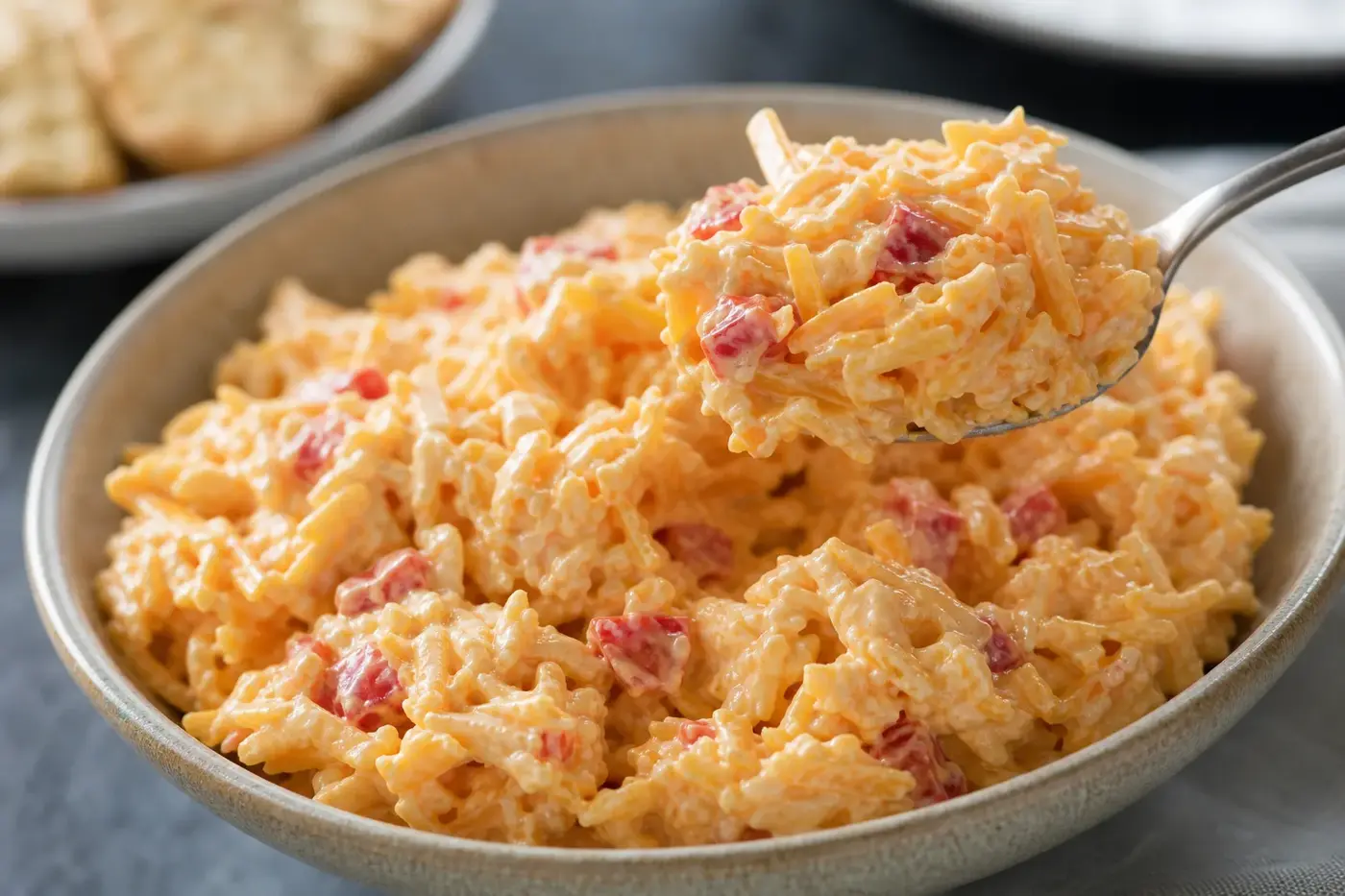
Drag a cracker through the bowl. You should catch sharp cheddar shreds, sweet red pepper and just enough creamy mayonnaise to bring them together. Pimento cheese is a spread with texture, not a single variety of cheese, and it asks rather more of a cracker than looking decorative.
Closely associated with the American Southern states, it is easy to make in your own kitchen with British cheddar and jarred peppers.[1]
Let those cheddar shreds show
Think sandwich filling or savoury dip: grated cheese bound by dressing and dotted with chopped pepper. The balance of cheese and mayonnaise decides whether your pimento cheese sits firmly on a cracker or spreads softly across bread.[4]
Give the cheese the leading role. You want visible shreds among small pieces of pepper, with mayonnaise coating each spoonful rather than pooling around it. Scatter the peppers throughout, so their sweetness reaches every bite.
A Southern story, on the page by 1913
Open Dishes & Beverages of the Old South, published in October 1913, and you find finely ground canned pimento, cream cheese and French dressing combined for a pineapple salad. Elsewhere, the book recommends pimento cheese inside buttered bread sandwiches.[2] This bowl has never had just one possible beginning.
Pimento cheese already belonged to the published Southern repertoire, but cheddar and mayonnaise were not fixed ingredients. That early cream cheese mixture gives today's soft cheese additions a historical precedent. You can still leave cream cheese out of the recipe below.[2]
Southern Living's contemporary recipe puts cheddar, mayonnaise and pimientos at the centre, with seasonings around them. Read it alongside the historical cookbook and you see an enduring pepper and cheese partnership. The cheese and dressing have changed; the idea has stayed.[1][2]
Meet the pepper that brings sweetness
Pimentos, also spelt pimientos, bring sweetness rather than fire. Oregon State University Extension describes pimiento peppers as thick-walled, sweet and red when ripe, and classifies them as having no heat. You want the pepper here, not the spice called pimento or allspice.[3]
In a British kitchen, drained jarred roasted red peppers make a practical substitute. Choose a plain version for your first batch, as garlic, smoke or a strongly vinegary preserving liquid will steer the spread elsewhere. Taste a piece before mixing: that flavour will come along in every spoonful.
Give good cheddar the lead
Start with a block of mature cheddar you enjoy eating. If its sharpness overwhelms the finished spread, try part mature and part milder cheddar next time. If mayonnaise takes over instead, increase the cheddar proportion; the cheddar guide explains the cheese itself.
Use ready-made mayonnaise and follow its storage instructions. A plain, full-fat version is your starting point, but taste it before reaching for seasonings. Sweet, salty or mustardy mayonnaise brings those qualities into the bowl, so mix everything first and then decide what is missing.
Make a bowl of your own
Recipe status: desk-developed adaptation informed by Good Food's published pimento cheese recipe, with a higher proportion of cheddar and optional soft cheese.[4]
Yield: approximately 400 g before optional additions, calculated from ingredient weights.
Serves: 6 as a spread.
Preparation: mixing and grating, plus 30 minutes chilling.[4]
Cooking and oven temperature: not applicable.
Equipment: scales, box grater, sieve, chopping board, knife, mixing bowl, spoon and lidded container.
Gather the cheddar and peppers
- 250 g mature cheddar, weighed without rind
- 75 g mayonnaise
- 75 g pimentos or plain roasted red peppers, weighed after draining and blotting
- Black pepper, to taste
- Optional: 5 ml hot sauce
- Optional: 50 g plain cream cheese for a softer version
- Salt, only if needed after tasting
Grate, fold and find your balance
- Wash your hands and use clean utensils. Drain the peppers in a sieve, then blot with kitchen paper. Remove stray seeds or tough skin and chop the flesh into small pieces.
- Grate the cheddar from the block. Use the coarse holes for most and the finer holes for the rest, leaving enough shreds to give your finished mixture texture.
- Stir together the mayonnaise and peppers. If you are using cream cheese, work it into the mayonnaise first, breaking up any large lumps.
- Fold in the cheddar with a spoon until the dressing coats it evenly. Stop while you can still see the shreds, before the mixture becomes a smooth paste.
- Taste, then add black pepper and the optional hot sauce. Try a little on your serving cracker or bread before deciding whether it needs salt.
- Cover and refrigerate for 30 minutes, then assess the consistency again.[4] Keep at 0 to 5 °C (32 to 41 °F) under the FSA guidance for England, Northern Ireland and Wales.[5]
Allergens: milk in cheddar and cream cheese; egg in conventional mayonnaise. Check for mustard in mayonnaise and for allergens in the hot sauce.[6]
Handling and leftovers: refrigerate promptly in a clean, covered container. Following the FSA's general household advice, use leftovers within 48 hours, or sooner if an ingredient's instructions require it.[5]
Choose softer, hotter or crunchier
Cream cheese gives you a softer, more cohesive spread. Good Food's recipe includes it, as does the earlier Southern cookbook, although with a different dressing.[2][4] Start without it for the cheddar-led mixture above, then choose the optional addition if you want something softer.
The peppers supply sweetness, not heat, so hot sauce is entirely optional.[3] Add it a little at a time. A vinegar-led sauce brings acidity as well as chilli, so taste before reaching for lemon juice or another acidic seasoning.
For another batch, try a little finely chopped spring onion or well-drained chopped pickle. Give each extra ingredient its own audition. Garlic, onion, smoke and chilli cannot all have the solo.
Nudge the balance, one spoonful at a time
Before changing the whole bowl, test your adjustment in a small spoonful. You can find the balance you like without involving every seasoning in the cupboard. Start with the fix that matches what you taste.
- Too sharp? Fold a little milder cheddar or optional cream cheese into a sample. Choose your favourite result before adjusting the batch.
- Too salty? Leave out further salt and hot sauce, and try the spread on unsalted bread. Next time, choose less salty ingredients rather than automatically adding more mayonnaise.
- Too hot? Make a second portion without hot sauce, then combine the two gradually. Sweetness alone changes the flavour without removing the chilli.
- Too stiff? Work in mayonnaise a teaspoon at a time. Stop when the spread no longer tears your bread.
- Too loose? Chill before adjusting. If liquid still collects around the mixture, fold in more grated cheddar. Next time, blot the peppers more thoroughly and add mayonnaise gradually.
Bring out the crackers and soft bread
Set out your bowl with crackers and celery sticks, or spread pimento cheese between slices of soft bread. A spoonful works as a burger topping, too.[1] Keep the accompaniments simple and let the chopped pepper and grated cheese hold your attention.
For your first serving, choose plain crackers rather than strongly flavoured ones. Put pickles alongside so everyone can find their own balance. Making sandwiches? Carry the filling evenly to the edges, rather than leaving a mound in the centre.
To drink, try a lightly bitter pale ale, a dry white wine such as Chenin Blanc, or sparkling water with lemon. The first two bring bitterness or acidity against the mayonnaise, while the water keeps the accompaniment neutral. Unsweetened iced tea gives you another alcohol-free option.
Alcoholic suggestions are for adults of legal drinking age, in small servings. If you would like more pairing principles, see cheese and wine pairing.
Keep your bowl cool and servings fresh
Keep your spread covered at 0 to 5 °C (32 to 41 °F), following the ingredients' use-by dates and after-opening instructions. The FSA guidance used here applies to England, Northern Ireland and Wales; November 2026 is the reference point. Keep chilled food out for the shortest possible time: the agency gives a maximum of four hours during preparation.[5]
At serving time, put out a small bowl and leave the rest refrigerated. When you need more, bring out a fresh bowl rather than topping up the old one.
Date the container when you mix the spread. Follow the FSA's general advice to eat leftovers within 48 hours, with any shorter ingredient instruction taking precedence. For broader storage principles, see how to store cheese at home.[5]
This page summarises published guidance from the official sources it cites. It is not medical advice. Guidance differs between countries and changes over time, so check the current source for where you live, and ask your doctor, midwife, pharmacist or dietitian about your own circumstances.
Look beyond the cheddar for allergens
Your bowl contains milk from cheddar and optional cream cheese, plus egg when you use conventional egg-based mayonnaise. Mayonnaise may also contain mustard. Bread and crackers can introduce cereals containing gluten, while celery alongside is itself an allergen identified in FSA guidance.[6]
The FSA advises checking labels and asking about specific allergens.[6] Look at every ingredient and accompaniment, including sauces and garnishes, rather than stopping at the cheddar. For personal dietary questions, follow the official guidance for your country and speak to your healthcare professional.
Questions people ask
What is pimento cheese?
Pimento cheese is a spread, not a single variety of cheese. It combines grated cheese, dressing and chopped sweet pepper, and is closely associated with the American Southern states.
What can I use instead of pimentos?
Drained jarred roasted red peppers are a practical substitute. Choose a plain version for the first batch, as garlic, smoke or a strongly vinegary preserving liquid will change the flavour.
How do you make pimento cheese?
Mix 75 g mayonnaise with 75 g drained, blotted and chopped pimentos or roasted red peppers, then fold in 250 g grated mature cheddar. Season to taste, cover and refrigerate for 30 minutes. The recipe makes approximately 400 g before optional additions and serves six as a spread.
What allergens are in pimento cheese?
The recipe contains milk from cheddar and optional cream cheese, and conventional mayonnaise contains egg and may also contain mustard. Bread, crackers and celery can introduce other allergens. The FSA advises checking labels and asking about specific allergens; see its allergen guidance.
How long does pimento cheese keep?
The FSA advises keeping it covered at 0 to 5 °C in England, Northern Ireland and Wales. Its general advice is to eat leftovers within 48 hours, or sooner if an ingredient has a shorter instruction. See the FSA guidance for current advice.
Sources
[1] Southern Living Test Kitchen. Basic Pimiento Cheese, updated 8 April 2024. Published recipe and accompanying ingredient and serving notes. Source.
[2] Project Gutenberg. Dishes & Beverages of the Old South, original edition published October 1913; electronic edition updated 2021. Original pages 192 and 217. Source.
[3] Oregon State University Extension Service. Grow your own peppers, EC 1227, online edition retrieved November 2026, section on pimiento peppers. Source.
[4] Good Food. Pimento cheese, undated online recipe, retrieved November 2026. Source.
[5] Food Standards Agency. How to chill, freeze and defrost food safely, published 18 December 2017, current online edition retrieved November 2026. Applies to England, Northern Ireland and Wales. Source.
[6] Food Standards Agency. Food allergy and intolerance advice for consumers, online edition retrieved November 2026; publication page updated 7 August 2026. Source.
[7] Food Standards Agency. Alerts, live recall and allergy alert index, retrieved November 2026. Source.
This piece combines desk research in a historical cookbook, published recipes, university horticultural guidance and current FSA consumer advice, with explicitly identified editorial recipe and pairing suggestions.
Last checked: November 2026
Last checked November 2026.
The editors suggest you read next