Queso Manchego vs Pecorino Romano
Set a 20 to 35 kg Pecorino Romano wheel beside a whole Manchego of just 0.4 to 4 kg.
Set a 20 to 35 kg Pecorino Romano wheel beside a whole Manchego of just 0.4 to 4 kg. One rather dominates the introductions.[4,5] Take a bite, though, and size becomes the less interesting difference. Both are sheep’s milk cheeses, but Manchego brings firm slices from La Mancha, while Pecorino Romano has a sharper, more assertive character shaped in central Italy and Sardinia.[1,2]
Picture Manchego at the centre of your plate. Reach for Pecorino Romano when you want a concentrated grated finish.[3,4] That gives you a useful starting point, but there is plenty to discover beyond the cheese knife.
Get acquainted, side by side
| What to look for | Queso Manchego | Pecorino Romano |
|---|---|---|
| The milk | Sheep’s milk, exclusively Manchega breed [1] | Whole sheep’s milk from the production area [3] |
| Its home ground | Listed municipalities in Albacete, Ciudad Real, Cuenca and Toledo [1] | Lazio, Sardinia and Tuscany’s province of Grosseto [2] |
| The whole wheel | Cylindrical, 0.4 to 4 kg [5] | Cylindrical, 20 to 35 kg [4] |
| Minimum maturation | Cited provisions differ on the size boundary and shorter minimum [1] | Depends on the operative specification [2] |
| How it is salted | Brine, dry salt or both [1] | Not specified here |
| Your first taste | Slices and small wedges | Fine grating and shavings |
Follow the names home
Pecorino Romano need not come from Rome. Its production area takes in all of Lazio and Sardinia, plus the province of Grosseto in Tuscany. A Sardinian wheel belongs here just as firmly: the island is expressly included in the production rules.[2,3]
For Manchego, milk production, cheesemaking and maturation all stay within specified municipalities of La Mancha. You will find these in Albacete, Ciudad Real, Cuenca and Toledo. Those four province names help you find your bearings, although the legally defined area is more precise.[1]
As of November 2026, both names appear as protected designations of origin, or PDOs, on Great Britain’s official register. Each entry records an original EU registration date of 21 June 1996 and entry into the UK scheme on 31 December 2020.[6,7] These are names governed by origin and production requirements, not simply descriptions of a style. You can explore the distinction in protected names explained.
Meet the sheep behind the cheese
For Manchego, everything starts with Manchega sheep: all the milk must come from that breed. The specification permits raw or pasteurised milk, so two qualifying cheeses can have different beginnings. Check the individual product, because even that distinctive patterned rind cannot tell you which treatment was used.[1,8]
Pecorino Romano starts with fresh whole sheep’s milk from farms within its production area, according to the consortium. The milk is used raw or heated to a maximum of 68 °C for no more than 15 seconds. The consortium also describes a locally prepared starter containing heat-loving lactic bacteria.[3]
That heating treatment should not simply be called “pasteurised”. When you read a label or choose your cheese, the distinctions between milk treatments matter.
Read the rind before you reach for a knife
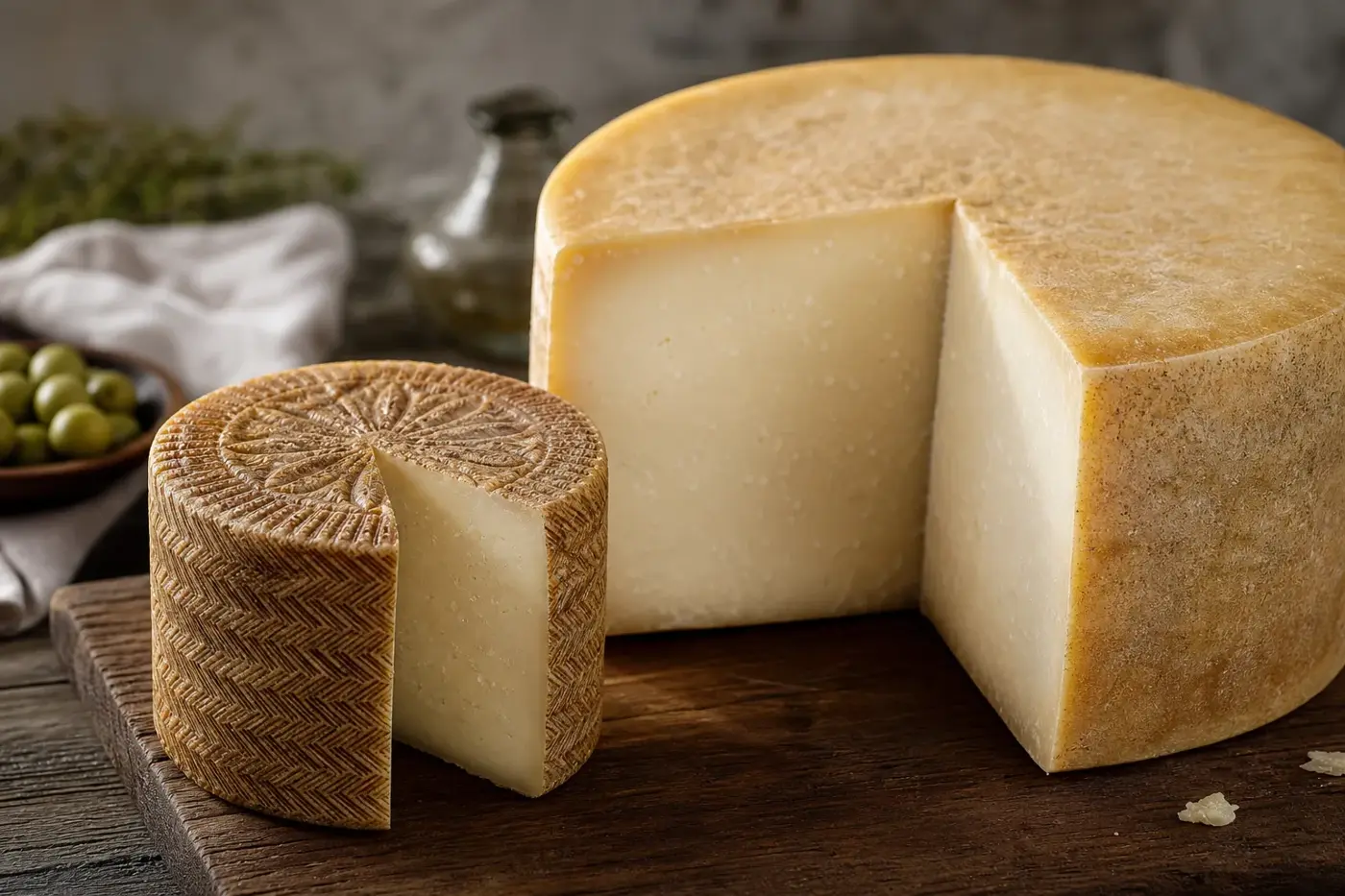
Manchego offers plenty of clues: a patterned side and flower-like impressions on its flat ends. Beneath the hard rind is a firm, compact paste, the cheesemaker’s word for the interior. Its colour runs from white to yellowish ivory, with small, irregularly scattered holes in some cheeses and none in others.[5]
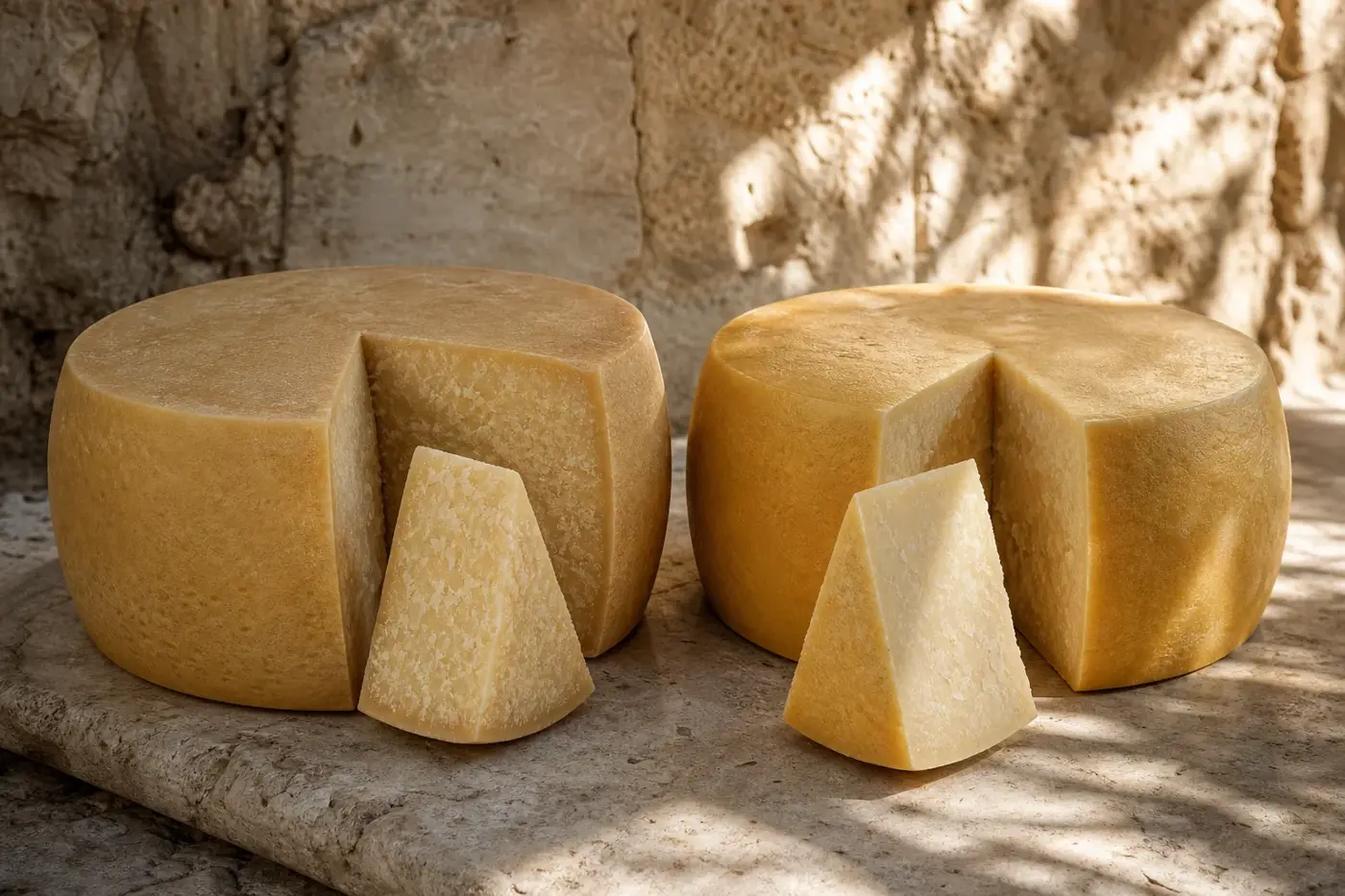
Pecorino Romano makes a much larger cylinder, carrying its name and sheep’s-head mark around the side. The consortium describes a thin ivory or straw-coloured rind, sometimes protected by a neutral or black coating. Inside, you will find white to straw-coloured cheese, with a compact texture or few holes.[4]
Once you cut a wedge, some of those identifying clues disappear. Keep the original product information with your cheese, so you can still establish exactly what you have.
Find the age that suits your appetite
Manchego becomes more piquant with extended maturation. Its specification describes a slightly acidic, strong and savoury flavour, with little elasticity and a slightly floury texture. Very mature cheese can become grainy too.[5]
That gives you more to work with than a solitary tasting adjective. Try a younger wedge when you want neat slices. Choose an older one when you fancy a more pronounced finish.
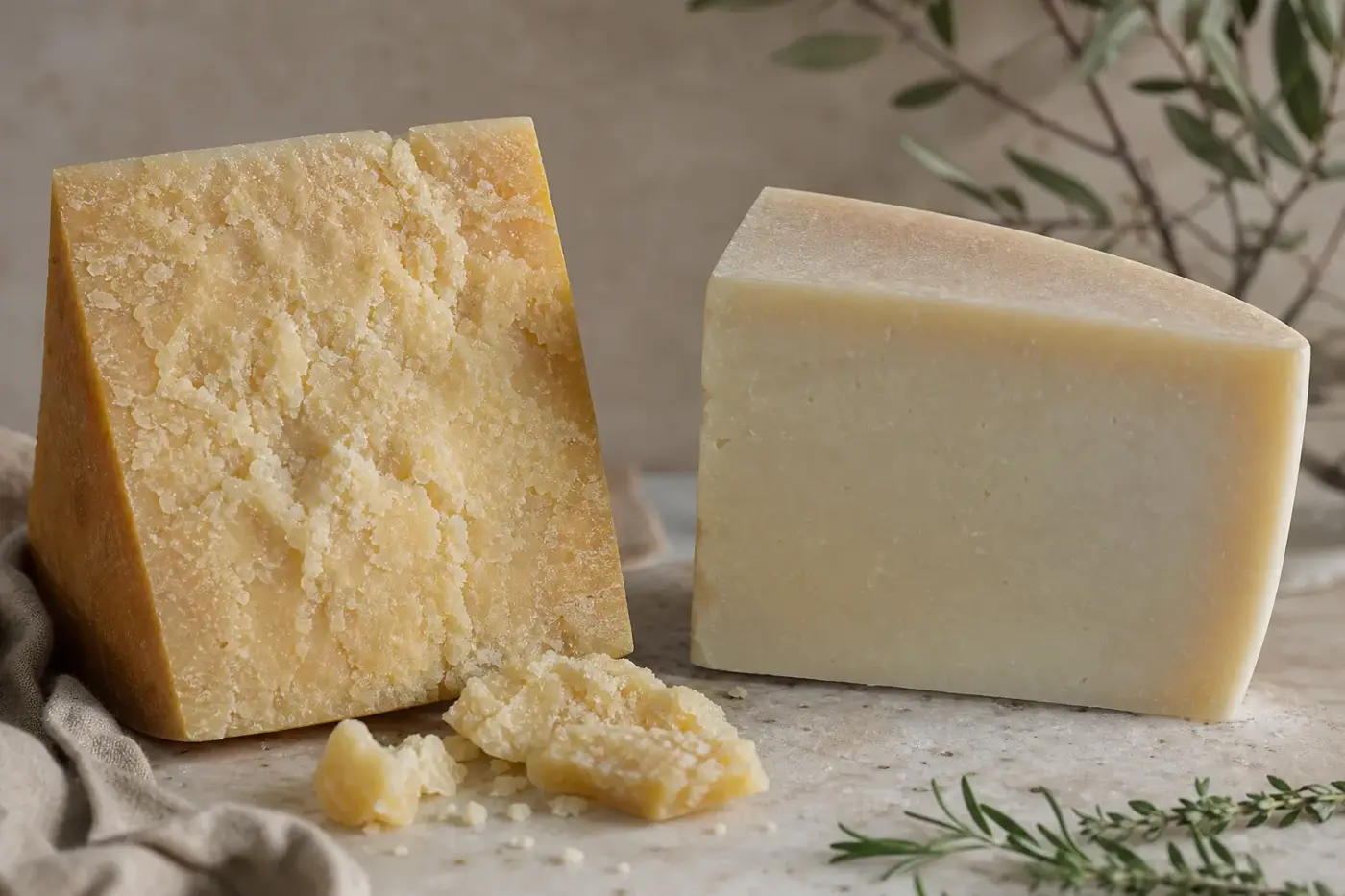
For Pecorino Romano, the consortium distinguishes between aromatic, lightly piquant table cheese and the more intensely piquant grating type.[4] Ask for the table version if you want to eat it in pieces. Choose the grating type when you need a finishing cheese.
Older is not a quality ranking, and the cheese counter is not a test of bravery. Tell the person serving you how you want to eat your cheese, rather than simply asking for the strongest one.
Step behind the rind: curds, salt and patience
Pecorino Romano uses lamb’s rennet paste. The consortium describes cutting the curd into pieces the size of wheat grains.[3] Rennet is the coagulant that helps milk become curd: the solids separated from liquid whey.
Manchego’s specification allows natural rennet or other authorised coagulating enzymes. The curd is reheated within 28 to 40 °C, then moulded and pressed.[5] Salting can involve brine, dry salt or both.[1]
The minimum maturation rules call for care: Manchego’s cited provisions differ on the size boundary and shorter minimum, while Pecorino Romano’s applicable minimum depends on its operative specification.[1,2] Keep that legal minimum separate from the age of the cheese you are buying. They are different facts, and the individual cheese’s age helps you decide how to serve it.
Make a little room on your cheeseboard
Cut Manchego into modest wedges or slices for your cheeseboard. Set accompaniments beside it rather than over it. Plain bread, pear or a little quince paste can bring contrast without taking over.
Give the cheese a taste on its own first, then try something sweet if you fancy it. You are making space for its flavour, not following a fixed pairing prescription. Let your appetite have a say.
Pecorino Romano belongs on the board too, especially its table type.[4] Offer smaller shavings with bread and raw vegetables. You can then choose the balance with each mouthful.
To compare the cheeses, give both the same accompaniments. Notice texture first, then acidity, salt and the piquancy that lingers. A consistent plate makes their differences clearer than two separate collections of strongly flavoured foods, while leaving you room to return to each cheese alone.
Ask your dish what it needs
Do you want distinct slices or a fine finishing accent? Decide that first. A less mature Manchego is a useful starting point for a sandwich, a warm vegetable tart or a topping where you want the slices to stay distinct.
Finely grated Pecorino Romano suits pasta, beans or vegetables that need a measured finishing accent. These suggestions follow the documented differences in texture and maturation. Your results will depend on the particular cheese and recipe.[4,5]
You can serve both cheeses as shavings, and Manchego’s specification expressly allows sliced and grated presentations too.[1] For a toastie, try thin slices of Manchego. For a sauce, grate Pecorino Romano finely and add it gradually, tasting before adding salt.
Work a little at a time and you stay in control. Building the balance is easier than committing the full amount at once.
Swap thoughtfully, then taste again
For a grated garnish, begin with a little of your replacement cheese. Taste it with the food before adding more. If you are replacing Manchego with Pecorino Romano, hold back the added salt until the cheese is incorporated.
Does your replacement taste saltier or more piquant? Start with less cheese, then decide whether the dish needs more. Compare the salt information on the actual packs too.
If you are swapping in the other direction, choose a mature Manchego for a pronounced finish. Taste before deciding whether extra seasoning is needed.[5] The cheese in front of you is your best guide to the next move.
For a sandwich or cheeseboard, rethink the cut as well as the cheese. Thin shavings of a forceful Pecorino Romano make a better starting point than a thick slice copied from Manchego. Adjust to the flavour and purpose of your dish, rather than looking for a fixed replacement ratio.
Give milk and rennet their own questions
Milk treatment and vegetarian suitability are separate questions. Manchego can use raw or pasteurised milk, and its rules permit more than one type of coagulating enzyme. Look for an explicit vegetarian statement supported by the producer’s coagulant information.[1,5]
For Pecorino Romano, the consortium describes lamb’s rennet. This is animal-derived and unsuitable for vegetarians.[3] For help with the terminology, turn to rennet explained.
In Great Britain, match the product name to the registered name: Queso Manchego or Pecorino Romano.[6,7] If you are buying a portion at a counter, ask to see the information from the original wheel or pack. Keep it if you will need the milk treatment, coagulant or storage instructions later.
A label can answer several questions, once you know which detail answers which. The guide to reading cheese labels helps you separate them.
Serve a portion, keep the rest chilled
For households in England, Wales and Northern Ireland, the Food Standards Agency advises a fridge temperature of 0 to 5 °C. Follow the packaging’s storage instructions and dates, including any directions after opening.[9] Prepare the portion you want to serve while keeping the remaining cheese refrigerated.
You can find more handling advice in storing cheese at home. Before serving, households in England, Wales and Northern Ireland should consult the Food Standards Agency’s current guidance on chilled food.[9] If you are serving elsewhere, follow the official advice for your country.
General information only, not medical advice: follow the official guidance where you live.
Questions people ask
What is the difference between Manchego and Pecorino Romano?
Both are sheep’s milk cheeses, but Manchego comes from specified municipalities in La Mancha and uses milk exclusively from Manchega sheep. Pecorino Romano comes from Lazio, Sardinia and the province of Grosseto in Tuscany and has a sharper, more assertive character.
Can I substitute Pecorino Romano for Manchego?
For a grated garnish, start with a little, taste it with the food and build up. When replacing Manchego with Pecorino Romano, hold back added salt until the cheese is incorporated.
Are Manchego and Pecorino Romano vegetarian?
Manchego permits natural rennet or other authorised coagulating enzymes, so look for an explicit vegetarian statement supported by the producer’s coagulant information. The Pecorino Romano consortium describes lamb’s rennet, which is unsuitable for vegetarians.
Are these cheeses made with pasteurised milk?
Manchego may be made with raw or pasteurised milk, so check the individual product. The Pecorino Romano consortium describes milk used raw or heated to a maximum of 68 °C for no more than 15 seconds; that treatment should not simply be called pasteurised.
How should I store Manchego and Pecorino Romano?
For households in England, Wales and Northern Ireland, the Food Standards Agency advises a fridge temperature of 0 to 5 °C. Follow the packaging’s storage instructions and dates, and consult the Food Standards Agency’s current guidance on chilled food before serving.
Sources
- Junta de Comunidades de Castilla-La Mancha, Resolución de 7 de febrero de 2025, Annexes I and II, consolidated single document and product specification for Queso Manchego, published in DOCM No. 38, 25 February 2025. Retrieved copy hosted by the designation’s foundation. Specification PDF.
- European Commission, Publication of the communication of an approved standard amendment to a product specification of a geographical indication, Pecorino Romano, C/2026/4125, 2 September 2026. Official Journal document.
- Consorzio per la Tutela del Formaggio Pecorino Romano, Processing, undated web edition retrieved November 2026. An industry consortium’s account of production. Processing account.
- Consorzio per la Tutela del Formaggio Pecorino Romano, Characteristics, undated web edition retrieved November 2026. Sensory descriptions are the consortium’s. Characteristics.
- Department for Environment, Food & Rural Affairs, Product specification Queso Manchego, English document identified internally as the 31 December 2020 version, linked from the current GB register entry. Specification PDF.
- Department for Environment, Food & Rural Affairs, Queso Manchego, protected food and drink names register, published 4 January 2021, current entry retrieved November 2026. Register entry.
- Department for Environment, Food & Rural Affairs, Pecorino Romano, protected food and drink names register, published 4 January 2021, current entry retrieved November 2026. Register entry.
- Fundación Consejo Regulador de la Denominación de Origen Queso Manchego, Manchego cheese, undated English web edition retrieved November 2026. Designation website.
- Food Standards Agency, How to chill, freeze and defrost food safely, household guidance, web and printable editions retrieved November 2026. Official guidance.
Researched through official register entries, published production documents, designation bodies’ accounts and Food Standards Agency guidance, with serving and substitution suggestions identified as editorial recommendations.
Last checked: November 2026
Last checked November 2026.
The editors suggest you read next
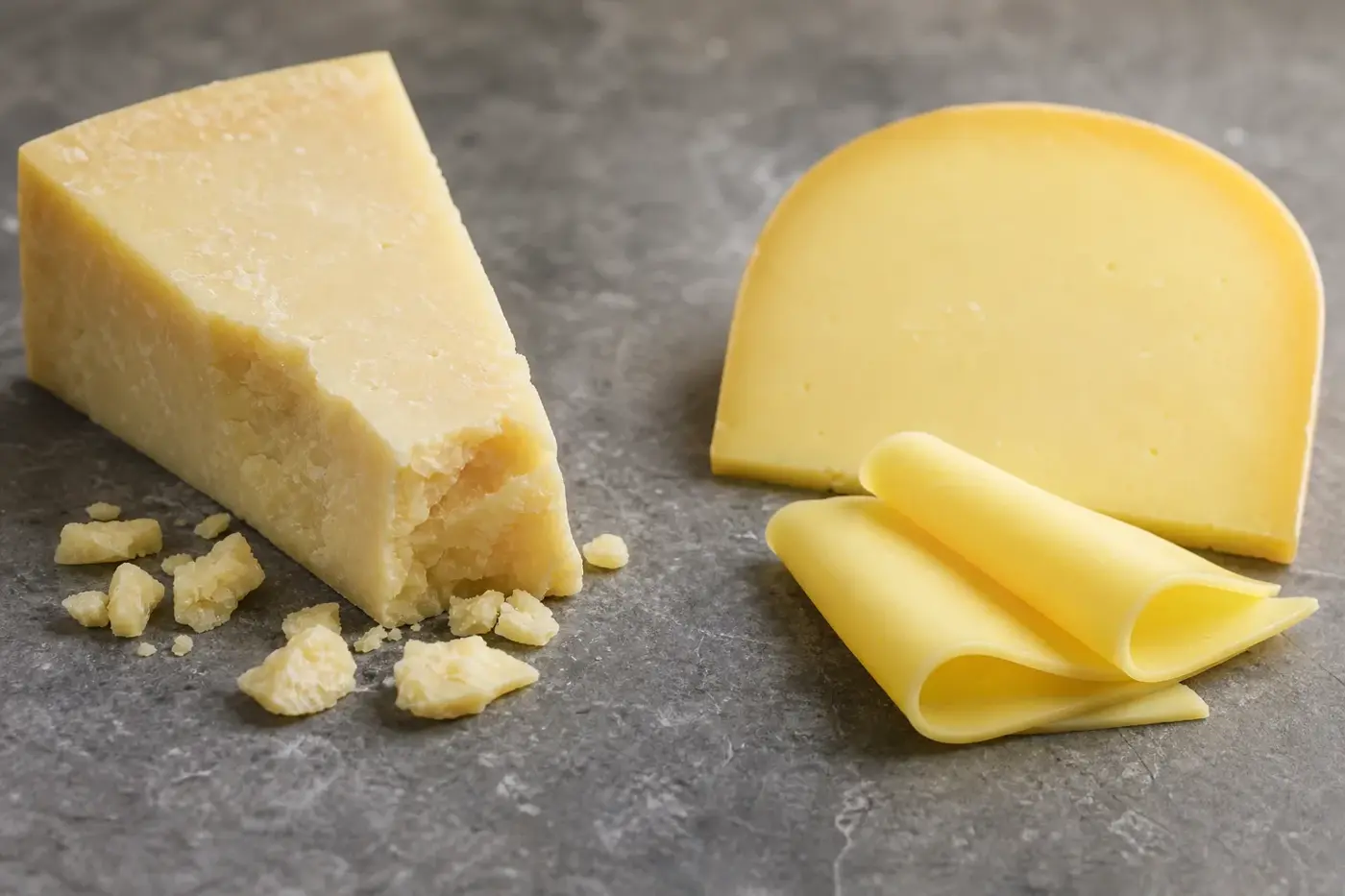
Cheddar vs Gouda: Taste, Texture and How to Use Each
Bite into a long-aged Gouda and, beneath your teeth, something crunches.