Quiche Lorraine
Cut a slice and you meet smoked bacon, thick cream and softly set eggs beneath a golden surface.
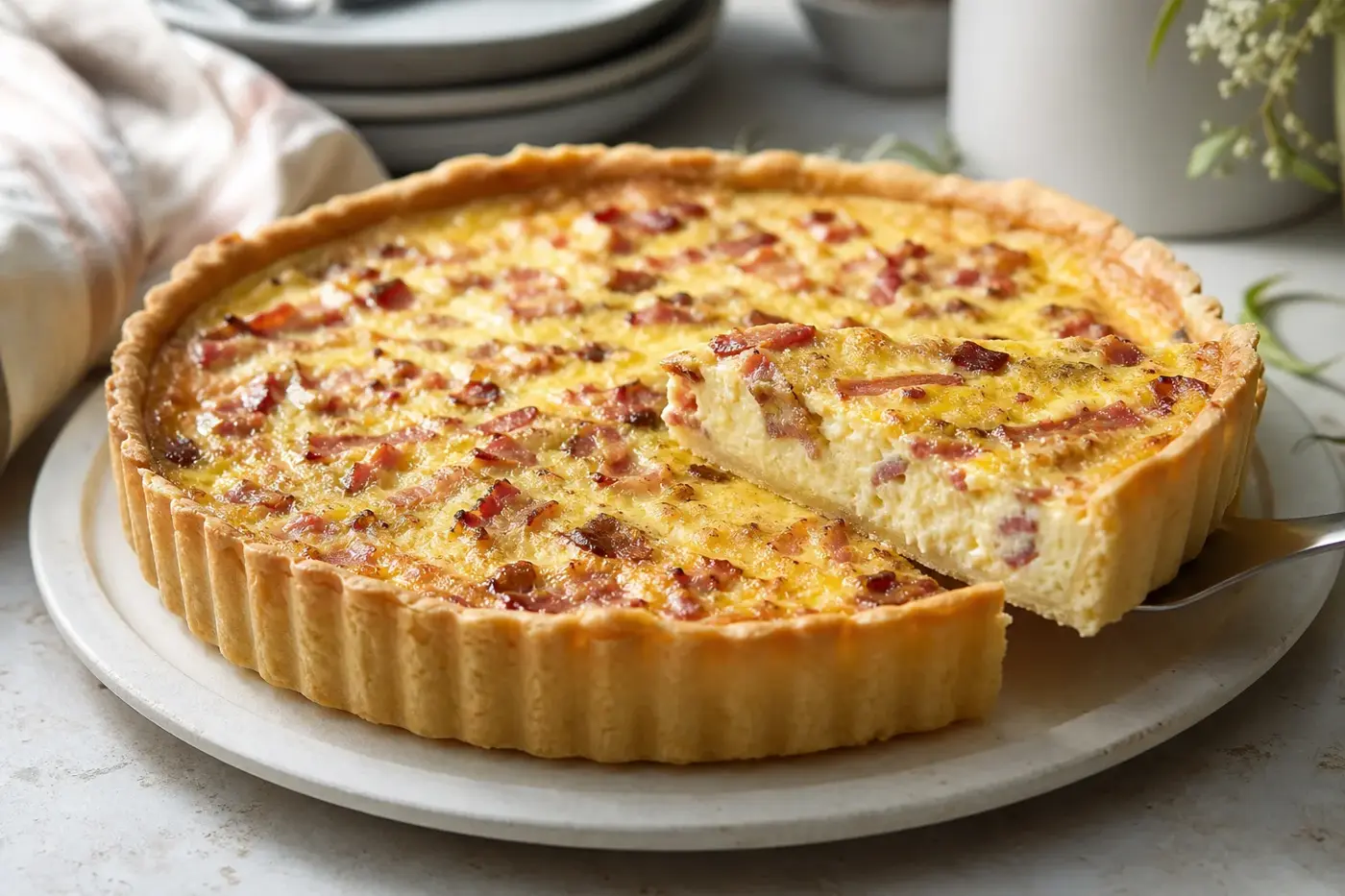
Cut a slice and you meet smoked bacon, thick cream and softly set eggs beneath a golden surface. If you are waiting for the cheese, you may be waiting a while. Traditional Quiche Lorraine, from Lorraine in north-eastern France, leaves it out and gives the pork and cream centre stage.[1][2][4]
The cheese-enriched versions familiar in Britain bring another savoury layer. Start with the Lorraine-style filling, then add cheese deliberately if that is the tart you want. There is room for both, provided you know which you are making.[1][2][4]
In Lorraine, the cream gets the spotlight
BLE Lorraine’s regional account is emphatic: traditional Quiche Lorraine contains smoked pork, eggs and thick cream, without cheese. The egg-and-cream mixture has its own name, migaine. In the regional recipe, it joins smoked bacon and a little nutmeg inside shortcrust pastry.[1]
Follow the published recipes and you can see how far this tart has travelled. Taste France keeps it cheese-free, using cream and milk; British Good Food recipes include Gruyère. A French vocational cookery teaching sheet also adds cheese in its contemporary recipe, while describing an earlier preparation without it.[2][3][4]
The clearest names are Quiche Lorraine for the first and Quiche Lorraine with cheese for the second. Whichever you choose, resist overloading it. You want pastry, scattered bacon and just enough custard to hold each slice together.
Before the pastry came bread dough
Quiche Lorraine once sat on a bread-dough base. BLE Lorraine’s regional heritage account describes its later replacement by shortcrust or puff pastry. The French vocational teaching sheet records the same broad journey from bread dough to shortcrust.[1][3]
That base does more than hold everything in place. Modern shortcrust gives you a distinct pastry shell around the eggs and cream, quite different from bread dough. The regional recipe recommends baking the shell before filling it, for a crisper finish.[1]
For the recipe below, choose shortcrust. It follows the modern regional preparation and gives you a practical starting point, whether you leave out the cheese or add it.
Your 23 cm Quiche Lorraine starts here
Recipe status: adapted from published BLE Lorraine and Good Food methods; not independently tested by fromage.co.uk.[1][5]
Yield: 8 slices, serving 8.
Tin: 23 cm diameter, approximately 2.5 cm deep, preferably metal with a removable base.
Preparation: allow about 30 minutes, plus 10 minutes chilling.
Cooking: approximately 45 minutes; use the doneness checks below, not the clock alone.[5]
Gather everything before you begin
For the pastry:
- 175 g plain flour, plus a little for rolling
- 100 g cold unsalted butter, diced
- 1 egg yolk
- 20 ml cold water
For the filling:
- 200 g smoked bacon lardons
- 3 eggs
- 200 ml full-fat crème fraîche
- 200 ml double cream
- A small pinch of ground nutmeg
- Black pepper
- Salt only if needed
For the optional cheese version:
- 50 g Gruyère or Comté
The pastry quantities, tin dimensions and cream mixture follow Good Food’s published 23 cm recipe. Leaving out its cheese is an editorial adaptation based on the regional cheese-free preparation.[1][5]
Equipment: scales, rolling pin, mixing bowl, fork or spoon, frying pan, baking sheet, foil, baking beans and a clean food thermometer.
Give your pastry a gentle start
Combine the flour, butter, yolk and water just until the dough binds. Gather it together, roll it on a lightly floured surface and ease it into the tin without stretching. Leave the edge slightly above the rim, lightly prick the base and chill for 10 minutes.[5]
Aim for an even shell, especially where the base meets the sides. Press dough into that corner rather than pulling the upper edge down to reach it. Keep the trimmings nearby: they can patch small cracks after blind baking.[5]
Prefer ready-made pastry? Plain shortcrust is a practical alternative; follow the packet instructions for handling and defrosting, and make sure it covers the tin’s base and sides. Choose plain, unfilled pastry rather than a seasoned or cheese-flavoured version, so either filling will work.
Bake the shell before the custard moves in
Heat the oven to 200 °C conventional or 180 °C fan (392 °F or 356 °F), with a baking sheet inside. Line the chilled pastry with foil, fill with baking beans and bake on the hot sheet for 15 minutes. Remove the foil and beans, then bake for another 4 to 5 minutes, until pale golden.[5]
This is blind baking: cooking the shell before adding its wet filling. Look at the base, not just the rim, which may already have taken on colour. The base should look dry; Good Food’s kitchen guidance identifies an insufficiently baked shell as a cause of a gummy bottom.[5]
Let the bacon lead, then stir gently
Fry the lardons, then drain away the released liquid and fat before spreading them over the pastry. Both the regional recipe and the French promotional recipe cook and drain the bacon before adding the egg mixture. It is a small step worth taking properly.[1][2]
Stir the crème fraîche until smooth, incorporate the double cream, then gently mix in the eggs, nutmeg and pepper. You want custard, not a bowl of bubbles. Good Food advises avoiding excessive air, which can make the filling rise in the oven and then sink.[5]
Keep raw bacon and its utensils separate from ingredients that are ready to use. Follow the bacon packet’s cooking instructions. Wash your hands and equipment after handling it, in line with the Food Standards Agency’s hygiene advice.[6]
Watch the centre, not just the clock
Lower the oven to 190 °C conventional or 170 °C fan (374 °F or 338 °F). Pour the custard over the bacon and bake for approximately 25 minutes. Use the following checks to judge when it is finished.[5]
Look for a golden surface and softly set filling, with no liquid custard moving beneath it. For food safety, the FSA guidance used here specifies a centre temperature of 75 °C (167 °F) for 30 seconds, or an equivalent time-and-temperature combination. Keep cooking until you reach that endpoint.[6]
Let the tart settle briefly before removing the outer ring. Support the base as you move it to a serving plate. You have taken care over that shell; take your time with this last move too.[5]
Cheese-free still means milk is present
This recipe contains wheat, egg and milk, with or without cheese. Read the packets for additional ingredients and precautionary allergen statements. For England, Wales and Northern Ireland, the FSA advises checking ingredients and discussing requirements with anyone with an allergy for whom you are preparing a meal.[8]
Adding cheese changes the flavour; milk is already in the recipe. Consult the relevant guidance on cheese allergy and lactose intolerance. Do not make assumptions from the presence or absence of cheese.
Adding Gruyère or Comté? A little is enough
Scatter 50 g finely grated cheese over the bacon before pouring in the custard. That is the cheese allowance in Good Food’s published 23 cm recipe. Comté is an untested editorial substitution for its Gruyère.[5]
Gruyère brings a distinct cheese flavour alongside the cream and smoked pork. The Swiss interprofession describes younger Le Gruyère as gentler, while longer-matured examples are more pronounced and aromatic. Your choice of maturity changes the emphasis of the filling.[9]
For Comté, start with the same modest quantity and let the custard remain the main filling. This is one occasion to resist the cheese lover’s instinct to grate just a little more. The guides to Comté and Le Gruyère can help you choose between individual examples.
Either cheese adds salt and milk fat. Leave the bacon quantity unchanged, and do not automatically salt the custard. Good Food’s published method likewise warns that little additional salt should be necessary.[5]
Small changes for a crisper, smoother slice
A gummy base or sunken filling can give you useful clues for next time. These are quality problems and preparation adjustments, though. They cannot rescue food that has been stored incorrectly.
| What happened? | Likely cause | Try this next time |
|---|---|---|
| Soggy or gummy base | Pastry insufficiently baked before filling | Blind bake until the base looks dry and pale golden.[5] |
| Greasy or watery filling | Bacon liquid or fat carried into the custard | Cook and drain the bacon before assembling.[2][5] |
| Filling rises, then sinks | Too much air beaten into the mixture | Stir gently; stop short of foam.[5] |
| Firm or rubbery filling | Baking beyond the softly set stage | Check promptly and stop at the cooking endpoint.[5][6] |
| Too much salt | Bacon, cheese and added salt combined | Leave out added salt initially; season cautiously.[5] |
If slicing is awkward, let the tart settle and use a sharp knife rather than dragging through the filling. Good Food’s methods allow cooling before unmoulding or serving.[4][5] A liquid centre is different: return the tart to the oven and complete the cooking check before serving.[6]
Give your slice something crisp alongside
Serve freshly baked quiche warm, or properly cooled quiche at room temperature with a green salad, as Good Food suggests.[4] Crisp leaves and a sharp vinegar dressing give you a contrast to the filling. You do not need another substantial element on the plate.
For a drink, try a dry, unoaked white wine or sparkling water with lemon. The wine is a culinary pairing suggestion for adults of legal drinking age; the water offers a clean, non-alcoholic accompaniment. Neither needs to dominate, and cheese and wine pairing offers broader principles.
The next section covers the FSA’s cooling advice for leftovers in England, Wales and Northern Ireland.[7] Before publication: add the applicable official time limit for serving chilled quiche at room temperature.
Take good care of the slices left over
The handling advice here follows FSA guidance for England, Wales and Northern Ireland. Its reference date is November 2026.[6][7]
Cool leftovers as quickly as possible, ideally within one to two hours, then put them in the fridge or freezer. The FSA advises dividing larger quantities into smaller portions to help them cool. Keep your fridge between 0 and 5 °C (32 to 41 °F), and eat refrigerated leftovers within 48 hours; freeze them if that will not be possible.[7]
Properly cooked, cooled and refrigerated leftovers can be eaten cold. If you reheat them, follow the FSA’s advice: reheat only once and make the food steaming hot throughout. Warm individual portions rather than repeatedly reheating the whole tart, and check the centre as well as the exposed pastry.[6]
For frozen portions, follow the FSA’s defrosting guidance and any instructions for the ingredients used. Do not judge storage or reheating by appearance. A browned crust cannot tell you whether the centre has been thoroughly reheated.[6][7]
Let your next filling have its own name
Onion, mushrooms, spinach and other cheeses can make worthwhile savoury tarts. Name those additions so you know what filling to expect. French cookery teaching and British published recipes already show how contemporary quiches stretch beyond the regional combination of eggs, cream and smoked pork.[3][4]
For your first attempt, make one clear choice: the cheese-free filling or the measured cheese variation. Get to know the pastry and custard before changing the filling. Then make those changes deliberately, giving each new ingredient a reason to be there.
General information only, not medical advice: follow the official guidance where you live.
Questions people ask
Does traditional Quiche Lorraine contain cheese?
No. BLE Lorraine says the traditional filling contains smoked pork, eggs and thick cream, without cheese.
Which cheese can I add to Quiche Lorraine?
The page suggests 50 g of finely grated Gruyère or Comté for a 23 cm tart. Comté is an untested substitution for the Gruyère in Good Food’s published recipe.
How can I stop the pastry base becoming soggy?
Blind bake the shell before adding the filling. Good Food identifies an insufficiently baked shell as a cause of a gummy bottom, so check that the base looks dry and pale golden.
How do I know when Quiche Lorraine is cooked?
Look for a golden surface and a softly set filling, with no liquid custard moving beneath it. The Food Standards Agency guidance used on the page specifies a centre temperature of 75 °C for 30 seconds, or an equivalent time and temperature combination.
How should I store leftover Quiche Lorraine?
The Food Standards Agency advises cooling leftovers as quickly as possible, ideally within one to two hours, then refrigerating or freezing them. It advises keeping the fridge between 0 and 5 °C and eating refrigerated leftovers within 48 hours. See the agency’s guidance on cooling and storing leftovers for England, Wales and Northern Ireland.
Sources
[1] BLE Lorraine, Origine et véritable recette de la quiche lorraine, 22 May 2024. Regional culinary account and recipe.
[2] Taste France Magazine, Quiche Lorraine, undated online recipe, retrieved November 2026.
[3] Académie de Bordeaux, vocational cookery resource, Quiche Lorraine, undated teaching sheet hosted in the 2017 resource collection.
[4] Good Food, Quiche Lorraine, recipe from the August 2003 magazine edition, current online version retrieved November 2026.
[5] Good Food, Ultimate quiche Lorraine, recipe from the September 2005 magazine edition, online publication dated 21 May 2019, current version retrieved November 2026.
[6] Food Standards Agency, Cooking your food, published 18 December 2017, current online guidance retrieved November 2026. Applies to England, Northern Ireland and Wales.
[7] Food Standards Agency, How to chill, freeze and defrost food safely, published 18 December 2017, current online guidance retrieved November 2026. Applies to England, Northern Ireland and Wales.
[8] Food Standards Agency, Food allergy and intolerance advice for consumers, current online guidance retrieved November 2026; publication landing page updated 7 August 2026.
[9] Interprofession du Gruyère, official website, description of its cheese varieties, undated current page retrieved November 2026. Industry body’s own descriptions.
This piece combines regional culinary accounts, published recipe methods and current official food-handling guidance; the recipe adaptation has not undergone a recorded site kitchen test.
Last checked: November 2026
Last checked November 2026.
The editors suggest you read next