Sage Derby
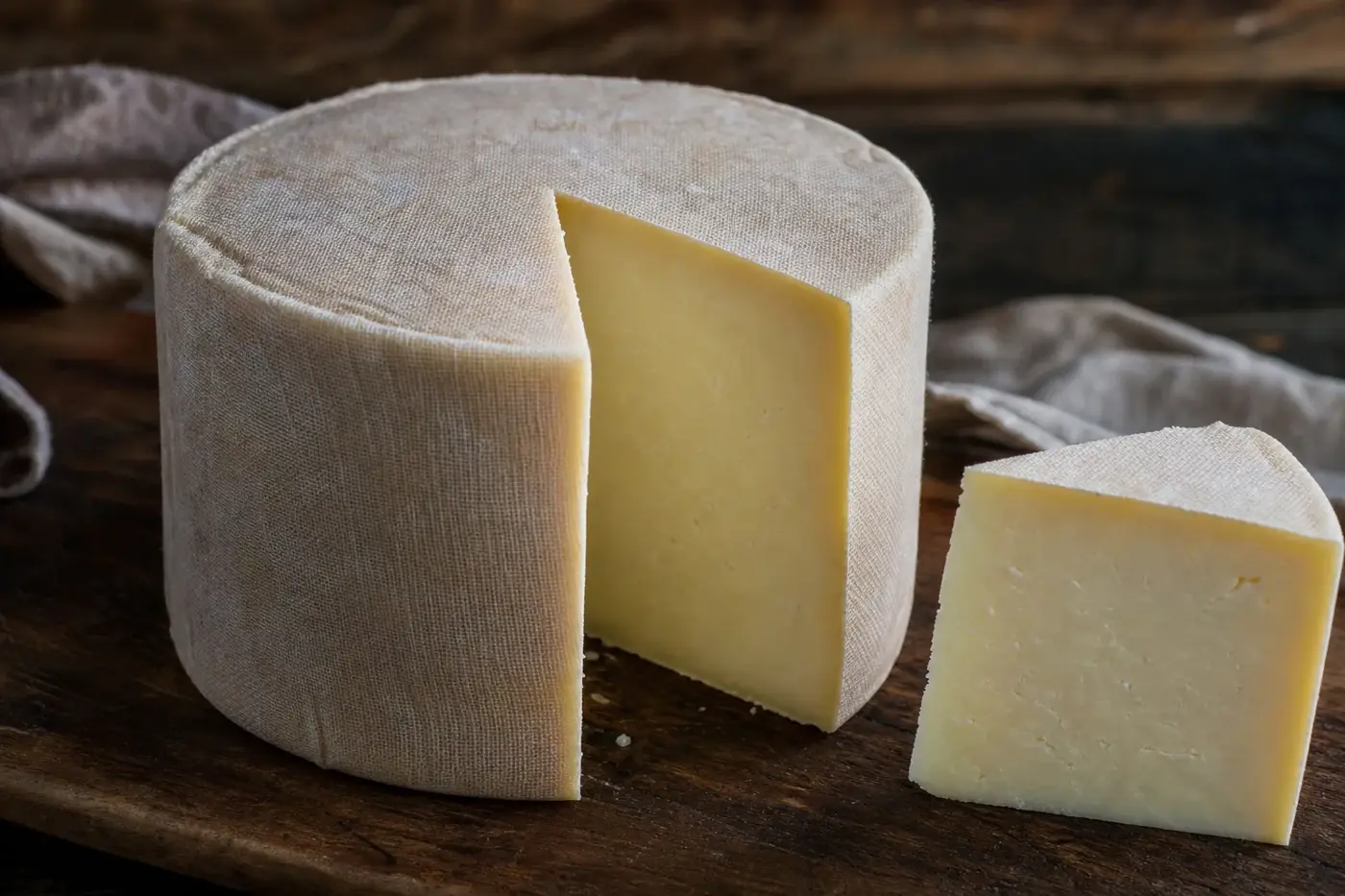
Cut into Sage Derby and green seams appear against the pale cheese.
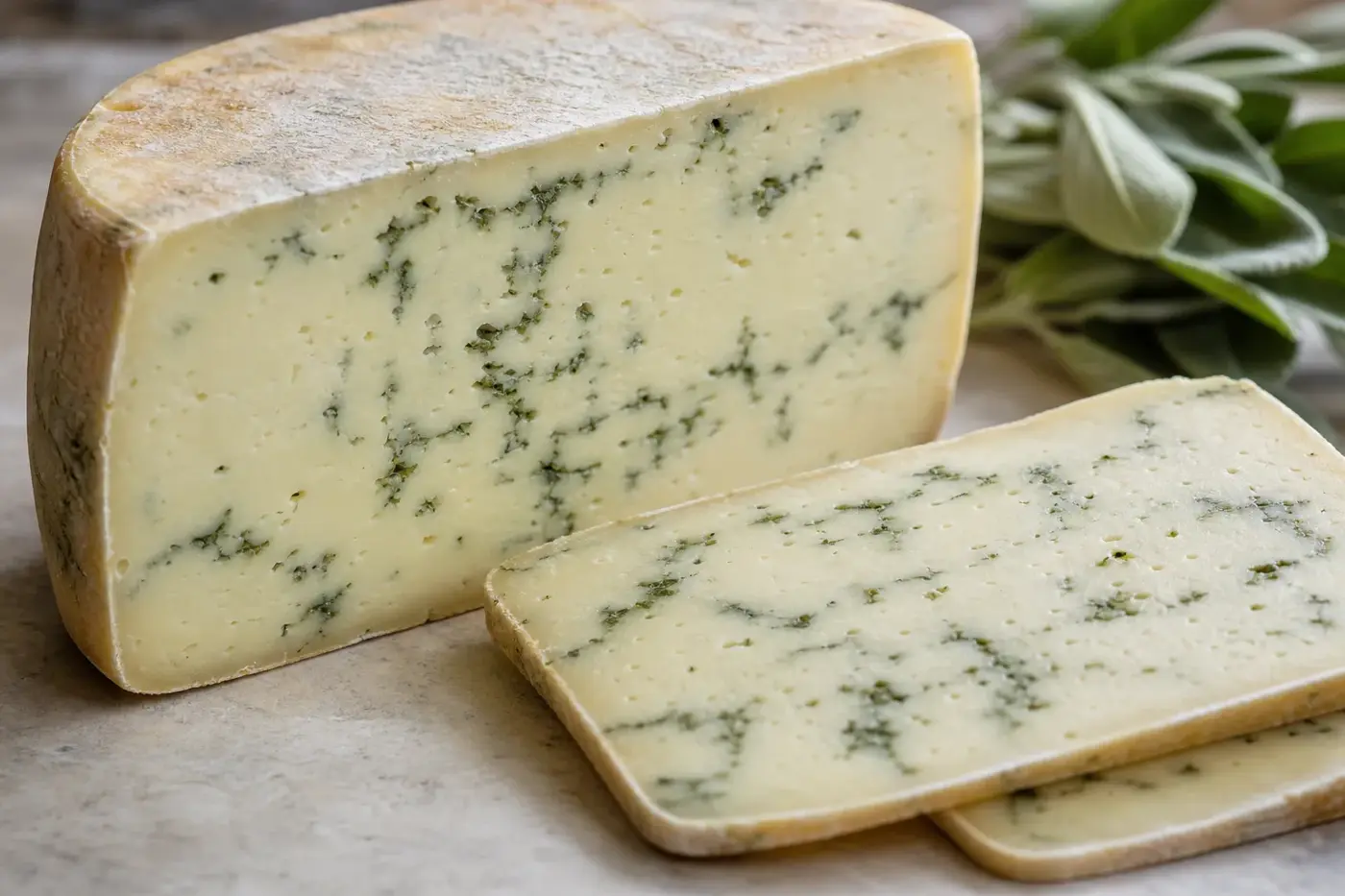
Cut into Sage Derby and green seams appear against the pale cheese. Then comes the scent of sage, a promise that this will be more than a mellow mouthful. Coombe Castle compares the base with mild Cheddar, but the herb has other plans.[2]
You are tasting the herb-flavoured variation of Derby, the British cheese associated with Derbyshire. Expect gentle dairy flavour, fragrant seasoning and plenty to enjoy where the two meet.[1][2][4]
Your quick guide to the green seams
- Name: Sage Derby.[1][2]
- Family: Herb-flavoured Derby, a pressed British cheese.[3][4]
- Customary association: Derbyshire, England.[4]
- Milk species: Cow.[1][2]
- Protection status: Great Britain, unconfirmed; EU, unconfirmed; Northern Ireland, unconfirmed.
Follow a green seam into your first bite
Look at the cut face and you will see irregular green seams and flecks running through pale cheese. Coombe Castle’s comparison with mild Cheddar gives you a useful starting point, but the maker emphasises the distinct flavour of aromatic sage. Think gentle cheese meeting savoury herb, not simply Cheddar dressed for a garden party.[2]
Belton Farm describes an open texture and a smooth body.[1] This is firm, sliceable cheese, although Derby can be softer and springier than Cheddar, according to the New England Cheesemaking Supply Company.[4]
Try a little pale cheese first, then take a bite across a green seam. Notice when the herb arrives. Is it there in the aroma, through the mouthful or right at the finish?
Meet Derbyshire’s special-occasion cheese
Harvest celebrations and Christmas are part of Sage Derby’s story. Belton Farm says it was originally made for special occasions, while Coombe Castle recounts a seventeenth-century origin. These modern commercial accounts describe the tradition, rather than providing contemporary records that establish the earliest use of the name Sage Derby or date its association with harvest and Christmas.[1][2]
Behind the sage sits Derby itself. The New England Cheesemaking Supply Company places the parent cheese in Derbyshire, in the English Midlands, and describes its relationship to Cheddar in flavour and process. You will find it among Britain’s territorial cheeses, the county-associated styles that also include Cheshire and Double Gloucester.[4]
Watch the milk take shape
Starter, rennet, careful draining and pressing turn milk into cheese. Belton Farm publishes a general account of its cheesemaking alongside its Sage Derby ingredient declaration. The sequence below follows that broader account, rather than a specification covering every step for this particular cheese.[1][3]
- Begin with milk and culture: Starter culture, the microorganisms that begin acidification, goes into pasteurised milk before the rennet.[3]
- Set the milk, then cut the curd: Rennet coagulates milk into curd, the soft solid that becomes cheese. Cutting releases whey, its watery portion.[3]
- Warm, stir and drain: The curds are gently heated, stirred and moved to a draining table. Turning helps squeeze out whey while the cheesemaker checks acidity.[3]
- Salt, mill and press: The curd is salted, passed through a mill, packed into moulds and pressed. More whey leaves, and the cheese takes shape.[3]
Belton’s Sage Derby ingredient list does not name the exact starter strains.[1] If you would like to follow the whole transformation, explore how cheese is made. For a closer look at the moment milk sets, try rennet explained.
Discover how those green patterns happen
Those green patterns begin during making. Belton calls its Sage Derby “vat-made”, meaning the sage is incorporated during the cheese-make. Its ingredients include both sage leaves and chlorophyll colouring.[1]
The New England Cheesemaking Supply Company describes two ways to create a pattern. Individual curd pieces can be coated with a herb infusion, or coloured curd can be mixed with plain curd. Pressing brings those pieces together, leaving green boundaries or patches through the pale cheese.[4]
Do not let your eyes do all the tasting. Coombe Castle lists dried sage without a separate colouring, while Belton declares chlorophyll, so vivid green alone tells you little about sage strength. Read the ingredients for the recipe, then taste for the balance you enjoy. The pattern catches your eye; the mouthful tells you how well cheese and herb get along.[1][2]
Ask about age, then trust your palate
If texture matters to you, ask the maker about age. The New England Cheesemaking Supply Company’s published Derby method gives approximately six months of ageing for that recipe.[4] Typical commercial maturation for Sage Derby is unconfirmed, so a producer’s stated maturation period is your useful reference when choosing a retail piece.
The same account describes young Derby as mild and springy, becoming firmer and subtly sweeter as it matures.[4] Ask whether the piece in front of you is intended to be mild and yielding or firmer and more developed. That gives you a clearer starting point than colour alone.
When comparing cheeses, note the producer and any stated age, then record firmness, saltiness and sage strength. Keep label details separate from your tasting observations. You will give your cheesemonger something precise to work with next time, beyond the familiar request for “that lovely one”.
Make room for Derby, Cheddar and Double Gloucester
Plain Derby gives you the clearest comparison: the cheese base, without sage joining the conversation. Coombe Castle’s mild Cheddar comparison offers another useful way in.[2] If cheddar is your usual choice, approach Sage Derby as an herbal change of direction, not simply a stronger version of something familiar.
Double Gloucester offers a different lesson in colour and flavour. Belton describes its version as mellow and buttery, with annatto supplying the colour.[5] Taste the two side by side: with Sage Derby, notice the added herb; with plain Double Gloucester, concentrate on the underlying cheese. It is a useful way to explore British cheeses without mistaking colour for intensity.
Belton also describes Double Gloucester as a good melting cheese, with enough bite in its texture to enjoy alone.[5] In the kitchen, let your dish guide the choice. Sage Derby brings its own sage seasoning, while a plain cheese leaves you free to season separately.
Let the label do the practical work
Start with the pack when you want to know about milk treatment or vegetarian suitability. Belton Farm and Coombe Castle both declare pasteurised cows’ milk for their Sage Derby examples. Coombe Castle specifies vegetarian rennet, while Belton describes using vegetarian rennet in its production.[1][2][3]
At the cheese counter, ask to see the original label. Look for the maker, whether the milk was pasteurised and whether there is a vegetarian declaration. Keep the wrapper or counter label until you finish the cheese, so its storage instructions stay handy. The guide to reading a cheese label helps you distinguish the product name from ingredients and handling information.
If you are offered a taste, give that mouthful a purpose. Are you getting a gentle sage aroma or a more assertive herbal finish, and does the texture suit your plans? Neat slices may matter for a board. For cooking, consider how the herb will sit with your other ingredients.
Keep it chilled and serve a little at a time
If you follow Food Standards Agency advice in England, Wales and Northern Ireland, keep dairy products refrigerated, with the fridge set between 0 and 5 °C (32 to 41 °F). Follow the cheese’s storage instructions and date marking. That includes any directions for after opening.[6]
Put out a small serving portion rather than the whole piece. Consult the current Food Standards Agency guidance on keeping chilled food out of refrigeration, including during preparation.[6]
Leave the rest in the fridge and bring out another small portion when you need it. For wrapping choices and everyday handling, turn to how to store cheese at home. Elsewhere, follow your local agency’s guidance on refrigeration and display.
Give the sage a little space on your board
Start simply: plain bread or oatcakes, a few slices of apple or pear, and water or unsweetened tea. Taste the cheese alone before adding anything alongside it. Then you can decide whether you prefer that herbal flavour uninterrupted or with fruit for company.
On a cheeseboard, choose a plain territorial cheese for comparison rather than several other herb-flavoured cheeses. Cut pieces containing both pale paste and green marbling, so each serving gives you the whole picture. Leave strongly flavoured chutneys to one side. Guests can add them after their first taste.
For an easy cooked dish, follow Belton Farm’s suggestion: grate Sage Derby into cheese sauce and serve it with pasta. The maker also publishes a Sage Derby scone recipe.[1][7] Let the cheese supply the first herb seasoning, then taste before adding more sage.
Use an established sauce or scone recipe, treating the cheese as a flavouring. Those green seams have a job beyond looking handsome.
Take your cheese curiosity a little further
- Raw Milk, Thermised and Pasteurised Cheese: get comfortable with the milk-treatment descriptions on your pack.
- How to Tell Cheese Styles Apart: Milk, Rind, Texture and Method: find Sage Derby’s place in the wider world of cheese styles.
General information only, not medical advice: follow the official guidance where you live.
Questions people ask
What does Sage Derby taste like?
Sage Derby has a mellow cheese base with a savoury, aromatic sage flavour. Coombe Castle compares the base with mild Cheddar.
How does Sage Derby get its green marbling?
The green pattern is created during cheesemaking. Curd pieces can be coated with a herb infusion, or coloured curd can be combined with plain curd before pressing.
Is Sage Derby suitable for vegetarians?
Coombe Castle specifies vegetarian rennet, while Belton Farm describes using vegetarian rennet in its production. Check the label for a vegetarian declaration.
How can you serve Sage Derby?
The page suggests serving it with plain bread or oatcakes and slices of apple or pear. Belton Farm also suggests grating it into cheese sauce for pasta.
How should Sage Derby be stored?
The Food Standards Agency advises keeping dairy products refrigerated at between 0 and 5 °C in England, Wales and Northern Ireland. Follow the cheese’s storage instructions and date marking, and check the current Food Standards Agency guidance on chilled food.
Sources
- Belton Farm, [Sage Derby](../sage-derby/), undated product page, retrieved November 2026; and Sage Derby Cheese, undated product page, retrieved November 2026. Producer descriptions, ingredient declarations and serving suggestions.
- Coombe Castle International, [Sage Derby](../sage-derby/), undated product page, retrieved November 2026. Supplier description and published ingredient declaration.
- Belton Farm, How We Make, undated production account, retrieved November 2026. Producer's published account of milk treatment, coagulation and curd handling.
- New England Cheesemaking Supply Company, Derby with Sage Recipe, undated online version, retrieved November 2026. Practitioner account of Derby, pattern formation and the maturation specified for its own method.
- Belton Farm, [Double Gloucester](../double-gloucester/), undated product page, retrieved November 2026. Producer's description of its own cheese.
- Food Standards Agency, How to chill, freeze and defrost food safely, published 18 December 2017, live version retrieved November 2026. Applies to England, Northern Ireland and Wales.
- Belton Farm, Belton Farm Sage Derby Cheese Scones, undated recipe page, retrieved November 2026. Cited for the existence of the maker's recipe only.
Researched through desk research, comparing published product declarations, a producer's process account, a practitioner's explanation and official food-handling guidance.
Last checked: November 2026
Last checked November 2026.
The editors suggest you read next
West Country Farmhouse Cheddar Cheese
Large pieces of curd turn and stack under the cheesemaker’s hands.