Ripening Conditions: Temperature, Humidity and Airflow
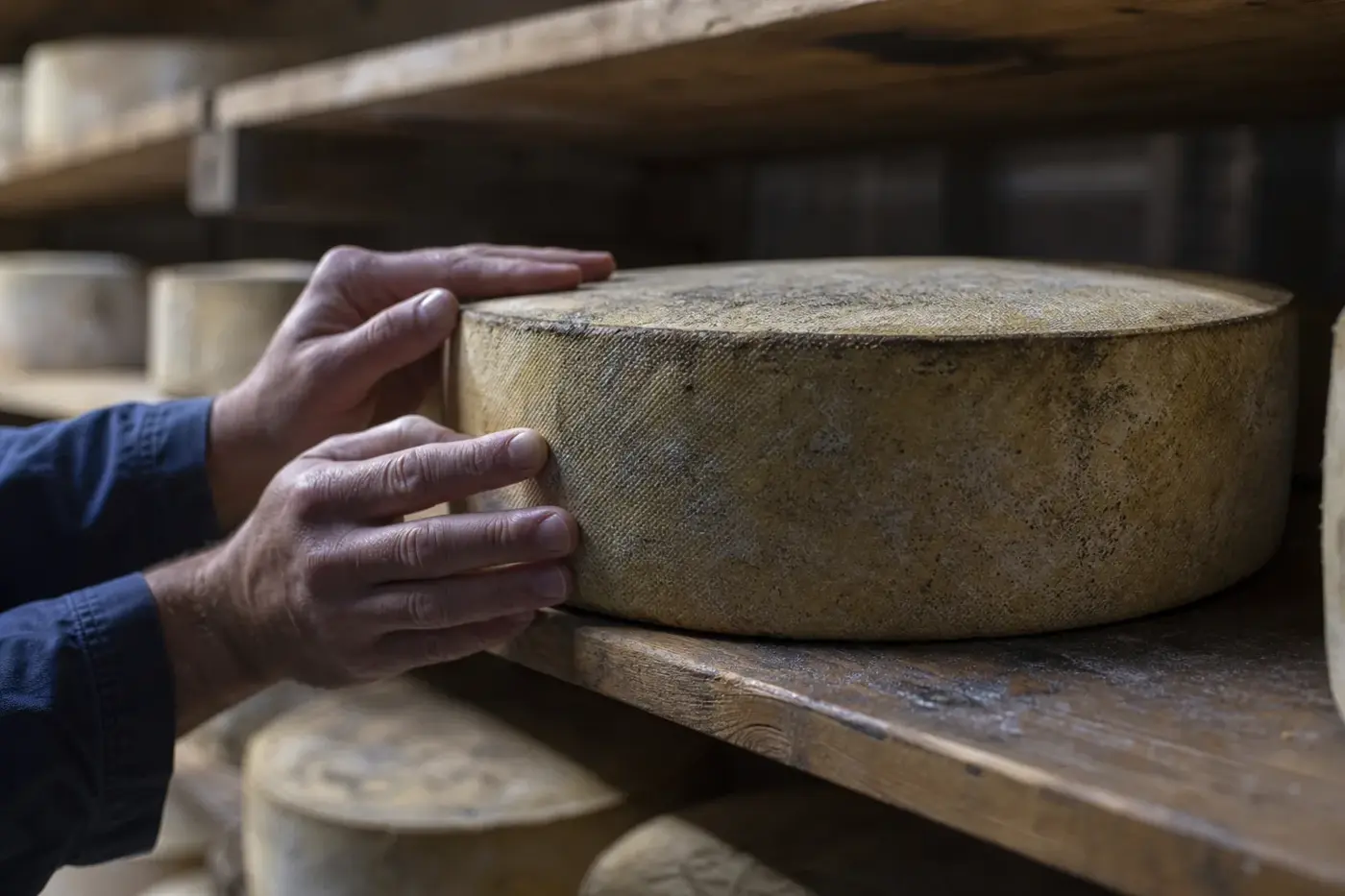
A rind begins to crack.
A rind begins to crack. The air that helped it form is now drawing water from the cheese, and the surface is showing the strain. Keep it persistently wet instead, though, and you invite another problem: unwanted growth. Cheese has a way of making you earn that perfect rind.[1][2][6]
This is the balancing act of affinage, the management of cheese as it matures. Temperature sets the pace of biological change, relative humidity influences moisture exchange, and airflow carries heat, water vapour and gases between cheese and room. Your best guide is what the cheese is doing.[1][2][6]
Beneath the rind, the work goes on
As cheese ripens, its structure changes along with the compounds that give it flavour. Enzymes break proteins into smaller components, changing texture and supplying material for further flavour development. Microbes change acidity and produce aroma compounds, while evaporation steadily reduces the water left in the cheese. The ripening room shapes both this biology and the conditions it works in.[2][3][8]
Don't picture the whole cheese moving in lockstep, though. In a controlled study of Camembert-type cheeses, researchers used gas chromatography and mass spectrometry to analyse volatile compounds separately in rind and core. Concentrations differed, and particular compounds were associated with particular cultures.[3]
Ripening does much more than make a cheese uniformly stronger. Several processes unfold at once, in different places, so what happens beneath the rind may not match what happens at the centre. For the story before this stage, see how cheese is made.[3]
Turn up the temperature, change the timetable
Warmer conditions can speed ripening within the range suited to a cheese and its cultures. But temperature does more than hurry things along. A 2012 experiment with pasteurised-milk Camembert-type cheeses shows you the difference: researchers ripened them at 8, 12 and 16 °C, under three relative humidities.[1]
At 8 °C, the rind's pH rose between days six and nine. At 16 °C, that rise arrived between days two and three. Higher pH means lower acidity.[1]
Softening beneath the rind took a different course, too. At 16 °C, approximately half the cheese's thickness appeared ripened by day 14, but pairing that temperature with 98% relative humidity produced a runny underrind. Temperature changed the biological timetable; humidity helped shape the texture. These results belong to that particular cheese and combination of cultures, not every wheel you might mature.[1]
Read humidity with temperature beside it
An RH reading gives you only part of the picture. Relative humidity, usually shortened to RH, expresses water vapour pressure as a percentage of the saturation vapour pressure at the same temperature. It describes the air in relation to its current temperature, not how much water your cheese contains.[4]
Cool air without removing water vapour and its relative humidity rises. Warm it and relative humidity falls. That is why the temperature belongs alongside your RH reading.[4]
At the rind, evaporation depends on the difference between water vapour pressure at the cheese surface and in the surrounding air. Surface temperature matters, as does water activity: how available the water is, rather than the total moisture content. Modelling research on Camembert and French smear cheese therefore considers heat and moisture transfer together, including changing room conditions over time.[11]
Help the rind find its balance
Evaporation helps build a rind. Too much drying, however, can leave it tough or cracked. The American Cheese Society's processing guide explains that room conditions help determine rind thickness and toughness, and describes bandaging as discouraging cracking compared with direct exposure to air.[6]
Excessive humidity brings troubles of its own. The same guide lists it, alongside undesirable surface flora, among the difficulties of rind development. If you find persistent wetness, investigate, especially when growth appears outside the intended rind community. Your question is whether the surface is developing as expected for that make and stage of maturation, not simply whether mould is present.[6]
Give moving air and fresh air their own jobs
Circulating air around cheeses and renewing a room's atmosphere do different jobs. Moving air affects evaporation and heat exchange at the surface; air renewal also influences oxygen and carbon dioxide concentrations. In chamber experiments with Camembert-type cheese, atmospheric composition affected microbial respiration, weight loss, appearance and development of the softened layer beneath the rind.[7]
A stagnant pocket can leave a cheese in an atmosphere unlike the one measured elsewhere in the room. A strong draught creates the opposite difficulty, rapidly transferring heat and moisture at the exposed face. Neither tells you much about conditions around its neighbours.[2][7]
Research combining continuous weighing with room measurements found that airflow near Camembert-type cheeses strongly influenced the transfer coefficient used to predict mass loss. Your fan-speed setting, then, is not a description of life around every wheel. The cheese has not read the control panel.[2][7]
Watch what happens when cold cheese meets warm air
Move cool cheeses into warmer, moist air and their surfaces can become wet without you adding any water. If those surfaces sit below the air's dew point, water vapour can condense on them. Dew point is the temperature at which air becomes saturated when cooled without changing its water vapour content.[5]
The US National Weather Service illustrates this with condensation on a cold bottle. The same physics applies to a cold cheese surface. Your room sensor can therefore show less than 100% RH while condensation forms on the cheese.[5]
Compare the local dew point with the surface temperature, rather than judging displayed RH against an assumed target. Moving air changes how quickly the surface exchanges heat and moisture, while microbial respiration generates heat within the cheese itself. The room reading and the rind's immediate surroundings are connected, but they are not identical.[2][5]
Let the cheese style lead the way
A developing smear and a film-wrapped block need different treatment. These examples describe experimental or industrial practice, with packaging and ripening stage part of the comparison. Use them to understand the differences, not as universal settings for every cheese carrying the same style name.[1][8]
| Cheese example | How it is ripened | What it tells you |
|---|---|---|
| Soft mould-ripened: Camembert-type | The experiment above combined different temperatures and humidities.[1] | Temperature and humidity both affect softening at the surface. |
| Washed-rind: Tilsiter-type | Tetra Pak describes smear development at 14 to 16 °C and about 90% RH, followed by cooler ripening.[8] | The conditions change as the surface community develops. |
| Hard: film-wrapped Cheddar | Tetra Pak describes ripening at 4 to 8 °C; room humidity figures are not relevant to bag-ripened cheese.[8] | The wrapping changes moisture exchange. |
A washed rind is managed by washing, often with a salt solution carrying ripening cultures. In the Tilsiter-type example, that developing smear gets different treatment from a sealed Cheddar block. This distinction is far more useful to you than a blanket instruction to keep all cheese humid. For the wider family, see cheddar.[8]
From the Combalou caves to your next shelf
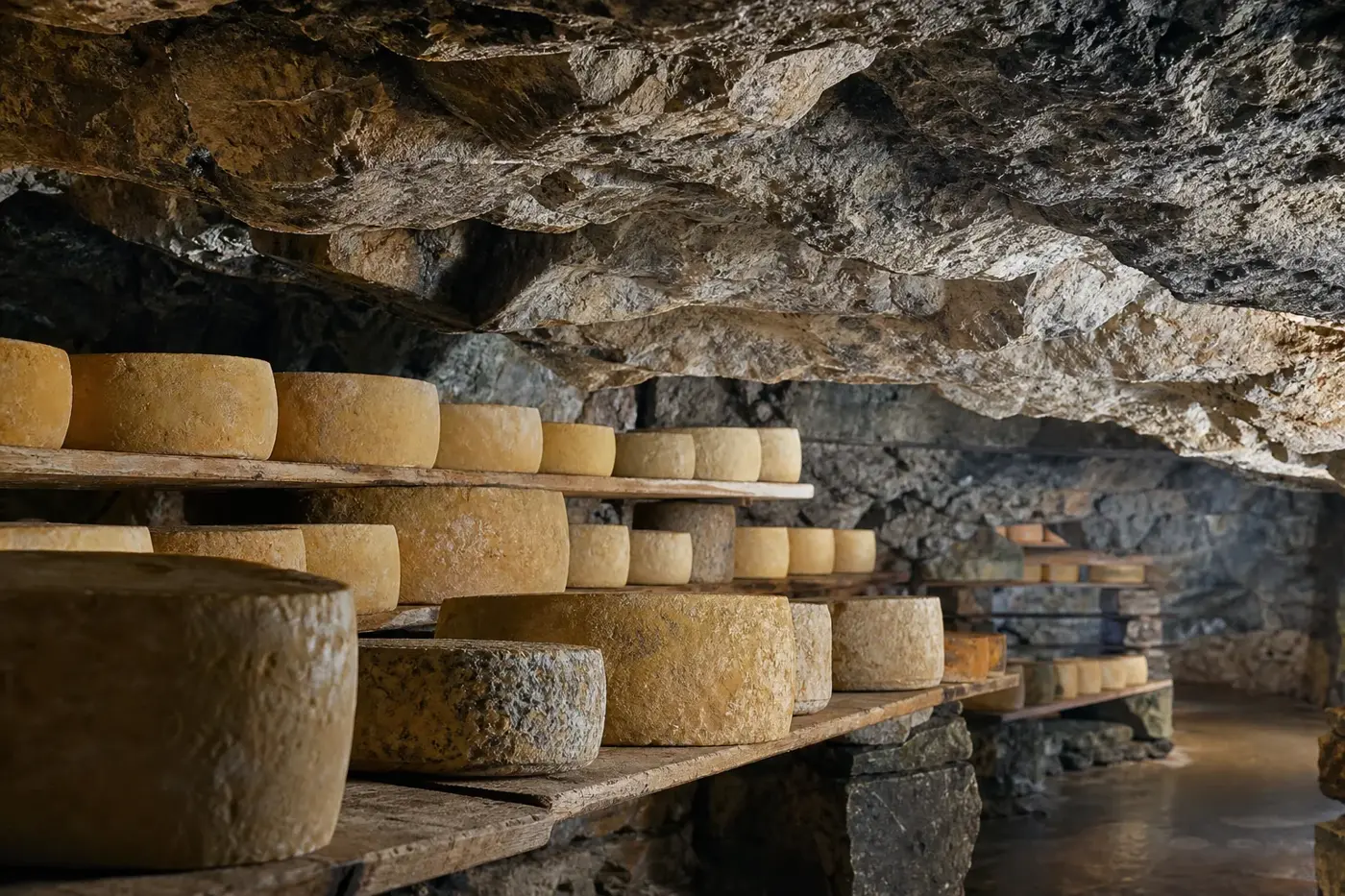
The Roquefort interprofession describes natural affinage in the caves of the Combalou, noting their north-facing orientation.[9] Whether you are considering caves or a controlled room, the same point deserves your attention: conditions reaching the cheese can differ from measurements taken elsewhere in the maturation space.[10]
A 2021 study followed three batches of ten cheeses in different zones of a prototype controlled room for 35 days. Mean temperatures and humidity differed between zones, and the airflow model showed uneven distribution around the stacks. The cheeses developed different measured firmness, too.[10]
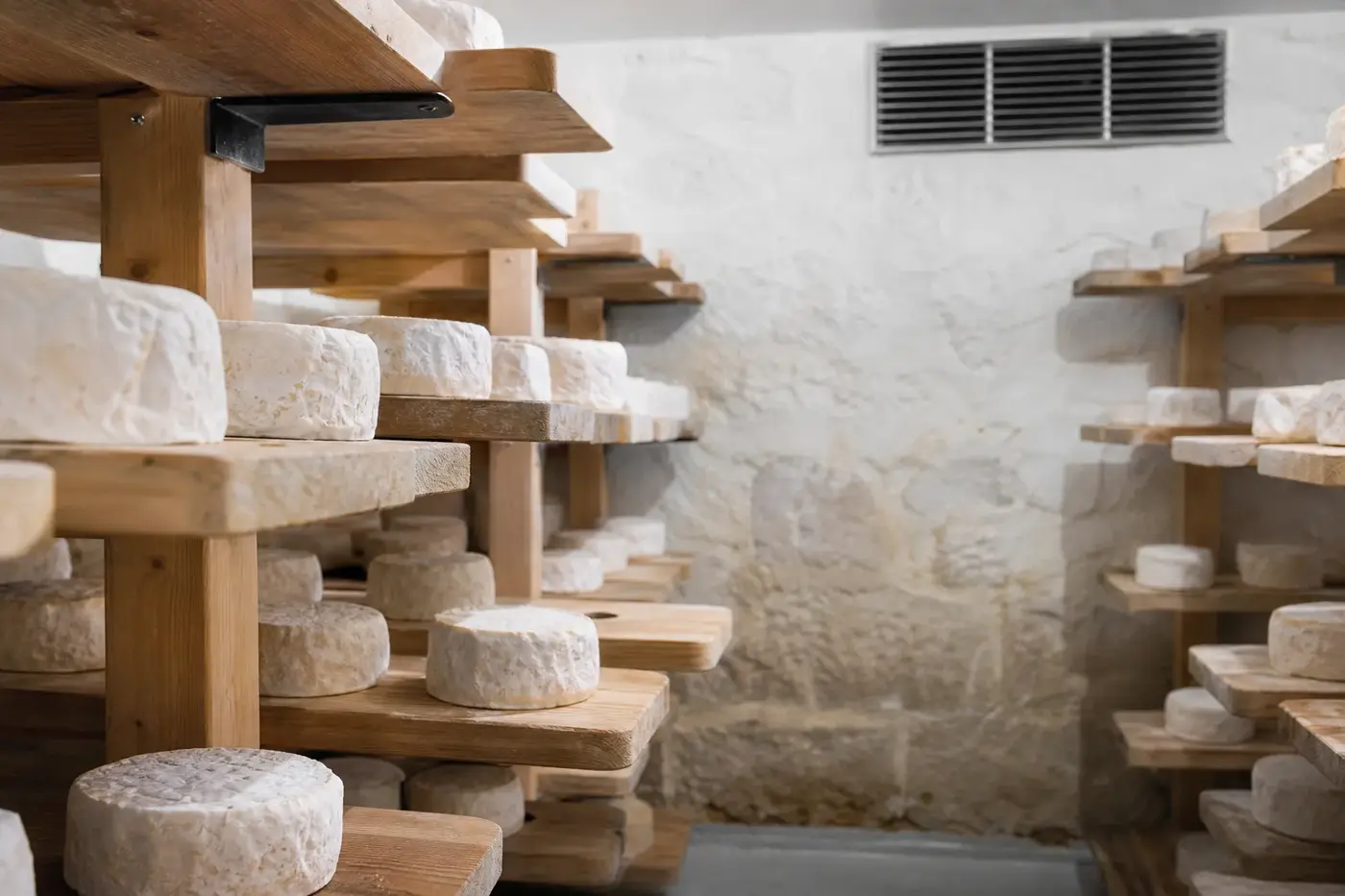
Even within one room, position matters. Shelving position, distance from cooling equipment and the route taken by air can all shape the conditions your cheese experiences. One room does not mean one perfectly uniform environment.[10]
Read the rind, not just the sensor
A useful sensor helps you understand conditions where the cheese actually sits. The prototype study monitored temperature, humidity and air velocity, linking those measurements to refrigeration, humidification and extraction controls. Its practical lesson is about location: differences between positions matter. Records over time also reveal changes a single inspection can miss.[10][11]
Then look at the cheese, which supplies information no air sensor can give you. Is the expected covering spreading? Is the surface drying, and is ripening proceeding evenly? The European artisan dairy hygiene guide combines visual or sensory inspection with relevant measurements and adjustments to ripening parameters.[12]
Read those forms of evidence together. A reassuring room average should not overrule a changing rind. After all, you are trying to mature the cheese, not produce a handsome set of readings.[12]
Find the pattern before reaching for the controls
If one position dries quickly, examine its local airflow before changing the whole room. If wetness follows a move between rooms, compare surface temperature with dew point. If an entire batch changes together, review the environmental record alongside the make's moisture and acidity. Start with the pattern, so you can connect changes in the room with changes in the cheese.[2][5][10]
Every adjustment can reach beyond the symptom that first caught your eye. Changing humidity to reduce drying also changes the microbes' surface environment. Increasing air movement affects heat transfer as well as evaporation.[11][12]
Turning, washing and other rind treatments give you further controls, each with cheese-specific methods. Judge any adjustment by the cheese's subsequent development and the recorded conditions. The control panel gives you part of the story, not the whole of it.[11][12]
This page summarises published guidance from the official sources it cites. It is not medical advice. Guidance differs between countries and changes over time, so check the current source for where you live, and ask your doctor, midwife, pharmacist or dietitian about your own circumstances.
Look beyond a handsome rind for safety
A rind can look exactly as its producer expects while food safety still depends on controls you cannot see. Food Standards Scotland's review of raw-milk artisan cheeses examines interacting factors including acidification, water activity, salt and contamination. It also explains why declining acidity in surface-ripened cheeses matters to pathogen control. Moisture management is just one part of that larger assessment.[13]
Food Standards Agency's Managing food safety guidance, updated on 21 August 2026, applies to food businesses in England, Wales and Northern Ireland. The Scottish source cited here is a review focused on artisan cheeses made from unpasteurised milk. Those different scopes help you distinguish general ripening science from the official safety material relevant to a particular operation.[13][14]
Generic temperature and humidity ranges are not a safe home-ageing recipe. Food Standards Scotland explicitly warns that its illustrative cheesemaking flowcharts are not prescriptive; a suitable method needs its own verified controls across the whole process. For purchased cheese, follow how to store cheese at home. For the wider safety context, see cheese food safety.[13]
Questions people ask
How do temperature and humidity affect cheese ripening?
Temperature sets the pace of biological change, while relative humidity influences moisture exchange. In one experiment, Camembert cheeses kept at 16 °C and 98% relative humidity developed a runny layer beneath the rind.
Why does cheese become wet in a ripening room?
Water vapour can condense on a cool cheese when its surface is below the air's dew point. This can happen even when a room sensor reads below 100% relative humidity.
Why is airflow important when cheese ripens?
Moving air affects evaporation and heat exchange at the cheese surface, while renewing the room air also influences oxygen and carbon dioxide concentrations. Stagnant pockets and strong draughts can expose cheeses to different local conditions.
Do all cheeses need the same ripening conditions?
No. Tetra Pak describes Tilsiter smear development at 14 to 16 °C and about 90% relative humidity, followed by cooler ripening. It describes film wrapped Cheddar ripening at 4 to 8 °C and says room humidity figures are not relevant to bag ripened cheese.
Can a good looking rind show that cheese is safe?
A rind can look as expected while food safety still depends on controls that appearance cannot reveal. Food Standards Scotland warns that its illustrative cheesemaking flowcharts are not prescriptive. See its review of raw milk artisan cheeses for the wider safety context.
Sources
-
INRA research team, Temperature and relative humidity influence the microbial and physicochemical characteristics of Camembert-type cheese ripening, Journal of Dairy Science, volume 95, 2012. Experimental temperature and humidity study.
-
INRA research team, Modeling of Camembert-Type Cheese Mass Loss in a Ripening Chamber: Main Biological and Physical Phenomena, Journal of Dairy Science, volume 90, 2007. Two experimental chamber trials and a heat and mass transfer model.
-
INRA and INA Paris-Grignon research team, Controlled production of Camembert-type cheeses. Part II. Changes in the concentration of the more volatile compounds, Journal of Dairy Research, volume 71, 2004. Duplicate experimental manufacture and chemical analysis.
-
US National Weather Service, Miami-South Florida, Mesoscale Analysis, Info, undated web edition, retrieved November 2026. Definitions of temperature, relative humidity and dew point.
-
US National Weather Service, Temperature, Dry Bulb/Web Bulb/Dew Point, undated technical training page, retrieved November 2026. Dew point and condensation on cold surfaces.
-
American Cheese Society, Best Practices Guide for Cheesemakers, 2025 edition, chapter 7, “Aging and Ripening”, particularly “Rind Development” and “Bandaging”. Industry guidance.
-
INRA research team, Effects of Atmospheric Composition on Respiratory Behavior, Weight Loss, and Appearance of Camembert-Type Cheeses During Chamber Ripening, Journal of Dairy Science, 2006. Experimental chamber research.
-
Tetra Pak, Dairy Processing Handbook, chapter 16, “Cheese”, current online edition retrieved November 2026, particularly “Ripening and storage of cheese”. Equipment manufacturer's technical guidance, not a cheese specification.
-
Confédération Générale de Roquefort, L'affinage naturel, undated web edition, retrieved November 2026. The interprofession's account of its maturation setting.
-
Research team, Applying Computational Fluid Dynamics in the Development of Smart Ripening Rooms for Traditional Cheeses, Foods, 2021. Prototype-room experiment, instrumentation and airflow modelling.
-
Queen's University Belfast and collaborating research institutions, An accurate account of mass loss during cheese ripening described using the reaction engineering approach (REA)-based model, International Journal of Food Science and Technology, volume 53, 2018; first published December 2017.
-
Farmhouse and Artisan Cheese and Dairy Producers European Network, European Guide for Good Hygiene Practices in the production of artisanal cheese and dairy products, revised 20 December 2016. Industry-authored hygiene guidance.
-
Food Standards Scotland, Review of Controls for Pathogen Risks in Scottish Artisan Cheeses Made from Unpasteurised Milk, December 2018, including the illustrative process flowcharts and their limitations. Official source link: Not verified.
-
Food Standards Agency, Managing food safety, updated 21 August 2026, GOV.UK edition. Stated geographical scope: England, Northern Ireland and Wales.
Researched through primary dairy experiments, technical processing guidance, an interprofession's published account and official food safety material, with experimental conditions distinguished from production requirements.
Last checked: November 2026
Last checked November 2026.
The editors suggest you read next

What Happens as Cheese Ripens?
Your knife slips through the rind and finds a supple band, beginning to flow around a still firm centre.