Rogue Creamery
Syrah grape leaves, soaked in pear spirits, folded by hand around a wheel of blue cheese.
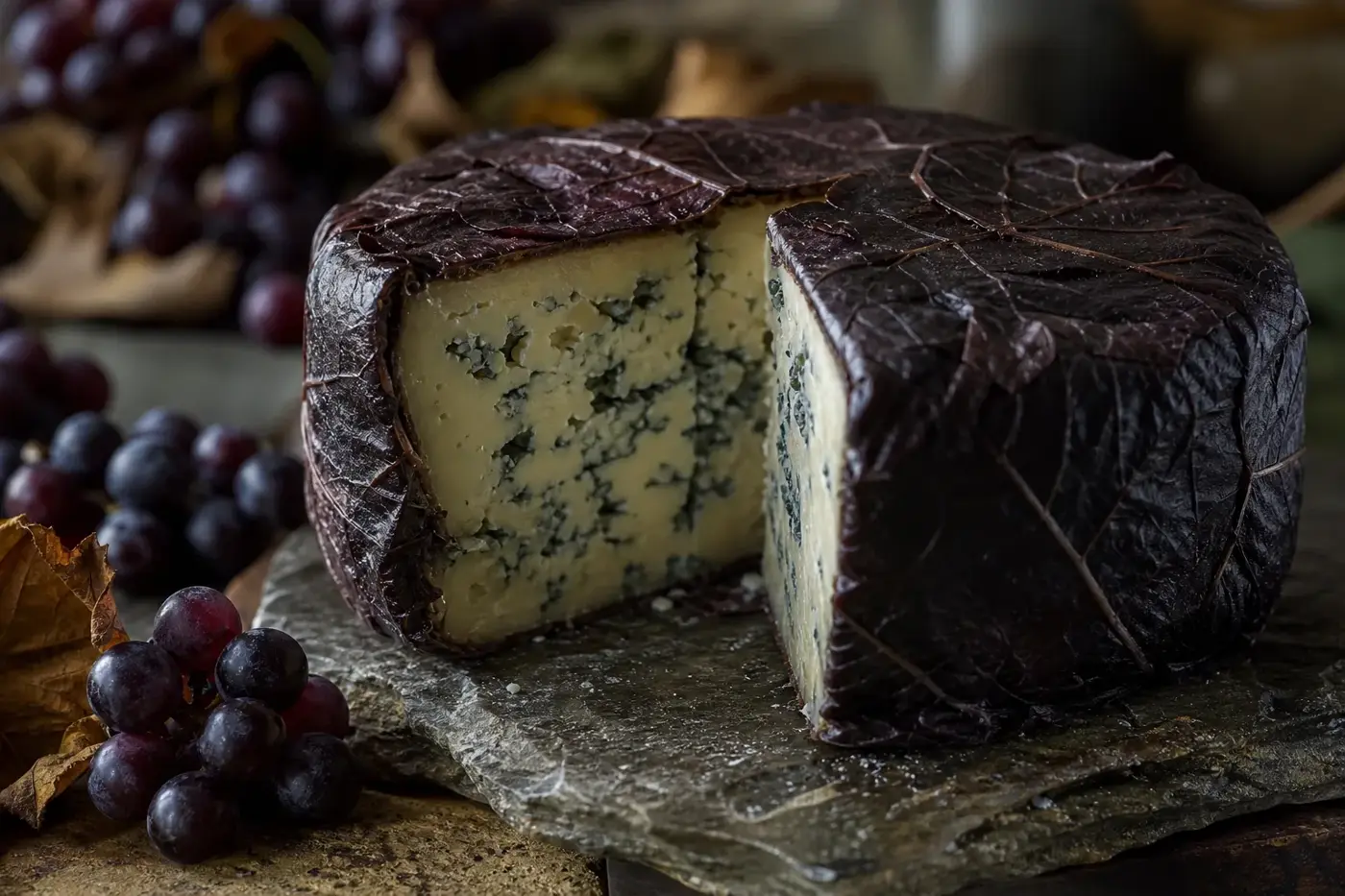
Syrah grape leaves, soaked in pear spirits, folded by hand around a wheel of blue cheese. Before you even reach the cheese, Rogue River Blue makes an entrance. It brought southern Oregon into the international spotlight as World Champion at the 2019 World Cheese Awards, according to Rogue Creamery’s published account. Follow those leaves back to Central Point and you find blue cheese, patient maturation and knowledge passed between generations of cheesemakers. [1][3]
| At a glance | What to know |
|---|---|
| Home | Central Point, southern Oregon, United States. [1] |
| Established | 1933. [1][2] |
| Known for | Blue cheeses, including Rogue River Blue, Oregon Blue and Smokey Blue. [3][4][5] |
| Group ownership | Joined Savencia Fromage & Dairy, effective 17 May 2018. [6] |
| Milk sourcing | Currently buys milk from regional dairy farms; allocation by featured cheese: unconfirmed. [7] |
| Certification | Maker names Oregon Tilth as organic certifier; current certificate and product schedule: unconfirmed. [3][4][5] |
Three blues, three very different characters
Begin with Oregon Blue, the established foundation of Rogue’s range. Then choose your direction: Smokey Blue brings cold smoking over hazelnut shells, while Rogue River Blue combines autumn production, prolonged ageing and grape leaves soaked in pear spirits. Choices about milk, maturation and finishing give these recognisably American blues their individual voices. [1][3][4][5]
This is not a ladder from strong to stronger, with a prize for whoever reaches the top without blinking. Each cheese has its own character and purpose, shaped by processing and maturation. Together, they offer you something more interesting than a competition record: a taste of thoughtful blue cheesemaking.
From Depression-era dairy to a taste for blue
Rogue’s story starts in Central Point in 1933. A creamery cooperative was established to support local dairy farmers during the Depression. Rogue’s published history records its acquisition in 1935 and a new name: Sonoma Valley Cheese Factory, Plant No. III. [1]
Cheddar had an important place in those early years, including during wartime production. Blue cheese entered the story through a journey to Roquefort, where, Rogue’s account says, one of the owners went to learn the craft. Back in Oregon, developing maturing rooms was the next step. [1]
Ownership changed across the decades, but the story continued. The Oregon Encyclopedia records a family succession in 1998, a purchase by two new owners in 2002 and one partner’s departure in 2015. [2]
The hands that kept the knowledge moving
A change of ownership need not mean losing the craft. Rogue’s history describes the previous owner mentoring cheesemakers after the sale, with an apprenticeship programme carrying knowledge from one pair of hands to another. The creamery credits one new owner with the ambition to express the Rogue Valley in blue cheese, through autumn milk and a distinctive leaf treatment. [1][2]
Another chapter began on 17 May 2018, when Savencia announced that Rogue had joined the group that day. Its announcement said Rogue would remain a separate public benefit corporation, with its president staying in post. Those were the arrangements set out in 2018. [6]
Following the milk back towards the farm
In 2012, Rogue bought a dairy farm at Grants Pass, according to the Oregon Encyclopedia. Bringing milk production alongside cheesemaking marked an important stage in the creamery’s development. [2]
B Lab’s profile describes an organic cow’s milk dairy beside the Rogue River. Current farm operations and herd details remain uncertain. [8]
For today’s milk supply, Rogue’s current sourcing statement is your starting point. Its mission page says the creamery buys milk from regional dairy farms whose suppliers participate in the national FARM programme. The current product pages identify organic cow’s milk for all three cheeses featured here. [3][4][5][7]
Keep three things separate as you follow that trail: owning a farm, buying regional milk and tracing a particular cheese to a particular herd. These are different relationships, not interchangeable descriptions. The farm purchase belongs to Rogue’s history; its current sourcing statement is the more relevant account of purchasing today.
Inside the wheel: how blue begins
Read Rogue’s published ingredient lists and you will find cultures, microbial clotting enzymes and Penicillium roqueforti. The enzymes turn milk into curd, while draining removes whey, the liquid portion. Penicillium roqueforti is the mould associated with blue development. [3][4][5][9]
Those blue pathways begin with practical work. The United States blue cheese standard describes cultured milk, coagulation, draining, salting and perforating the formed cheese before mould development. Perforations provide routes for the characteristic internal blue growth. This is the statutory framework, rather than Rogue’s own production manual. [9]
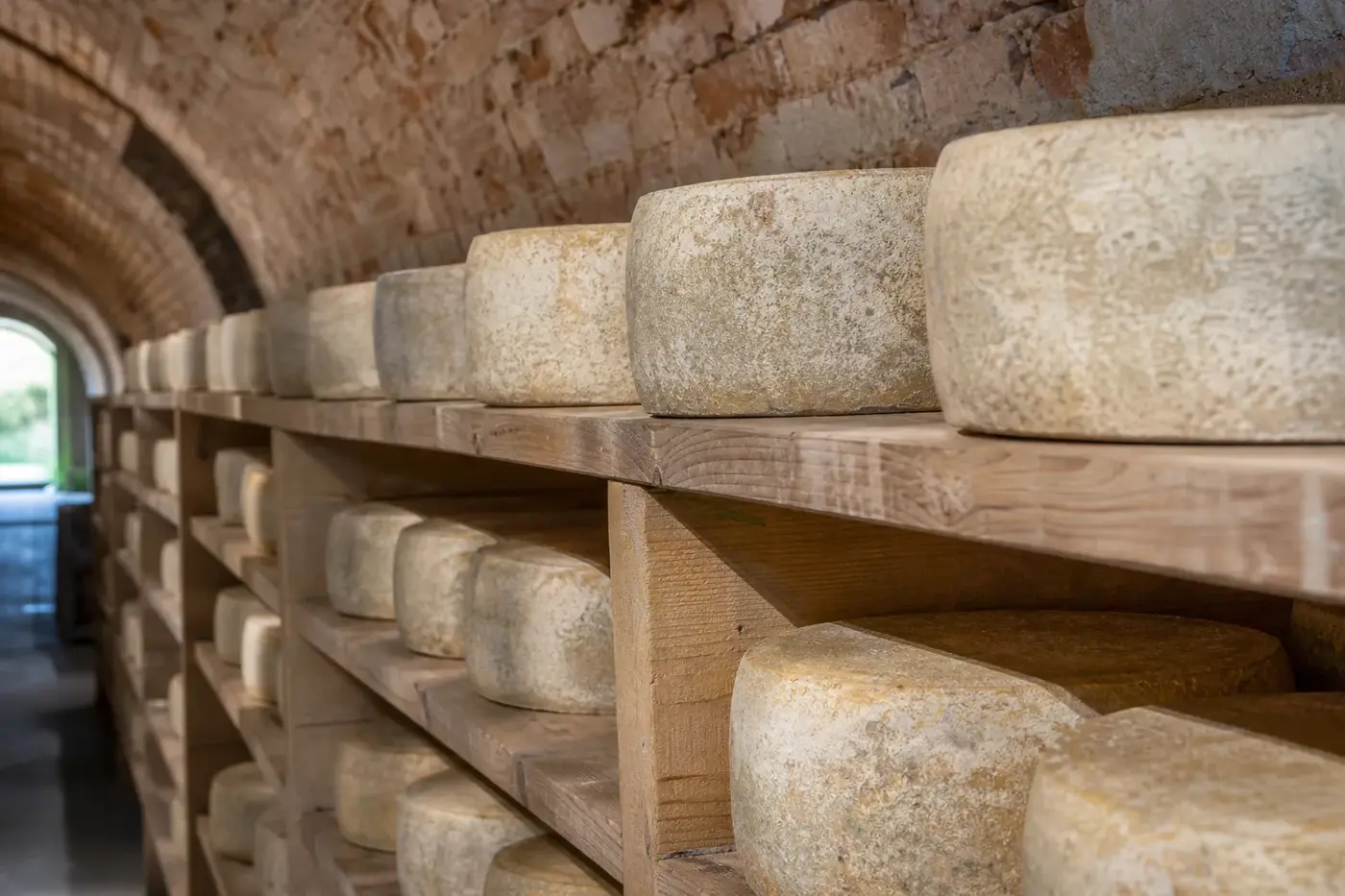
From there, the cheeses go their separate ways. Oregon Blue and Smokey Blue are cave-aged for 90 days. Rogue River Blue takes much longer to mature and receives its leaf wrapping before a seasonal release. [3][4][5]
You can explore the broader stages in how cheese is made. Rogue’s range gives you a useful illustration of what happens next: different finishing treatments turning shared stages into distinctly different cheeses.
Rogue River Blue keeps time with autumn
For Rogue River Blue, autumn is part of the recipe’s rhythm. The creamery connects seasonal production with cooler, wetter conditions and renewed pasture growth, describing autumn milk as particularly suitable. The cheese then matures for at least nine months before its annual release around the autumn equinox. [3]
Every wheel is wrapped by hand in Syrah grape leaves soaked in pear spirits. The current ingredient list names grape leaves and organic pear liqueur alongside milk, salt, enzymes and cultures. Those leaves are doing a job, not merely dressing the wheel for company. [3]
What can you expect beneath them? The maker describes a dense, fudge-like texture, pronounced blue character and flavours recalling pear brandy, toffee, fig and truffle. Richness is as much a part of the experience as blue intensity. [3]
When buying, check the milk treatment on your piece. The current manufacturer’s product page declares pasteurised organic whole cow’s milk. Pay particular attention to that label if an older description of Rogue River Blue is guiding your choice. [3]
Oregon Blue and Smokey Blue, from fruit to smoke
Oregon Blue gives you a visual starting point for the range: an ivory interior threaded with green-blue veins. Its current product page describes a crumbly texture and flavours recalling pear, green apple and honey. The maker lists pasteurised organic cow’s milk and microbial enzymes. [4]
Smokey Blue begins with Oregon Blue wheels, then changes direction through cold smoking over Oregon hazelnut shells. Rogue’s notes suggest vanilla, bread pudding and roasted-nut aromas, followed by a comparatively mild blue finish. You are tasting an added layer of character, rather than simply the effect of longer maturation. [5]
| Cheese | Milk listed by the maker | Time to mature | Its distinctive touch |
|---|---|---|---|
| Oregon Blue | Pasteurised organic cow’s milk | 90 days | Blue maturation. [4] |
| Smokey Blue | Pasteurised organic cow’s milk | 90 days | Cold smoking over hazelnut shells. [5] |
| Rogue River Blue | Pasteurised organic cow’s milk | At least nine months | Pear-spirit-soaked grape leaves. [3] |
Manufacturer’s descriptions: November 2026.
The night Oregon took the championship
Bergamo, Italy, was the setting for Rogue River Blue’s World Champion title at the 2019 World Cheese Awards, as recorded by Rogue. The creamery describes it as the first American-made cheese to win that title. This was the overall championship, not simply an award within a blue-cheese class. [1][3]
The result put an Oregon producer firmly into the international cheese conversation. Yet the lasting interest lies beneath the title: seasonal milk, extended maturation and that distinctive finish. The championship belongs to that competition and year, rather than a permanent ranking of every cheese you might encounter.
Organic milk and the questions beyond the label
Rogue names Oregon Tilth as the organic certifier for all three featured cheeses. The current certificate and product schedule remain unconfirmed. Keep organic certification, animal care programmes and environmental performance separate: each answers a different question about the cheese and the business behind it. [3][4][5]
On animal welfare, Rogue says it buys milk only from regional farms certified through FARM, Farmers Assuring Responsible Management. FARM describes animal-care guidelines supported by on-farm evaluations and third-party verification. Rogue supplies the account of its suppliers’ participation; FARM explains the programme itself. [7][10]
The creamery also reports solar generation, water-conservation measures and reuse of food waste and cardboard. Its current mission page says annual water consumption fell by more than 8% in 2025. That figure is a company-reported operational result. [7]
B Lab independently lists Rogue as a Certified B Corporation, certified since June 2016. This assessment concerns the business rather than particular foods. It is separate from organic certification and from the animal-care arrangements on farms supplying milk. [8]
Milk treatment and ageing: what you need to know
The United States blue cheese standard, 21 CFR 133.106, says dairy ingredients may be pasteurised and blue cheese must be at least 60 days old. That ageing requirement applies to cheeses covered by the standard. It is not a general health assurance. [9]
If you are pregnant in the UK, NHS guidance says pasteurised and unpasteurised soft blue-veined cheeses must be thoroughly cooked. It permits cheese cooked until steaming hot. Consult the current NHS page for the full advice; the guidance here is dated November 2026. [11]
Milk treatment is one consideration, and subsequent handling is another. You can explore that distinction in raw milk, thermised and pasteurised cheese. For your own circumstances, follow the official guidance where you live.
Bringing Rogue to your table in Britain
At a specialist cheesemonger, ask for the exact cheese, its milk treatment, the batch’s label information and storage instructions. If you are considering Rogue River Blue, ask which seasonal release is on offer too. The details attached to your piece matter more than an old product description.
Bringing cheese home yourself is different from buying through commercial supply. GOV.UK guidance dated November 2026 prohibits milk-based products in personal imports when you travel directly from the United States into Great Britain, with no transit country. [12]
Once home, follow the storage label supplied with your cheese. FSA consumer guidance for England, Wales and Northern Ireland recommends a fridge temperature between 0 and 5 °C. Rogue recommends wrapping cut cheese in cheese paper or parchment, then putting it in a bag or container in the refrigerator. [13][14]
For serving and storage decisions, use current FSA guidance alongside the instructions supplied with the cheese. Keep those practical details to hand before you begin serving. [13][14]
Start by tasting the cheese alone, then try the maker’s suggested fruit accompaniment for Rogue River Blue. Keep the remainder refrigerated. For more on looking after a cut piece, turn to how to store cheese at home. [3][13]
General information only, not medical advice: follow the official guidance where you live.
Questions people ask
What makes Rogue River Blue distinctive?
Each wheel is wrapped by hand in Syrah grape leaves soaked in pear spirits. The cheese is made seasonally, matures for at least nine months and is released around the autumn equinox.
Is Rogue River Blue made with pasteurised milk?
The current manufacturer’s product page declares pasteurised organic whole cow’s milk. Check the label on the piece offered, especially if you have seen an older description.
Can you eat blue cheese during pregnancy?
NHS guidance says pasteurised and unpasteurised soft blue veined cheeses must be thoroughly cooked, and permits cheese cooked until steaming hot. Consult the current NHS page for the full advice.
Can I bring Rogue cheese from the United States into Great Britain?
GOV.UK guidance prohibits milk based products in personal imports when travelling directly from the United States into Great Britain, with no transit country. Personal travel follows different rules from commercial supply.
How should I store Rogue cheese?
Rogue recommends wrapping cut cheese in cheese paper or parchment, then putting it in a bag or container in the refrigerator. FSA guidance for England, Wales and Northern Ireland recommends keeping the fridge between 0 and 5 °C.
Sources
- Rogue Creamery, Our Story, undated current webpage, retrieved November 2026. Source.
- Oregon Encyclopedia, Rogue Creamery, published historical account, retrieved November 2026. Source.
- Rogue Creamery, Rogue River Blue, current manufacturer’s product description and ingredient declaration, retrieved November 2026. Source.
- Rogue Creamery, Oregon Blue, current manufacturer’s product description and ingredient declaration, retrieved November 2026. Source.
- Rogue Creamery, Smokey Blue, current manufacturer’s product description and ingredient declaration, retrieved November 2026. Source.
- Savencia Cheese USA, Rogue Creamery Becomes Part of Savencia, 17 May 2018. Source.
- Rogue Creamery, On a Mission, current company statements, including a reported 2025 water-consumption result, retrieved November 2026. Source.
- B Lab, Rogue Creamery: Certified B Corporation, current certification profile, retrieved November 2026. Source.
- Electronic Code of Federal Regulations, 21 CFR 133.106: Blue cheese, displayed current text, retrieved November 2026. Source.
- National Dairy FARM Program, FARM Animal Care, current programme description, retrieved November 2026. Source.
- NHS, Foods to avoid in pregnancy, current guidance, retrieved November 2026. Source.
- GOV.UK, Bringing food into Great Britain: Meat, dairy, fish and animal products, current traveller guidance, retrieved November 2026. Source.
- Food Standards Agency, How to chill, freeze and defrost food safely, published 18 December 2017, current retrieved version, November 2026. Source.
- Rogue Creamery, Frequently Asked Questions, current manufacturer’s cheese-care advice, retrieved November 2026. Source.
Researched through manufacturer records, a published historical account, a certification profile, official legislation and national consumer guidance; sensory descriptions are attributed to the maker.
Last checked: November 2026
Last checked November 2026.
The editors suggest you read next
Farmhouse, Artisan and Industrial Cheesemakers Explained
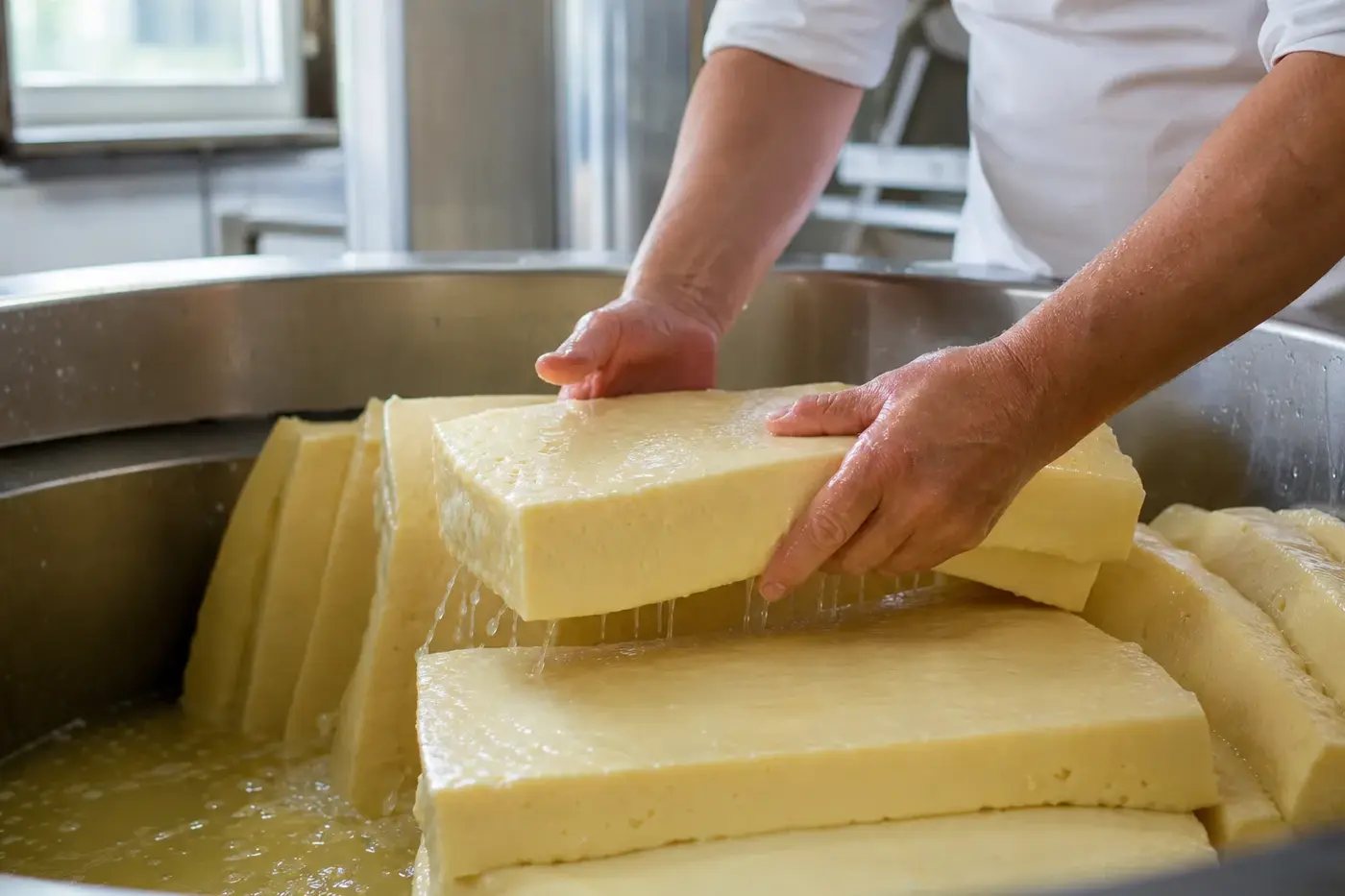
Slabs of curd are turned and stacked by hand.