Sainte-Maure de Touraine
Look closely at this ash-coated log: there is writing on the straw running through its middle.
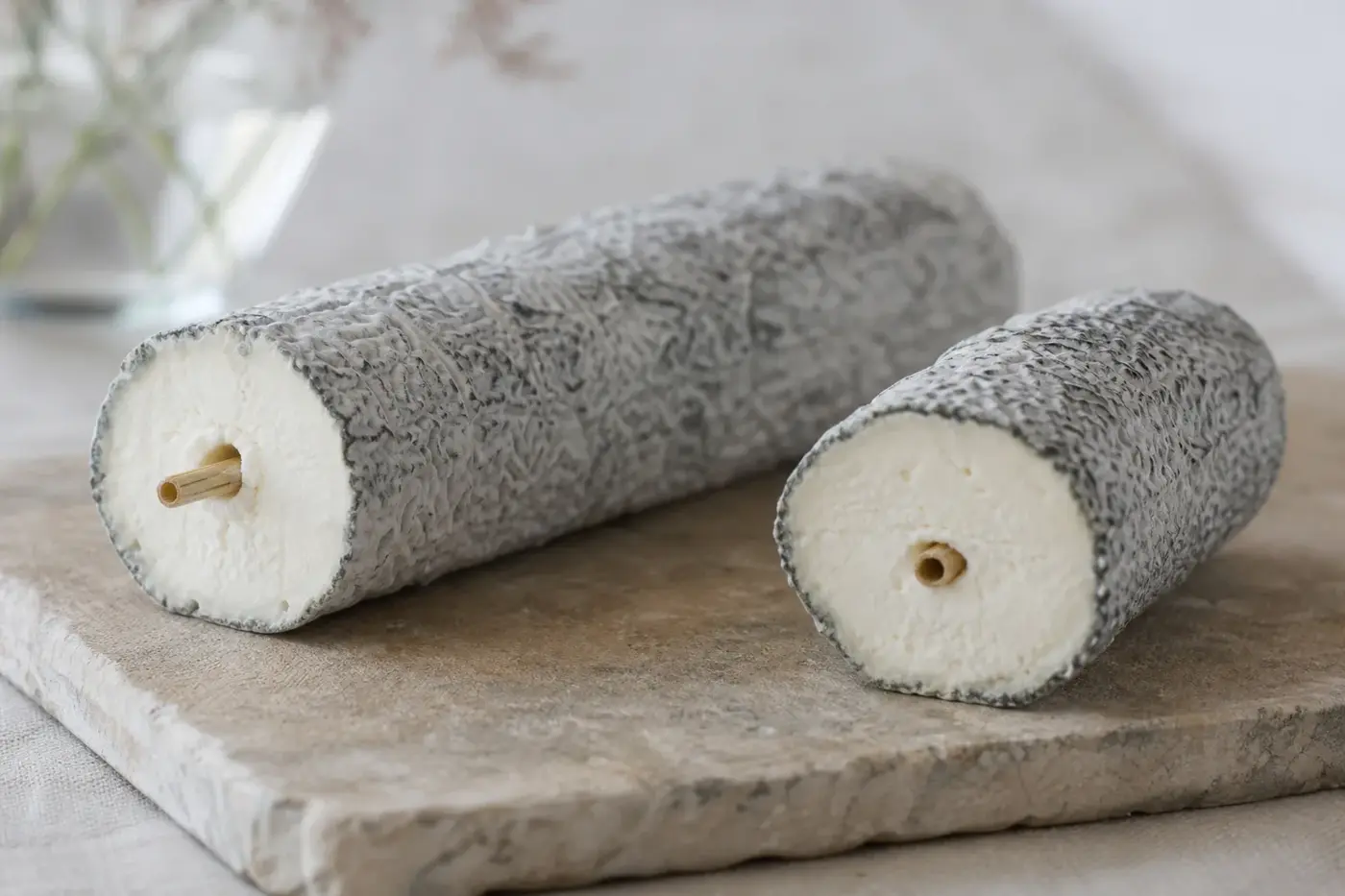
Look closely at this ash-coated log: there is writing on the straw running through its middle. The engraving gives you the appellation name and a number identifying its producer, a small introduction before the first bite. Once a support for fragile cheese during handling, the straw now identifies one of Touraine’s most distinctive cheeses: a tapered log of whole raw goat’s milk, with a grey rind and fine white paste that grows drier and more crumbly with age.[1][2]
| What to look for | The useful details |
|---|---|
| Name on the label | Sainte-Maure de Touraine.[2][3] |
| Registration authority and register ID | EU: European Commission; register ID: unconfirmed. Great Britain: Defra, Foods: designated origin and geographical indication register.[3] |
| Protected status | EU: AOP, the French abbreviation for PDO. Great Britain: registered PDO from 31 December 2020 at 23:00. Northern Ireland, Switzerland and United States: status unconfirmed. EU and Great Britain status as of November 2026.[1][3] |
| Dates in its story | French appellation recognition: 1990. Original EU registration date recorded by Defra: 21 June 1996.[1][3] |
| Where it must be made | Listed communes in Indre-et-Loire, Indre, Loir-et-Cher and Vienne, France.[2] |
| Milk and how it sets | Whole raw goat’s milk; predominantly lactic coagulation with a small addition of rennet.[2] |
| Minimum time to mature | Ten days from the day rennet is added; the rind must also be developed and visibly covered in mould before release.[2] |
| Shape and composition | Tapered log; at least 100 g dry matter per cheese and at least 45% fat in dry matter.[2] |
| Its distinctive exterior | Salted, coated with vegetable charcoal and threaded lengthways with an engraved cereal straw.[2] |
Meet a log with a signature
The straw, taper and ash belong together. INAO, France’s official institute for origin and quality, describes a fine, regular, bluish ash-coloured rind surrounding a white paste. You can expect a characteristic goat’s milk flavour with fruity or hazelnut nuances, shaped by the season and the cheese’s maturation.[1]
When choosing your log, begin with texture. The protected specification describes a supple, sometimes slightly moist paste that becomes drier and occasionally friable with age.[2] Something to spread over bread and something to cut into firm little pieces are quite different pleasures. The oldest cheese does not automatically win.
French appellation recognition came in 1990, followed by EU registration in 1996.[1][3] AOP means appellation d’origine protégée, the French term corresponding to protected designation of origin. To explore how a specification ties cheese to its place, start with protected names explained.
Follow the goats into Touraine
Sainte-Maure de Touraine belongs to a precise patch of France, not the whole Loire Valley. Its legal boundary extends beyond the town of Sainte-Maure-de-Touraine, following a commune-by-commune list across four departments. Milk production, cheesemaking and maturation must all take place within that area.[2]
The Loire and its tributaries cross this landscape. INAO describes an oceanic influence, with relatively mild winters and summers supporting the forage and cereal crops used in goat farming.[1] The goats must be Alpine, Saanen or Poitevine, or crosses between those breeds.[2]
Drought has prompted a temporary change to feeding requirements. Adopted on 13 October 2026 and published on 18 October, the order applies from 1 October 2026 to 30 September 2027. During that period, at least 50% of forage must come from the geographical area.[4] This relaxation concerns the goats’ feed, not the cheesemaking method.
The geographical designation tells you where your cheese comes from and which specification it follows. For a closer picture of a particular herd’s life, ask the producer about farming and feeding practices. If those details influence your choice, they deserve a conversation.
From raw milk to the familiar taper
Whole raw goat’s milk slowly sets into curd. Most of the work happens through lactic coagulation, helped by a small addition of rennet, the preparation that coagulates milk.[2] For the wider picture of milk treatments, explore raw, thermised and pasteurised cheese.
The specification allows 18 to 48 hours for coagulation, at no more than 25 °C. The curd is placed by hand into individual moulds or permitted multi-mould equipment, then drains without pressure for at least 18 hours from the start of moulding. Once out of its mould, the cheese receives salt and vegetable charcoal over every surface.[2]
The mould gives the cheese its familiar taper. Its specified internal measurements are 260 mm high, with diameters of 48 mm and 65 mm at opposite ends.[2] These are mould dimensions, not prescribed measurements for the finished log.
The weight requirement needs the same careful reading. The minimum of 100 g refers to the cheese’s dry matter, not its total retail weight. Neither that minimum nor the mould measurements tells you directly how large or heavy the finished cheese should be.
Get to know the ash and straw
That grey coat is vegetable charcoal, often called ash in cheese descriptions. Together with slow drainage and maturation, surface ashing and salting help develop the cheese’s characteristic ripening flora, as the specification explains.[2] You are looking at part of the prescribed cheese, not a wrapper to peel away.
The straw has both a practical role and an identifying one. Produits laitiers AOP, the industry organisation, calls it rye straw; the legal specification uses the broader term “cereal straw”.[2][5] Rye is the documented tradition, while cereal straw is the production requirement.
INAO explains that the straw originally strengthened the fragile cheese during handling. Today, its engraving carries the appellation name and a number identifying the producer.[1][2] Read those markings alongside the label to establish exactly what is on the counter. Few cheeses arrive with quite such discreet stationery.
Find the texture you love
White to ivory, fine and homogeneous: that is the official description of the paste. Its flavour is lactic, neither excessively salty nor excessively acidic. The aromas recall dried fruit and vegetation such as hay.[2]
INAO adds fruity and hazelnut nuances associated with season and ageing.[1] Together, these descriptions give you a sense of the cheese’s typical character. Treat them as a flavour map from the cited sources, rather than a fromage.co.uk tasting account.
At the counter, texture tells you more than a rigid calendar. The industry describes cheeses offered as supple, partly matured or matured, with paste moving from smooth to drier and more crumbly.[5] Ask your cheesemonger where this particular log sits along that journey.
Before reaching for bread or fruit, try a small piece alone. Taste the rind, then the centre, then both together. You will have your own reference for the next purchase, rather than letting age alone decide which cheese should be best.
Give the full name a moment
Look for Sainte-Maure de Touraine, written in full. The specification requires an individual label showing the registered name and the EU PDO symbol in the same visual field.[2] A moment with the label helps you choose with confidence.
“Sainte Maure” alone is not the complete registered designation. Cheese sold under that shorter name may not meet the Sainte-Maure de Touraine specification. If the counter card shortens the name, ask for the original label and read it alongside the identifying straw.
Four quick checks will help:
- Read the full product name.
- Find the PDO identification on the label.
- Look for the tapered shape and engraved straw.
- Ask who made it and how mature this particular cheese is.
Keep the label as your reference, rather than relying on the counter card. For help with the rest of the pack, including the difference between a producer and a packer, turn to how to read a cheese label.
This page summarises published guidance from the official sources it cites. It is not medical advice. Guidance differs between countries and changes over time, so check the current source for where you live, and ask your doctor, midwife, pharmacist or dietitian about your own circumstances.
Choose for your meal, store with care
Tell the cheesemonger when you plan to serve your cheese and whether you prefer a supple or drier paste. If there is a cut example, ask to see it rather than pressing a whole log yourself. Keep the original label with the cheese so its identity, storage instructions and batch details stay together.
Follow the storage directions on the pack. The Food Standards Agency’s household guidance for England, Wales and Northern Ireland recommends a fridge between 0 °C and 5 °C (32 °F to 41 °F). The US FDA recommends 4 °C (40 °F) or below, with refrigerated food kept covered; these recommendations reflect both sources in November 2026.[6][7] For wrapping options, see how to store cheese at home.
Shortly before your meal, bring out only the portion you intend to serve. US FDA guidance allows foods requiring refrigeration no more than two hours at room temperature, falling to one hour above 32 °C (90 °F).[7] Preparation and serving time both count towards that interval.
You do not need an exact serving temperature to plan the meal. Put out a modest portion and leave the rest in the fridge. Follow any more restrictive instructions supplied with your cheese.
Bring bread and a little seasonal company
Start with plain bread and let the cheese introduce itself. Produits laitiers AOP suggests traditional baguette, seeded baguette, fruit bread and Viennese bread.[5] Plain baguette keeps your attention on the cheese; fruit bread takes a more noticeable role in each mouthful.
Set accompaniments alongside rather than on top, so everyone can find their own balance. The combinations below are editorial serving suggestions. The industry’s drink suggestions are identified separately.
| Your choice | Good company | A way to enjoy it |
|---|---|---|
| A supple example | Baguette and sliced pear | Taste the cheese alone, then with a bite of fresh fruit. |
| A firmer example | Seeded bread and apple | Alternate small pieces without letting toppings take over. |
| A simple seasonal plate | Radishes in spring or ripe tomatoes in summer | Keep preparation simple and the produce distinct. |
| An alcohol-free drink | Water or diluted strawberry juice | Use water for a neutral comparison; strawberry juice is an industry-listed suggestion.[5] |
| An alcoholic pairing | A small serving of dry Loire white wine | Explore this regional suggestion published by the industry.[5] |
Alcoholic pairings are for adults of legal drinking age. Water is equally welcome at your table. For a broader approach to matching intensity and style, read cheese and wine pairing.
Take out the straw, then share the log
Set your cheese on a stable board and find the end of the straw. Remove it before eating: it is an identifying support, not part of your portion.[1][2] Once you have read the markings, its work at the table is finished.
Support the log and gently withdraw the straw lengthways. If it resists, cut a short end portion to expose it more clearly, then ease it out without pulling the cheese apart. You can set it aside for guests who would like to see the engraving.
Cut across the log into rounds, choosing their thickness to suit the firmness of the paste. A drier cheese may break naturally; there is no need to insist on perfectly smooth slices. Keep the label nearby until the meal is over, and return any cheese you are keeping to refrigeration within the applicable handling limit.[7]
Questions people ask
What milk is Sainte-Maure de Touraine made from?
It is made from whole raw goat’s milk. The permitted goats are Alpine, Saanen and Poitevine, including crosses between those breeds.
How can I recognise genuine Sainte-Maure de Touraine?
Look for the full registered name and the EU PDO symbol on the individual label. The cheese is a tapered log with an engraved straw running through it.
Can you eat the rind and straw?
The grey rind is part of the cheese, not a wrapping to peel away. Remove the straw before eating, as it is an identifying support rather than part of the portion.
How does Sainte-Maure de Touraine change as it matures?
Its paste can be supple and slightly moist when younger, becoming drier and sometimes crumbly with age. It must mature for at least ten days from the day rennet is added and have a visibly mould-covered rind before release.
How should I store Sainte-Maure de Touraine?
Follow the storage directions on the pack. For England, Wales and Northern Ireland, the Food Standards Agency’s household guidance recommends a fridge temperature between 0 °C and 5 °C; check its current guidance.
Sources
-
INAO. Sainte-Maure de Touraine. Official product record, undated, retrieved November 2026. Product identity, recognition year, sensory description, geography and straw identification.
Read at inao.gouv.fr -
French Ministry of Agriculture and Food. Avis relatif à l’approbation par la Commission européenne d’une modification mineure du cahier des charges de l’appellation d’origine protégée (AOP) « Sainte-Maure de Touraine », with the attached specification effective from 18 March 2022. Bulletin officiel 2022-17, 2022. Also consulted the specification homologated on 17 November 2021.
Read at info.agriculture.gouv.fr
Read at info.agriculture.gouv.fr -
Defra. Sainte-Maure de Touraine. Great Britain protected food name register entry, published 4 January 2021, retrieved November 2026.
Read at gov.uk -
French Republic. Arrêté du 13 octobre 2026 relatif à la modification temporaire du cahier des charges de l’appellation d’origine protégée (AOP) « Sainte-Maure de Touraine ». JORF 0244, text 20, published 18 October 2026, Article 1.
Read at legifrance.gouv.fr -
Produits laitiers AOP. Sainte-Maure de Touraine. Industry promotional reference, undated, retrieved November 2026. Rye straw, maturation descriptions, breads and drinks.
Read at produits-laitiers-aop.fr -
Food Standards Agency. How to chill, freeze and defrost food safely. Published 18 December 2017, retrieved November 2026. Applies to England, Northern Ireland and Wales.
Read at gov.uk -
US Food and Drug Administration. Are You Storing Food Safely? Current retrieved version, November 2026. Storage basics and refrigeration tips.
Read at fda.gov -
Official recall services. FSA Alerts, French Rappel Conso, and FDA Recalls, Market Withdrawals, & Safety Alerts. Index pages retrieved November 2026; limitations recorded below.
Read at alerts.food.gov.uk
Read at rappel.conso.gouv.fr
Read at fda.gov
This piece was researched from official designation records, the published specification and temporary amendment, official food-handling guidance and attributed industry material.
Last checked: November 2026
Last checked November 2026.
The editors suggest you read next