Salers
Milk flows into a wooden vat in the Auvergne uplands, meeting a living surface.
Milk flows into a wooden vat in the Auvergne uplands, meeting a living surface. This is the gerle: its resident microorganisms help seed the milk, tying each farm’s vessel to its cheese. Raw whole milk from the farm’s own cows becomes Salers through seasonal grazing, repeated pressing and at least three months of maturation. The vat has rather more on its CV than holding milk. [1, 2, 5]
| At a glance | Salers |
|---|---|
| The name to look for | Salers. [1, 4] |
| Where it comes from | Legally delimited parts of Cantal and neighbouring Aveyron, Corrèze, Haute-Loire and Puy-de-Dôme, France. [1, 2] |
| EU protection | PDO; current register status and register ID are not supplied here. |
| Great Britain protection | Registered PDO; UK scheme registration dated 31 December 2020, 23:00. Register record: Salers. Reference month: November 2026. [4] |
| The milk and where it becomes cheese | Raw whole cow’s milk, made into cheese on the farm that produces it. [1, 2] |
| What sets the milk | Rennet. [1] |
| The style | Firm, pressed, uncooked cheese. [1] |
| The whole wheel | Cylindrical; 30 to 50 kg after minimum maturation. [1] |
| Time to mature | At least three months from assembly of the wheel. [1] |
| Usual making season | 15 April to 15 November, subject to grazing requirements; a temporary feeding amendment applies during autumn 2026, explained below. [1, 3] |
Follow the grass into the Auvergne uplands
Picture the extensive grasslands of the volcanic Cantal massif. This is Salers country, though it reaches beyond the village whose name the cheese carries. INAO, France’s national authority for geographical indications, describes an area extending into the Cézalier and part of the monts Dore. The legal boundary takes in whole communes and specified parts of others. [1, 2]
“Auvergne” gives you your bearings; the Salers specification draws the precise line. Milk production, cheesemaking and maturation must all take place inside that boundary. A broad regional name alone cannot qualify a cheese as Salers. [1]
The ordinary making season runs from 15 April to 15 November, when the animals are grazing. That rhythm shapes how the cheese is made, rather than simply lending the label a pastoral flourish. Maturation carries Salers beyond its making season, so your eating calendar need not follow the cheesemaker’s production calendar. [1, 2]
Drought has brought a temporary exception for autumn 2026. A French order allows meadow hay to provide no more than 50% of the basic ration, measured as dry matter, from 15 September to 15 November 2026. The cows must still eat grazed grass daily, and the basic ration must come from the geographical area. During that period, this amendment applies to the usual feeding provisions. [3]
One farm, one milk supply, its own cheese
Every Salers must be a farmhouse cheese. The milk comes from the farm that makes it, and the specification does not allow several farms to share one manufacturing workshop. That milk is raw and whole, with neither its fat nor its protein content standardised. [1]
It enters the farm’s cheesemaking system immediately after milking. This close relationship between herd and dairy gives you a useful question at the counter: which farm made this? Alongside the cheese’s age and the person responsible for maturation, the producer’s identity helps explain the piece in front of you. [1, 2]
“Raw milk” and “farmhouse” do different jobs here. One describes how the milk has been treated; the other, for Salers, describes the relationship between milk production and cheesemaking. For the wider distinctions, explore raw, thermised and pasteurised milk.
Meet the gerle, the vat that plays its part
The gerle receives milk during milking, and rennet goes into that same vessel. It is working dairy equipment, not a handsome relic brought out for visitors. The Salers producers’ organisation describes gerles made from chestnut or acacia wood. [1, 6]
Inside, the surface supports a community of microorganisms called a biofilm. As milk touches it, the vessel contributes microorganisms to the milk. The wood therefore does more than keep everything in one place: its resident community participates in the cheesemaking environment. [5]
A 2012 study in the International Journal of Food Microbiology examined gerles from ten Salers farms over two production years. Researchers analysed their microbial populations and used experimental gerles to investigate milk inoculation. They found substantial differences between farm vessels, including their bacteria, yeasts and moulds. Their conclusion was that the biofilm contributed to inoculating the milk. [5]
Here, the link between a farm and its cheese becomes wonderfully tangible. Each vessel carries a microbial community that helps start cheesemaking, rather than serving as an interchangeable container. Alongside that studied role, the producers’ organisation identifies the gerle as a contributor to each cheese’s individual character. [5, 6]
Read the rind, then look inside
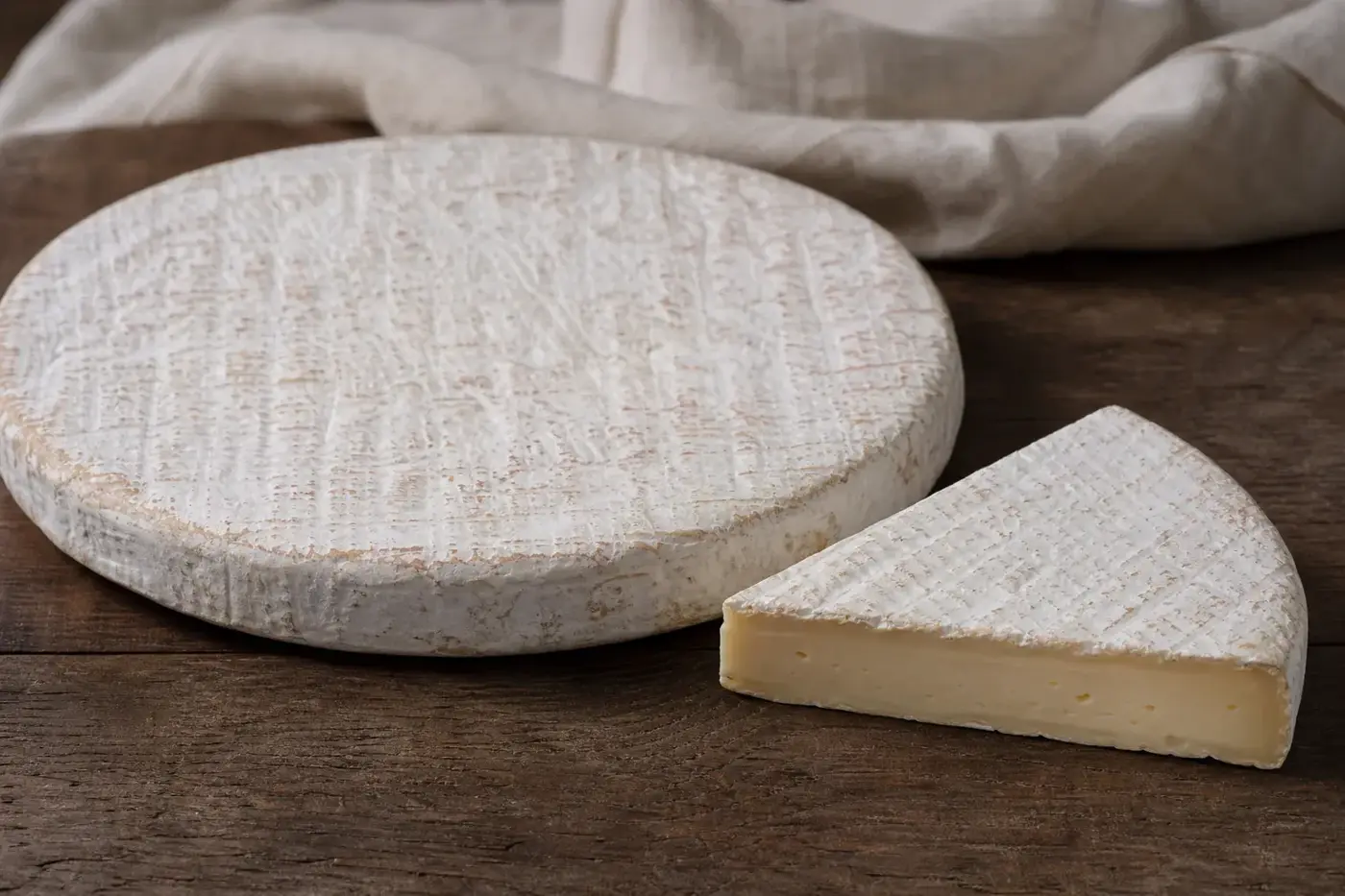
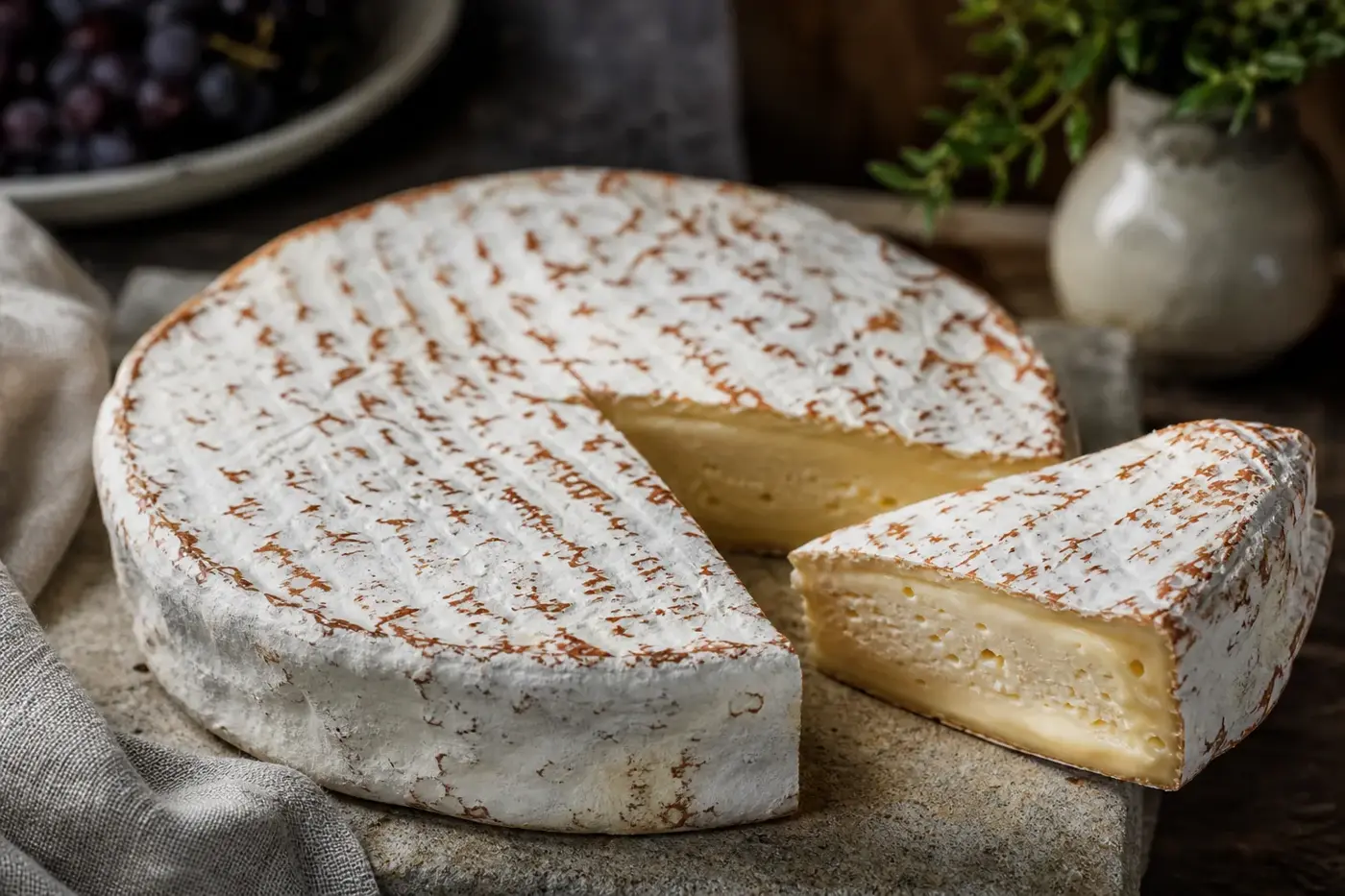
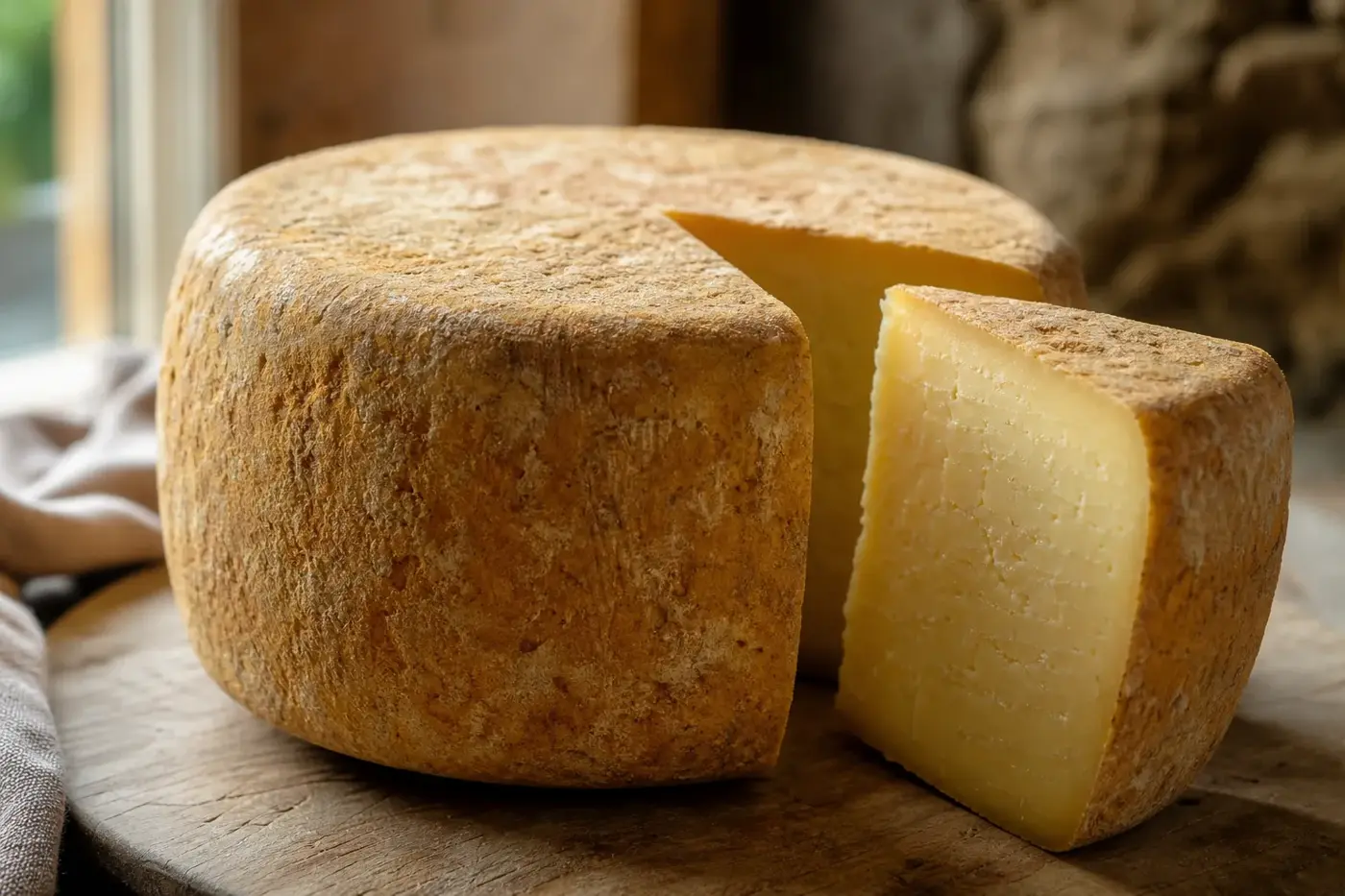
A whole Salers is a substantial cylinder, slightly swollen towards each end. Its dry, uneven rind ranges from golden to ochre, sometimes carrying naturally occurring red, orange and yellow moulds. Inside, the paste runs from ivory to straw yellow. [1]
Look closely at the cut face and you can follow some of the making. Pieces of milled curd have been pressed back together, leaving a knitted structure rather than a completely uniform interior. The cheese shows its construction: pressed, broken down, then assembled again. [1]
At the counter, ask to see both the rind and the cut face. The outside tells you part of the story; the inside starts a more useful conversation about texture. You and the cheesemonger have something concrete to discuss, instead of leaving the name to do all the explaining.
Press, pause, break up and begin again
Salers does not acquire its final shape in one straightforward squeeze. Rennet, the milk-clotting preparation, starts coagulation in the gerle. The solid curd is cut by hand, and the whey, the liquid it releases, drains away. The compacted curd then passes through pressing, fermentation and reassembly. [1, 6]
| Stage | What happens at the dairy |
|---|---|
| First pressing | The cheesemaker progressively presses the curd, cuts it into blocks and turns it by hand. This pressed mass is the tome. [6] |
| Acidification and maturation | The tome rests for lactic fermentation, followed by a further maturation period. [1, 6] |
| Milling and salting | The cheesemaker breaks the tome into small pieces and mixes dry salt through by hand. [1, 6] |
| Resting with salt | The salted material rests before assembly. [6] |
| Assembly and second pressing | The pieces go into a cloth-lined mould, then are progressively pressed and turned into a wheel. [1, 6] |
The pauses deserve as much attention as the pressing. Acidification takes eight to twelve hours, followed by a maturation phase of equivalent duration. The second pressing lasts approximately forty-eight hours. These are distinct stages with different purposes, not one long pressing of freshly formed curd. [1]
That sequence explains the structure in your wedge. Before the curd takes its final shape, it has already been pressed and fermented. Only then is it milled, salted and compacted into the finished wheel. Its knitted interior preserves the evidence. [6]
To put those steps into the wider cheesemaking picture, take a look at how cheese is made.
Three months at least, with more to ask about
Salers must mature for at least three months, counted from assembly of the wheel. During maturation, the wheels are regularly turned and wiped. The producers’ organisation reports maturation extending to two years. That is a possible duration, not the legal minimum or the age of every wheel for sale. [1, 6]
Ask the age, then ask what those months mean for the piece you are considering. How readily does it break? Which aromas stand out, and how long does the flavour linger? A good description connects the number to the cheese in front of you.
For a first purchase, that conversation is more useful than automatically choosing the oldest piece. Age is not a competitive sport, even at a cheese counter. When comparing ages, note the farm and the affineur, the specialist responsible for maturation, as well as the number of months. Those details help distinguish differences between producers from differences attributed to age.
Make room for butter, hay, citrus and walnut
Butter and fermented cream. Grass and hay. Citrus and walnut. The Salers producers’ organisation offers an aromatic vocabulary with plenty for you to explore in your next piece. [7]
It gathers the leading notes into three families. Lactic covers butter and fermented cream; vegetal includes grass, hay and allium; fruity includes citrus, walnut and hazelnut. Peppery, animal and roasted characters also feature in its vocabulary. [7]
Let those words sharpen what you notice, rather than turn tasting into a checklist. “Vegetal” becomes more useful when you ask whether your piece suggests fresh grass, dried hay or something closer to onion. Citrus and walnut point in quite different directions, despite sharing the broad family of fruit-associated aromas.
The organisation attributes this variation to pasture flora, the microbial richness of the gerle and the producer’s methods. INAO likewise describes a broad aromatic range, with each Salers possessing its own character. Think of that published vocabulary as a starting point, not a script you must follow. [2, 7]
Try a small piece by itself before bringing in bread or fruit. Notice the texture first, then the aromas as you chew, then what remains after swallowing. You need not find every listed note. The pleasure is in recognising what your particular piece offers.
Tradition Salers puts the herd in the picture
The shared name can catch you out: Salers cheese does not have to come exclusively from Salers cattle. INAO identifies Tradition Salers as cheese made exclusively with milk from Salers-breed herds. That extra word tells you something specific about the milk behind the wheel. [2]
Producers using the designation must make a prior commitment, and the specification provides for identification on the cheese. Within the Salers appellation, Tradition Salers therefore supplies an additional detail about the herd. It is information you can bring to your conversation at the counter. [1]
Ask the same questions you would for any Salers. Which farm made it, when was it made, how was it matured and what is it like now? The breed designation answers a provenance question. Tasting and a clear description still help you choose between individual pieces.
Salers or Cantal? Look beyond the wheel
A large wheel may catch your eye, but the making is a better starting point for comparing Salers with Cantal. INAO maintains separate product records for Salers and Cantal ou Fourme de Cantal. Treat them as distinct cheeses, rather than allowing their shared appearance to settle the question. [2, 9]
For a detailed comparison of production rules, turn to the current specifications. At the counter, focus your questions on the pieces actually being offered. Which Cantal is it, how was its milk treated, where was it made and how long has it matured?
Keep a note of the identities of the pieces you taste. Your comparison then becomes about actual cheeses, rather than names in the abstract. Neither name alone can tell you everything about the flavour and texture you will find.
Choose your piece and let it lead the plate
Start with the exact name, producer and age, then ask who matured the cheese. If the cattle breed matters to you, look for Tradition Salers. When tasting is available, describe what you enjoy in concrete terms: more lactic, more like hay, more peppery, or a particular texture.
For help with the wording, see how to read a cheese label. Keep the seller’s wrapping or label, so the details travel home with your cheese. Otherwise, that excellent counter conversation can become surprisingly difficult to recall beside the fridge.
The Food Standards Agency advises keeping a domestic fridge at 5 °C or below and following packaging instructions. Consult the current advice for your country. Keep those practical instructions alongside your plans for serving. [8]
Serve modest portions and replenish the plate as needed. Keep the main piece refrigerated with its label and handling instructions. For wrapping and the wider storage routine, see storing cheese at home.
The accompaniments below are suggestions drawn from the published aroma vocabulary, not reported tasting results. Try them separately, so you can discover what each brings to your piece:
- Plain bread: a simple place to start, keeping the cheese in focus.
- Fresh apple or pear: take a separate bite alongside the cheese and see whether you enjoy the contrast.
- Walnuts: explore the walnut association in the producers’ aroma vocabulary.
- Water or an unsweetened alcohol-free drink: keep your attention on the cheese when comparing pieces.
Begin with Salers alone, then introduce one accompaniment at a time. Let the character of your particular piece decide which combination deserves another bite.
General information only, not medical advice: follow the official guidance where you live.
Questions people ask
Where and when is Salers made?
Salers is made in legally delimited parts of Cantal and neighbouring areas of France. Its normal production season runs from 15 April to 15 November, subject to grazing requirements.
Is Salers made with raw milk?
Yes, Salers is made from raw whole cow’s milk. It must be made on the farm that produces the milk.
What is Tradition Salers?
Tradition Salers is made exclusively with milk from Salers cattle. Other Salers cheese need not be made exclusively from the milk of that breed.
How long is Salers matured?
Salers must mature for at least three months from assembly of the wheel. The producers’ organisation reports that maturation can extend to two years.
How should I store Salers at home?
The Food Standards Agency advises keeping a domestic fridge at 5 °C or below and following packaging instructions. Consult the agency’s current guidance and check the advice for your country.
Sources
[1] Institut national de l’origine et de la qualité and French Ministry of Agriculture. Cahier des charges de l’appellation d’origine « Salers », approved by the order of 7 July 2021, published in JORF on 16 July 2021 and the Ministry’s official bulletin no. 2021-30. Retrieved copy hosted by the Salers producers’ organisation.
[2] Institut national de l’origine et de la qualité. Salers, official product profile and printable record, undated, retrieved November 2026.
[3] French Government, Légifrance. Arrêté du 2 octobre 2026 relatif à la modification temporaire du cahier des charges de l’appellation d’origine protégée (AOP) « Salers », JORF no. 0235, 8 October 2026, text no. 13, Article 1.
[4] Department for Environment, Food & Rural Affairs. Salers, protected food and drink names register, published 4 January 2021, retrieved November 2026.
[5] International Journal of Food Microbiology. “Characteristics of microbial biofilm on wooden vats (‘gerles’) in PDO Salers cheese”, volume 156, issue 2, 2012, pages 91 to 101. DOI: 10.1016/j.ijfoodmicro.2012.03.007. Publisher’s abstract and article extracts retrieved.
[6] Comité Interprofessionnel des Fromages, Salers website. La Fabrication, undated, retrieved November 2026. Industry source, used for its account of equipment and manufacturing operations.
[7] Comité Interprofessionnel des Fromages, Salers website. Arôme, undated, retrieved November 2026. Industry source, used for its attributed sensory vocabulary.
[8] Food Standards Agency. How to chill, freeze and defrost food safely, published 18 December 2017, retrieved November 2026. Applies to England, Northern Ireland and Wales.
[9] Institut national de l’origine et de la qualité. Cantal ou Fourme de Cantal, official product record, search record retrieved November 2026; full specification not retrieved.
Researched through official product information, a published specification, French legislation, the Great Britain register, primary microbiological research and attributed industry descriptions.
Last checked: November 2026
Last checked November 2026.
The editors suggest you read next