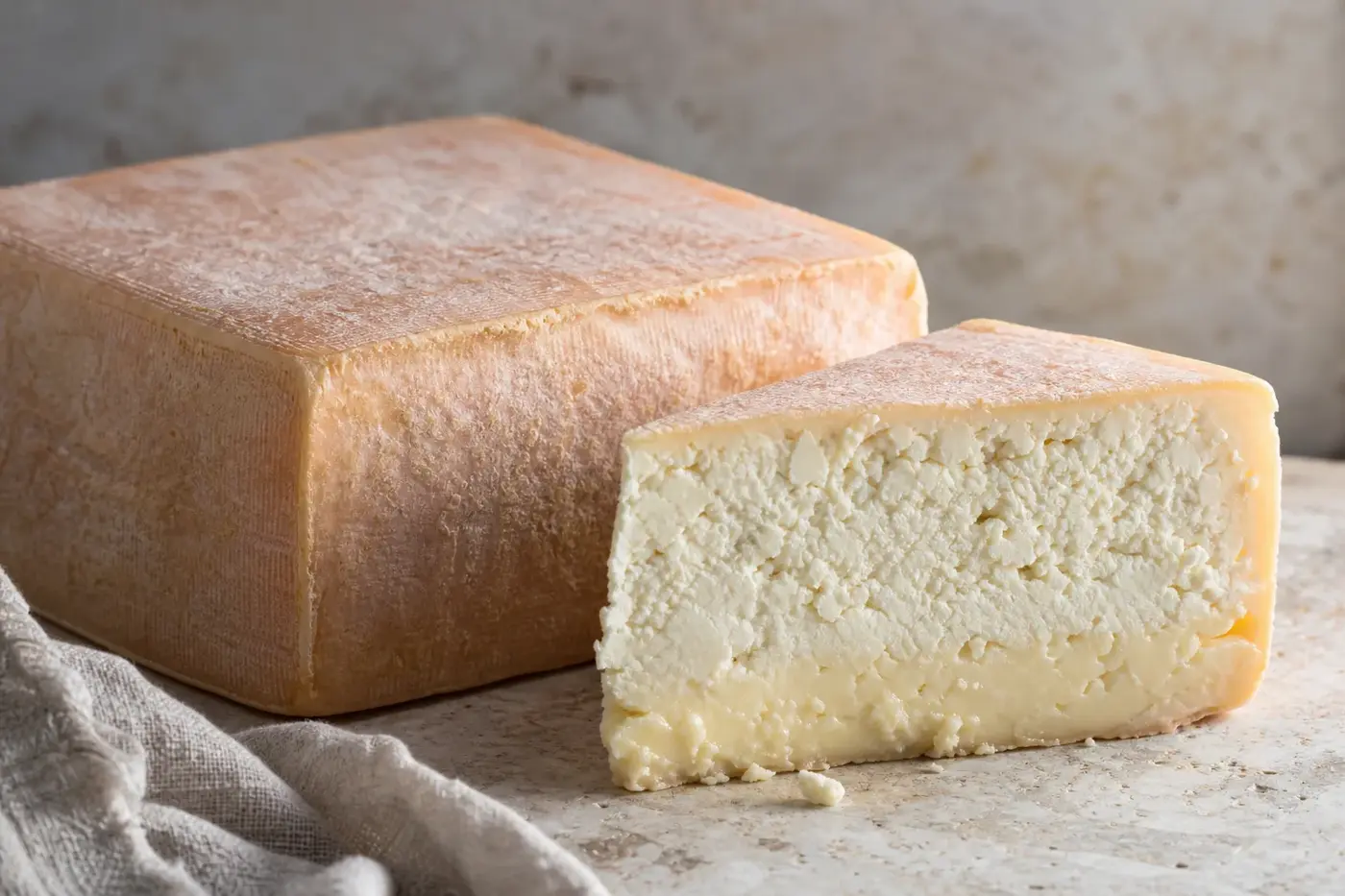
Cut into a square of Salva Cremasco. Your knife meets a crumbly white centre, then a softer layer tucked beneath the rind: two textures, neither willing to leave the other all the attention. Its name tells a story of surplus spring milk saved for later, rooted in Crema and the surrounding Lombard territory. This Italian cows’ milk cheese is listed in Great Britain’s register as a registered PDO. [1,2,3]
Salva Cremasco at a glance
| What you want to know | What to look for |
|---|---|
| Registered name | Salva Cremasco. [1,2] |
| Registration authority and reference | European Commission; application reference IT-PDO-0005-0639-30.07.2007; register ID uncertain. [3] |
| Registration instrument | Commission Implementing Regulation (EU) No 1377/2011, identified in a later decree; operative act uncertain. [7] |
| Protection | EU: current status uncertain. Great Britain: registered PDO from 31 December 2020; register information dated November 2026. Northern Ireland, Switzerland and the United States: status uncertain. [2] |
| Where it comes from | Six Lombard provinces, listed below. [1] |
| Milk and coagulant | Whole cows’ milk; permitted milk treatment uncertain; liquid bovine rennet. [1,3] |
| Minimum maturation | 75 days under Article 5. [1] |
| Sizes | Square faces of 11 to 13 cm or 17 to 19 cm; weights 1.3 to 1.9 kg or 3 to 5 kg, with a permitted 10% tolerance. [1] |
| Composition | At least 48% fat in dry matter; at least 53% dry matter. [1] |
| Rind | Washed rind, thin, sometimes with surface mould. [1] |
| Pregnancy guidance | Official guidance links: uncertain. |
Spring’s milk, kept for later
“Salva” comes from salvare, meaning to save. The official specification connects that word specifically with preserving excess spring milk, while “Cremasco” takes you to Crema and its surrounding territory. When milk arrived in abundance, cheesemaking kept some of it for another day. [1]
You can follow traces of its visual history through paintings and frescoes, too. The registration dossier cites a 2001 study by a local anthropological group. It interpreted cheeses in seventeenth and eighteenth century works as resembling Salva Cremasco. [1,3]
That resemblance does not give the named cheese an invention date. A specific local origin legend remains uncertain, and older evidence of milk processing belongs to the wider history of dairying. The story has depth, but no precise beginning. [1,3]
Follow the milk through Lombardy
Crema gives Salva Cremasco its association and part of its name, but the protected territory reaches beyond it. It covers the entire provinces of Bergamo, Brescia, Cremona, Lecco, Lodi and Milan. Milk production, cheesemaking and maturation must all take place within that area, so your Salva Cremasco need not come from Crema itself. [1]
The dossier describes an irrigated agricultural plain shaped by drainage and canals, with cereals and fodder growing across it. Local dairying also connects with cattle moving seasonally between mountain districts and the plain. Farms provided the milk; cheesemakers brought the salting and maturing skills that helped preserve it. [3]
How the milk becomes a square
Whole cows’ milk and liquid bovine rennet begin the process. Rennet is the animal enzyme preparation that sets the milk, and the cited specification names Frisona Italiana and Bruna Alpina cattle. The documents differ on milk treatment, leaving the current operative requirement uncertain. [1,3]
A natural or selected starter derived from local strains joins the milk. Coagulation turns it into a gel at 32 to 40 °C over 10 to 20 minutes. The cheesemaker then cuts it twice: first into coarse pieces, then into pieces approximately the size of hazelnuts. [1]
The curd is not cooked. If you encounter pasta cruda, that is what the term describes, not whether the milk was pasteurised. Curd treatment and milk treatment are separate questions, so you need a separate answer for each. [1]
Moulds give the cheese its square outline before stufatura, a warm draining stage lasting 8 to 16 hours at 21 to 29 °C. The cheeses are turned and receive their identifying impression before salting, either dry or in brine. For the wider sequence, take a look at how cheese is made. [1]
The patient work beneath the rind
Article 5 requires at least 75 days of maturation. The cheeses rest on wooden boards in rooms held at 2 to 8 °C and 80 to 90% humidity, with frequent turning. These are controlled production conditions, not instructions for your fridge. [1]
The surface needs regular care: sponging with water and salt, plus brushing. The specification also permits food oil, grape marc and aromatic herbs. Marc is what remains after grapes have been pressed; ask which treatment your particular cheese received. [1]
The registration dossier gives particular importance to the maturing rooms’ resident microflora and the cheesemaker’s judgement in managing the surface. Ripening moves from the outside towards the centre. That explains the contrast in your slice: a firmer middle, with softer paste just beneath the rind. [3]
Look closely, then take a taste
Start with the cut face. The specification describes compact, friable paste, with occasional, irregular holes and softening immediately beneath the surface. It begins white, moving towards straw yellow as it matures, under a thin, fairly smooth rind that sometimes carries surface mould. [1]
Now bring your piece closer. The EU dossier describes citrus, melted butter and a hint of sour milk in the aroma. Its account of the typical flavour is more forceful, with relatively restrained saltiness and a slightly bitter, green grass character, particularly near the rind. [3]
Longer maturation brings stronger aromas and more pronounced flavour in the official description. Ask the actual age, then whether the piece is firmer and more crumbly or further developed beneath the rind. Choose what suits your meal, rather than assuming the longest wait makes the best choice. [1,3]
A familiar shape beside Taleggio
That square outline may bring neighbouring Taleggio to mind. If you want to compare dimensions, maturation or sensory descriptions, a reliable comparison depends on Taleggio’s current operative specification.
Meet tighe, the sharp local companion
The most distinctly local accompaniment is tighe: Lombard green peppers preserved in vinegar. The producer consortium publishes a preparation combining diced Salva Cremasco and chopped tighe with olive oil and black pepper. The cheese and peppers rest in the refrigerator before the final dressing is added. [4]
Here, contrast is the point: pickled pepper against compact paste and increasingly assertive cheese flavour. Taste the cheese alone first, then add a small piece of pepper. That gives the vegetable and vinegar their say without appointing the pickle chair of every mouthful. [1,4]
The consortium also suggests pears, celery and curly salad leaves alongside Salva Cremasco. Keep things simple, letting fruit and crisp vegetables provide the contrast. Plain bread gives you a neutral companion for comparing the centre with the softer paste near the rind, while water is a straightforward alcohol free drink to serve with it. [4]
Three good questions for your cheesemonger
How long has it matured? Was the milk raw or pasteurised? How was the rind treated? The answers tell you more about the piece in front of you than its square outline can. [1]
The cited specification describes different milk treatments and several surface treatments, while its sensory account allows for changes with age. If you can, compare two ages from the same maker. Ask which suits eating in slices and which the seller recommends for the dish you have in mind. [1]
When you taste, note the maker and stated age. Those small details make it easier to find a cheese you enjoyed again. For help with the wider label details, turn to reading cheese labels.
At home, follow the pack
Follow the storage and opening instructions on your particular pack. For England, Wales and Northern Ireland, consult the Food Standards Agency guidance on chilling food, published on 18 December 2017, with the guidance reference dated November 2026. [6]
Domestic storage guidance serves a different purpose from professional maturation conditions. Your kitchen is not the maturing room. You can find more context in storing cheese at home.
Bring Salva Cremasco into your cooking
Fusilli with walnuts and marjoram, a vegetable and mushroom frittata, stuffed courgette flowers: the consortium’s recipe collection offers several ways to cook with Salva Cremasco. It also includes a sweet tart combining the cheese with apple. These suggestions come from the producer group as part of its promotion of the cheese. [4]
The walnut and marjoram pasta gives you an approachable starting point. Its published method softens small pieces of cheese with milk to make a sauce, rather than treating a firm piece as a hard cheese for grating. Follow the original recipe for quantities and method, and ask your cheesemonger which maturity would suit it. [4]
Find the details behind the protected name
DOP is the Italian abbreviation for PDO, protected designation of origin. Salva Cremasco’s specification connects the cheese with its defined territory and production requirements, supported by recorded traceability and conformity checks. Great Britain’s register lists it as a registered PDO from 31 December 2020 and records its original EU registration as 23 December 2011. [1,2]
Look for the full name and traceable packaging. The cited documents describe an impressed origin mark, a dairy identification number, and packaging bearing the full name and product logo. For current identification and packaging requirements, refer to the operative specification and the rules of the market where the cheese is sold. [1,3]
The specification requires portioning, and the packaging associated with that portioning, to take place within the production area. Keep the original wrapper after your first serving so you still have the maker, product and batch information to hand. For the distinction between a protected name and a general cheese style, read protected names explained. [1,3]
The useful combination is the complete name, traceable packaging and an informed seller. You may recognise the square shape and the rind. They are only part of identifying the cheese. [1,3]
General information only, not medical advice: follow the official guidance where you live.
Questions people ask
Where does Salva Cremasco come from?
It comes from six Lombard provinces: Bergamo, Brescia, Cremona, Lecco, Lodi and Milan. Milk production, cheesemaking and maturation must all take place within this area.
What does the name Salva Cremasco mean?
Salva comes from salvare, meaning to save, and refers to preserving excess spring milk. Cremasco names the connection with Crema and its surrounding territory.
Is Salva Cremasco made with raw or pasteurised milk?
The cited documents differ on milk treatment, and the current operative requirement remains unverified. Ask the cheesemonger whether the milk in your particular cheese was raw or pasteurised.
Is Salva Cremasco vegetarian?
The specification calls for liquid bovine rennet. This is an animal enzyme preparation used to set the milk.
What does Salva Cremasco taste like, and what can I serve with it?
The registration dossier describes citrus, melted butter and a hint of sour milk in its aroma, with a slightly bitter, green grass character in its flavour. A local accompaniment is tighe, Lombard green peppers preserved in vinegar; the producer consortium also pairs the cheese with pears, celery and curly salad leaves.
Sources
- Ministero dell’agricoltura, della sovranità alimentare e delle foreste (MASAF). Disciplinare di produzione “Salva Cremasco” DOP. Ministry-hosted specification, undated version supplied through its product specification page. Articles 2 to 6 and 8. Official specification page.
- Department for Environment, Food & Rural Affairs. Salva Cremasco. Great Britain protected food names register, published 4 January 2021; live entry retrieved November 2026. Register entry.
- European Commission. Publication of an application pursuant to Article 6(2) of Council Regulation (EC) No 510/2006, “Salva Cremasco”, 2011/C 124/13. Official Journal C 124, 27 April 2011, pages 20 to 23. Published single document.
- Consorzio Tutela Salva Cremasco. Website recipe collection, including Tighe al Salva Cremasco, Insalata di pere e Salva Cremasco and Fusilli alle noci e maggiorana. Undated online edition, retrieved November 2026. This producer organisation promotes the cheese. Consortium recipe text.
- MASAF. Proposta di modifica del disciplinare della denominazione di origine protetta “Taleggio”. Ministry-hosted specification proposal, undated PDF, retrieved November 2026. Articles 1, 2 and 5. Published document.
- Food Standards Agency. How to chill, freeze and defrost food safely. Published 18 December 2017; live guidance retrieved November 2026. Applies to England, Northern Ireland and Wales. Official guidance.
- MASAF. Modifica temporanea del disciplinare di produzione della denominazione “Salva Cremasco”. Decree dated 28 February 2023, protocol 0128532. Its preamble identifies Commission Implementing Regulation (EU) No 1377/2011 of 20 December 2011 and publication on 23 December 2011.
This piece was researched from official specifications, registration records and published agency guidance, with historical and culinary accounts attributed to their sources.
Last checked: November 2026
Last checked November 2026.
The editors suggest you read next
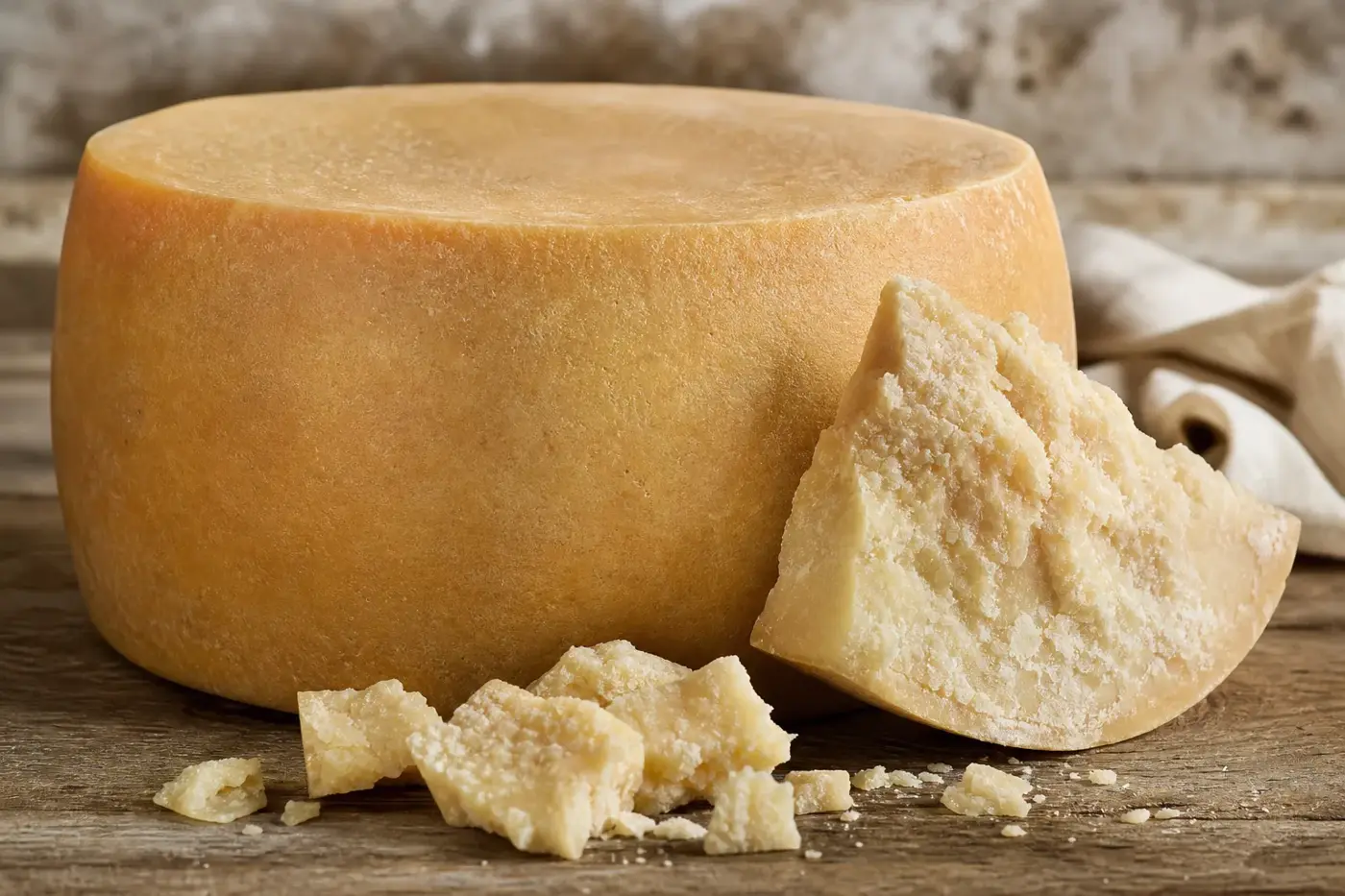
Parmigiano Reggiano
Break into a wheel of Parmigiano Reggiano and flakes fall away, revealing a finely granular cheese, pale straw to straw in colour.