Schabziger
A little green Schabziger falls from your grater onto a plain potato.
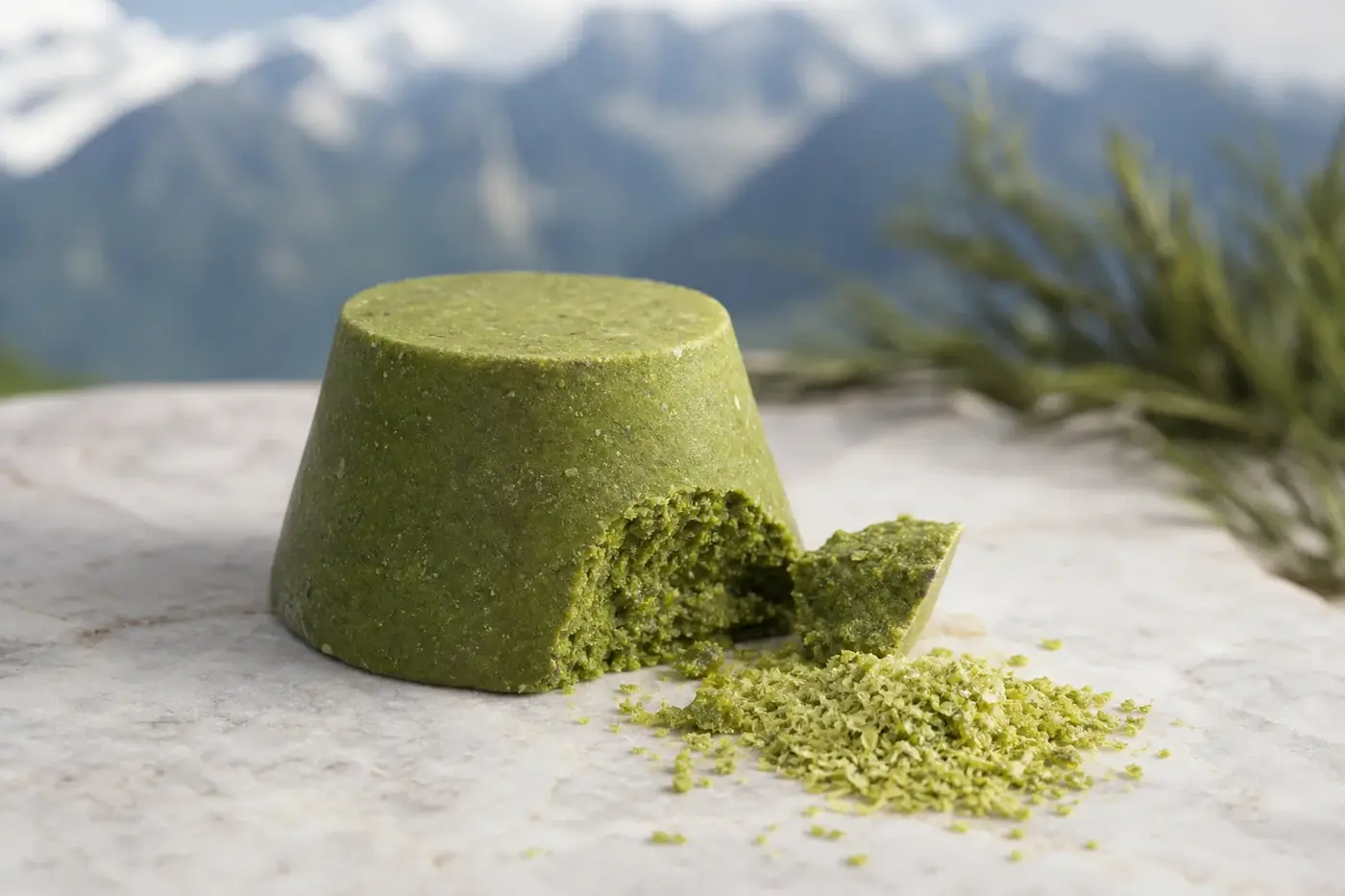
A little green Schabziger falls from your grater onto a plain potato. Take a bite before you add more: this small cone has considerable presence. Made in Glarus, Switzerland, from skimmed cow's milk and blue fenugreek, it is a firm herb cheese for grating, not thick slices, bringing concentrated flavour to butter, potatoes and pasta.[1,2,3]
| What to know | A closer look |
|---|---|
| Name | Schabziger; also called Glarner Schabziger.[1] |
| Home | Traditionally associated with the canton of Glarus, Switzerland.[2] |
| Milk in the named product | Pasteurised skimmed cow's milk, Stöckli Original.[1] |
| The herb | Blue fenugreek, Trigonella caerulea.[4,5] |
| How the curd forms | Heat and acid; no rennet declared by the producer.[1,6] |
| Shape and size | A cone with a flat top; Original product 100 g.[1,7] |
| Rind | No rind.[7] |
| Swiss AOP or IGP registration | Status not established. |
| Registered name and register ID | Details not established. |
| Dietary declarations | Stöckli Original: vegetarian and lactose-free, according to its producer.[1] |
Meet the little green cone with a big presence
That green runs right through Schabziger, rather than sitting on the outside as a coating. The cone has a flat top and a wider base. An Agroscope-hosted dairy research account describes it as rindless; today's producer calls its Original Stöckli semi-hard, ready for grating or shaving.[1,7]
Think seasoning cheese, not a wedge for generous slicing. Swiss dairy research describes the flavour as spicy to distinctly piquant. The producer makes much of its intensity too, describing a cheese made with salt and herb.[1]
For your first taste, finely grate a little over buttered bread or a plain potato. Taste before adding more, especially if milder cheeses are usually your favourites. This is one cheese where enthusiasm need not mean a thicker slice.
Follow the mountain milk into the making
The story starts with skimmed milk, not simply the whey left after another cheese has been made. Geska's production account begins with cow's milk from the mountain area around Glarus. It is heated above 90 °C before the sour culture called Sauer or Etscher is slowly added; the separated milk solids become Rohziger, the curd that precedes the finished green cheese.[6,8]
Heat and acidity draw the proteins out of the milk. That is a different approach from setting milk with rennet, the coagulating preparation used for many other cheeses. The producer explicitly declares its Original product rennet-free; you can explore the distinction in how cheese is made.[1,6]
The liquid left apart from the curd has a name too: Schotte, in the producer's account. Keep those stages in mind and you can follow the transformation: skimmed milk goes in, Rohziger forms, and that curd goes on to become Schabziger. It is quite a different route from the one you might picture for Switzerland's great cheese wheels.[8]
Maturation comes before the familiar cone. Agroscope's 2009 account of the classical process describes about 3 to 12 weeks of initial maturation, then salting and approximately 3 to 6 months in a silo. The matured mass is ground with the herb, then shaped into cones or dried for powder; these are documented process ranges, not a legal minimum ageing period.[6]
Get to know the blue herb behind the green
Blue fenugreek gives Schabziger its characteristic colour and an important part of its aroma. At the Royal Botanic Gardens, Kew, its accepted botanical name is Trigonella caerulea (L.) Ser.; German names include Schabzigerklee. If the name on your packet looks different, the producer's ingredient declaration uses an older botanical spelling rather than the currently accepted scientific name.[1,4]
You are tasting powdered herb, not the seed of ordinary fenugreek. Germany's federal plant reference lists the herb of Trigonella caerulea separately from the seed of Trigonella foenum-graecum. Mixed into matured cheese, that powdered plant material contributes both the green and its share of the aroma.[5,6,7]
The herb has a farming story of its own. Geska's account includes cultivation around Lachen in neighbouring Schwyz. Schabziger belongs to Glarus, but its ingredients need not all grow within the canton: alongside the milk, maturing and grinding comes a supporting crop from beyond its boundary.[9]
Visit Glarus in 1463, when the maker's mark mattered
In 1463, the Glarus Landsgemeinde, the cantonal assembly, laid down requirements for cheese offered for sale. It had to be clean and good, properly worked and salted, and marked by its maker. The Swiss art and architectural heritage inventory for Glarus Nord, published in 2017, reproduces a passage from those rules.[10]
That maker's mark deserves a moment of your attention. An identifiable producer took responsibility for the cheese, giving Schabziger a documented history of quality requirements and identification in the fifteenth century. The familiar claim that it is the world's oldest brand stretches beyond what this evidence establishes.[10]
The same inventory records the later importance of grinding mills, where white Ziger was milled and mixed with aromatic herb. Glarus's connection is a story of recognisable trade, specialist equipment and local rules, not simply a date printed on a wrapper. The current producer's published account still places production in Glarus.[8,10]
Soften the intensity with Zigerbutter
Work grated Schabziger into butter and you have Zigerbutter, ready for bread or alongside potatoes. The Swiss Culinary Heritage inventory also records Ankeziger as a name for a butter mixture. Geska's current range includes prepared Zigerbutter products, with serving suggestions reaching to toast and pasta.[2,3]
For your first batch, work a small amount of finely grated cheese into butter, then taste. Add more only if you want a stronger flavour. Spread it thinly enough to enjoy the bread too: it has not volunteered to be merely a delivery service.
At the shops, keep the green seasoning cone and the prepared butter spread separate in your mind. Geska lists butter mixtures with differing descriptions, including one with cream. Each has its own ingredients and storage instructions, so follow those rather than borrowing the cone's details.[3]
Give familiar dishes a little green seasoning
Pasta, potatoes, sauces, soups, risotto and polenta all feature in the producer's serving suggestions. Let Schabziger provide seasoning rather than the bulk of a sauce. Start with a dish you know well, so you can taste exactly what this cheese brings to it.[1,3]
For pasta, grate a little over your finished portion, toss and taste before adding more. Give potatoes a light grating or a little Zigerbutter. For soup or sauce, put a spoonful in a small bowl and try a few gratings first; if you like the combination, season the main dish gradually.
Leave your final salt adjustment until after the cheese goes in, allowing for its declared salt content and its role as a seasoning. Grating over individual portions also lets everyone choose their own level of that strong herbal flavour.[1,3]
Pick your format and give it the right home
Choose a cone if you want to grate as needed, grated cheese for convenience, or Zigerbutter for spreading. All appear in the producer's range. Read the exact product name and ingredients, particularly when you see that familiar green on several different preparations.[3]
Once home, follow the packet's refrigeration instructions and its directions for storage after opening. In England, Wales and Northern Ireland, the Food Standards Agency advises a fridge temperature of 5 °C (41 °F) or below.[11]
When deciding whether to use it, start with the date and storage history. UK government guidance distinguishes a best before date, about quality, from a use-by date, about safety. Incorrect storage can make food unsafe before its use-by date, and you should follow any shorter instruction that applies once the pack is open.[12]
Green colour and herbal pungency belong to this cheese.[7] But if you suspect it is unsafe, do not eat it, and follow any recall notice. For handling principles, see how to store cheese at home; for the separate question of unexpected growth, see mould on cheese.
Find the milk and dietary details on your label
Geska declares its Original Stöckli suitable for vegetarians and says it contains no rennet. Those declarations belong to this particular product. If you are cooking with it, remember to check the other ingredients: the cheese's declaration does not cover your stock, sauce or accompaniment.[1]
The producer also describes that same product as lactose-free and made from pasteurised skimmed cow's milk. Read those facts together, because lactose-free dairy is still a milk product. The guide to cheese allergy versus lactose intolerance explains the distinction, with official sources to support your personal dietary decisions.[1]
Keep three questions separate: what is in the product, which dietary statements its maker makes, and how you plan to use it. Treat the cone, powder and butter spread as separate foods, each with a label of its own. For a systematic approach to the packet, turn to how to read a cheese label.
General information only, not medical advice: follow the official guidance where you live.
Questions people ask
What does Schabziger taste like?
Swiss dairy research describes its flavour as spicy to distinctly piquant. It is a firm seasoning cheese made to be grated or shaved rather than cut into thick slices.
How is Schabziger made?
Skimmed cow's milk is heated above 90 °C, then a sour culture is added to form a curd called Rohziger. The curd matures before it is ground with blue fenugreek and formed into cones or dried for powder.
How do you eat Schabziger?
Grate a little over potatoes, pasta or buttered bread. You can also work grated Schabziger into butter to make a spread called Zigerbutter.
Is Schabziger vegetarian and lactose free?
Geska declares its Original Stöckli suitable for vegetarians and says it contains no rennet. The producer also describes this product as lactose free, although it is made from cow's milk.
How should you store Schabziger?
Follow the pack's refrigeration instructions and any directions for storage after opening. In England, Wales and Northern Ireland, the Food Standards Agency advises keeping the fridge at 5 °C or below.
Sources
[1] Geska AG, Stöckli Original 100g, current producer product declaration, undated, retrieved November 2026. Ingredients, milk treatment, format, uses and dietary declarations.
[2] Association Patrimoine culinaire suisse, Schabziger, Swiss Culinary Heritage inventory, online edition, undated, retrieved November 2026. Regional identity, culinary use and Ankeziger.
[3] Geska AG, Produkte, current online product range, undated, retrieved November 2026. Cone, grated cheese, powder and butter preparations, with the producer's serving suggestions.
[4] Royal Botanic Gardens, Kew, Plants of the World Online: Trigonella caerulea (L.) Ser., 2026 taxonomic backbone. Accepted botanical name and vernacular names.
[5] German Federal Office of Consumer Protection and Food Safety, List of Substances of the Competent Federal Government and Federal State Authorities: Category “Plants and plant parts”, 2014, table status December 2013. Entries for Trigonella caerulea and Trigonella foenum-graecum.
[6] Agroscope Liebefeld-Posieux, ALP forum, 2009 report on biogenic amines in cheese, section 3.9, “Schabziger”. Classical acid and heat coagulation, maturation sequence and shaping.
[7] Swiss Federal Dairy Research Station, Schabziger als proteinreiche Nahrungsquelle, Schweizerische Milchzeitung/Le Laitier Romand, issue 42, 16 November 2001, archived by Agroscope. Rindless cones, herb addition, colour and piquant character.
[8] Geska AG, Produktion, current producer account, undated, retrieved November 2026. Skimmed milk, heating, sour culture, milk supply and Glarus production.
[9] Geska AG, Der Schabziger-Klee, current producer account, undated, retrieved November 2026. Herb terminology and cultivation history.
[10] Gesellschaft für Schweizerische Kunstgeschichte, Die Kunstdenkmäler des Kantons Glarus, Band II: Glarus Nord, 2017, introductory section “Zigerproduktion”. Transcribed passage from the 1463 requirements and history of grinding mills.
[11] Food Standards Agency, How to chill, freeze and defrost food safely, GOV.UK HTML edition, originally published 18 December 2017, retrieved November 2026. Applies to England, Wales and Northern Ireland.
[12] UK Government, Understanding food labelling: Best before and use-by dates, current online guidance, retrieved November 2026. Date meanings, storage conditions and after-opening instructions.
This piece was researched through producer declarations, Swiss dairy research, botanical references, a scholarly historical transcription and official food-handling guidance; culinary suggestions are editorial recommendations rather than independently tested recipes.
Last checked: November 2026
Last checked November 2026.
The editors suggest you read next