Stilton vs Roquefort vs Gorgonzola
Air slips through the caves beneath the Combalou rockfall, following natural fissures called fleurines.
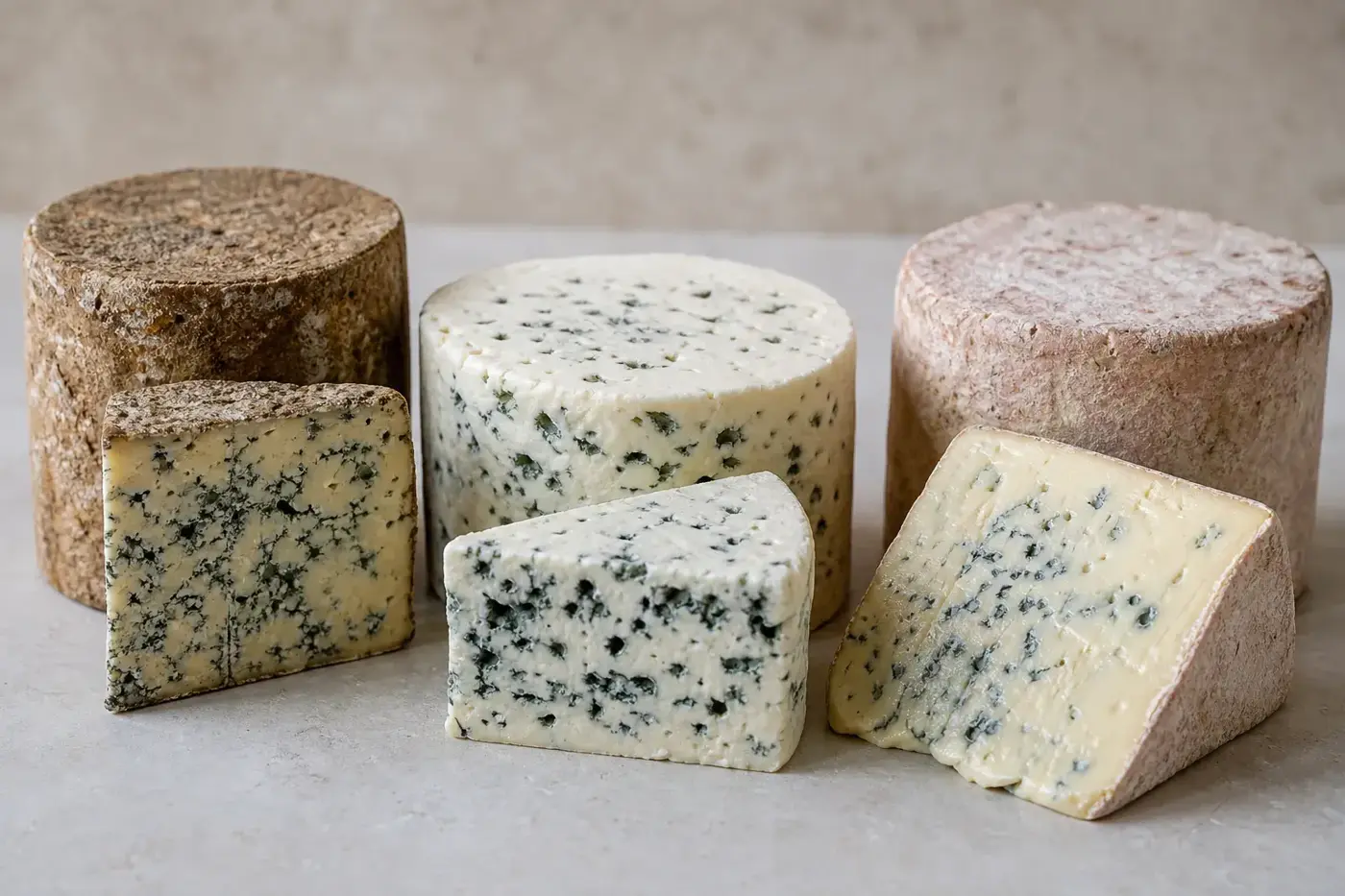
Air slips through the caves beneath the Combalou rockfall, following natural fissures called fleurines. Inside, Roquefort develops its blue-green marbling. That cave air is your first clue: these three blue cheeses may share a look, but milk, making and maturation give each its own texture and flavour. [5][13]
So, what would you like on your plate? Choose Blue Stilton for tang and crumbs that soften in your mouth, Roquefort for pronounced sheep’s-milk character, or Gorgonzola Dolce for a softer, gentler introduction. Gorgonzola Piccante keeps company with the stronger blues: firmer, more crumbly and rather less inclined to whisper. [1][2][3][4]
Meet four blues with minds of their own
English, French or Italian gets you only so far. Milk, moisture, curd handling and maturation shape what happens when you cut, crumble or cook these cheeses. The descriptions below draw on published specifications, an official product record and an attributed industry account, giving you a useful starting point for choosing your wedge. [1][3][4][5]
| Cheese | Milk | Where it is made | What you can expect | Your first serving |
|---|---|---|---|---|
| Blue Stilton | Pasteurised cow’s milk | Three permitted English counties | Milky background, tangy finish; slightly crumbly, softening with maturation | On a cheeseboard or crumbled over salad |
| Roquefort | Raw, whole Lacaune sheep’s milk | Defined southern French area; matured at Roquefort-sur-Soulzon | Pronounced flavour; unctuous paste with blue-green cavities | In a strongly flavoured dressing |
| Gorgonzola Dolce | Pasteurised whole cow’s milk | Defined areas of Piedmont and Lombardy | Mild blue flavour; soft, yielding paste | In a smooth pasta sauce |
| Gorgonzola Piccante | Pasteurised whole cow’s milk | The same defined Italian area | Stronger, more pungent flavour; firmer, crumbly paste | As a stronger cheeseboard blue |
Milk, origins and published sensory descriptions: [1][3][4][5][6].
Before dinner, ask yourself two questions. Do you want distinct pieces of cheese, and how loudly should the blue flavour speak? Your answers will serve you better than treating these three names as interchangeable ingredients.
Blue Stilton: a little tang, a lovely crumble
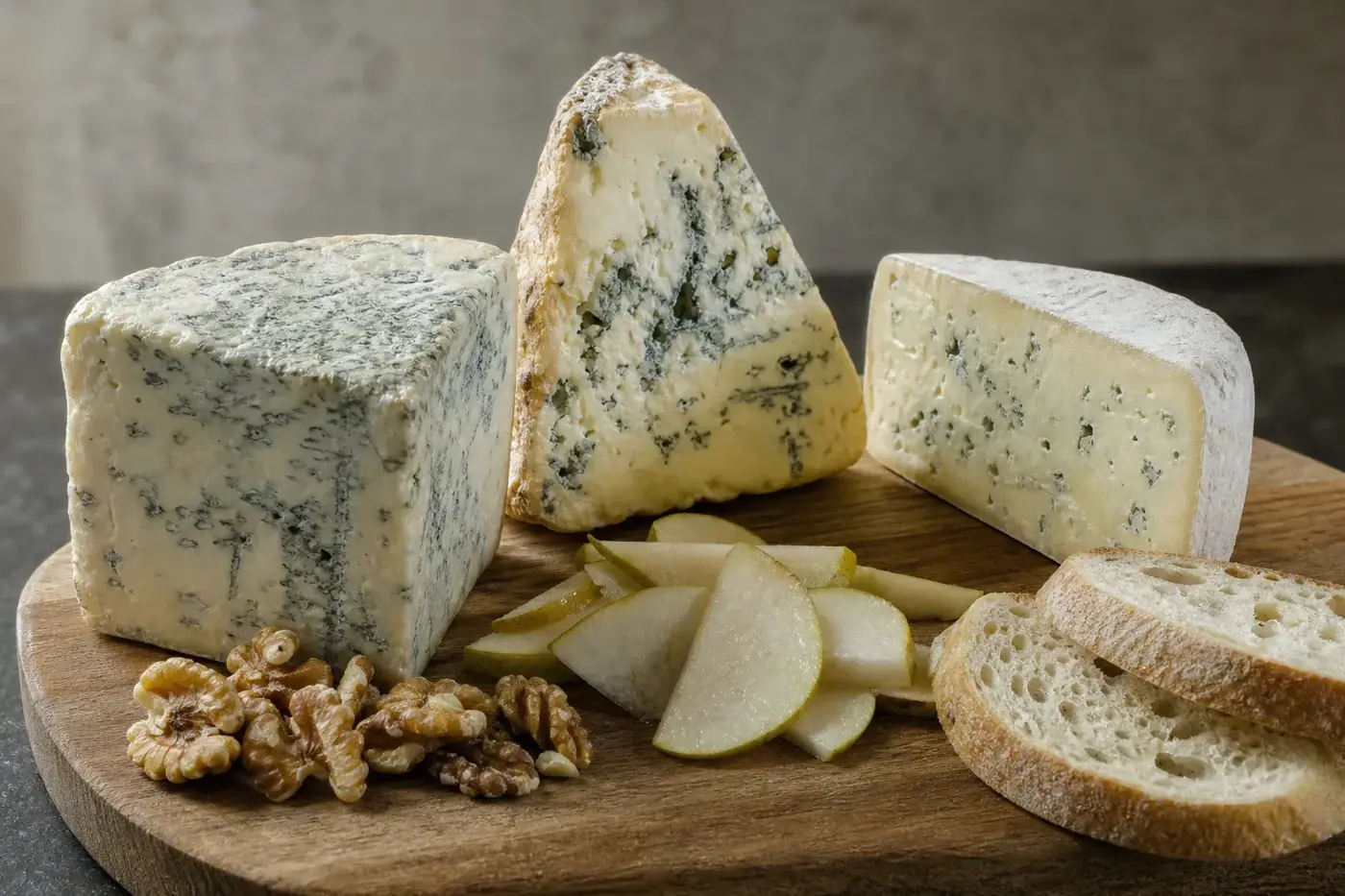
Break into Blue Stilton and you find an open, slightly crumbly structure with a milky background. Its specification describes the younger cheese as slightly sharp; the Stilton Cheesemakers’ Association’s labelling guidance identifies a tangy finish. In your salad, that combination can give each mouthful definition without taking over. [1][2]
Age changes more than the strength of the flavour. The specification describes Mature Blue Stilton as softer and fuller-flavoured, while Vintage Blue Stilton is drier, stronger and more complex. An older piece may behave differently under your knife and on your plate, not simply taste more powerful. [1]
The story starts with curd, the coagulated milk solids separated from liquid whey. Stilton curd drains without applied pressure, and the cheese forms its own coat. The association describes smoothing the outside, then later piercing the wheel to encourage blue development within. [1][7]
At the cheese counter, ask about your particular piece’s age and texture. If you are cooking, choose a tangy, crumbling piece when you want recognisable cheese, rather than something that melts into the background.
Roquefort: bold flavour with a yielding heart
Do not mistake intensity for hardness. Roquefort brings you pronounced flavour in a moist, yielding cheese made with raw, whole milk from Lacaune sheep. INAO, France’s official origin and quality institute, describes its paste as unctuous. [5]
That yielding paste and substantial blue flavour make Roquefort useful for dressings. Start with a modest amount, taste, then decide whether you need more cheese or additional salt. Your leaves, fruit or vegetables should still have something to contribute, rather than simply carry the dressing.
The maker matters here, too. Roquefort’s interprofessional body points to seasonal changes in milk, mould strains, piercing and cave maturation as reasons why different makers’ cheeses can taste distinctly different. The name gives you a starting point; your particular piece fills in the detail. [8]
If Dolce feels too gentle, Roquefort takes you somewhere deliberately different. You get sheep’s milk, pronounced flavour and another maturation environment, rather than simply a stronger version of the same cheese. [5]
Gorgonzola: first, choose your Dolce or Piccante
Before you choose Gorgonzola for a dish, choose your version. Dolce and Piccante share a protected name, but their textures can take your cooking in quite different directions.
The Gorgonzola consortium describes Dolce as soft and creamy, with a milder blue flavour. Piccante is stronger, firmer and more crumbly. Reach for Dolce when you want sauce to coat pasta evenly; choose Piccante when your dish needs distinct pieces and a stronger blue presence. [4]
Time gives you a clue, not a promise about taste. The consortium publishes maturation ranges of 50 to 150 days for Dolce and 80 to 270 days for Piccante. Those broad windows offer context, but cannot tell you exactly how an individual wedge will taste. [4]
There is a legal detail worth knowing. The published EU single document also distinguishes strong cheeses by wheel size, including a small-wheel category with a different maturation range. Its requirements are more specific than “Piccante always means at least 80 days”. [3]
When you buy for a recipe, ask for Dolce or Piccante by name. If the recipe does not specify the version, decide what you need first: softness, distinct crumbs or pronounced blue flavour.
Follow the blue: how the veins develop
Those blue interiors are cultivated, not happy accidents. Stilton and Roquefort’s published accounts identify Penicillium roqueforti, while the Gorgonzola consortium describes selected moulds added during production. Selected mould cultures give blue cheese the characteristic interior you see when you cut it. [7][8][4]
Piercing helps the blue develop inside. Stilton’s association describes stainless-steel needles piercing the cheese after an initial ripening period, with another piercing before grading. Roquefort’s interprofessional body also identifies piercing as an operation that influences the finished cheese. [7][8]
Mould does not do the whole job, though. Milk, spaces within the curd, moisture, maturation conditions and the cheesemaker’s decisions all play their part. Roquefort’s industry account explicitly links flavour differences to mould strains, their concentration and piercing practices. [8]
You can follow the wider journey in how cheese is made. These three cheeses show you just how much variety sits behind a blue-veined appearance. Similar-looking interiors can come from distinctly different production choices.
A name with a place behind it
Behind each name sits a place, and a set of rules. Stilton Blue Cheese, Roquefort and Gorgonzola are registered protected designations of origin, or PDOs, on the Great Britain register as at November 2026. Their GB registration dates are 31 December 2020; a PDO connects a registered food name with its specified origin and production requirements. [9][10][11][12]
For Blue Stilton, your map takes you to Leicestershire, Derbyshire or Nottinghamshire. Its specification requires pasteurised cow’s milk and permits milk from listed surrounding counties during shortages. Where the cheese may be made and where its milk may come from are related, but separate, rules. [1]
Roquefort’s milk production and cheesemaking area stretches across defined parts of southern France. INAO identifies parts of Aveyron, Tarn, Hérault and Lozère, together with some communes in Aude and Gard. Affinage and maturation take place at Roquefort-sur-Soulzon. [5]
Gorgonzola belongs to a defined area spanning Piedmont and Lombardy. That includes named provinces and the Casale Monferrato area. You cannot give a blue cheese the name simply because it was made somewhere in Italy. [6]
There is another boundary to keep in mind. Great Britain and the EU operate separate GI schemes, while Northern Ireland follows the EU scheme. For the difference between origin protection, a cheese style and a brand, turn to protected names explained. [12]
What time and place bring to your wedge
With Stilton, the calendar does not have the final word. Its published specification gives typical ages of 6 to 12 weeks for Blue Stilton, 10 to 15 weeks for Mature and beyond 15 weeks for Vintage. These are guidelines: grading rests primarily on flavour and texture, rather than age alone. [1]
Roquefort’s journey combines cave affinage with subsequent maturation. Its interprofessional body gives a minimum of 14 days in the caves and at least 90 days for affinage and maturation together. Those 14 days describe the cave stage, not the age at which you can buy your finished cheese. [8]
The caves are working surroundings, not just a handsome backdrop. Beneath the Combalou rockfall, fleurines carry air through the cave system. INAO describes these natural fissures’ role in maintaining its particular microclimate; the interprofessional account explains how blue-green marbling develops during this stage. [5][13]
Gorgonzola offers you another route to variety: shared milk and origin, but different finished textures and maturation schedules. The consortium’s published ranges help you choose. For an exact legal minimum, consult the specification’s wheel-size categories separately. [3][4]
Start gently, then turn up the blue
Begin with Gorgonzola Dolce, Blue Stilton, Gorgonzola Piccante, then Roquefort. Think of it as a suggested route, not a seating plan nobody dares change. A strongly matured Stilton may belong later, and Roquefort varies with its maker and production choices. [1][4][8]
Taste each cheese alone first and notice what happens. Does it spread, fracture into crumbs or yield before breaking? Consider milk flavour, tang and blue intensity, then try bread, followed by fruit or another accompaniment, keeping the cheese’s character distinct from the pairing.
Ask your cheesemonger which piece is gentlest. The names Dolce, Stilton and Roquefort do not give every wedge a fixed place in the tasting order. For your comparison board, choose four modest pieces, including both Gorgonzola versions, rather than several similar examples of one cheese.
Give each blue the right kitchen job
For distinct salad crumbs, choose Blue Stilton or Gorgonzola Piccante. If you want something softer, try small spoonfuls of Dolce alongside crisp leaves. Choose Roquefort when you want the cheese to supply the dish’s strongest flavour; these recommendations follow the published texture descriptions above. [1][4][5]
You have good culinary company for these choices. The Stilton association suggests crumbling the cheese over leaves and mixing it into dressings. The Gorgonzola consortium publishes an endive and green apple salad, alongside pasta dishes and sauces. [14][15]
For a smooth sauce, start with Dolce. For a dressing with a sharper blue identity, consider Stilton or Roquefort. Taste as you go: how much cheese you use, and what you put beside it, can matter as much as the name.
When you need a substitute, match the job rather than reaching for any available blue. Let these differences guide your choice:
- Replacing Dolce: look for a soft, mild blue; adjust the liquid if your replacement is firmer.
- Replacing Stilton: choose a blue that crumbles, then adjust the amount to suit its intensity.
- Replacing Roquefort: expect a cow’s-milk blue to change both the milk character and the flavour balance.
- Replacing Piccante: choose a firmer, stronger blue rather than automatically reaching for Dolce.
These swaps adapt the documented differences; they do not reproduce the protected cheeses. [1][4][5] Whenever you change an ingredient, check dietary requirements again.
Bring bread, fruit and a glass you enjoy
Start simply and give your cheese some room. INAO suggests Roquefort with bread and in a pear dessert. The Stilton association recommends crackers, plum bread and sweet wines, including Port. [5][14]
The suggestions below build on those published characteristics. You might enjoy crisp fruit against yielding paste, or an accompaniment with enough flavour to hold its own beside the cheese. A little contrast gives you something to notice without losing the cheese itself. [1][4][5][14]
| Cheese | Try it with | Wine, if you fancy it | Without alcohol |
|---|---|---|---|
| Blue Stilton | Plum bread or apple | A small serving of Port, as the association recommends | Apple juice diluted with sparkling water |
| Roquefort | Pear, plain bread and walnuts | A sweet white wine | Pear juice or water |
| Gorgonzola Dolce | Crisp apple and bread | An off-dry white wine | Sparkling water |
| Gorgonzola Piccante | Bread, walnuts and dried fruit | A sweet wine with sufficient intensity | Water alongside fresh fruit |
Walnuts offer a suggested textural contrast; you do not need to include them. When you serve a group, keep nuts separate so your guests can choose their own combination.
Wine is optional, and these suggestions are for adults of legal drinking age. If you would like to explore intensity and sweetness further, see cheese and wine pairing.
This page summarises published guidance from the official sources it cites. It is not medical advice. Guidance differs between countries and changes over time, so check the current source for where you live, and ask your doctor, midwife, pharmacist or dietitian about your own circumstances.
From fridge to plate: storage and label essentials
Keep your home refrigeration at 5 °C or below. That is the Food Standards Agency’s advice in its guidance for England, Wales and Northern Ireland. Follow the pack’s use-by date and storage instructions, including any directions for after opening. [17]
Let the particular cheese’s instructions guide your serving temperature. Not every wedge needs the same spell out of the fridge: put out a portion for immediate eating and keep the rest chilled. For wrapping and everyday handling, see how to store cheese at home.
Vegetarian suitability needs a separate label check. Stilton’s specification permits animal or non-animal rennet, the enzyme preparation used to coagulate milk, so the name alone cannot tell you which was used. Gorgonzola’s published EU single document specifies calf rennet. [1][3]
Look for an explicit vegetarian product declaration. If you are buying an unlabelled cut piece, ask about it. Neither pasteurisation nor blue mould establishes vegetarian suitability. [1][3]
Pregnancy: find the guidance for your cheese
United Kingdom, NHS guidance, November 2026: the NHS says pasteurised or unpasteurised soft blue-veined cheeses, specifically including Gorgonzola and Roquefort, must be thoroughly cooked. It says any cheese cooked until steaming hot can be eaten during pregnancy. Simply softening your cheese or stirring it into a warm dressing does not meet that wording. [16]
The same NHS page distinguishes hard cheeses and pasteurised semi-hard cheeses from soft blue-veined cheeses. It does not currently name Stilton in its examples. For a particular Stilton product, consult the current category guidance and ask your midwife if its classification is unclear. [16]
Use the current NHS pregnancy guidance. The guidance described here is from November 2026; if you live elsewhere, do not transfer these UK categories to another country.
Questions people ask
What milk is used in Stilton, Roquefort and Gorgonzola?
Blue Stilton and Gorgonzola are made with pasteurised cow’s milk. Roquefort is made with raw, whole milk from Lacaune sheep.
Where must Blue Stilton be made?
Blue Stilton must be made in Leicestershire, Derbyshire or Nottinghamshire. Its specification permits milk from listed surrounding counties during shortages.
What is the difference between Gorgonzola Dolce and Piccante?
Dolce is soft and creamy, with a milder blue flavour. Piccante is stronger, firmer and more crumbly.
Which blue cheese is best for pasta sauce or salad?
Gorgonzola Dolce is a starting choice for a smooth pasta sauce. For distinct crumbs in a salad, choose Blue Stilton or Gorgonzola Piccante.
How should blue cheese be stored?
The Food Standards Agency advises keeping home refrigeration at 5 °C or below in England, Wales and Northern Ireland. Follow the pack’s use by date and storage instructions, including any instructions for after opening.
Sources
- Department for Environment, Food & Rural Affairs. Stilton Cheese: product specification, version linked from the GB register, undated.
- Stilton Cheesemakers’ Association. Good Labelling Practice for Stilton Cheese, December 2023 revision. Industry guidance.
- European Commission. Single document: Gorgonzola, Official Journal publication, 27 May 2016.
- Consorzio per la tutela del formaggio Gorgonzola. The Gorgonzola, undated, current webpage. Industry account.
- Institut national de l’origine et de la qualité. [Roquefort](../roquefort/), undated, current product record.
- Consorzio per la tutela del formaggio Gorgonzola. Production area, undated, current webpage. Industry account.
- Stilton Cheesemakers’ Association. Making Stilton, undated, current webpage. Industry account.
- Confédération Générale de Roquefort. FAQ, undated, current webpage. Interprofessional account.
- Department for Environment, Food & Rural Affairs. Stilton Blue Cheese, GB protected food name register, published 4 January 2021.
- Department for Environment, Food & Rural Affairs. [Roquefort](../roquefort/), GB protected food name register, published 4 January 2021.
- Department for Environment, Food & Rural Affairs. [Gorgonzola](../gorgonzola/), GB protected food name register, published 4 January 2021.
- Department for Environment, Food & Rural Affairs. Protected geographical food and drink names: UK GI schemes, updated 8 March 2024.
- Confédération Générale de Roquefort. L’affinage naturel, undated, current webpage. Interprofessional account.
- Stilton Cheesemakers’ Association. Enjoying Stilton, undated, current webpage. Industry serving and pairing suggestions.
- Consorzio per la tutela del formaggio Gorgonzola. Recipes, current recipe index. Commercially interested industry source.
- NHS. Foods to avoid in pregnancy, current webpage, checked November 2026.
- Food Standards Agency. How to chill, freeze and defrost food safely, published 18 December 2017, current guidance.
Researched through official register records, published specification material, national guidance and attributed industry accounts; culinary choices are editorial synthesis, with no site tasting or recipe trial.
Last checked: November 2026
Last checked November 2026.
The editors suggest you read next
Cheddar vs Gouda: Taste, Texture and How to Use Each
Bite into a long-aged Gouda and, beneath your teeth, something crunches.