Strachitunt
Evening’s cool curd meets the next morning’s warm curd in a mountain dairy in Val Taleggio, Bergamo, Lombardy.
Evening’s cool curd meets the next morning’s warm curd in a mountain dairy in Val Taleggio, Bergamo, Lombardy. They share a mould, but keep a little distance. [4, 5, 6]
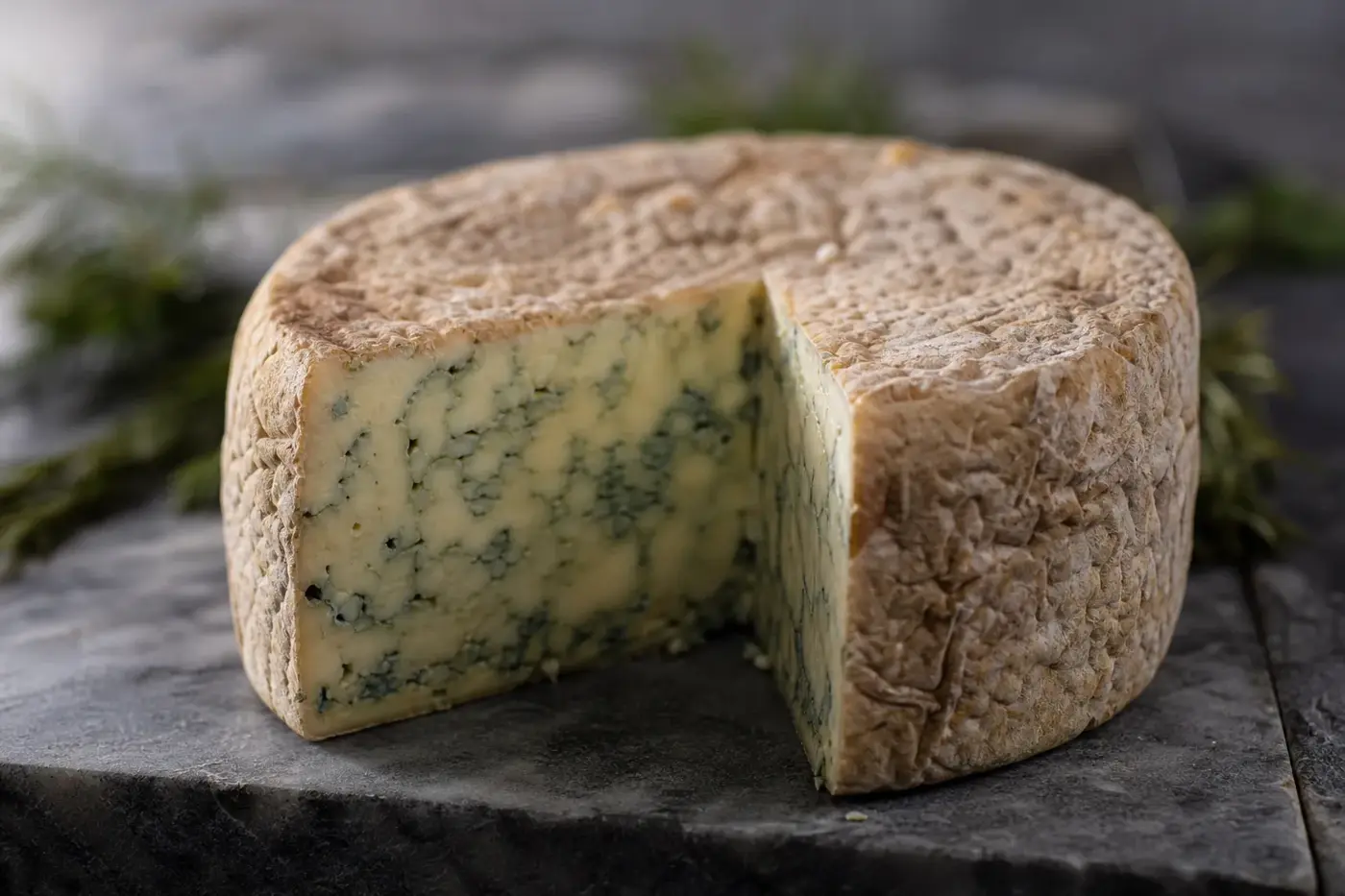
In the gaps between them, naturally occurring moulds find room to grow, giving this raw cow’s milk cheese its irregular blueing. Look closely at a slice of Strachitunt and you can see where those two curds met, without ever quite becoming one. [4, 5, 6]
| What to know | The details |
|---|---|
| Familiar and registered name | Strachitunt. [2, 3] |
| EU designation | PDO registration enacted by Commission Implementing Regulation (EU) No 244/2014. Current register status: Unconfirmed. [2] |
| Published EU amendment document identifier | PDO-IT-1047-AM02. [1] |
| Great Britain | Registered PDO; UK scheme registration dated 31 December 2020 at 23:00. Record reference: November 2026. [3] |
| Where it is made | Defined territories of Blello, Gerosa, Taleggio and Vedeseta, province of Bergamo, at a minimum altitude of 700 metres. Gerosa is now within Val Brembilla. [1, 4] |
| Milk and rennet | The 2023 amendment application describes raw whole cow’s milk, at least 90% from Bruna cows, and calf rennet. Current requirements: Unconfirmed. [1] |
| Minimum maturation | 75 days. [1, 4] |
| Usual maturation | Around three months, according to the protection consortium. [6] |
| Wheel dimensions in the March 2023 EU single document | Cylindrical; diameter 25 to 28 cm; height 10 to 18 cm; matured weight 4 to 7 kg. [1] |
| Rind and interior | Natural, wrinkled rind; pale, marbled interior with variable green-blue veins. [7] |
| Pregnancy guidance | UK NHS guidance, November 2026, is summarised below. [11] |
Follow the cheese into Val Taleggio
Meadows, pasture and woodland surround Val Taleggio’s settlements in Lombardy’s Orobie Prealps. The Enna runs through the valley towards the Brembo. In the protection consortium’s account, farming, forestry and cheesemaking have shaped this inhabited mountain landscape over centuries. [8]
The name takes you to defined territories within the province of Bergamo, not the whole province. Gerosa’s incorporation into Val Brembilla changed the administrative description, but did not open production to the entire enlarged municipality. The March 2023 EU amendment document explicitly records that the geographical area remained unchanged. [1]
That local connection begins before the milk reaches the vat. The document requires cattle rearing, milking, milk collection and processing, cheesemaking and maturation to happen within the defined area. Cutting and packaging may happen elsewhere under specified arrangements, so a packer’s address tells you about a different stage of the journey, not necessarily where your cheese began. [1]
Read the story behind the protected name
You will see PDO, meaning protected designation of origin, or its Italian equivalent, DOP. Strachitunt’s EU registration was enacted in 2014. Great Britain lists it separately as a registered PDO under its own scheme: each record belongs to its own jurisdiction. [2, 3]
For Strachitunt, origin goes hand in hand with a production method and a local milk supply. The 2023 document is an amendment application, rather than confirmation of the rules currently in force, including feed requirements. [1] For the broader distinction between designation types, see protected names explained.
Meet the two curds behind the marbling
The 2023 document specifies whole, raw milk, with at least 90% coming from Bruna cows. That percentage concerns the milk supply; it does not mean every contributing animal must belong to the breed. Calf rennet supplies the coagulating enzymes that turn liquid milk into curd, the solid material that becomes cheese. [1]
The two milkings take separate paths. In the production specification reproduced by the consortium, the first curd is gathered into cloth and drains for at least 12 hours. A second curd is made later, broken in the vat, then layered alternately with the first inside a cloth-lined mould. [4]
“Cold curd” and “warm curd” give you the clue to what happens next. One has already drained and acidified; the other is newly made. Their different consistencies and acidity stop them knitting into a completely uniform mass, leaving small gaps that the consortium identifies as the starting point for mould development. [5, 6]
Remember those layers when you look at a cut wheel. The marbling begins with the arrangement of two different curds, long before any blue veins appear. For the broader sequence, see how cheese is made.
Let a little air into the blue
Strachitunt’s moulds are naturally present; fungal starter cultures are not added to the milk. Their development makes each wheel different. Some show very little visible veining, according to the consortium, so do not be surprised if your slice is rather quiet on the blue front. [4, 5]
Piercing lets air reach the gaps between the curds. The specification reproduced by the consortium places this operation at approximately 30 days into maturation. Metal needles pass through the flat faces and curved side, and piercing may be repeated as ripening progresses. [4]
The legal minimum maturation recorded in the documents is 75 days. The consortium favours approximately three months for developing the characteristic moulds, but that is a preference, not a separate legal grade. Its explanation brings you back to those joins: air enters where the two pastes have not fully come together. [4, 6]
Take a closer look beneath the rind
A Strachitunt wheel has flat faces and a straight or slightly rounded side. The March 2023 EU single document describes a cylinder measuring 25 to 28 cm across and 10 to 18 cm high. Its matured weight is 4 to 7 kg. [1]
The consortium describes a thin, rough rind, sometimes covered in mould. Yellowish at first, it tends towards grey with longer maturation. Cut beneath it and you find pale straw-white, marbled paste, with softer areas immediately under the rind. [7]
You have plenty to explore in a single slice. Supple or creamy streaks meet uneven green-blue veins. Rather than one consistent feel, several distinct textures share the same piece. [7]
Taste your way from milk to piquancy
Start with the consortium’s published tasting description: lightly milky aromas give way to more prominent metallic notes. The flavour is aromatic and intense, moving from sweet to piquant as the cheese matures, then finishing with a vegetal aftertaste. These are the consortium’s notes, not a fromage.co.uk tasting. [7]
Age and blueing help you make sense of that range. The consortium links mould development with pungency and describes flavour strengthening through maturation. A lightly veined piece and a more extensively blue one can therefore give you different expressions of Strachitunt. [4, 5]
There is a chemical perspective, too. A 2017 study examined ten wheels produced weekly during spring 2015 and matured for 75 to 77 days. Researchers measured composition, protein breakdown and volatile compounds associated with aroma in that defined sample. [9]
Interesting as that is, you need not turn a visit to the cheese counter into a laboratory session. The consortium’s sensory descriptions give you a useful starting point for asking your cheesemonger about a particular wheel.
A round cheese with deep valley roots
“Round stracchino” is the consortium’s translation of Strachitunt in the Bergamasque dialect. The name places the cheese within the valley’s wider stracchino tradition. It also distinguishes its shape from the square cheeses in local accounts. [5, 8]
The consortium’s reconstruction of regional dairy history brings together resident farmers and transhumant cattle keepers. The latter moved seasonally between mountain pasture and the plains. Its account follows the expansion of square stracchino production alongside the continuing presence of round forms. [8]
Modern legal recognition gives you a more precise chronology. The EU registration regulation was adopted on 7 March 2014 and published on 14 March 2014. Entry into force on the twentieth day makes 3 April 2014 the operative date: a distinct chapter in a much older valley tradition. [2]
Get to know its neighbours, Taleggio and Gorgonzola
Taleggio shares Strachitunt’s valley history. In the consortium’s account, the square stracchino associated with Taleggio sits alongside the round form called Strachitunt. Geography introduces them, but Strachitunt’s two-curd construction and irregular internal blueing tell you what to look for in the cheese itself. [5, 8]
A blue-veined slice may bring Gorgonzola to mind first. Here, the Strachitunt consortium draws a specific distinction in method. Strachitunt’s moulds develop naturally, whereas Gorgonzola production involves adding Penicillium. [5]
At the counter, go beyond “which Italian blue?”. Ask about the particular Strachitunt wheel’s age, extent of blueing and texture. Those details tell you more about what to expect than treating it as a substitute for either neighbour. [4, 5, 7]
Give your first slice a moment of its own
Try a small piece on its own, then with plain bread. Compare a pale section with a veined one before bringing in stronger accompaniments. This suggested approach gives you room to explore the milky, piquant and vegetal qualities described by the consortium. [7]
For an alcohol-free accompaniment, try fresh pear and water. The fruit offers contrasting sweetness while leaving the cheese centre stage. This is a pairing suggestion, rather than a recorded tasting result.
Put out only what you expect to eat, then promptly return the rest to the fridge. UK NHS guidance says to eat chilled ready-to-eat foods within four hours of removing them from refrigeration. In hotter-than-usual weather, UK government guidance says to discard perishables left out for more than two hours. [12, 13]
This page summarises published guidance from the official sources it cites. It is not medical advice. Guidance differs between countries and changes over time, so check the current source for where you live, and ask your doctor, midwife, pharmacist or dietitian about your own circumstances.
Keep your cheese chilled and health guidance close
Keep chilled ready-to-eat food at 5 °C (41 °F) or below, following UK NHS guidance. Follow storage instructions, observe the use-by date and use opened food within two days unless the packaging says otherwise. Keep raw foods separate from ready-to-eat cheese. [12]
For help with wrapping and arranging your fridge, see how to store cheese at home. You will find practical advice to help you put storage guidance into action.
If you are pregnant in the UK, NHS guidance requires thorough cooking of pasteurised or unpasteurised soft blue-veined cheeses. It lists cheese cooked until steaming hot among foods that can be eaten. Its advice also requires thorough cooking of foods made from unpasteurised milk in the relevant soft-cheese category. [11]
Strachitunt is not named in that guidance. Consult the current NHS advice and a healthcare professional about your circumstances. [11]
The NHS identifies pregnant people, newborn babies, people with weakened immunity and older people as groups at greater risk of serious listeriosis. It lists blue-veined cheeses and unpasteurised dairy products among foods associated with the infection. If you belong to one of these groups, consult official advice and your healthcare professional about your circumstances. [12]
Questions people ask
Where is Strachitunt made?
It comes from defined territories in Blello, Gerosa, Taleggio and Vedeseta in the province of Bergamo, at a minimum altitude of 700 metres. Gerosa is now within Val Brembilla, but the production area has not been extended to the whole enlarged municipality.
What does Strachitunt taste like?
The protection consortium describes an aromatic, intense flavour that moves from sweet to piquant as the cheese matures, with a vegetal aftertaste. It also describes lightly milky aromas that give way to more prominent metallic notes.
How long is Strachitunt matured?
The documented legal minimum is 75 days. The protection consortium favours around three months to develop the characteristic moulds.
Is Strachitunt suitable for vegetarians?
The 2023 amendment application specifies calf rennet. The page says current requirements have not been verified.
Can you eat Strachitunt during pregnancy?
The UK NHS advises thorough cooking of soft blue veined cheeses, whether pasteurised or unpasteurised, and lists cheese cooked until steaming hot among foods that can be eaten. Strachitunt is not named in the guidance, so consult the current NHS advice and a healthcare professional.
Sources
- European Commission, Publication of an application for approval of an amendment to a product specification: Strachitunt, 2023/C 82/05, including the single document, 6 March 2023. The publication records proposed amendments and must be read with the subsequent approval instrument before treating amended provisions as current law.
- European Commission, Commission Implementing Regulation (EU) No 244/2014 of 7 March 2014 entering a name in the register of protected designations of origin and protected geographical indications [Strachitunt (PDO)], Official Journal L 74, 14 March 2014, Articles 1 and 2 and Annex.
- Department for Environment, Food & Rural Affairs, Strachitunt, Great Britain protected food names register entry, published 4 January 2021, retrieved November 2026.
- Consorzio per la Tutela dello Strachitunt Valtaleggio, Strachítunt, un’eccellenza solo bergamasca: il rigidissimo disciplinare che lo tutela, 8 October 2019, reproducing the then specification. Historical version, with subsequent amendments requiring reconciliation.
- Consorzio per la Tutela dello Strachitunt Valtaleggio, Lavorazione e produzione, undated, retrieved November 2026.
- Consorzio per la Tutela dello Strachitunt Valtaleggio, Stagionatura, undated, retrieved November 2026.
- Consorzio per la Tutela dello Strachitunt Valtaleggio, Caratteristiche organolettiche, undated, retrieved November 2026.
- Consorzio per la Tutela dello Strachitunt Valtaleggio, Origini e tradizione and La Val Taleggio, undated, retrieved November 2026.
- Journal of Dairy Science, Composition, proteolysis, and volatile profile of Strachitunt cheese, volume 100, 2017, introduction and Materials and methods.
- casArrigoni, Strachitunt DOP, commercial product information sheet, undated, retrieved November 2026. Pairings are the company’s suggestions.
- NHS, Foods to avoid in pregnancy, live guidance retrieved November 2026, section “Cheese, milk and other dairy”.
- NHS, Listeriosis, reviewed 10 November 2023, live guidance retrieved November 2026, sections on risk and prevention.
- UK Health Security Agency, Food safety in a heatwave: advice for consumers, live guidance retrieved November 2026, sections on chilling and outdoor food.
Researched through official designation documents, the Great Britain register, the protection consortium’s published accounts, a peer-reviewed study and UK official food-safety guidance.
Last checked: November 2026
Last checked November 2026.
The editors suggest you read next
Parmigiano Reggiano
Break into a wheel of Parmigiano Reggiano and flakes fall away, revealing a finely granular cheese, pale straw to straw in colour.