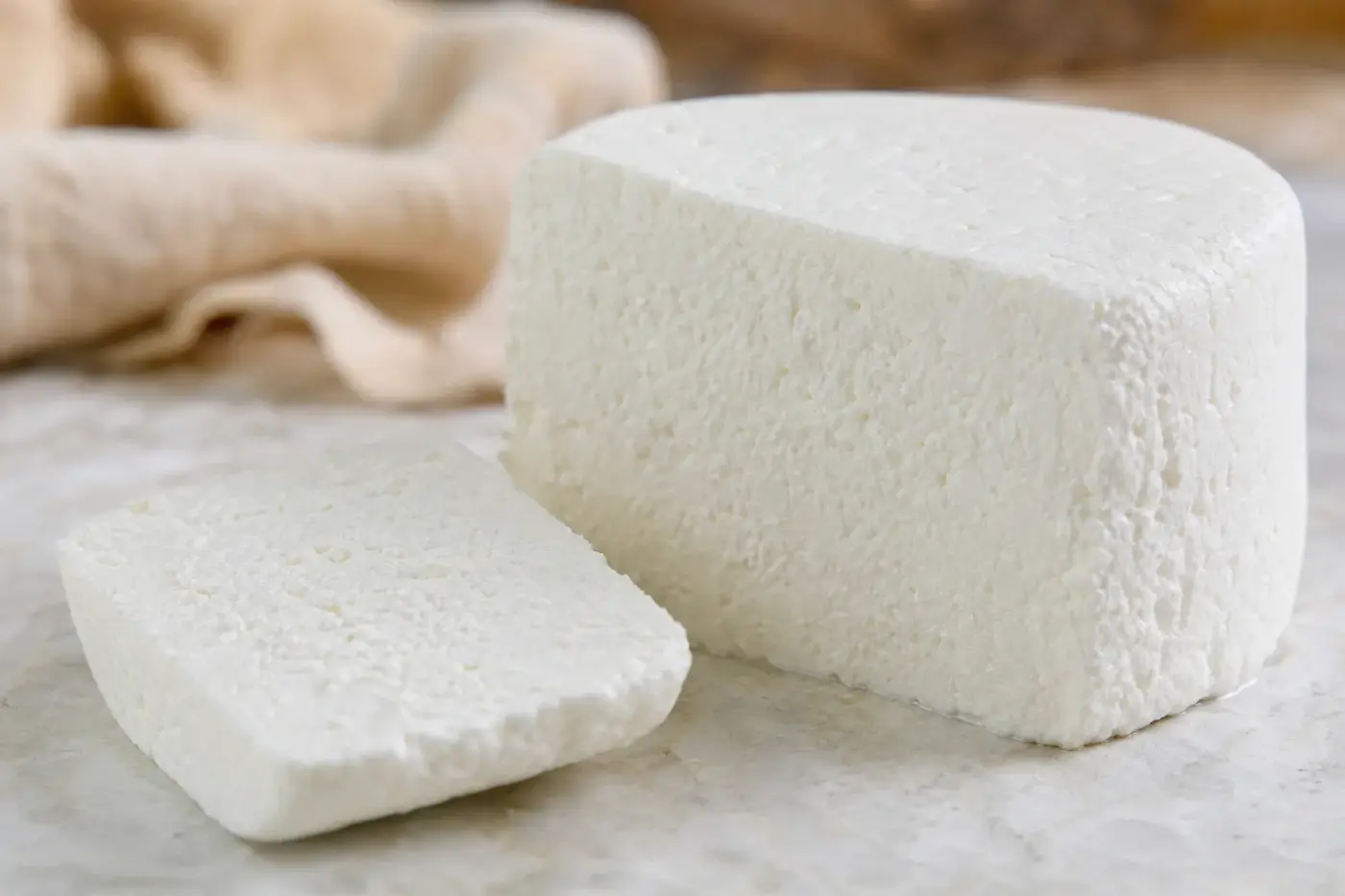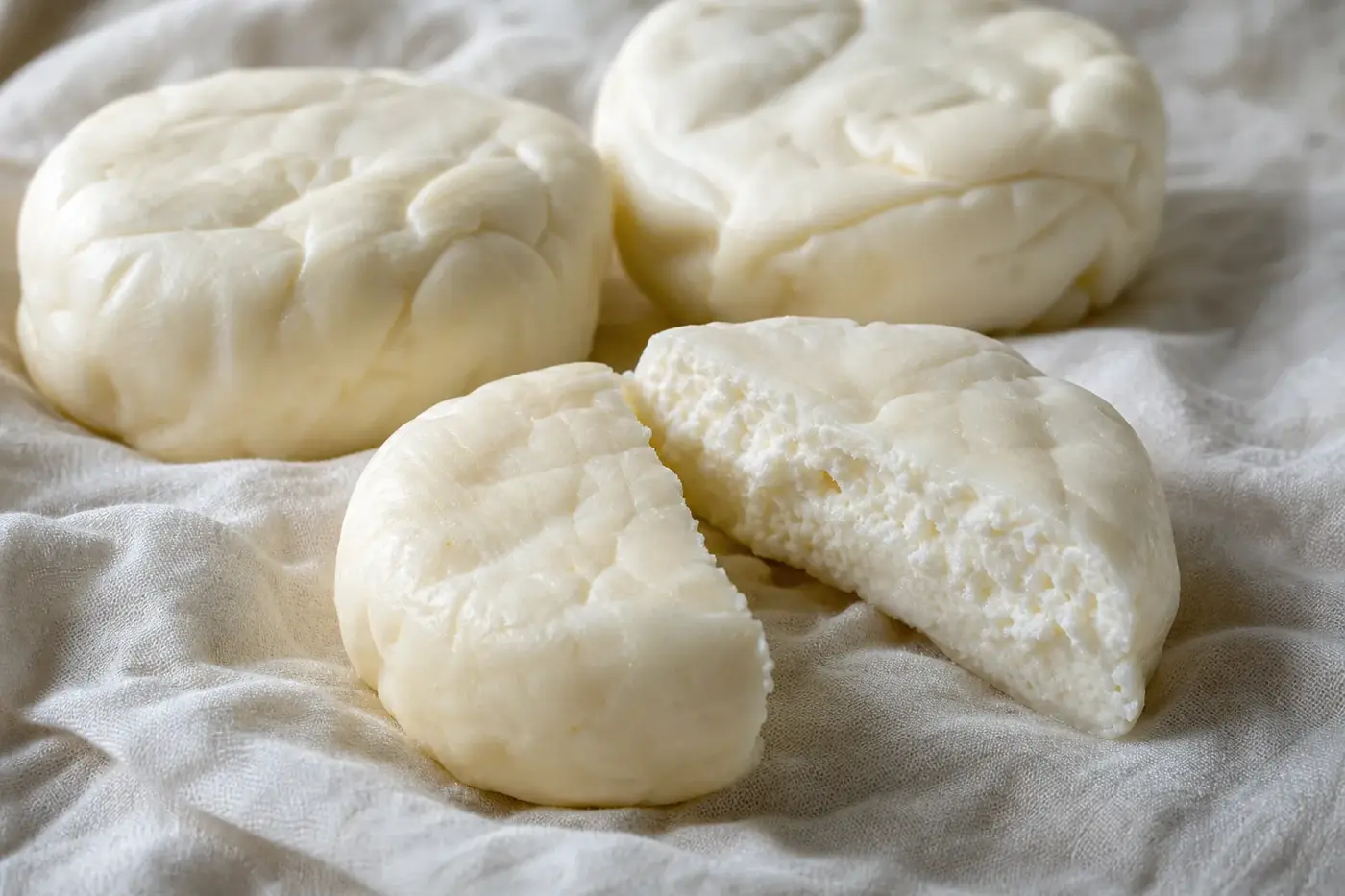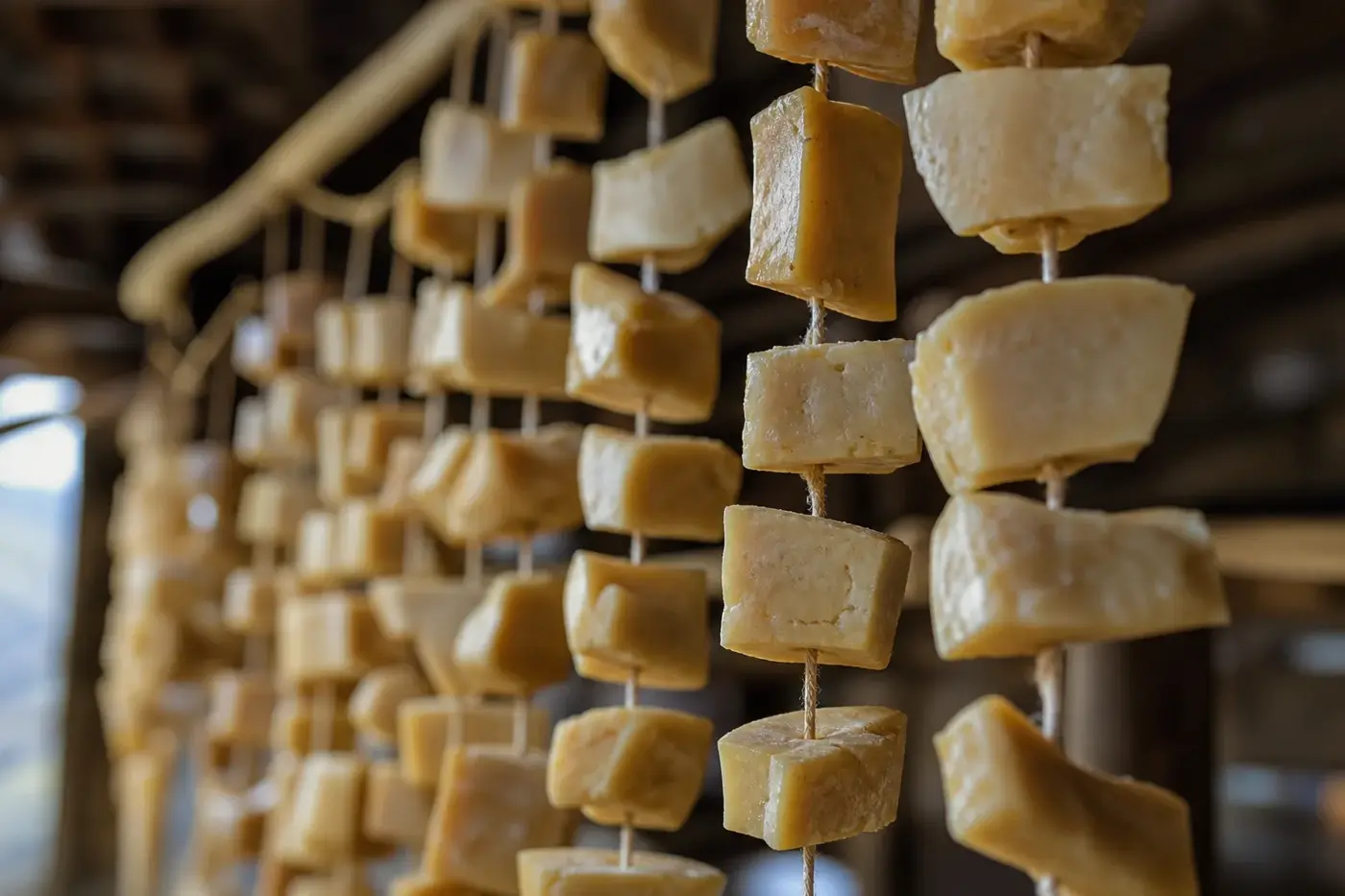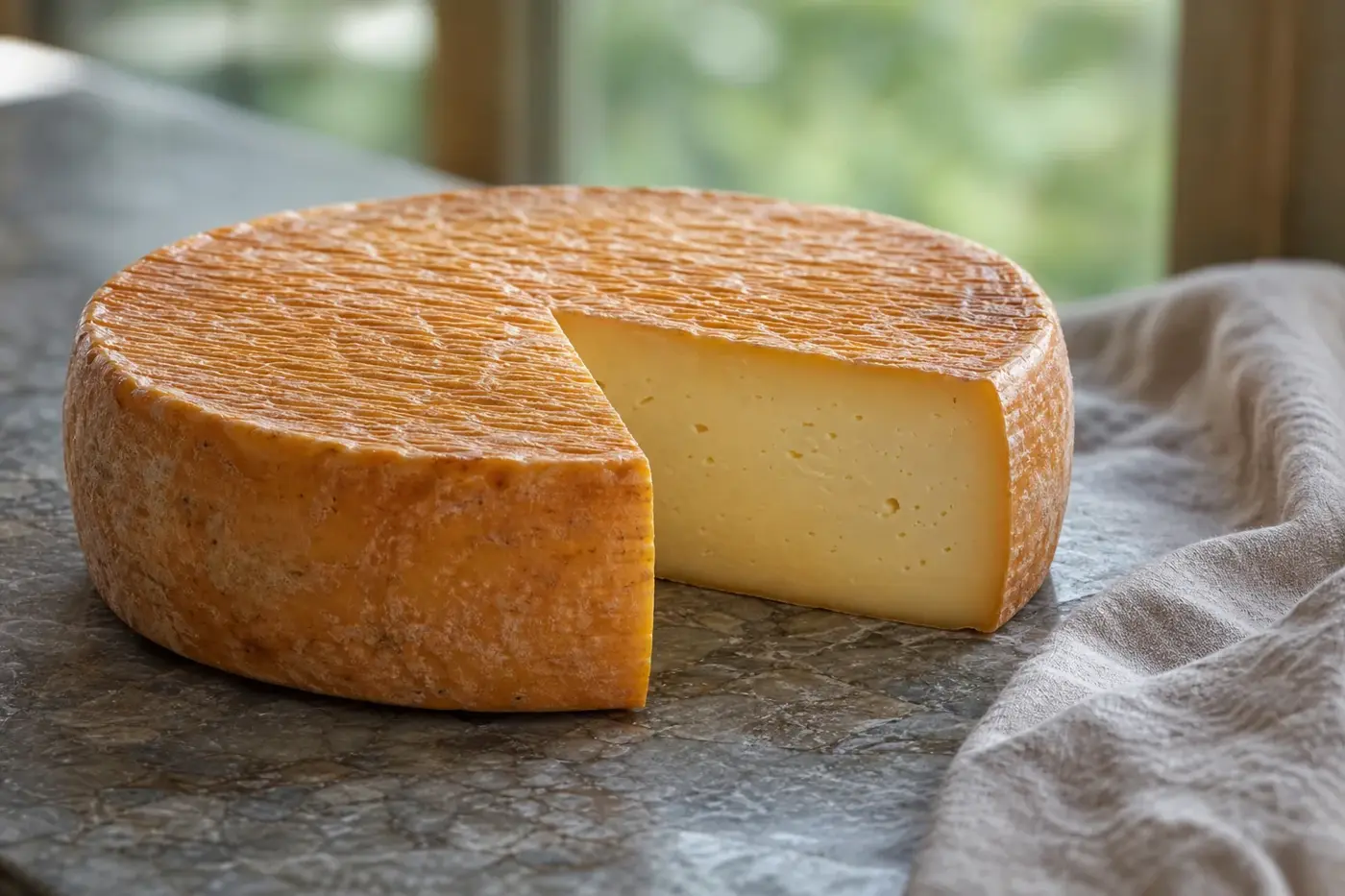
A slice melts over potatoes and vegetables. Then come the aromas: nuts, dried hay, fresh milk. Your nose has arrived in Tokachi, the broad farmland of south-eastern Hokkaido, where this pressed, semi-hard, washed-rind cheese gives Alpine raclette a Japanese home. Particularly suited to melting, it carries a name registered as a geographical indication in Japan; those aromas appear in the registration itself.[1][2][3][4]
Your quick introduction to Tokachi Raclette
- Familiar name: Tokachi Raclette.[1]
- Registered names: 十勝ラクレット; Tokachi Raclette.[1]
- Japan: registered GI, Ministry of Agriculture, Forestry and Fisheries, No. 128; registered 31 March 2023. Status as of November 2026.[1]
- Home ground: the 19 municipalities of Tokachi, Hokkaido, listed in the Japanese registration.[1]
- Milk: local cows' milk; the representative producer below uses low-temperature pasteurisation.[2][6]
- Coagulant: animal-derived rennet, required by the Japanese specification.[2]
- Minimum maturation: eight weeks under the Japanese specification.[2]
- One maker's maturation: approximately three months for Kyodogakusha Shintoku Farm's Raclette.[7]
- Rind: salt-washed and brushed; Kyodogakusha says its Raclette rind is edible.[6][7]
- Pregnancy guidance: NHS, United Kingdom, November 2026; see the safety section.[11]
Step into Tokachi's farming country
Mountains frame the view: the Hidaka mountains to the west, the Daisetsu mountains to the north, and the Pacific Ocean to the south. In this part of south-eastern Hokkaido, the Tokachi River crosses a central plain. Obihiro sits within a region stretching through farming towns and villages including Shintoku, Otofuke and Makubetsu.[3]
The fields grow fodder crops, potatoes and beans. MAFF's regional account links those feed resources and the cool climate to the establishment of dairy farming and cheese production. Put melted local cheese over potatoes and you have two products of the same farming region on your plate. They make a persuasive case for staying together.[4]
Small cheesemaking workshops share the landscape with larger dairy processors. The Japanese specification records a local natural-cheese promotion association established in 1991, followed by the first marketing of Kyodogakusha's Raclette in 1992. Behind those milestones were producers learning techniques in France, then working together to develop a regional practice of their own.[2]
An Alpine ritual settles into Japan
Heat a cut wheel, then scrape away its melted surface. That is the Alpine practice described by Raclette Suisse, the Swiss producers' association. Raclette names both the cheese and the way you eat it; the name is associated with the French racler, to scrape. Tokachi's makers adopted that melting-and-scraping tradition, adapting production to their milk and conditions.[2][5]
The Japanese registration protects a regional cheese made by multiple workshops, rather than one producer's recipe. Makers follow shared requirements but bring their own production and maturation techniques, individual practices recognised in MAFF's regional account. Look for the producer's name when you choose: two cheeses meeting the specification can still differ in strength and texture.[4]
Curious about the difference between a regional name and the systems that protect it? Start with protected names explained.
Follow the milk into the making room
At Kyodogakusha Shintoku Farm, the published production outline begins with milk from the farm's cows and low-temperature pasteurisation. This representative method is based on raclette. First come starter cultures, the microorganisms that begin fermentation. Then comes rennet, an enzyme preparation that sets the milk into curd.[6]
The farm describes grazing from around May, when fresh grass becomes available, and feeding mainly hay through the cold winter. Its account connects summer milk with fresh pasture and winter milk with dried forage. Ask who made your cheese, when it was made and how that producer handles seasonal milk. Those answers bring the wheel, and the farming behind it, into sharper focus.[6]
Next, the curd is cut and stirred to release whey, the liquid portion of milk. It is gathered into cloth-lined moulds, pressed, then salted in brine. During maturation, the wheels are repeatedly turned and brushed with salt water to develop their surface. Kyodogakusha lists approximately three months for its Raclette.[6][7]
The regional specification requires water drawn in Tokachi to lower lactose concentration during production. The ripening wash contains local water, salt and linens bacteria, surface-ripening bacteria associated with the rind. Maturation must last at least eight weeks. That regional minimum is not necessarily the age at which a particular maker sells its cheese.[2]
If you choose cheese on vegetarian grounds, pay attention to the rennet: the specification requires it to be animal-derived. Japanese manufacture does not imply a microbial coagulant. For help with milk terminology, see raw milk and pasteurised cheese.[2]
Get acquainted with the wheel
Picture a low cylinder with a brushed rind and a pressed, semi-hard interior, also called the paste. Kyodogakusha describes its Raclette wheels as approximately 30 cm across, 7 cm high and 5 kg in weight. Not quite a cheese you slip absent-mindedly into your pocket.
Alongside nuts, dried hay and fresh milk, the Japanese registration describes restrained pungency. That gives you a more useful starting point with a cheesemonger than simply asking, “Is it strong?” Ask how the rind aroma, milky character and maturity balance in that particular wheel.[1]
Tokachi Raclette Moor Wash follows a distinct path. Kyodogakusha describes this collaboratively matured cheese as washed using Tokachigawa hot-spring water, with a mellow flavour. That wash belongs to this named variation. The shared Japanese specification requires local water, not this particular treatment for every Tokachi Raclette.[2][7]
Give the cheese gentle heat
Low heat is the key to Kyodogakusha's serving method. Melt its Raclette in a non-stick frying pan, then pour it over cooked vegetables, or use a raclette appliance. Raclette Suisse advises stopping as soon as the cheese has melted. Prolonged heating can cause the fat to separate.[7][8]
Have your potatoes and vegetables ready first. Melt a manageable slice, looking for a soft, flowing surface rather than a dark crust, then transfer it straight to the waiting plate. If the underside browns before the cheese flows, lower the heat. Let the cheese guide you, rather than a fixed cooking time.[7][8]
Follow the pack's cooking instructions. Where food requires cooking or reheating, the FSA advises heating until steaming hot throughout; a melted surface tells you about texture, not temperature all the way through. Keep unused cheese refrigerated while you prepare successive portions.[10]
Make room for potatoes, vegetables and pickles
Begin with Kyodogakusha's recommendations: boiled potatoes, bread and warm seasonal vegetables. Raclette Suisse adds pickles, onions, mushrooms and fresh salads. Give your cheese something substantial to settle onto, a vegetable alongside, and something sharp or fresh between mouthfuls.[7][8]
For a Japanese variation, try cooked potatoes and roasted kabocha squash beneath the melted cheese. Add cooked shiitake mushrooms and a little pickled daikon alongside, then finely sliced spring onion after heating. These suggestions take the producer's vegetable-based serving idea in a Japanese direction. They do not reproduce a documented regional recipe.
Prefer a quieter plate? Keep to potatoes and mushrooms, with the pickle offered separately. If you fancy miso, spread a little on the vegetables before adding the cheese, then taste before adding other seasoning. Leave soy sauce and strongly seasoned pickles optional, so everyone can find their own balance.
Put something refreshing in your glass
Raclette Suisse suggests sparkling apple juice, black tea or herbal tea.[8] For your Japanese table, try unsweetened hōjicha alongside the potatoes and cheese. Sparkling water with a small squeeze of citrus is another suggested companion.
Choose a wedge and give it a good home
Look for the producer, exact product name, milk treatment, storage instructions and date marking. Ask how long the cheese has matured and whether you can eat its rind. A cut wedge's maker and handling instructions tell you more than the broad label “Japanese raclette”. For help with the details, turn to reading a cheese label.
FSA consumer guidance for England, Wales and Northern Ireland recommends a fridge temperature between 0 and 5 °C and prompt refrigeration after shopping. Follow the pack's storage instructions after opening. If there are no opening instructions, its listeria guidance says to use opened foods within two days, and keep raw foods separate from ready-to-eat cheese.[9][10]
Kyodogakusha says its Raclette rind is edible: leave it on when heating for stronger flavour, or remove it for a milder result. For other cheeses, follow the individual producer's instructions. Always remove packaging before heating. You'll find wrapping and refrigeration guidance in storing cheese at home.[7]
This page summarises published guidance from the official sources it cites. It is not medical advice. Guidance differs between countries and changes over time, so check the current source for where you live, and ask your doctor, midwife, pharmacist or dietitian about your own circumstances.
Keep the right safety advice close
Pregnant people, older people and people with weakened immunity face an increased risk from listeriosis, according to FSA guidance for England, Wales and Northern Ireland. The November 2026 guidance advises prompt refrigeration, observing use by dates and preventing cross contamination. Eat ready-to-eat foods within four hours of leaving refrigeration, or two hours on a very warm day.[10]
If you are pregnant in the United Kingdom, NHS guidance lists pasteurised semi-hard cheeses among those you can eat. It also says any cheese cooked until steaming hot can be eaten, while setting out additional precautions for mould-ripened soft cheeses and soft blue cheeses. Match the actual product's milk treatment and cheese class to that advice, with your midwife if needed.[11]
For the full advice and exceptions, consult the NHS pregnancy guidance and FSA listeria guidance, both dated here to November 2026. If you live elsewhere, consult your national food safety authority. You can find further context in the site's listeria and cheese safety article.
Questions people ask
Where is Tokachi Raclette made?
It is made in the 19 municipalities of Tokachi in south eastern Hokkaido, Japan. The name was registered as a Japanese geographical indication on 31 March 2023.
Is Tokachi Raclette vegetarian?
The Japanese specification requires animal derived rennet. This is an important detail for anyone choosing cheese on vegetarian grounds.
How do you melt and serve Tokachi Raclette?
Kyodogakusha recommends melting its Raclette over low heat in a nonstick frying pan and pouring it over cooked vegetables. It suggests boiled potatoes, bread and warm seasonal vegetables as accompaniments.
Can you eat the rind of Tokachi Raclette?
Kyodogakusha says the rind of its Raclette is edible. Including it when heating strengthens the flavour, while removing it gives a milder result.
Can you eat Tokachi Raclette during pregnancy?
NHS guidance lists pasteurised cheeses classified as semi hard among those that can be eaten during pregnancy. It also says any cheese cooked until steaming hot can be eaten; see the NHS pregnancy guidance at https://www.nhs.uk/pregnancy/keeping-well/foods-to-avoid/ for the full advice.
Sources
- Ministry of Agriculture, Forestry and Fisheries, Japan: Registration No. 128: 十勝ラクレット. Official registration page, updated 26 May 2025; registration dated 31 March 2023.
- Ministry of Agriculture, Forestry and Fisheries, Japan: 十勝ラクレット 明細書, product specification. Created 19 July 2018; revised 11 May 2023. Sections 4 to 8.
- Hokkaido Government, Tokachi General Subprefectural Bureau: とかち2026, Tokachi 2026. May 2026 edition, chapter 01, regional map and geographical description.
- Ministry of Agriculture, Forestry and Fisheries, Hokkaido District Agriculture Office: 十勝地域の概要, Overview of the Tokachi region. Edition containing 2024 information, particularly the section on geographical indications.
- Raclette Suisse Association: History. Undated institutional account, retrieved November 2026. Used for the association's account of the Swiss serving tradition and name.
- Kyodogakusha Shintoku Farm: チーズができるまで, How cheese is made. Undated producer account, retrieved November 2026. Raclette-based production outline and seasonal feeding account.
- Kyodogakusha Shintoku Farm: チーズ・乳製品ご紹介, Cheese and dairy products. Undated producer catalogue, retrieved November 2026. Raclette and Tokachi Raclette Moor Wash sections. This is the producer's own commercial account.
- Raclette Suisse Association: Preparation. Undated industry guidance, retrieved November 2026. Used for melting behaviour, accompaniments and drink suggestions, excluding its digestive-health assertions.
- Food Standards Agency: Food safety in a heatwave: advice for consumers. Published 27 June 2024; applies to England, Northern Ireland and Wales.
- Food Standards Agency: Listeria. Published 8 January 2018; live version retrieved November 2026. Sections 3 to 5; applies to England, Northern Ireland and Wales.
- NHS: Foods to avoid in pregnancy. Live guidance retrieved November 2026, particularly the dairy and alcohol sections.
Researched through Japanese government registration and regional documents, Swiss industry sources, the representative producer's published accounts and UK official food safety guidance, with editorial pairing suggestions identified separately.
Last checked: November 2026
Last checked November 2026.
The editors suggest you read next