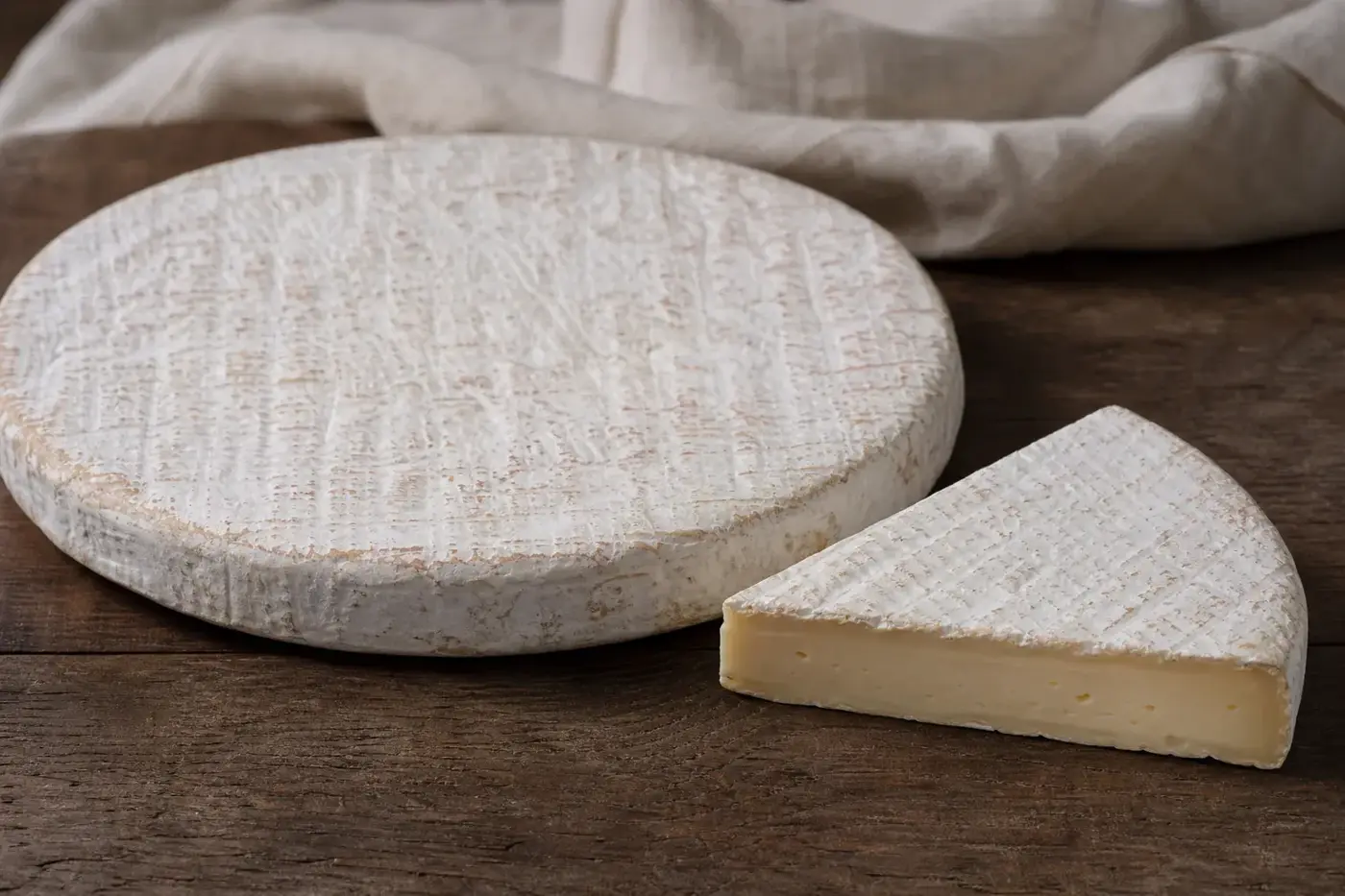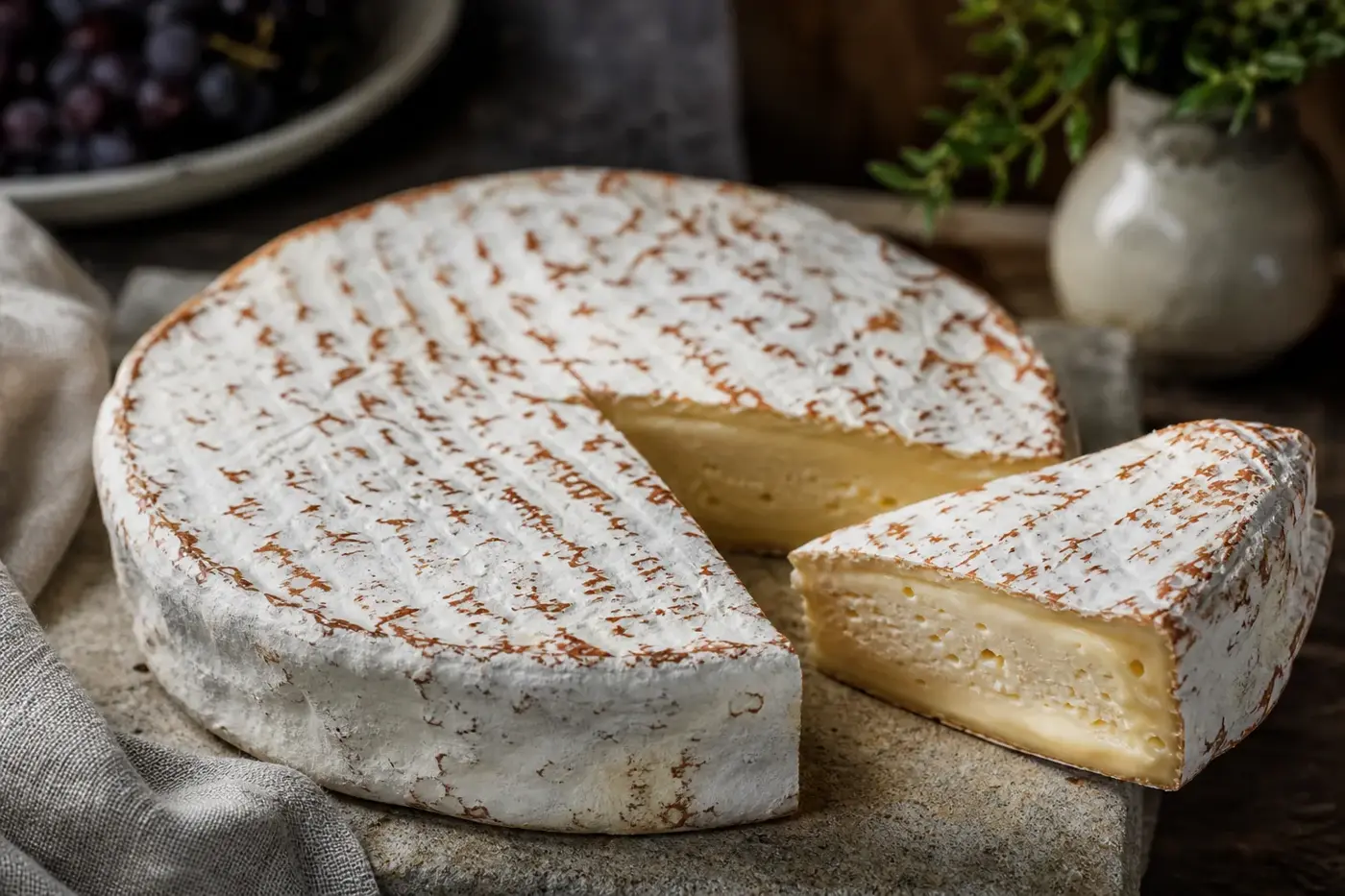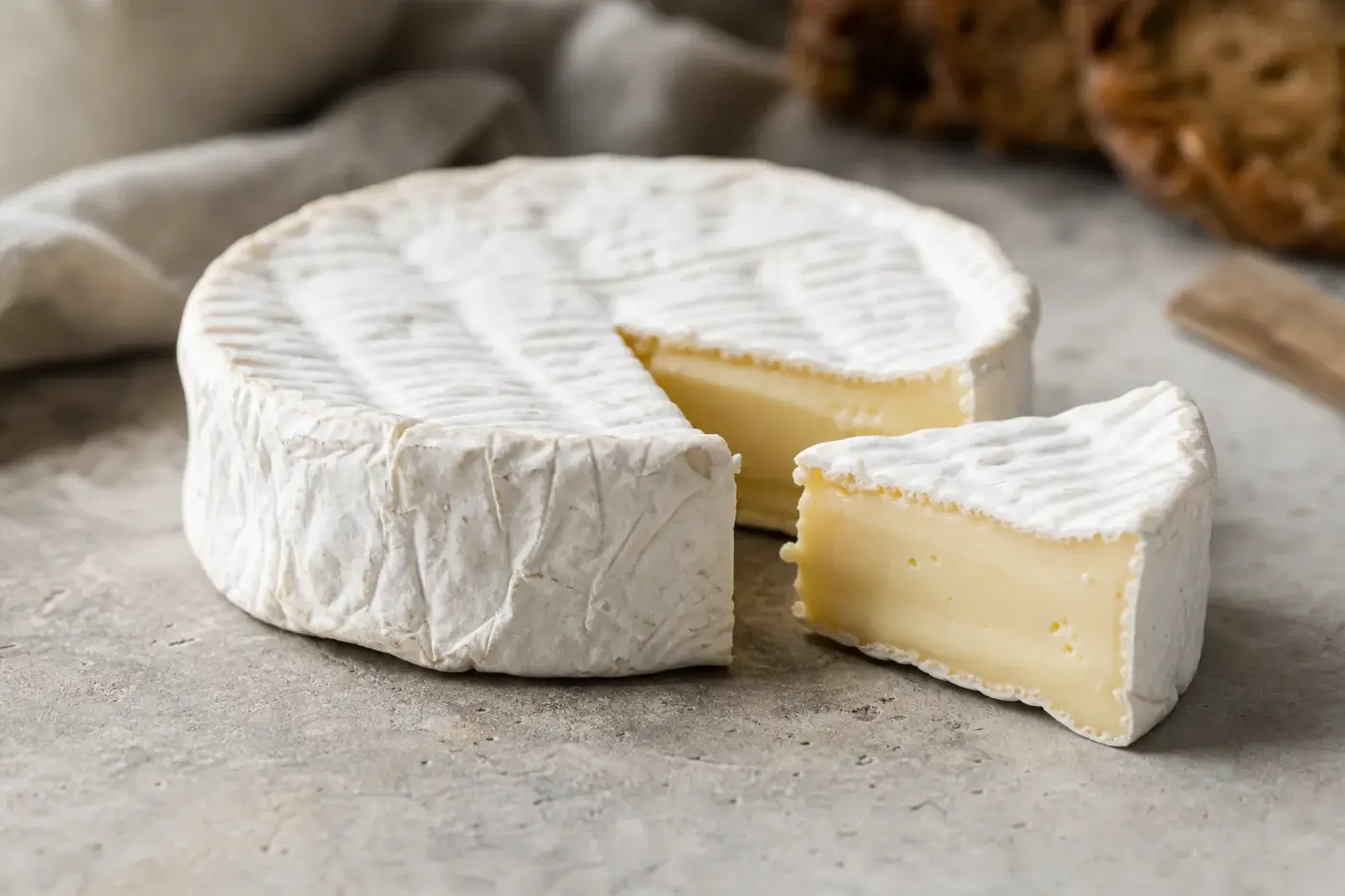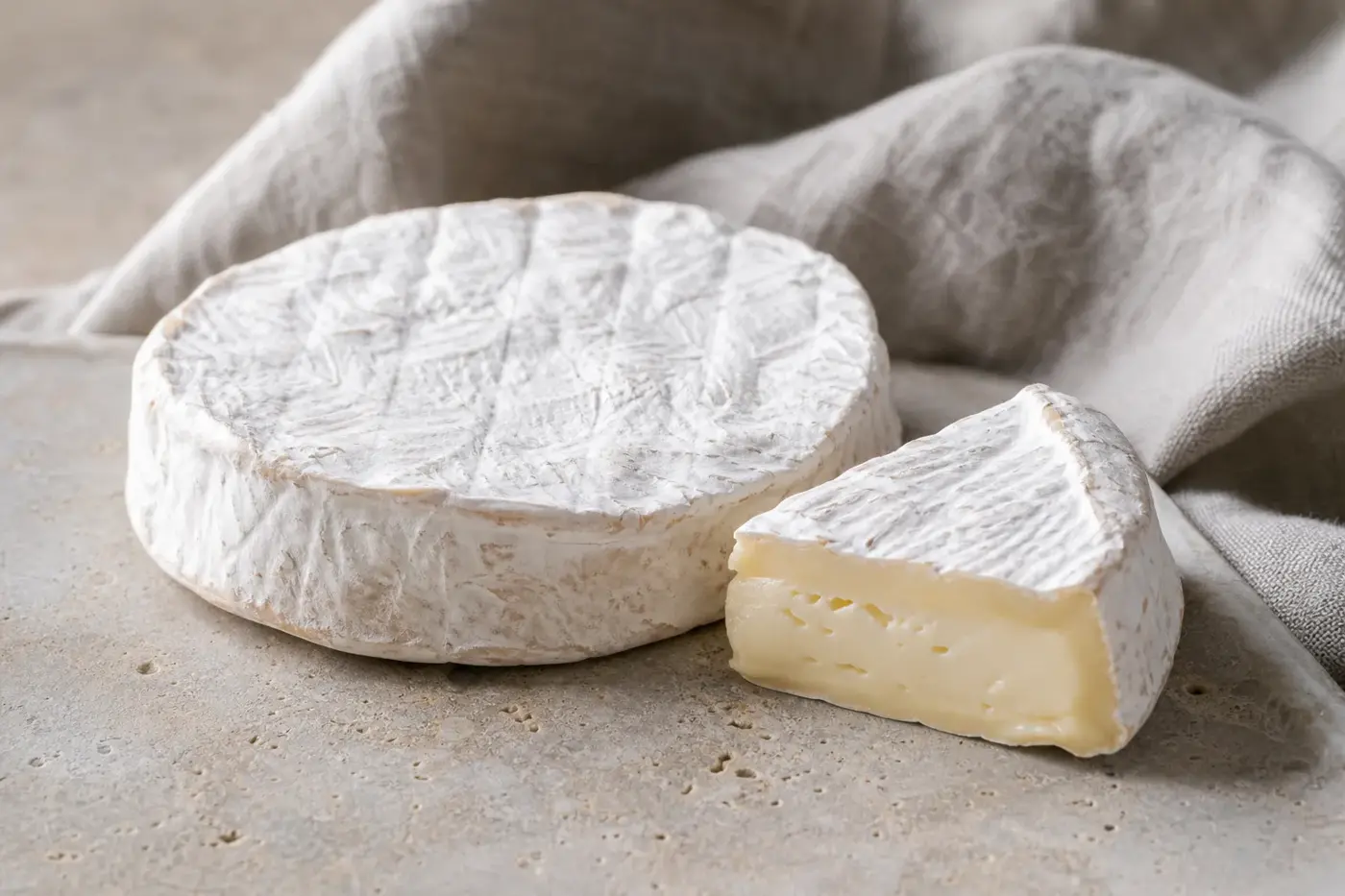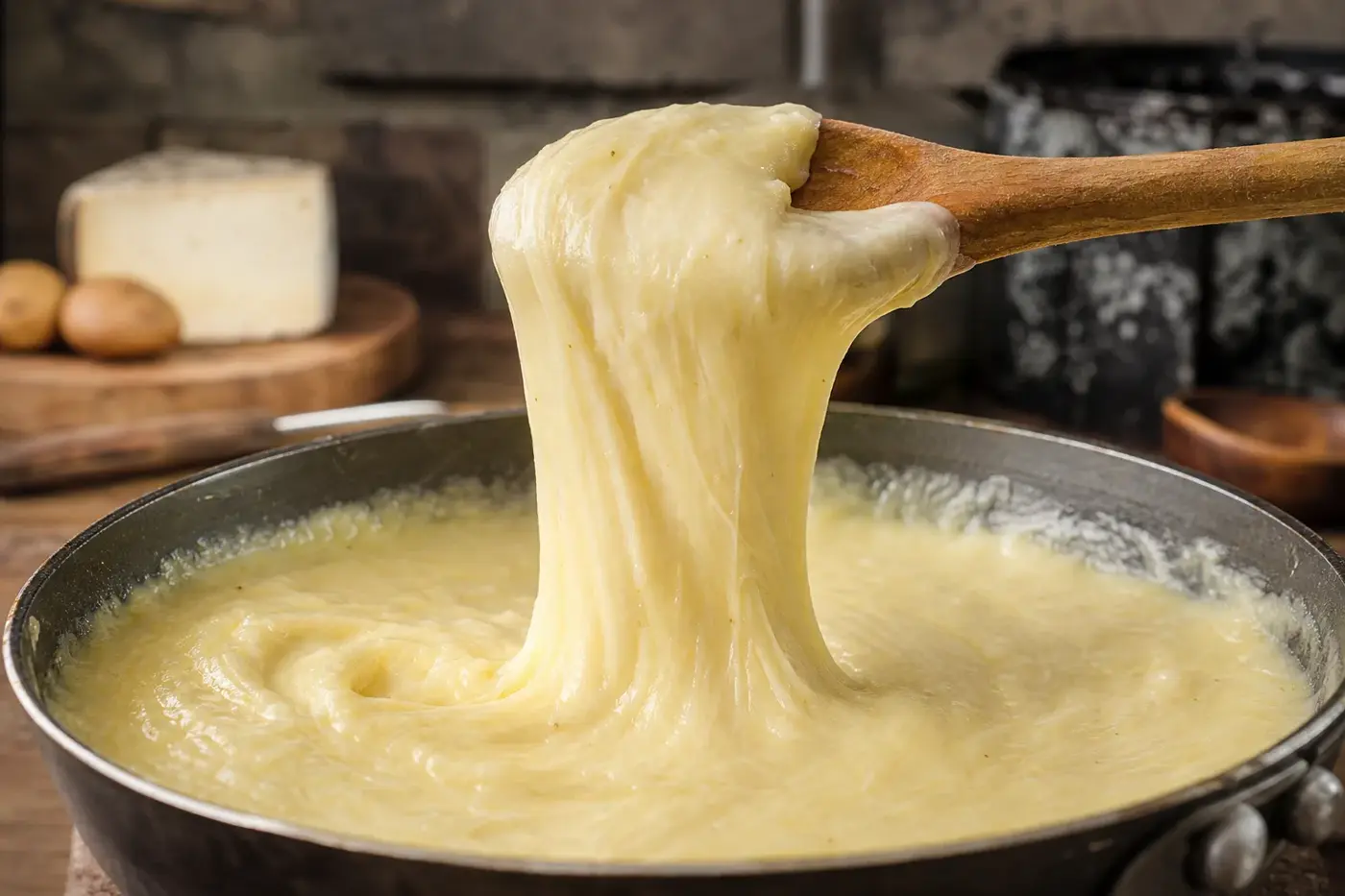
Lift your spoon from a pan of aligot. Up comes a ribbon of potatoes and cheese, stretching in one smooth, elastic thread, with every intention of stealing dinner’s attention. Behind the spectacle is Tome fraîche de l’Aubrac, a young, rindless cow’s milk cheese whose brief maturation prepares it for the pan, not for months of ageing.[1][3]
| What to know | The details |
|---|---|
| Name you’ll recognise | Tome Fraîche de l'Aubrac |
| Exact registered name | Tome fraîche de l’Aubrac.[2] |
| EU protection | Protected geographical indication, PGI, called IGP in French; registration recorded in October 2023. Status reference: November 2026.[1][2] |
| EU dossier identifier | PGI-FR-02839.[3] |
| Registration instrument | Commission Implementing Regulation (EU) 2023/2219.[2] |
| Where it comes from | Defined parts of the Aubrac across Aveyron, Cantal and Lozère, France.[3] |
| Milk | Raw, whole cow’s milk.[1][3] |
| Cheese style | Uncooked pressed cheese, unsalted and unaffined, sold after brief maturation.[3] |
| What you’ll see | Cream to pale yellow; supplied in portions or smaller pieces.[1] |
| Allergen to know | Milk.[3] |
| What to cook | Aligot; also regional potato dishes including retortillat.[5][9] |
Meet fresh tome, with its gentle squeak
Take a bite of fresh tome and you may hear a small squeak against your teeth. That texture earns a place in the published specification, alongside a pale paste that is supple but firm enough to cut, sometimes with small openings. Expect slight acidity and aromas of fresh milk and butter, rather than the deeper character of a cellar-aged wheel.[3]
Mild need not mean forgettable. INAO describes gentle, persistent dairy notes, while producer Jeune Montagne adds fresh hay and floral notes to its tasting description.[1][5] These are quiet flavours, in a cheese whose most impressive work happens in your kitchen.
Colour and cooking performance can vary within the specification. The paste ranges from cream to pale yellow, and the short maturation keeps changing how the cheese behaves in your pan. Jeune Montagne recommends its tome for aligot between two and eight days after manufacture: even fresh cheese has a moment to shine.[3][5]
That window concerns cooking quality, not storage safety. Follow the packet’s storage and handling instructions, along with its use-by date.[5][12]
Into the Aubrac, where the story begins
The Aubrac uplands stretch through Aveyron, Cantal and Lozère. Within this cheese’s defined production area, milk production, cheesemaking and maturation must all happen locally. When you choose this tome, its place of origin is part of the requirements, not just an attractive backdrop.[3]
Its story leads to the burons, upland summer dairies where cheesemakers called buronniers worked. INAO records their role in keeping production alive, followed by a revival led by a new generation of farmers during the 1960s. Fresh tome’s place in regional cooking grows out of that cheesemaking tradition.[1]
The full name Tome fraîche de l’Aubrac is an EU protected geographical indication. Its registration instrument is Regulation (EU) 2023/2219, and INAO records recognition in October 2023. Any description calling it an application still awaiting protection is outdated.[1][2]
At the counter, look for the complete registered name and its IGP identification. The broader expression tome fraîche simply means fresh tome. Those words alone do not tell you that the cheese meets the Aubrac specification.[2][3]
This protection applies in the EU. For help separating a geographical indication from a general cheese description, turn to protected names explained.
Press, turn, repeat: fresh tome takes shape
Fresh tome owes its structure to repeated pressing. First, the cheesemaker sets raw, whole cow’s milk with rennet, the enzyme preparation that turns milk into a gel. They cut and stir the resulting curd, then drain away whey, the liquid released as the curd contracts.[4]
Next comes the presse-tome, where the curd is pressed in cloth. The cheesemaker cuts the block, stacks the pieces and presses again. With each repetition, more whey leaves and the curd draws together into a cohesive mass.[4]
The published specification requires at least an hour’s pressing and at least five turnings. Maturation follows for at least 20 hours. During this stage, bacterial activity develops acidity, with a specified final pH of 4.9 to 5.3.[4]
If “maturation” makes you picture a long cellar stay, think much shorter here. This is preparation for cooking, and the cheese is sold unsalted and unaffined.[3] These are professional production requirements; you can follow the broader journey from milk to finished cheese in how cheese is made.
Laguiole, Cantal and the cheese your pan needs
Fresh tome and Laguiole share their beginnings. Jeune Montagne describes its fresh tome as the first stage in making Laguiole. The Laguiole producers’ organisation records the same opening sequence: setting the milk, draining the curd and pressing fresh tome.[5][6]
Then their paths part. For mature Laguiole, the tome is broken down, salted throughout its mass, put into moulds and pressed again before cellar ageing. Those later stages give you the finished wheel and developed rind, rather than the fresh ingredient intended for your pan.[6]
At the cheese counter, that distinction matters more than the family resemblance. A wedge of mature Laguiole and a portion of fresh tome have different jobs in a recipe. If aligot is on your menu, ask specifically for fresh, unsalted tome.[5][6]
The same distinction matters with Cantal: fresh cooking tome is not a cut of mature Cantal. Regional culinary sources associate Cantal with truffade, but choosing it is a different decision from buying fresh Aubrac tome for aligot. Start with the cheese your recipe calls for, rather than the regional name that catches your eye.[9][11]
Make aligot, and have your spoon ready
Have your mashed potatoes ready before adding the cheese. In the local recipe published in the Aubrac tourism guide, you stir cream into the mash, seasoning with garlic if you wish. Cut the tome into thin strips, add them to the potatoes and stir over moderate heat until the cheese melts and the aligot stretches.[7]
Those thin strips matter. You can spread them through the hot mash rather than wait for a large block to soften unevenly. As you stir, potato and cheese come together into one cohesive mixture.[7]
Cream supplies the richness in this documented version. If your chosen recipe uses butter, follow its proportions rather than treating butter and cream as interchangeable. For your first attempt, choose one complete, attributed recipe and stay with it, however tempting a little recipe matchmaking might be.
The finish announces itself: lift your spoon and a connected ribbon follows, potato and cheese moving together. Stop there. The Aubrac guide warns that too long over the heat breaks the thread, so have the rest of your meal ready before you finish the aligot.[7]
You need not save fresh tome exclusively for potatoes. Jeune Montagne also suggests pizzas, gratins and hot sandwiches. Keep those in mind when you want melted cheese rather than aligot’s long, elastic ribbons.[5]
What makes that lovely stretch possible?
A good stretch depends on a protein network that softens without losing its connections. The University of Wisconsin’s Center for Dairy Research explains that casein, milk’s principal cheese-forming protein, creates a network containing fat, moisture and minerals. Heat matters, but so does the way those components interact.[8]
Acidity changes the calcium phosphate associated with that network. With the right balance, the protein structure can move and extend; too much or too little acid development can restrict that movement. Moisture matters too, though water alone cannot make every cheese stretch.[8]
That brief, controlled maturation therefore does more than give your fresh tome a little tang. The Aubrac specification explicitly links acidification during maturation with the cheese’s ability to stretch when cooked.[3]
Ageing changes the picture again. Protein breakdown can help some cheeses flow while weakening their ability to form long strands. A cheese that melts beautifully is not necessarily a good substitute for one you have chosen for elasticity.[8]
Back at your hob, the instruction is simpler than the science: follow the local method’s moderate heat and avoid prolonged cooking once the texture is right. Its warning concerns lost stretch. It does not give a universal saucepan temperature that guarantees successful aligot.[7]
Truffade and retortillat: potatoes with their edges intact
Aligot gives you mash; truffade leaves the potatoes in slices. You cook them in a pan before adding the cheese. The Aubrac tourism office describes its regional version as an adaptation of the Auvergne dish, made with local cheese.[9]
Retortillat belongs to this same sliced-potato family, and the names overlap. The Aubrac tourism office calls its preparation both truffade de l’Aubrac and retortillat. In its published recipe, fresh tome joins mature Laguiole, with garlic and parsley offered as optional additions.[9]
Aveyron’s tourism organisation takes a different route. Its version uses fresh tome, potatoes, garlic, and oil or duck fat, without the extra mature cheese. Read the recipes side by side and you find a tradition with room for variation, rather than one compulsory ingredient list.[10]
Your most dependable distinction is what happens to the potatoes. Choose aligot for continuous, elastic mash, or truffade and retortillat for browned potato slices joined by melted cheese. Jeune Montagne makes precisely this comparison in its account of the dishes.[11]
At the counter, tell your cheesemonger the plan
Start with what you intend to cook. Ask for Tome fraîche de l’Aubrac IGP, and whether the portion is at the producer’s recommended stage for aligot. If manufacturing information is available, read it alongside the use-by date and refrigeration instructions.[5][12]
Look at the milk treatment as well. The Aubrac specification requires raw milk; a pasteurised fresh cooking cheese might perform a similar role in a recipe, but it is a different product. You can untangle the terminology in Raw, thermised and pasteurised cheese.[3]
If Aubrac tome is unavailable, talk through another fresh cooking tome with a knowledgeable cheesemonger. Explain the job clearly: you need an unsalted cheese intended to stretch into potatoes. “Any young cheese” leaves rather too much to chance.
Low-moisture mozzarella is a more widely recognisable alternative when elasticity matters most. Wisconsin’s dairy research guidance includes mozzarella among cheeses with useful melting and stretching properties.[8] Choose a recipe designed for it, rather than assuming it is equivalent to Aubrac tome, and follow that recipe’s decisions on moisture and seasoning.
This page summarises published guidance from the official sources it cites. It is not medical advice. Guidance differs between countries and changes over time, so check the current source for where you live, and ask your doctor, midwife, pharmacist or dietitian about your own circumstances.
Keep your tome chilled and handle it safely
Refrigerate your cheese and follow the packaging, including any shorter storage period after opening. For England, Wales and Northern Ireland, the Food Standards Agency recommends a fridge temperature between 0 and 5 °C. If the manufacturer specifies a lower temperature, use that instead.[12]
Keep chilled ingredients out only for as long as preparation needs. For leftovers, the FSA advises cooling as quickly as possible, ideally within two hours. Then refrigerate and eat within 48 hours, or freeze them.[12]
If you’re pregnant in the UK, consult the NHS guidance on foods to avoid in pregnancy for advice on cheese and milk. Guidance reference: November 2026.[13]
Check the full ingredient list when you cook, including cream, butter and any substitutes. Keep the packaging until you have used the cheese, so you can identify the product and batch if an official recall notice applies. For broader handling advice, see cheese food safety.
Questions people ask
What is Tome fraîche de l’Aubrac made from?
It is made from raw, whole cow’s milk. The cheese is unsalted, rindless and sold after a brief maturation.
How do you use fresh tome to make aligot?
The Aubrac tourism guide adds cream to mashed potatoes, then stirs in thin strips of tome over moderate heat until the mixture stretches. It warns that too much time over the heat breaks the thread.
What is the difference between aligot and truffade?
Aligot is an elastic mixture of mashed potatoes and cheese. Truffade uses potato slices cooked in a pan before the cheese is added.
What can you use instead of Tome fraîche de l’Aubrac?
The page suggests asking a cheesemonger about another unsalted fresh cooking tome intended to stretch into potatoes. Low moisture mozzarella is another option when elasticity comes first, but it needs a recipe suited to it.
Can you eat Tome fraîche de l’Aubrac during pregnancy?
The cheese is made from raw milk. For advice in the UK, consult the NHS guidance on cheese and milk in its [foods to avoid in pregnancy](https://www.nhs.uk/pregnancy/keeping-well/foods-to-avoid/) guide.
Sources
- INAO, Tome fraîche de l’Aubrac, official product record, undated current page, retrieved November 2026.
- European Commission, Commission Implementing Regulation (EU) 2023/2219 of 16 October 2023, registration of Tome fraîche de l’Aubrac, published 23 October 2023.
- European Commission, Document unique: Tome fraîche de l’Aubrac, 2023/C 237/08, 5 July 2023, sections 3 to 5.
- French Ministry of Agriculture, Cahier des charges de l’indication géographique protégée « Tome fraîche de l’Aubrac », text approved 25 and 26 January 2022, published with the 2022 national application documentation.
- Coopérative fromagère Jeune Montagne, La Tome fraîche de l’Aubrac IGP, undated current producer account, retrieved November 2026. Commercial producer source for its own product, tasting descriptions and culinary recommendations.
- Syndicat de défense et de promotion du fromage de Laguiole, Un cahier de ressources, undated production account, particularly “Du lait au fromage”.
- Aubrac tourism guide, L’Aubrac, retrieved guide edition, section on Jeune Montagne and the aligot recipe, printed page 88.
- University of Wisconsin Center for Dairy Research, How the cheesemaking process influences melt and stretch, Dairy Pipeline, volume 33, number 3, autumn 2021, pages 1 to 3.
- Office de tourisme en Aubrac, La truffade de l’Aubrac « le Retortillat », undated current culinary account and recipe, retrieved November 2026.
- Aveyron tourism organisation, La recette traditionnelle : rétortillat de l’Aubrac, updated 16 June 2026.
- Coopérative fromagère Jeune Montagne, La Truffade de l’Aubrac, undated current producer account, retrieved November 2026.
- Food Standards Agency, How to chill, freeze and defrost food safely, current guidance for England, Wales and Northern Ireland, retrieved November 2026.
- NHS, Foods to avoid in pregnancy, current UK guidance, retrieved November 2026.
Researched through official product documentation, published specifications, regional culinary accounts, university dairy science guidance and official food safety advice; no site tasting or recipe trial was undertaken.
Last checked: November 2026
Last checked November 2026.
The editors suggest you read next