Tvorog
Dip in your spoon: tvorog may yield softly or tumble into loose, pale crumbs.
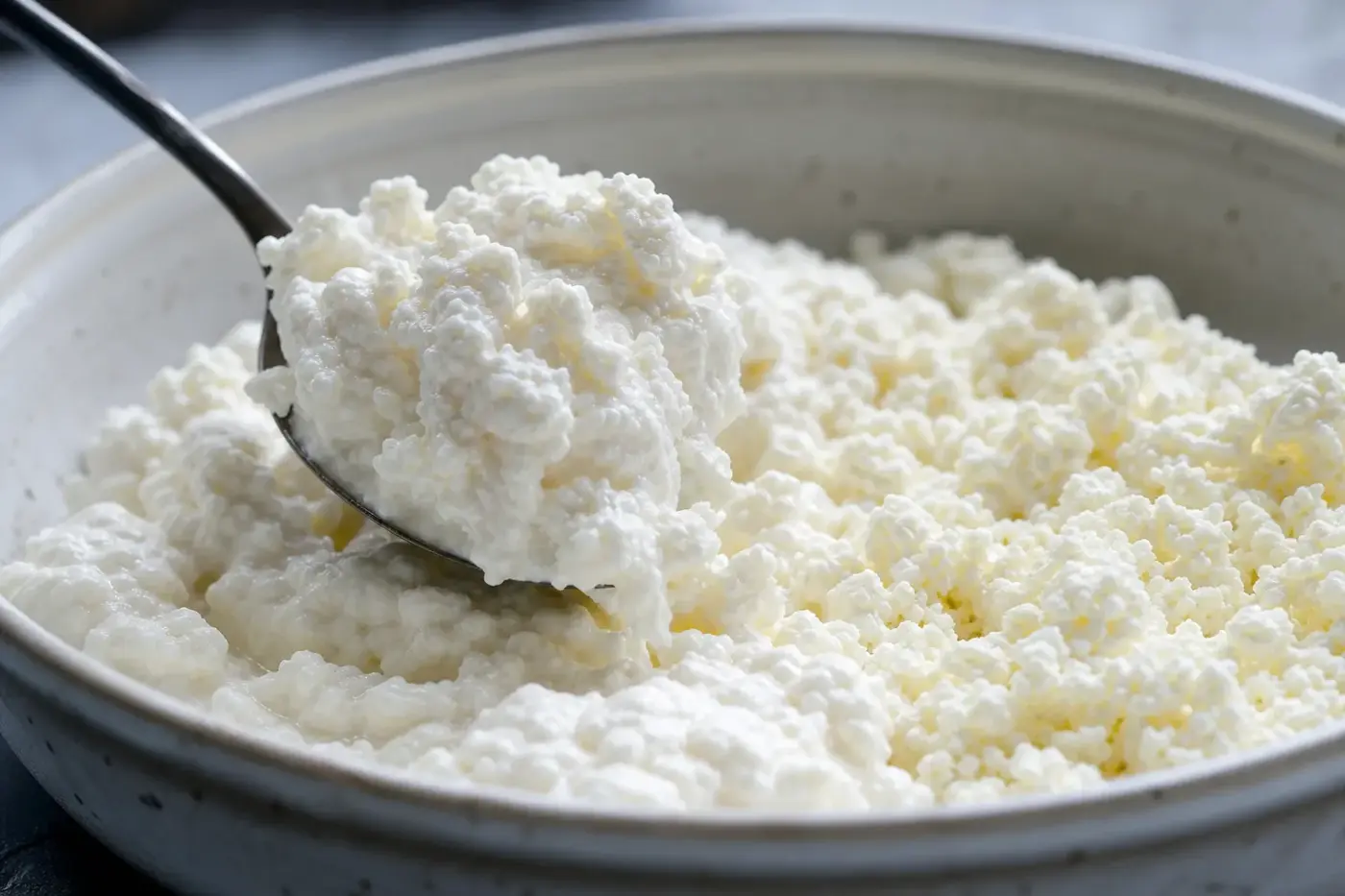
Dip in your spoon: tvorog may yield softly or tumble into loose, pale crumbs. Then comes that gentle sourness. Much of this fresh, unripened cheese’s character depends on what stays in the curd and what drains away. [1][2][3]
The story starts with soured milk. As milk proteins gather into curd, whey is released and drained off. Milk composition, handling and the amount of whey removed decide whether your spoon meets something soft and yielding or drier and crumbly. [1][2][3]
| Your first taste of tvorog | What to know |
|---|---|
| Familiar name | Tvorog, Russian творог. [2] |
| Cheese type | Fresh curd cheese; the cited Eurasian technical regulation classifies it separately as a fermented milk product. [2][3] |
| At home on the table | Eastern Europe and countries of the former Soviet Union. [4] |
| Milk | Cow’s milk and dairy ingredients covered by the cited GOST specification. [1] |
| How the curd forms | Lactic acid fermentation, sometimes assisted by milk-clotting enzymes. [2] |
| What you’ll see | White to creamy white; soft, spreadable or crumbly. [1] |
| Main allergen | Milk. [11] |
Meet the pale curds with a tangy streak
With tvorog, the curd is the whole attraction. You might find small granules or a smoother mass, but there is no developed ripened rind. Tetra Pak’s Dairy Processing Handbook places it among formed fresh cheeses, ready to eat after packaging and refrigerated distribution. [1][3]
The 2013 GOST specification allowed both spreadable and crumbly consistencies, with or without noticeable particles of milk protein. It described a uniformly white or cream tinted colour, with the clean, characteristic flavour and smell of fermented milk. The current applicable specification remains uncertain. [1][12]
When choosing a packet, ask two separate questions: can you see the curd particles, and how moist is the cheese? “Granular” does not mean “dry”. Look for loose crumbs, curd that holds together or something spreadable, then choose the texture your recipe needs. [1][3]
Follow tvorog from bowl to border
A bowl with sour cream or fruit is only the beginning. Across Eastern Europe and the former Soviet Union, tvorog finds its way into dumpling fillings, fried curd cakes and baked dishes. Those everyday uses tell you more about this widely shared food than pinning it to one birthplace could. [4]
In Russian, the name is творог, commonly transliterated as tvorog. Related regional names include Polish twaróg, Czech and Slovak tvaroh, Lithuanian varškė and Ukrainian сир, transliterated syr. Each belongs to its own language and food tradition, so keep a recipe’s original name alongside its English translation. [4]
“Cottage cheese” deserves a second look in English descriptions or translations. Read the method, not just the ingredient list. Instructions to drain, rub through a sieve or shape a filling offer useful clues about the cheese you actually need. [3][4]
See how soured milk becomes curd
First comes fermentation, then separation. Starter bacteria acidify the milk, encouraging its proteins to gather into a network; that curd is then handled and drained. The original text of technical regulation TR TS 033/2013 includes both acid coagulation and acid coagulation assisted by milk-clotting enzymes in its definition of tvorog. [2]
“Coagulation” simply means the formation of that protein network. Where rennet is used, it supplies milk-clotting enzymes, so do not assume every tvorog is made by acid alone. The regulation names lactococci, or a mixture of lactococci and thermophilic lactic streptococci, as starter organisms. [2]
You can still recognise traditional draining and pressing in the standards. GOST 31453-2013 describes whey removal through self-pressing or pressing. With self-pressing, the curd’s own weight does the work of releasing the whey. [1]
Modern production has other ways to separate curd and whey. The cited technical regulation describes centrifugal separation and ultrafiltration, a membrane process. Tetra Pak’s industrial example starts with pasteurised, standardised milk, followed by bacterial acidification, gentle stirring and heating, then mechanical drainage and forming. [2][3]
These descriptions help you picture how the cheese takes shape; they are not a home cheesemaking method. To follow the relationship between curd and whey further, explore how cheese is made. [2][3]
Give texture as much attention as fat
Fat content tells you one thing; consistency tells you another. The cited GOST specification covers whole, standardised, skimmed or reconstituted milk, and mixtures of these. Its composition table groups products by fat content and sets different moisture limits for those categories. [1]
For cooking, look at both the fat figure and the texture. Fat alone cannot tell you whether you are buying loose crumbs or a spreading curd. Also distinguish fat in the whole product from fat in dry matter, which leaves water out of the calculation. [1]
Draining changes the balance. Whey carries water and dissolved components, including lactose and minerals, so removing it concentrates the curd that remains. That makes moisture important when you adapt a filling or batter, quite apart from the fat content. [3][5]
Give the ingredient list its moment, too. The Eurasian regulation distinguishes tvorog from tvorozhnaya massa, a curd preparation that may include cream, butter, sugar or salt. A sweetened preparation gives your savoury dish a different starting point: an unexpected dessert ambition, perhaps. [2]
Find the right neighbour on the cheese shelf
Quark and cottage cheese are useful neighbours to consider. The same dairy reference describes their production alongside tvorog. If you need a substitute, start with the moisture and consistency your recipe expects, rather than putting your faith in a loose English translation. [3]
| A possible stand-in | What makes it different | Your kitchen approach |
|---|---|---|
| Quark, also written quarg | Unripened sour-milk curd, commonly concentrated by centrifugal separation or ultrafiltration; cream may be added. [3] | Match its consistency to the tvorog described in your recipe. |
| Cottage cheese | The handbook’s process washes the curd and adds a cream dressing. [3] | Check whether your recipe needs drained curd rather than dressed curds. |
| Ricotta | Production comparison: not established | Choose a recipe that permits ricotta and specifies any draining adjustments. |
| Farmer’s cheese | Product-specific production method: not established | Read the description and ingredients before using it in a tvorog recipe. |
Keep the choice practical: will you spoon, spread, crumble or shape the cheese? Choose for that job, then follow the recipe’s adjustments. Differences in curd handling make this more useful than simply swapping one cheese name for another. [1][3]
Set the table for sweet and savoury
Start with a bowl of tvorog, sour cream, fruit, berries or honey. Then follow the cheese into syrniki, dumpling fillings, cheesecakes, casseroles and filled pastries. Syrniki, also encountered as Ukrainian syrnyky, are curd cakes, not a pouring pancake batter. [4]
For a simple sweet serving, choose fruit and a texture you enjoy eating straight from the bowl. Distinct crumbs keep the curd visible; softer tvorog lets you bring everything together more thoroughly. Between its texture range and customary accompaniments, you have plenty to work with. [1][4]
If savoury is more your thing, try plain tvorog with chopped herbs and season it to your taste. Start with an unsweetened product, then keep the granules intact or work them into a spread. The same choice matters in a filling: visible curd and smooth paste give different eating textures. [1][2]
Let your recipe choose the curd
Before opening a packet, read how the recipe handles its cheese. Curd cakes that must hold their shape, and fillings that will be enclosed, make moisture especially worth your attention. For a smooth mixture, look for instructions to sieve or blend. [3][4]
Next, compare the ingredients. Plain curd and a preparation containing added cream, sugar or salt are different starting materials. Account for those additions before changing the rest of your dish, rather than treating every related name as a promise that the cheeses are interchangeable. [2]
If a substitute is unfamiliar, choose a recipe written for it. That gives you a more reproducible approach than repeatedly adding flour to compensate for different moisture content. Flour need not become your kitchen’s answer to every question.
Use the production differences above to guide your choice, then let the recipe guide the final adjustment. Need help with the packet itself? Turn to reading a cheese label.
Make room in the fridge
Keep tvorog refrigerated and follow the instructions on its packaging. For England, Northern Ireland and Wales, the Food Standards Agency’s November 2026 household guidance recommends a fridge temperature between 0 and 5 °C. It advises refrigerating dairy foods and leaving chilled food out for the shortest possible time during preparation. [6]
The instructions after opening matter just as much as the unopened date. Choose a pack size you can finish within those instructions, and keep the remaining cheese in the fridge while you prepare a portion. The printed date assumes correct storage. [6][7]
UK government guidance distinguishes a use-by date, which concerns safety, from a best-before date, which concerns quality. Eat tvorog within its use-by date and follow any shorter after-opening instruction. Incorrect storage can make food unsafe before that printed date arrives. [7]
For the bigger household picture, see how to store cheese at home.
This page summarises published guidance from the official sources it cites. It is not medical advice. Guidance differs between countries and changes over time, so check the current source for where you live, and ask your doctor, midwife, pharmacist or dietitian about your own circumstances.
Look past the tang for lactose and milk advice
A sour taste cannot tell you how much lactose is in your packet. The UK NHS identifies lactose as a sugar in animal milk and dairy foods, including cheese. Although tvorog production involves fermentation and whey removal, the name gives you no measured lactose value. [2][5][9]
Check the specific product information rather than judging by taste or name. If you are considering dietary changes, discuss them with a GP or dietitian. [9]
Milk allergy and lactose intolerance are different conditions. The NHS identifies cow’s milk allergy as a reaction to milk protein, while lactose intolerance concerns the digestion of milk sugar. Lactose free dairy products are not suitable for milk allergy, and milk from other mammals is not a safe substitute for people with cow’s milk allergy. [8][9]
For your individual needs, consult a doctor or dietitian. You can also read cheese allergy versus lactose intolerance. [8][9]
If you are pregnant in the UK, consult the NHS guidance on foods to avoid, which distinguishes between cheese types and milk treatments. Ask your midwife about your own circumstances. [10]
Questions people ask
What is tvorog?
Tvorog is a fresh, unripened curd cheese made from soured milk. It can be soft and spoonable or dry and crumbly.
How is tvorog eaten?
It can be served with sour cream, fruit, berries or honey. It is also used in dumpling fillings, cheesecakes and syrniki, which are curd cakes.
Can I substitute quark or cottage cheese for tvorog?
Quark and cottage cheese are useful comparisons, but their consistency and production differ. Check whether your recipe needs a cheese that can be spooned, spread, crumbled or shaped.
How should I store tvorog?
Keep it refrigerated and follow the packaging instructions. For England, Northern Ireland and Wales, the Food Standards Agency recommends a fridge temperature between 0 and 5 °C.
Can I eat tvorog during pregnancy?
The NHS guidance on foods to avoid during pregnancy distinguishes between cheese types and milk treatments. Consult the [NHS guidance](https://www.nhs.uk/pregnancy/keeping-well/foods-to-avoid/) and ask your midwife about your circumstances.
Sources
- Interstate Council for Standardization, Metrology and Certification. GOST 31453-2013: Tvorog. Specifications, official 2013 edition, reproduced PDF. Sections 3, 4 and 5, particularly Table 1. Retrieved document.
- Eurasian Economic Commission. Technical Regulation of the Customs Union TR TS 033/2013: On the Safety of Milk and Dairy Products, original 2013 text. Definitions of творог and творожная масса. Official document.
- Tetra Pak. Dairy Processing Handbook, online edition, publication revision not displayed, accessed November 2026. Chapter “Cheese”, sections “Fresh cheese”, “Formed fresh cheese” and “Quarg”. This is an equipment manufacturer’s technical account. Chapter.
- Wikipedia contributors. Tvorog, retrieved November 2026. Regional names and consumption sections. Used as a secondary cultural starting point, subject to the editorial verification flag below. Retrieved article.
- Tetra Pak. Dairy Processing Handbook, online edition, publication revision not displayed, accessed November 2026. Chapter “Milk and whey fractionation”, introductory whey description and Table 18.1. Chapter.
- Food Standards Agency. How to chill, freeze and defrost food safely, published 2017, retrieved November 2026. Applies to England, Northern Ireland and Wales. Official guidance.
- GOV.UK. Understanding food labelling: Best before and use-by dates, online guidance retrieved November 2026. Official guidance.
- NHS. Dairy and alternatives in your diet, online guidance retrieved November 2026. Sections on milk allergy, lactose intolerance and dairy alternatives. Official guidance.
- NHS. Lactose intolerance, online guidance retrieved November 2026. Official guidance.
- NHS. Foods to avoid in pregnancy, online guidance retrieved November 2026. Section on cheese, milk and other dairy products. Official guidance.
- Food Standards Agency. Food allergy and intolerance advice for consumers, updated 7 August 2026. Applies to England, Northern Ireland and Wales. Official guidance.
- Rosstandart. GOST 31453-2013: Tvorog. Specifications, catalogue record retrieved November 2026, identifying GOST 31453-2025 as its replacement. Official catalogue record.
This desk-researched draft brings together a historical specification, an official regulatory definition, dairy processing references and attributed UK consumer guidance; outstanding verification and review requirements are recorded below.
Last checked: November 2026
Last checked November 2026.
The editors suggest you read next
Jarlsberg
Cut into Jarlsberg and those great, rounded holes catch your eye before you take a bite.