Four washes with brine, then two more with cider in the mix. Before you cut into Yarlington, its rind has already had quite a bathing routine.[2] Inside this soft Gloucestershire cow’s milk cheese, a milky centre meets a savoury, cider-washed surface. The cider is Yarlington Mill from Oliver’s, but don’t expect an apple-flavoured cheese: the maker describes a gentle apple tang alongside notes of cooked ham.[1][2]
| At a glance | Your introduction |
|---|---|
| Name | Yarlington.[1] |
| Made by | King Stone Dairy.[1] |
| Made at | Manor Farm, Chedworth, Gloucestershire, England.[2] |
| Milk | Pasteurised cow’s milk.[2] |
| Milk’s home | Single herd at Manor Farm.[3] |
| Coagulant | Animal rennet.[2] |
| Style | Soft, cider-washed rind.[1] |
| Size and shape | Small round, 220 g.[1][10] |
| Maker’s age profile | 6 to 8 weeks.[1] |
| Labelled ingredients | Milk, salt, starter cultures, animal rennet and cider.[2] |
| Allergen declared on maker’s label | Milk.[2] |
Meet the pale orange rind
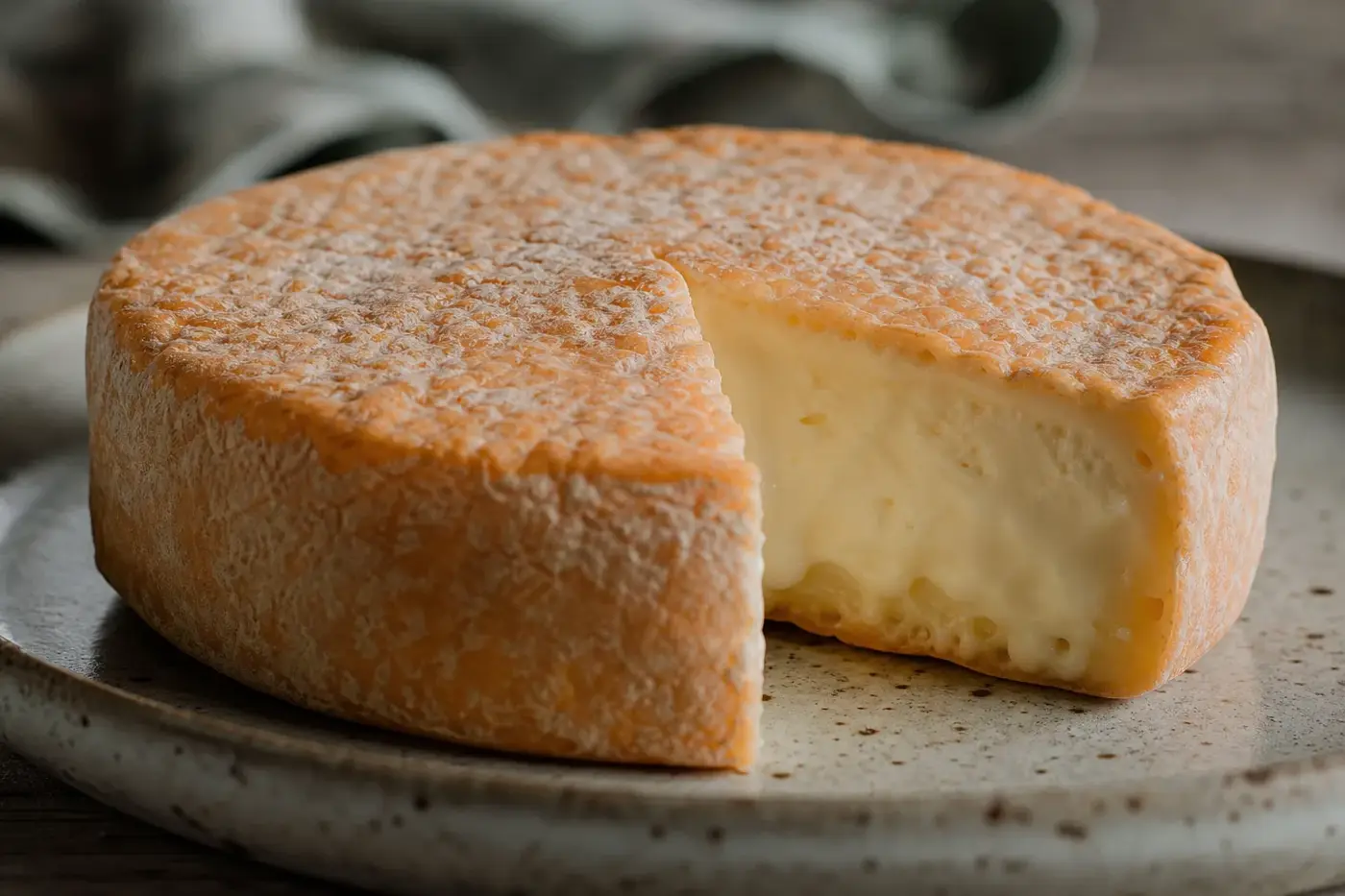
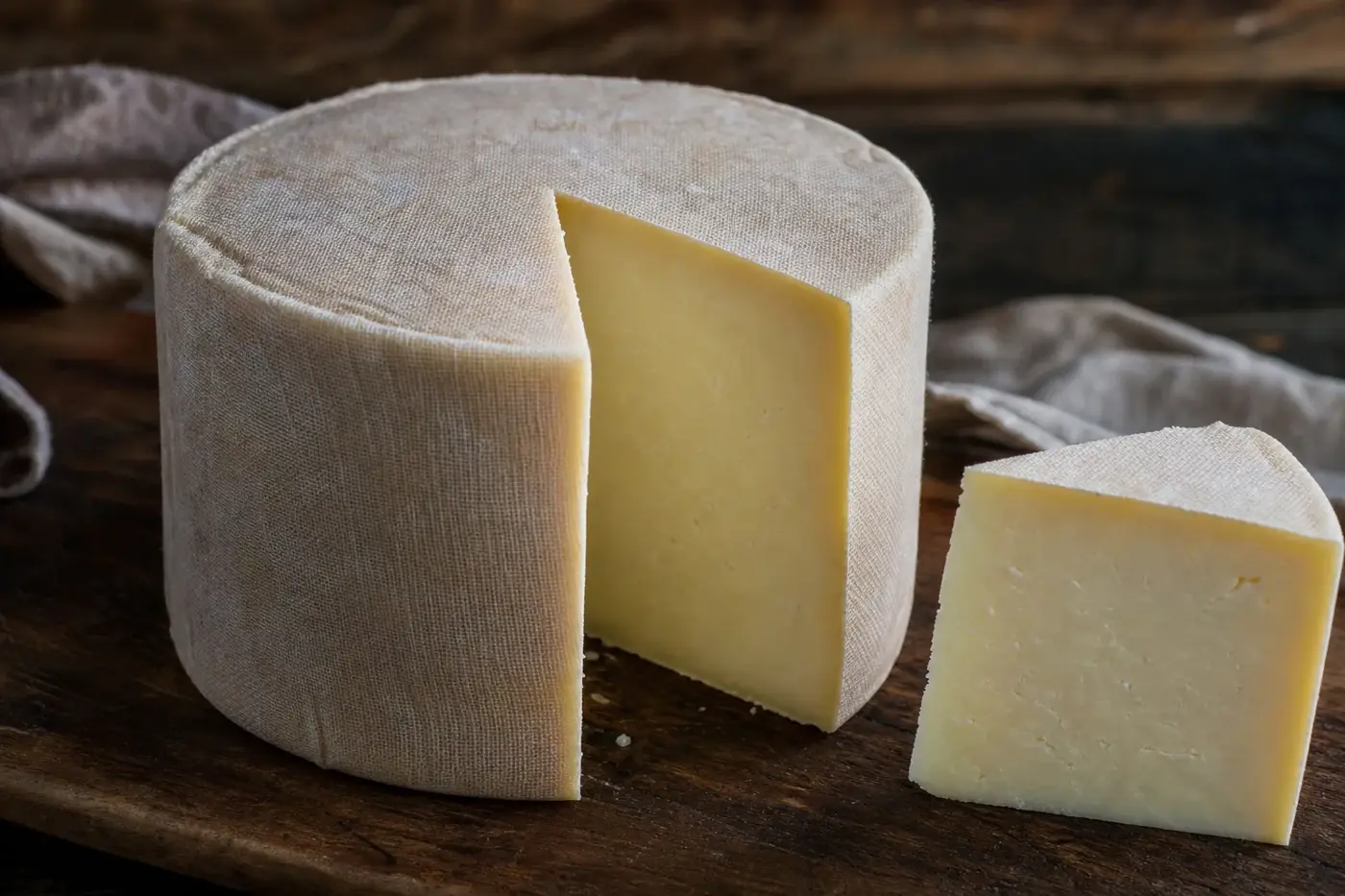
Yarlington is a small, low round with a pale orange rind. Look at Neal’s Yard Dairy’s product photograph and you’ll see a lightly mottled surface rather than a perfectly uniform coating.[10] The cheesemonger describes a sticky rind surrounding a silky, yielding interior.[7]
That contrast gives you a good place to start tasting. The rind reflects washing and surface ripening; the paste, the cheese inside it, offers a different texture and a milky counterpoint. Try a little of each separately, then together. Yarlington’s character lies partly in how those two meet.
Yarlington belongs to the washed-rind family, where the telling detail is treatment during maturation, not simply which animal supplied the milk. A washed rind tells you how a cheese has been ripened. For a closer look at washed, bloomy and other rinds, explore how cheese styles differ.
Follow the morning milk to Chedworth
At Manor Farm in Chedworth, in the Gloucestershire Cotswolds, King Stone Dairy makes Yarlington by hand. The dairy describes its work as small-scale farmhouse cheesemaking, using milk from a single herd on the farm.[4] Gloucestershire is the cheese’s working home, not just the address you find on its wrapper.
Each morning, the dairy says, milk is collected from the farm’s milking parlour and taken to the creamery less than a mile away.[3] That short daily journey links herd, farm and cheesemaking. The milk is produced close to the place where it becomes cheese.
Three places have a part in Yarlington’s story, and it helps to give each its due. Gloucestershire makes the cheese, Somerset supplies the connection behind its name, and a Herefordshire producer supplies its cider.[1][2][11] Follow those separate threads and you can keep your bearings.
A Somerset name, a Herefordshire cider
Yarlington takes its name from Yarlington Mill in Somerset. King Stone Dairy identifies the mill as the home of the first example of the Yarlington Mill apple. The dairy also confirms that the cheese wash combines brine with Yarlington Mill cider from Oliver’s.[1]
Oliver’s describes using selected cider apples grown in Herefordshire. Its cider undergoes spontaneous fermentation, with yeasts fermenting the pressed juice.[11] The apples and cider join a Gloucestershire cheesemaking story. They do not change where the cheese itself comes from.
If that apple connection has you expecting a mouthful of orchard fruit, pause before your first bite. King Stone Dairy describes a gentle apple tang alongside savoury, cooked-ham character.[2] Think ripening treatment, not apple juice. Then taste for yourself how much fruit appears beside the milk and savoury rind.
One herd, two questions about milk
The maker’s resource sheet identifies pasteurised cow’s milk and animal rennet in Yarlington.[2] Rennet is the enzyme preparation that helps milk form a gel as curd formation begins. If you’d like to untangle its different sources, turn to rennet explained.
King Stone Dairy says its cheeses use milk from the single herd at Manor Farm. Its milk page also describes the farm’s use of diverse herbal leys within its agricultural system.[3] Those details give you a picture of the milk supply and the farming approach behind it.
Where milk comes from and how it is treated are separate questions. Manor Farm answers the first; pasteurisation answers the second, describing treatment before cheesemaking. Neither replaces the other, however absorbing you find the farming story. For the wider vocabulary, see milk treatments explained.
Six washes, with cider at the finish
Milk, starter cultures, animal rennet, salt and cider make up Yarlington’s labelled ingredients.[2] In the general rennet-cheese process, cultures produce acid and rennet helps milk form a gel. The curd is then separated from whey, the liquid portion of milk.[5]
Cutting and handling the curd influence how much whey remains, while moulding gives the cheese its shape.[5] For the particulars of Yarlington’s curd preparation, drainage and moulding, ask the maker. You can trace the broader journey in how cheese is made.
The washing sequence gives you a more precise picture. King Stone Dairy records four brine washes, followed by two finishing washes with a mixture of brine and cider.[2] Cider therefore arrives after an initial period of brine washing. It finishes the sequence rather than directing the whole business of rind development.
The dairy gives Yarlington an age profile of 6 to 8 weeks.[1] Neal’s Yard Dairy lists an average age of one month.[7] Those descriptions leave open whether they refer to the same stage. For the cheese you take home, follow its use-by date and storage instructions rather than treating either age description as a substitute.
What keeps a washed rind busy?
A washed rind is a living, changing surface. In washed-rind cheesemaking generally, brine treatment spreads surface growth and favours particular bacteria over competing moulds. Some of those bacteria produce orange or yellow pigments, along with compounds responsible for pronounced aromas.[5]
Yeasts help prepare the ground. A peer-reviewed review of cheese yeasts explains that early surface yeasts can consume lactate and raise the surface pH.[6] That creates more welcoming conditions for bacteria that tolerate acidity less well. You’re looking at a changing microbial community, not one organism working alone.
There is more happening here than colour and smell. Microorganisms and their enzymes help alter flavour and texture through processes that include breaking down proteins and fats.[6] In surface-ripened cheeses, softening can develop unevenly, travelling from the outside towards the centre.[5]
You can explore those differences without turning your cheeseboard into a laboratory. Taste the paste just beneath the rind, then try the middle. A cut face need not have one uniform texture. Moving between the two tells you more than taking every bite from the same spot.
Find the milk, then the savoury depth
“Bright and milky” is how Neal’s Yard Dairy describes Yarlington, alongside its sticky rind and silky, yielding centre.[7] That description invites you to pay attention to the cheese’s interior. It offers a counterpart to the maker’s more savoury tasting notes.
King Stone Dairy emphasises umami, the savoury quality associated with foods such as stock or cooked meat. It also describes cooked ham and a gentle farmhouse apple tang.[2] Together, those accounts give you a useful direction for tasting: a milky interior meeting a more assertive surface.
Prefer a centre that holds its shape? Ask the seller about ripeness. Research into surface ripening explains why aroma and texture change during maturation, and the maker’s age range gives you a starting reference.[1][5] What matters when you buy, though, is the condition of that individual cheese.
Give aroma and flavour a moment each. Smell a freshly cut piece, then taste a little paste on its own. Follow with paste and rind together, noticing texture and finish as well as your first impression. It becomes easier to distinguish what the centre brings from what the surface contributes.
Keep it cold, and keep the label
Follow the storage instructions and use-by date on the cheese you receive. The maker’s illustrated label specifies storage below 8 °C (46 °F).[2] For home refrigeration in England, Wales and Northern Ireland, Food Standards Agency guidance recommends a fridge between 0 and 5 °C (32 to 41 °F). Food Standards Scotland recommends the same range.[8][9]
Keep the label with your cheese after opening so that the instructions remain to hand. For practical help with wrapping and choosing a place for cheese in the fridge, see storing cheese at home.
Before preparing and serving chilled cheese, check the current advice from your local food safety agency. For the maker’s advice on eating Yarlington’s rind, ask the dairy directly.
Give Yarlington room on the board
Start simply: Yarlington, plain bread or crackers, and slices of apple or pear. Set the accompaniments beside the cheese rather than over it. You’ll have room to taste paste and rind without another flavour interrupting. Then try what the bread or fruit brings to your next bite.
For adults of legal drinking age who choose alcohol, the maker suggests a sparkling, fruity cider with gentle tannin, or a full-bodied white wine with some oak character.[2] Offer a small serving alongside the cheese. The aim is to explore the combination while keeping Yarlington in focus.
People who are pregnant, driving, taking medicines that interact with alcohol or recovering from alcohol dependence should not drink. Check current NHS advice. Still or sparkling water offers an alcohol-free option; sparkling apple juice is another suggestion.
For a larger board, give Yarlington the soft, washed-rind position. Choose contrasting textures for the other cheeses rather than several similarly yielding examples. Begin with the cheese alone, then return to the bread, fruit or drink. The best combination for you is the one you prefer.
General information only, not medical advice: follow the official guidance where you live.
Questions people ask
What does Yarlington taste like?
Neal’s Yard Dairy describes it as bright and milky, with a sticky rind and a silky, yielding centre. King Stone Dairy notes cooked ham and a gentle farmhouse apple tang.
What cider is used to make Yarlington?
The cheese is finished with a mixture of brine and Yarlington Mill cider from Oliver’s. Oliver’s uses selected cider apples grown in Herefordshire and spontaneous fermentation.
Is Yarlington suitable for vegetarians?
Yarlington is made with animal rennet. Its labelled ingredients also include milk, salt, starter cultures and cider.
How long is Yarlington aged?
King Stone Dairy gives an age profile of 6 to 8 weeks. Neal’s Yard Dairy lists an average age of one month, but whether the two descriptions refer to the same stage has not been verified.
How should Yarlington be stored?
Follow the storage instructions and use by date on your cheese; the maker’s label specifies storage below 8 °C. For home refrigeration, check the current guidance from the Food Standards Agency or Food Standards Scotland, which both recommend a fridge temperature of 0 to 5 °C.
Sources
[1] King Stone Dairy, The Cheese, undated live page, Yarlington section. Retrieved November 2026. Maker’s cheese descriptions.
[2] King Stone Dairy, Yarlington, two-page product resource sheet, undated edition linked from the maker’s website. Both pages retrieved; label artwork on page 2 inspected. Product resource sheet.
[3] King Stone Dairy, The milk, undated live page. Retrieved November 2026. Milk supply and farm description.
[4] King Stone Dairy, King Stone Dairy, undated home page. Retrieved November 2026. Dairy’s description of its operation.
[5] American Society for Microbiology, The Basics of Cheesemaking, Microbiology Spectrum, volume 1, number 1, 31 October 2013, DOI 10.1128/microbiolspec.CM-0002-2012. Published scientific explanation.
[6] Agroscope researchers, Cheese yeasts, Yeast, volume 36, issue 3, pages 129 to 141, 2019, DOI 10.1002/yea.3368. Published abstract retrieved through PubMed. Review abstract.
[7] Neal’s Yard Dairy, Yarlington, undated live product page. Commercial seller’s own sensory description. Retrieved November 2026. Cheesemonger’s description.
[8] Food Standards Agency, How to chill, freeze and defrost food safely, published 18 December 2017, live guidance retrieved November 2026. Applies to England, Northern Ireland and Wales. Official refrigeration guidance.
[9] Food Standards Scotland, Chilling, undated live consumer guidance. Retrieved November 2026. Official Scottish refrigeration guidance.
[10] Neal’s Yard Dairy, Yarlington, product photograph linked from its product page, undated. Inspected November 2026 for shape and visible rind appearance only. Publication permission has not been established.
[11] Oliver’s Cider & Perry, home page, undated live company account of location, fruit sourcing and fermentation. Retrieved November 2026. Cider producer’s account.
This desk-researched article combines the maker’s product information with attributed cheesemonger descriptions, published ripening science and official British refrigeration guidance.
Last checked: November 2026
Last checked November 2026.
The editors suggest you read next
West Country Farmhouse Cheddar Cheese
Large pieces of curd turn and stack under the cheesemaker’s hands.