Bonchester Cheese
Cut into a ripe Bonchester and the yellow paste can flow beneath its white bloomy rind.
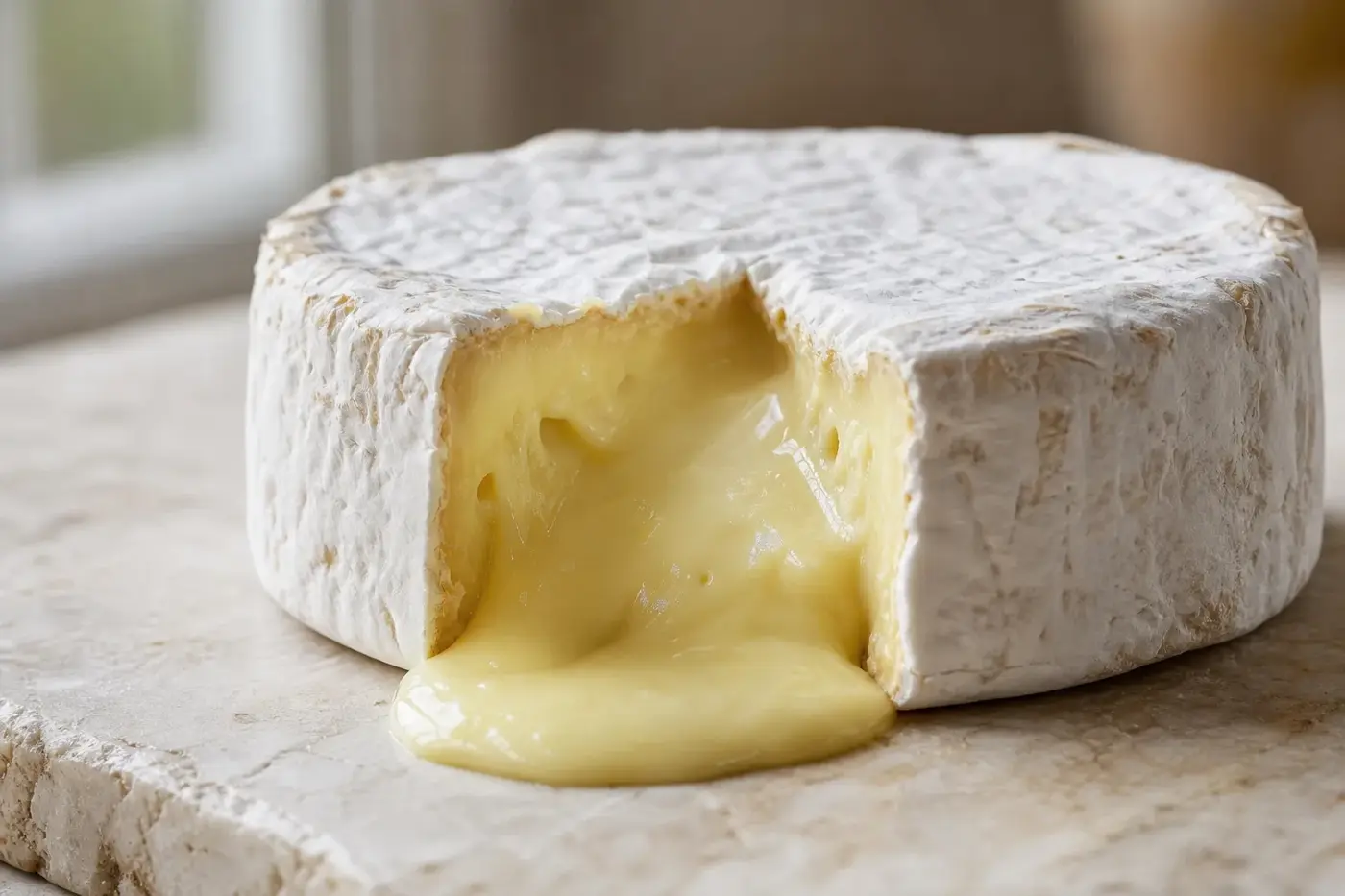
Cut into a ripe Bonchester and the yellow paste can flow beneath its white bloomy rind. You might want your bread within reach. This small, soft cheese leads you to Easter Weens Farm, near Bonchester Bridge in the Scottish Borders, to unpasteurised Jersey milk and a modern cheesemaking venture. Its protected name also has a story to tell, distinct from the history of its production. [1, 2, 3]
| At a glance | Your quick guide |
|---|---|
| Familiar and GB registered name | Bonchester Cheese. [1] |
| Registration authority | Defra, Great Britain protected food names register. [1] |
| GB protection | Registered PDO, November 2026. UK scheme registration dated 31 December 2020 at 23:00. [1] |
| Original EU registration | Defra records 21 June 1996. [1] |
| Milk | Unpasteurised whole Jersey cows’ milk. [2] |
| Coagulant | Rennet; animal or other source unspecified. [2] |
| Shape and size | White-coated cylinders: small, 78 mm diameter, minimum 100 g; medium, 130 mm, minimum 280 g. [2] |
| Composition | Minimum 20% milk fat; maximum 60% water, both in the whole cheese. [2] |
| UK pregnancy guidance | NHS guidance on thoroughly cooking unpasteurised and white-rinded soft cheeses, November 2026. [7] |
Start at the farm, then unfold the map
Find Bonchester’s birthplace and you find Easter Weens Farm at Bonchester Bridge, Roxburghshire, in southern Scotland. That is where the registration documents begin, but the designated territory stretches much further. It reaches for a radius of 90 kilometres from the summit of Peel Fell, across the English and Scottish border into country associated with the Tyne, Tweed and Solway river systems. [2, 3]
Grass-based dairy farming runs through the specification. There is grazing, then conserved grass fed as hay or silage. The document connects the cheese’s character with this environment, the dairy’s microbial population and consistent cheesemaking practice, without measuring each one’s share of the flavour. [2]
Keep two places in mind as you follow the story. There is the farm where Bonchester began, and the wider territory its specification allows. Within that cross-border area, the milk is obtained and the cheese is made and matured. [2]
A farmhouse beginning, not an ancient legend
Bonchester took shape in 1980 and 1981 at Easter Weens Farm. The makers started with the Camembert method, helped by the West of Scotland Agricultural College. The original application names Easter Weens Enterprises as the applicant. [3]
Commercial production began in converted buildings in 1982. Demand grew, followed by a purpose-built dairy in 1987. This was modern British farmhouse cheesemaking: an established soft-cheese approach adapted to the makers’ milk and farming setting, rather than an ancient local recipe revived. [3]
The later chapter comes with a qualification. CooksInfo, a secondary account, reports that production ceased in September 1998 and points to contemporary newspaper reporting. Read that as a reported closure date, rather than a definitive date from the underlying record. [14]
Jersey milk earns its place
You cannot swap in just any cows’ milk and call the result Bonchester. The specification requires unpasteurised whole Jersey milk and describes the finished cheese as full-fat and soft. That milk belongs at the heart of its identity. [2]
The original application gives you a vivid glimpse inside. The paste is yellow, close and smooth, with an initially moderately firm body that softens as it matures. Milk, drainage and ripening work together here; the breed alone does not explain every mouthful. [3]
“Unpasteurised” tells you about the milk treatment, rather than the whole cheesemaking story. For the differences between raw, thermised and pasteurised milk, turn to milk treatments explained.
Into the dairy, then the ripening room
The documented method brings evening and morning milk together. Starters and rennet go in, before the resulting curd is cut and transferred into moulds. Bonchester is unpressed, with turning, brining and draining ahead of its passage through controlled ripening rooms. [2]
Japan’s official description of the registered British product takes you a little closer to that daily rhythm. Moulding is followed by repeated turning, then brining the following morning. The cheeses spend four days in a temperate room before maturing at a lower temperature. [6]
The specification names starters, but not individual strains. General soft-cheesemaking accounts can help you understand how cultures, moisture loss and ripening transform curd. They cannot fill in those missing Bonchester-specific strains or identify the organisms in a particular batch. [2]
The timing needs a careful distinction, too. The original application gives six days of subsequent maturation for small cheeses and twelve for larger ones. Those durations do not appear in the specification currently linked by Defra, so they are historical application figures, not stated current legal minimums. [2, 3]
Watch the white coat and yellow heart soften
White rind, yellow interior: Bonchester makes a striking pair of colours. The original application describes the young cheese as clean and mild, with a moderately firm body and a close, smooth texture. As it matures, the description turns stronger, more mellow and softer. [3]
You can picture a contained slice when young, then a softer centre with maturity. The specification goes further, describing ripe cheese that can flow when cut. Take ripening too far and the curd can become runny. [2]
Ripeness is not a safety test. Maturity, appearance and food safety are separate judgements. Use the storage instructions and date marking when deciding whether to serve it. [8, 15]
A protected name with a place attached
Bonchester Cheese remains a registered protected designation of origin, or PDO, on the Great Britain register as of November 2026. Defra records its original EU registration as 21 June 1996. Commission Regulation (EC) No 1107/96, the original registration regulation, was adopted on 12 June and published on 21 June 1996. [1, 4]
The map matters as much as the name here. Defra explains that UK GI schemes protect registered names in Great Britain. EU schemes cover the EU and Northern Ireland. [5]
A protected designation is not a privately owned brand. According to Defra, a producer can use the registered name when it follows the specification and has approval to do so. Those requirements preserve the defined product and its geographical connection. [5]
If you would like to untangle the wider differences between the schemes, there is a separate guide. Read protected names explained.
Looking for Bonchester today?
| Your question, November 2026 | What you need to know |
|---|---|
| Is the name registered in Great Britain? | Yes. [1] |
If you come across a present-day offer, ask three straightforward questions. Who made it, where was it produced and when was that batch made? Request the original product information rather than relying on a catalogue description carried over from an older reference.
The historical specification records availability from April to December, with little or no manufacture in January and February. Keep that seasonal picture in its proper chapter. It describes the document’s production pattern, not what you can expect to find today. [2]
Let the cheese lead at the table
Think simple bread or plain oatcakes, with pear or apple alongside. They would leave room for Bonchester’s documented mild young flavour or stronger mature character. These are serving suggestions, not accompaniments drawn from a recorded Bonchester tasting.
For your glass, water or an alcohol free apple drink would be straightforward company. The accompaniments need not audition for the leading role.
Bring out only what you intend to serve. UK NHS handling guidance says to keep chilled ready-to-eat food at 5 °C or below and eat it within four hours of removal from refrigeration. In hotter-than-usual weather, the FSA’s published advice is to discard perishables left out for more than two hours. [8, 10]
Keep it chilled, and follow the date
Start with the maker’s packaging instructions and use-by date. NHS guidance advises using opened ready-to-eat food within two days unless the packaging says otherwise. That is general UK advice, not an established shelf life for Bonchester. [8]
Keep your cheese refrigerated and separate from raw foods. The NHS recommends a domestic refrigerator setting of 5 °C or below. The FSA’s chilling guidance also stresses correct refrigeration and following storage instructions. [8, 9]
Once the use-by date has passed, discard the cheese, even if it looks acceptable. In UK official guidance, use-by dates concern safety; best-before dates concern quality. Appearance cannot override that distinction. [15]
If you notice unexpected growth on the surface, consult mould on cheese. Do not apply hard-cheese trimming advice to a soft round.
Take extra care when choosing soft cheese
During pregnancy, UK NHS advice is to avoid mould ripened soft cheeses with a white coating unless they are thoroughly cooked until steaming hot all the way through. Bonchester’s specification describes a white coated soft cheese. Read the NHS guidance for its full advice on unpasteurised dairy products. [2, 7]
If you are choosing cheese for babies or young children, the UK NHS advises against giving them mould ripened soft cheeses such as Brie and Camembert. Its guidance sets out the full advice on cheese for young children. [12]
The NHS identifies older people and people with weakened immunity among those more vulnerable to serious listeriosis. Follow current official guidance and a clinician’s advice for your individual circumstances. [8]
Get to know Bonchester’s British soft-cheese neighbours
Keep three things in mind when you think of Bonchester. Jersey milk, its specified cross-border production area and that small white-coated format together define its identity. [2]
Baron Bigod offers an interesting comparison. Fen Farm Dairy describes it as a Brie-style cheese made with milk from its Montbéliarde herd, using hand-ladled curd and hand salting. The dairy’s own tasting notes describe a mushroom-like rind and softer outer paste around a fresher centre. [13]
Softness gives you a starting point, not a promise of the same experience. Breed, method, geography and maturation give each cheese its own character. Choose another British soft cheese for its documented qualities, rather than asking it to be Bonchester.
General information only, not medical advice: follow the official guidance where you live.
Questions people ask
What milk is Bonchester made from?
Bonchester must be made from unpasteurised whole Jersey cows’ milk. Its specification describes the finished cheese as full fat and soft.
What does Bonchester taste like?
The original application describes young Bonchester as clean and mild, with a close, smooth texture. As it matures, it becomes stronger, more mellow and softer.
Is Bonchester still being made?
A current producer and current retail availability were not verified when the page was checked in November 2026. The name remains registered as a protected designation of origin in Great Britain.
Can you eat Bonchester when pregnant?
The NHS advises avoiding mould ripened soft cheeses with a white coating during pregnancy unless they are thoroughly cooked until steaming hot all the way through. Bonchester’s specification describes a white coated soft cheese. Check the NHS guidance for its full advice on unpasteurised dairy products.
Can you eat the rind on Bonchester?
The page does not verify whether Bonchester’s rind is edible. It describes the cheese as having a white outer coat and a yellow interior.
Sources
- Defra. Bonchester Cheese. Great Britain protected food names register, published 4 January 2021; entry retrieved November 2026.
- Defra. Bonchester Cheese: Product specification. Version currently linked from the GB register; revision date not stated in the retrieved document. Sections 4.2 to 4.6.
- Easter Weens Enterprises. Application for Registration of a Designation of Origin for Bonchester Cheese under Regulation (EEC) No. 2081/92. Undated application, preserved copy hosted by CooksInfo.
- European Commission. Commission Regulation (EC) No 1107/96 of 12 June 1996. Original Official Journal version, OJ L 148, 21 June 1996.
- Defra. Protected geographical food and drink names: UK GI schemes. Updated 8 March 2024.
- Japan Ministry of Agriculture, Forestry and Fisheries. Notice of designation, designation number 158: Bonchester Cheese. 20 December 2024; product characteristics and production description.
- NHS. Foods to avoid in pregnancy. Current retrieved version, November 2026.
- NHS. Listeriosis. Reviewed 10 November 2023; retrieved November 2026.
- Food Standards Agency. How to chill, freeze and defrost food safely. Current retrieved GOV.UK version, November 2026.
- Food Standards Agency and UK Health Security Agency. Food safety in a heatwave: advice for consumers. Current retrieved version, November 2026.
- Food Standards Agency. Alerts. Current alert index, retrieved November 2026. Used for the editorial check only.
- NHS. What to feed young children. Cheese section, current retrieved version, November 2026.
- Fen Farm Dairy. Baron Bigod. Undated producer account and tasting notes, retrieved November 2026. Commercial source used for its own product descriptions.
- CooksInfo. Bonchester Cheese. Updated 31 May 2022. Secondary historical account.
- UK Government. Understanding food labelling: Best before and use-by dates. Current retrieved version, November 2026.
Research combined official registration documents, the preserved application, national safety guidance and attributed producer material, with unresolved production history retained for editorial verification.
Last checked: November 2026
Last checked November 2026.
The editors suggest you read next
Shropshire Blue
Cut into Shropshire Blue and you get quite a colour scheme: orange crossed by blue-green veins.