Brined Cheeses Explained
Break a white block of cheese and crumbs tumble from your fingers.
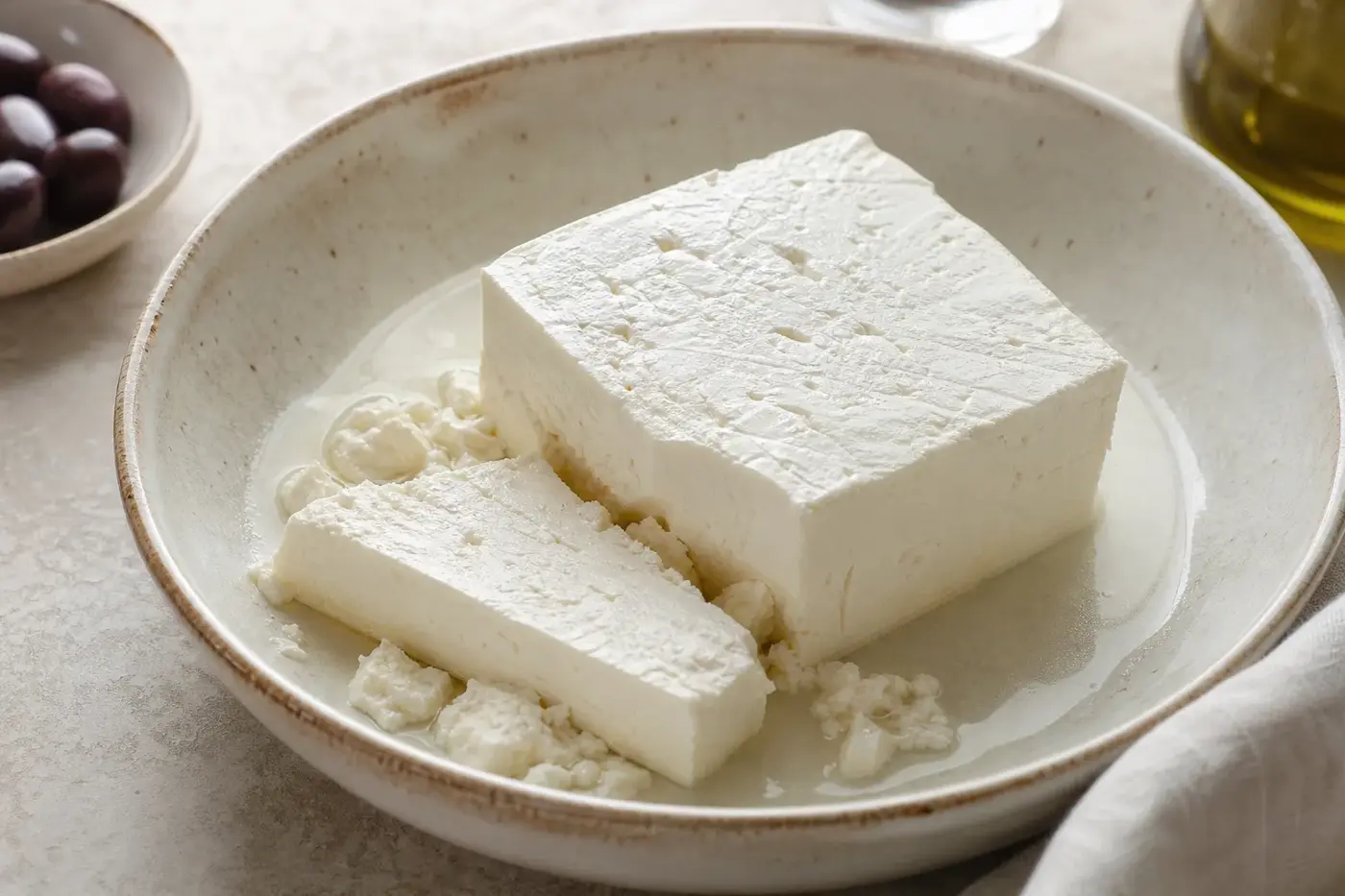
Break a white block of cheese and crumbs tumble from your fingers. Cut another and you get a firm slice, ready for grilling. Saltwater helps make both possible: it seasons the curd and helps control the conditions in which cheese keeps and ripens. Cheeses kept or matured in that salty liquid belong to the brined family.[1,2]
There is more to that white block
Think of brining as something you do to cheese, not a promise about its firmness. The liquid can be made with water or whey, the liquid separated from curds during cheesemaking. Salt moves into the cheese, while moisture and other soluble components can travel between cheese and liquid.[1,3]
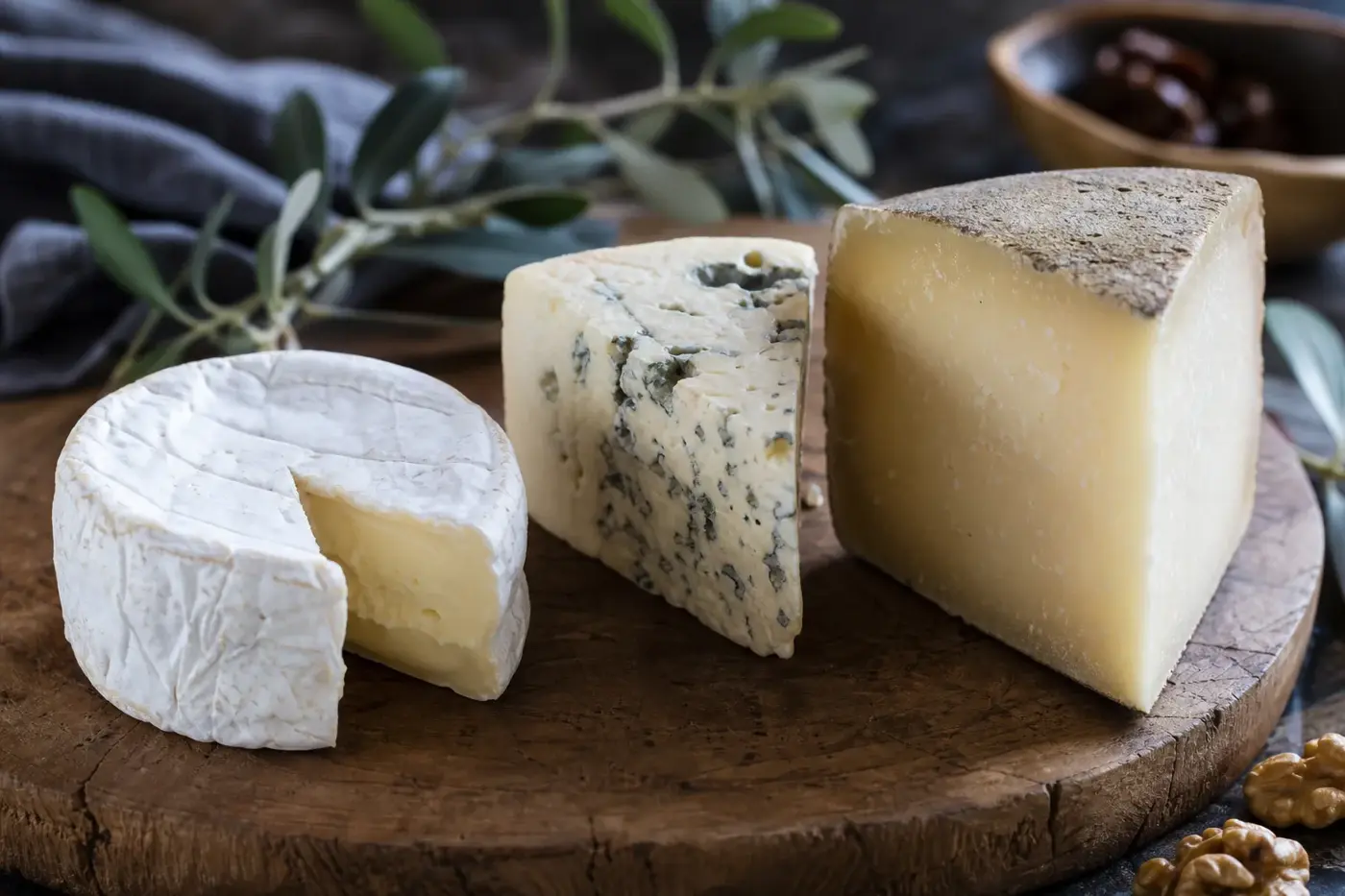
Looks, then, can lead you astray. A white, rindless block might spread softly, hold a neat slice or tumble into crumbs. Start with the milk, the curd treatment and whether the cheese is young or matured. Then use how to tell cheese styles apart to find its place among the wider families.[1,2]
Follow the makers from milk to brine
For many brined cheeses, the work begins with rennet, an enzyme preparation that sets milk into a gel, and starter bacteria that develop acidity. Makers cut the gel into solid pieces called curds, then drain them to let whey escape. Moulding, turning and sometimes pressing bring those pieces together before the cheese is divided into blocks.[1,4]
Follow different makers and the sequence changes. The European Commission describes feta curds draining without pressure, then being cut and salted with coarse salt before brine is added. Akkawi curd is pressed to squeeze out whey. Halloumi takes another route: the formed cheese is heated in whey, giving it a very different body from an acidic, crumbly white cheese.[4,5,6]
These are production descriptions, not one recipe shared by the whole family. Salting can start before immersion, happen mainly in the liquid, or combine the two. You can follow the broader sequence in how cheese is made.[1,4]
Give salt, acidity and time their due
Salt does more than make your mouth register “salty”. It affects water activity, meaning the water available to microorganisms, and changes the activity of ripening bacteria and enzymes. Brine strength therefore influences both how cheese keeps and how quickly its flavour and texture develop.[2,5]
Acidity works alongside it. As starter bacteria ferment milk sugar, they lower the pH, a measure of acidity. Those changes, together with calcium movement, affect the protein framework holding the cheese together. Moisture, salt uptake and that framework help explain why your cheese stays yielding or becomes firmer and more brittle.[2,6]
Time brings another change: enzymes break down proteins in a process called proteolysis. In a nine week experiment with Turkish Beyaz cheese, researchers compared four brine concentrations. Stronger brines changed composition and texture and, above a particular concentration, reduced proteolysis and sensory acceptance. More salt, in other words, was not automatically an improvement.[2]
Milk supplies fat, protein and flavour precursors, but it does not get all the credit. The Bulgarian specification explicitly names starter cultures and brine maturation as major influences on taste and aroma. The animal supplying the milk is only part of the finished character.[7]
A pool of liquid does not mean maturation
A cheese maturing in brine keeps changing within that environment. Fresh mozzarella's surrounding liquid belongs to a different method: Codex describes mozzarella as unripened, with high moisture versions optionally packed in liquid. Its defining pasta filata process heats, kneads and stretches the curd. The liquid in the pack tells you little about maturation.[8]
Codex is an international reference standard, not a worldwide law. Explore mozzarella for the stretched curd family and its fresh forms. Washed rind cheese is different again: repeated surface treatments during ripening encourage a rind community, rather than keeping the whole cheese submerged in brine.
Five cheeses worth getting to know
Feta, Greece. In the EU, Feta is a registered protected designation of origin, or PDO, tying its name to a specified place and production rules. It uses sheep's milk, alone or with up to 30% goat's milk, from the defined Greek area: Macedonia, Thrace, Epirus, Thessaly, Central Greece, the Peloponnese and Lesvos. The European Commission gives a minimum total maturation of two months.[4,9,10]
The Commission describes feta as salty and slightly acidic. When you choose and serve it, notice how a block holds a slice, then releases crumbs when you break it. White brined cheeses from elsewhere have identities of their own. Follow the named origin rather than making feta do duty as everyone's surname.[4,10]
Bulgarian white brined cheese, Bulgaria. Picture a cut surface with a porcelain like appearance, followed by a pronounced lactic acid flavour. The EU application published in 2023 for Българско бяло саламурено сирене / Bulgarsko byalo salamureno sirene describes this cheese as moderately firm and pliant.[7]
Beyaz peynir, Türkiye. Turkish white cheese can use sheep's, goat's or cow's milk, or mixtures. Research describes an acidic or salty cheese matured as blocks in brine. Choosing between a younger table cheese and a more developed version? Read the maker's description and declared maturation: the name alone does not promise one fixed firmness.[2,5]
Akkawi, the Levant. Also written Akawi, this cheese is documented in Lebanese and Syrian production. Its curd is pressed before brine storage, a useful contrast with unpressed feta. Published descriptions place it towards the smooth, mild, sliceable end of the family, though its saltiness depends on production and storage.[1,5]
Halloumi, Cyprus. Χαλλούμι (Halloumi)/Hellim is registered as an EU PDO from Cyprus. Production uses sheep's or goat's milk, with cow's milk also used in mixtures. The halloumi.cy description distinguishes elastic, sliceable fresh halloumi from a harder, less elastic mature version with a saltier, more pungent character.
Choose your cheese by the mouthful
Before choosing a name, think about what you want your cheese to do. For scattered crumbs, find one that breaks cleanly; for a sandwich or breakfast plate, pick a cohesive block. For grilling, choose a cheese whose producer specifically recommends it. A spell in brine does not give every cheese halloumi's cooking behaviour.[1,6]
- Start with a small taste. Notice salt at the surface, acidity through the bite and whether the texture feels smooth, elastic or crumbly. Let that mouthful guide how much extra seasoning your dish needs.
- Cut or crumble to suit the plate. Break a friable cheese into irregular pieces for salads, or slice a more pliant block. Leave some larger pieces when you want a distinct mouthful of cheese.
- Pick your cooking cheese carefully. Halloumi is the clearest grilling example here. Drain it, pat the surface dry and follow the product's cooking instructions. Sliceable akkawi and crumbly feta bring different textures to cooked dishes.[1,6]
- Give the salt a little contrast. My serving suggestion is salty cheese with tomatoes, cucumber, bread or unsalted beans before you add olives or another salty ingredient. Taste the assembled dish before reaching for the salt. The salt cellar can wait its turn.
Too salty? Taste before you soak
Drain the cheese and taste it before doing anything else. A brief rinse can remove salty liquid clinging to the surface; soaking lets salt inside the cheese move into the water. That may help a heavily salted cheese, particularly when you want its texture rather than a strong salty accent.[1,3]
Water changes the cheese's environment too. Reducing salt can soften its character, while water uptake and mineral movement can alter its surface and texture. Follow the maker's desalting directions if supplied. A rinse adjusts flavour; it cannot rescue deteriorating cheese.[3,6]
This page summarises published guidance from the official sources it cites. It is not medical advice. Guidance differs between countries and changes over time, so check the current source for where you live, and ask your doctor, midwife, pharmacist or dietitian about your own circumstances.
Bring it home and store it properly
For home storage in England, Wales and Northern Ireland, the Food Standards Agency advises a fridge temperature between 0 and 5 °C and refrigeration for dairy products. Follow the pack's storage instructions, including its directions after opening. Keep the cheese in its supplied liquid where instructed, and always take your portion with clean utensils.[13]
Saltwater helps preservation, but the manufacturer's shelf life depends on the complete product and process, including acidity, temperature and hygiene. Research documents salt-tolerant yeasts in brined cheeses. Replacing the liquid with homemade brine does not start a new storage period. Keep the original date and opening instructions as your guide.[3,5,13]
UK official guidance says you must not eat food after its use by date, even if it looks or smells acceptable.[14] If changes concern you, turn to mould on cheese rather than washing away the evidence. For containers, refrigeration and opened packs, see how to store cheese at home.[14]
Sources
- Dairy Consultant, White Brined Cheese Production (Feta, Halloumi, Domiati), undated technical account. Used for the family overview, contrasting production routes and culinary behaviour.
- Çukurova University and İnönü University, Influence of salt concentration on the characteristics of Beyaz cheese, a Turkish white-brined cheese, Lait, volume 86, issue 1, 2006, pages 73 to 81. The retrieved publisher abstract reports four experimental brines and nine weeks of ripening.
- Foods, The Effects of Adding Different Stabilizers in Brine on the Physicochemical, Sensory, Microbiological and Textural Properties of White Cheese, volume 8, issue 4, article 133, 2019. Retrieved abstract and summary concerning water movement and texture.
- European Commission, Directorate-General for Agriculture and Rural Development, Feta PDO, undated production account, checked November 2026. Describes unpressed drainage, dry salting and at least two months' total maturation.
- Frontiers in Microbiology, Occurrence of Yeasts in White-Brined Cheeses: Methodologies for Identification, Spoilage Potential and Good Manufacturing Practices, volume 11, article 582778, 2020. Peer reviewed synthesis covering regional production and salt-tolerant spoilage yeasts.
- Foods, Influence of Salting Method on the Chemical and Texture Characteristics of Ovine Halloumi Cheese, volume 8, issue 7, article 232, 2019. Retrieved material describes salting effects, calcium movement and the mature whey-brine route.
- European Commission, Publication of an application for registration of a name, single document for Българско бяло саламурено сирене / Bulgarsko byalo salamureno sirene, EU application number PDO-BG-02656, Official Journal C 129, 13 April 2023, pages 67 to 71. This is the published application document, not evidence by itself of subsequent registration. )
- FAO and WHO, Codex Alimentarius, Codex Standard for Mozzarella, CODEX STAN 262-2006, retrieved edition amended in 2010 and 2013, section 2. International reference describing unripened mozzarella, liquid packaging and pasta filata processing.
- World Intellectual Property Organization, Defining a Name's Origin: The Case of Feta, published case study, 2015. Reports the sheep's milk requirement and maximum 30% goat's milk proportion.
- Feta PDO campaign website, Safety & Quality, undated producer-facing account. Lists the Greek production regions and milk proportions; its promotional provenance is distinct from binding legislation.
- European Commission, Commission Implementing Regulation (EU) 2021/591 of 12 April 2021 entering a name in the register of protected designations of origin and protected geographical indications (‘Χαλλούμι’ (Halloumi)/‘Hellim’ (PDO)), published 13 April 2021.
- Halloumi.cy, Ingredients and Main Characteristics, undated product account. Used for its attributed descriptions of fresh and mature halloumi and the milk species used.
- Food Standards Agency, How to chill, freeze and defrost food safely, published 18 December 2017, live GOV.UK version checked November 2026. Its stated territorial coverage is England, Northern Ireland and Wales.
- GOV.UK, Understanding food labelling: Best before and use-by dates, live guidance checked November 2026. Used for the instruction not to eat food after its use-by date.
This desk-researched article brings together official production accounts, published designation documents, food science research and official household storage guidance.
Last checked: November 2026
Last checked November 2026.
The editors suggest you read next
How to Tell Cheese Styles Apart: Milk, Rind, Texture and Method
Watch mozzarella curd being worked and stretched in hot water.