Butterkäse
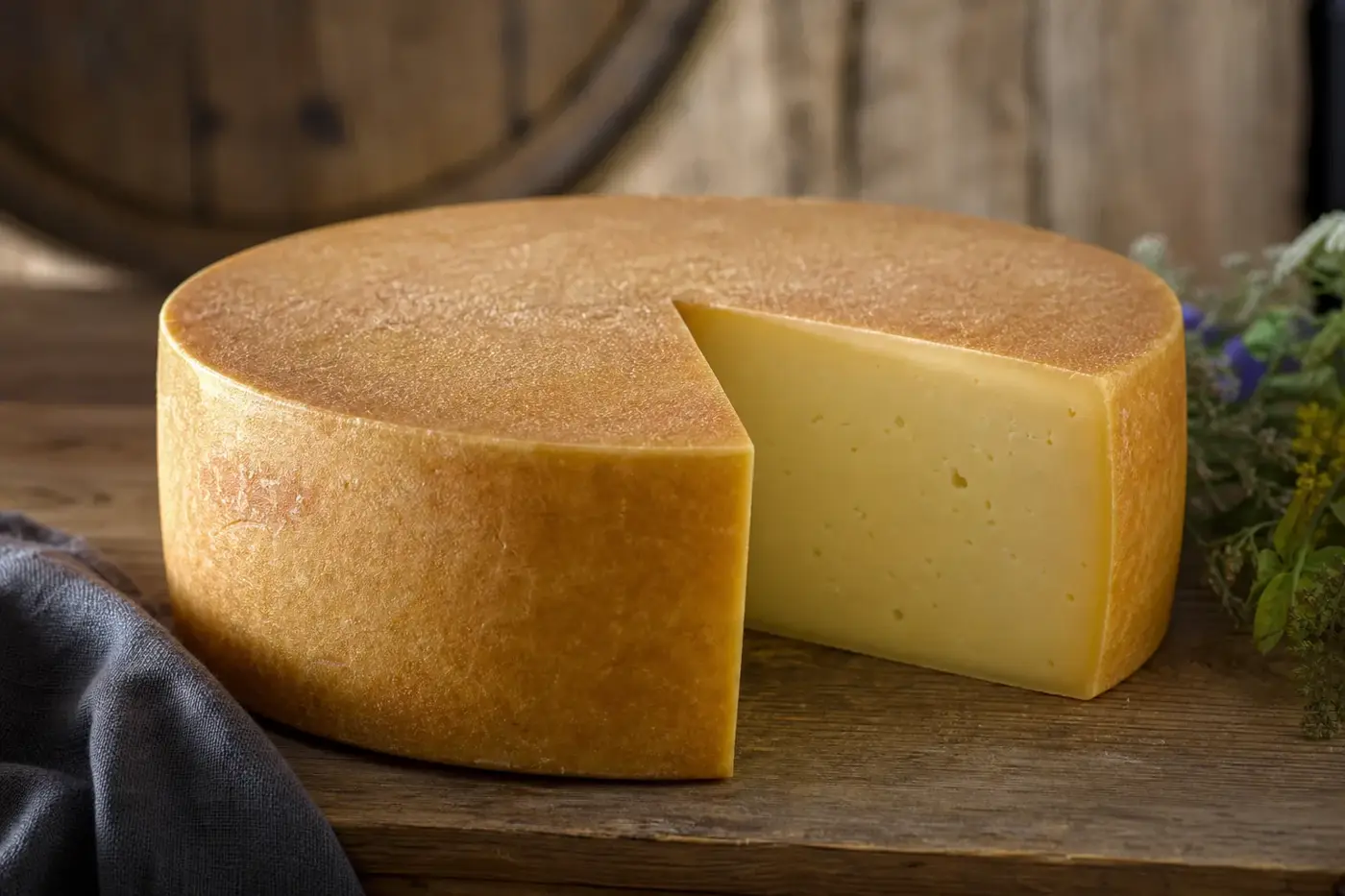
Your knife slips through Butterkäse, leaving a supple slice with a gentle flavour and buttery character.
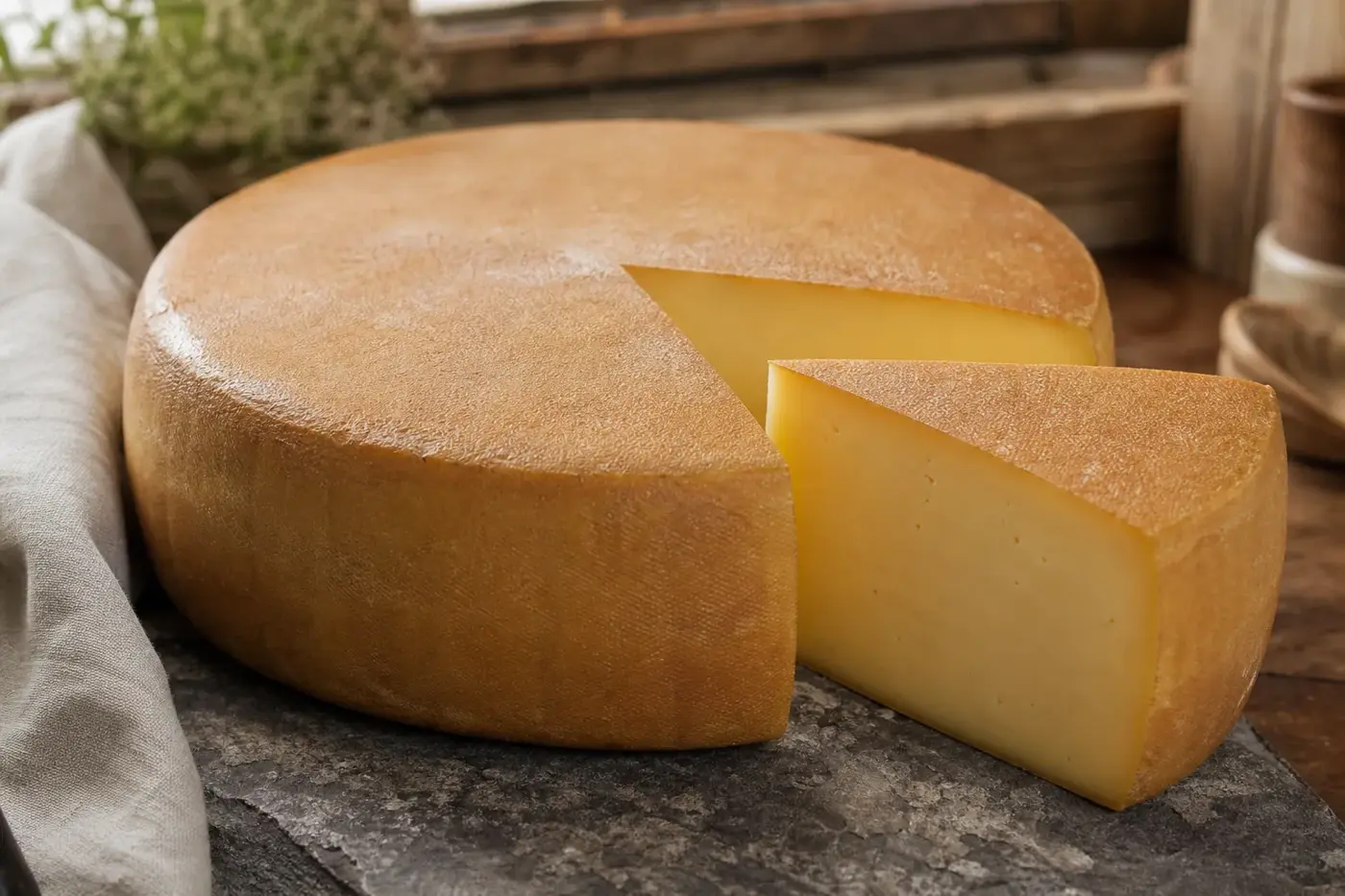
Your knife slips through Butterkäse, leaving a supple slice with a gentle flavour and buttery character. Its name means “butter cheese”, though there is no added butter behind the promise. Associated with Germany and also made elsewhere, including Austria, it is an easy companion for your sandwiches and everyday cooking.[1][2]
| Butterkäse at a glance | Your quick guide |
|---|---|
| Name to look for | Butterkäse.[1] |
| German legal category | Halbfester Schnittkäse, a semi-firm slicing cheese.[3] |
| Usual milk | Cow’s milk; the documented Austrian example uses pasteurised milk.[2] |
| Rennet in the cited products | Microbial rennet.[2][4] |
| A ripening example | Four weeks for Steirischer Butterkäse.[2] |
| German legal minimum ageing | Not specified in the Butterkäse standard.[3] |
| EU registered name, status and register ID | Not established here.[10] |
| Name protection in other jurisdictions | Not established here. |
Make time for the mild one
Butterkäse does not need to shout to earn your attention. The Hungarian Dairy Research Institute describes a buttery flavour, while the Austrian product record calls Steirischer Butterkäse mild and buttery, with a cream-like character.[1][2] Think gentle pleasure rather than a cheese that takes over the conversation.
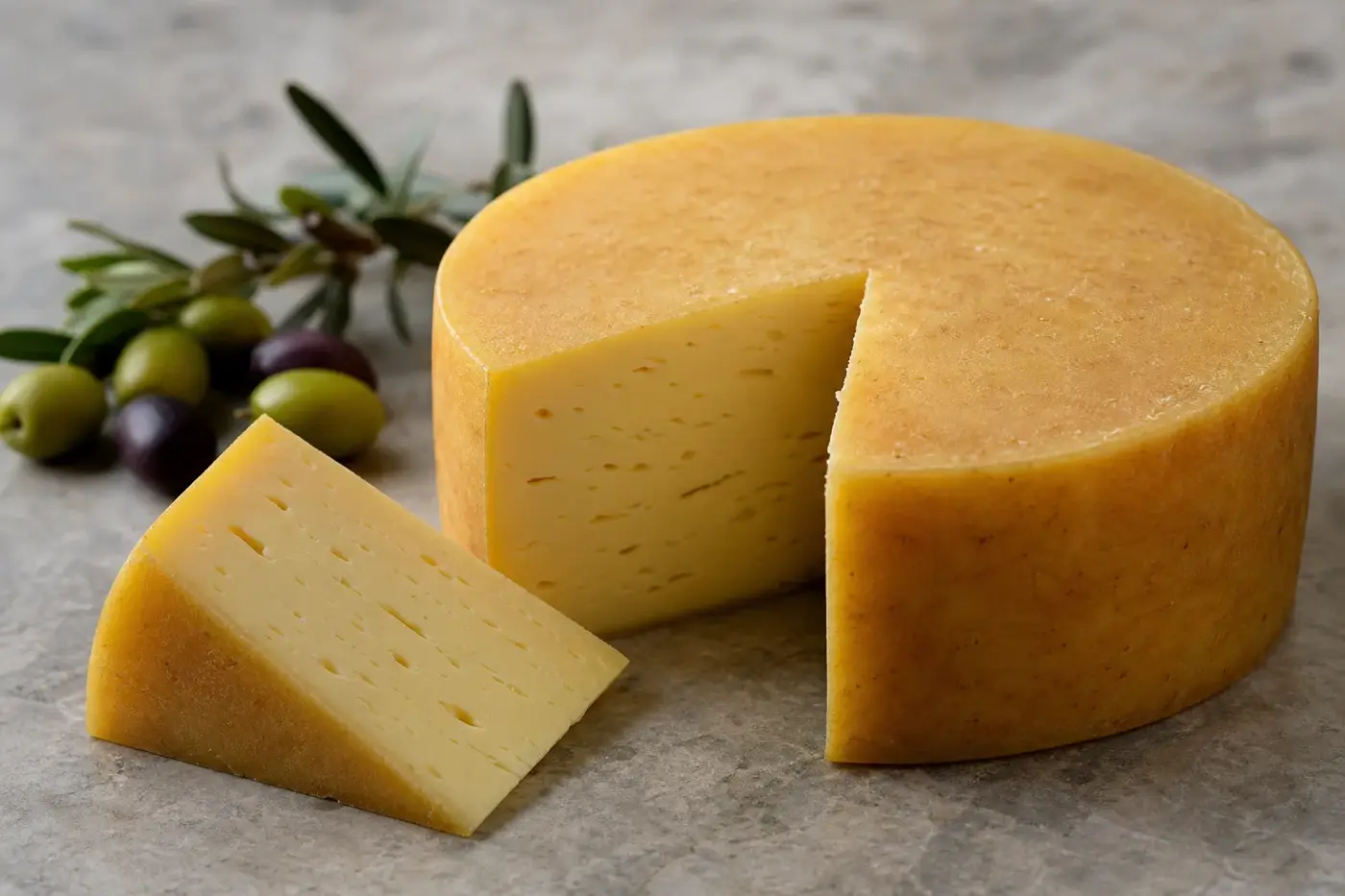
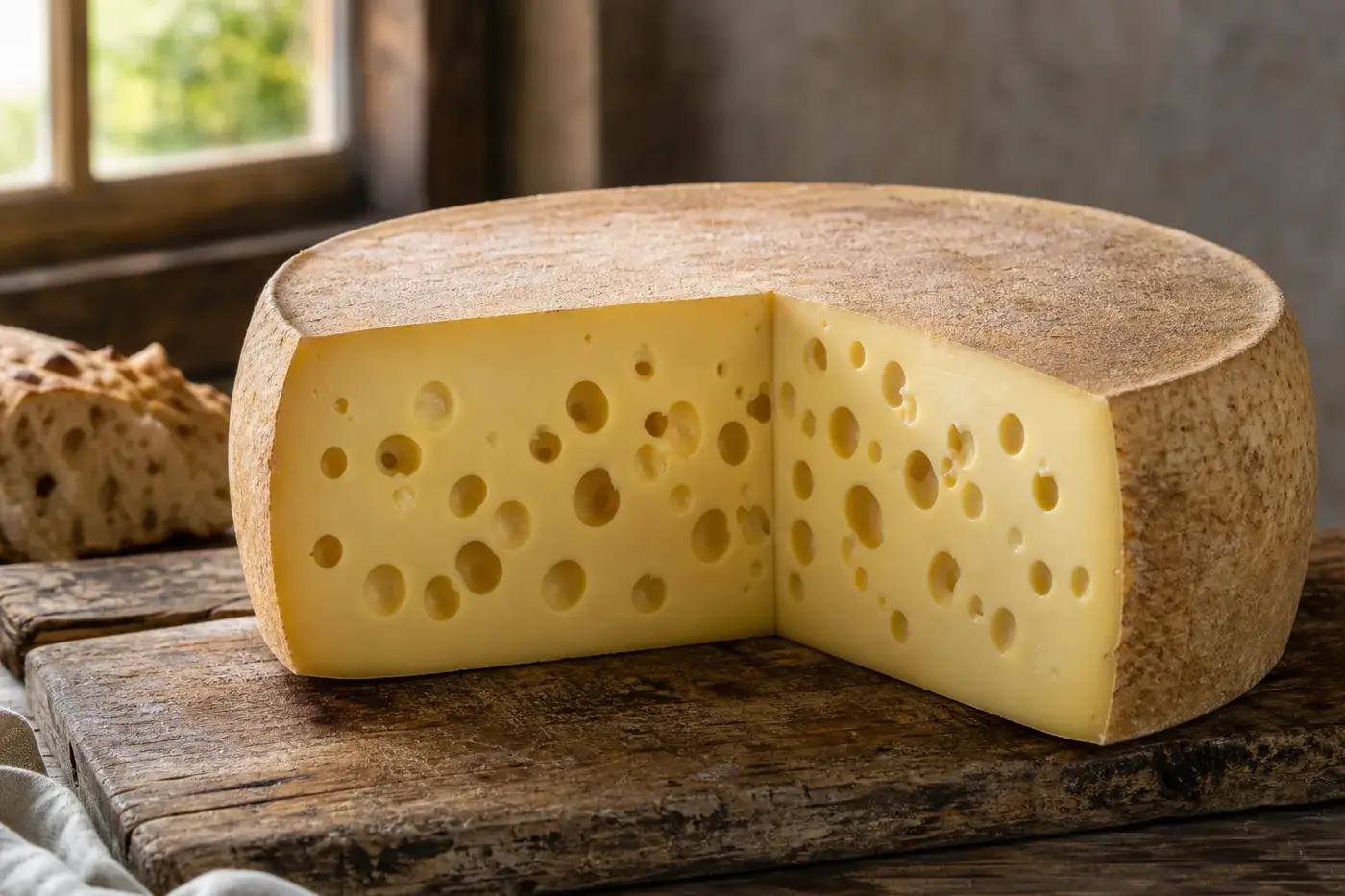
Inside, you find yellowish cheese, supple enough for neat slices. Outside, the picture changes: Bavaria’s food heritage record describes traditional Tölzer Butterkäse with a flexible yellow-brown to reddish skin, while the Austrian example is explicitly rindless. Both a wheel with a skin and a rindless block belong in this story.[2][5]
You may spot small openings in the cheese, although the Bavarian account says traditional Tölzer Butterkäse should ideally have none. There is no need to conduct a hole census at the cheese counter. Start with the maker’s description and the condition of the cut face.[5]
The shape offers another clue to the cheese you are buying. The Bavarian record describes a traditional wheel and a later elongated rectangular format; the Austrian record describes a block. Packaged slices are another familiar introduction to Butterkäse.[2][4][5]
The buttery promise, explained
That inviting name describes character, not a recipe for mixing cheese with butter. As the Hungarian Dairy Research Institute explains, Butterkäse takes its name from its buttery qualities rather than added butter.[1]
Jeden Tag’s published ingredients make the distinction plain: pasteurised cow’s milk, salt, acidifying cultures and microbial rennet. Butter does not appear in that list.[4] Your ingredient declaration is a better guide to the contents than a literal translation.
While you have the label in hand, look for milk treatment, coagulant and added ingredients too. Those details describe your particular cheese, not every Butterkäse on the shelf. Keep the current packaging nearby, and turn to how to read a cheese label if the terminology needs unpacking.
Step inside the cheese room
That supple slice begins with a sequence of work: milk preparation, acidification, coagulation, cutting, draining, shaping, salting and ripening. Equipment supplier Tetra Pak describes these shared stages for hard and semi-hard cheeses in its Dairy Processing Handbook. The precise handling depends on the individual Butterkäse recipe.[6]
Start with the cultures and rennet. Starter cultures are microorganisms added to guide acidification and development. Rennet is a preparation of enzymes that makes milk proteins form a network, trapping fat and water in a gel: the setting process called coagulation.[6]
When that gel is cut, it becomes curd grains. Curd is the concentrated material that becomes cheese; whey is the liquid released around it. Cutting encourages whey to leave, and the handling that follows helps establish the cheese’s eventual moisture and structure.[6]
How the curd is handled, and how much liquid stays behind, help shape the texture you meet in your slice.[6] That handling can vary between Butterkäse recipes. No single method tells the story of every version.
Ripening brings the next change. Enzymes act on proteins, while microbial and biochemical activity develops consistency and taste. Tetra Pak singles out protein breakdown as particularly influential in this transformation.[6]
For Steirischer Butterkäse, the product record gives you a useful timescale: four weeks of ripening.[2] That is one producer’s example, not a timetable for the whole style. Follow the broader journey in how cheese is made.
Follow the wheel back to Bavaria
The story of the original Tölzer Butterkäse takes you to Upper Bavaria’s Bad Tölz-Wolfratshausen district. Until 1972, the Alpenländische Molkerei made it there. Bavaria’s official food heritage account preserves that part of its history.[5]
The original cheese was made from raw milk and shaped into wheels. The account distinguishes it from the later Butterkäse Tölzer Art, an industrially produced cheese formed in an elongated mould and ripened in film. Its recipe was related to the earlier version, but not identical.[5]
The exact original recipe has not survived. In discussing its reconstruction, the Bavarian record refers to the Italian cheese Bel Paese.[5] It is worth keeping the distinction clear: a recorded Bavarian product is one thing, a reconstructed recipe another.
Butterkäse’s history is therefore a story of changing recipes as well as changing shapes. A traditional regional wheel and a modern sliced product show you different chapters. Neither format can tell you everything about the cheese on its own.
Read the rules behind the gentle name
Butterkäse has a legal framework as well as a buttery reputation. For November 2026, Germany’s applicable statutory provisions are in the Milchproduktqualitätsverordnung, § 32 and Annex 4, Section A. The regulation entered into force on 14 June 2026.[3]
The standard sets minimum dry matter in the whole cheese at 48% for Vollfettstufe, 50% for Rahmstufe and 55% for Doppelrahmstufe. These figures mean dry matter, not fat in dry matter. The entry describes Butterkäse as mild, delicately acidic and evenly ripened throughout.[3]
A statutory product standard is separate from geographical name protection. If you want a clearer route through the language of protected names, start with PDO, PGI and TSG explained.
Butterkäse, Gouda, Tilsit or Edam?
You might reach for Butterkäse, Gouda, Tilsit or Edam for similar jobs in a sandwich or on a board. German law nevertheless distinguishes them. These are their German statutory categories and minimum ages for November 2026.[3]
| Cheese | German legal category | Minimum ageing required |
|---|---|---|
| Butterkäse | Halbfester Schnittkäse | None specified |
| Gouda | Schnittkäse | Five weeks |
| Tilsiter | Schnittkäse | Five weeks |
| Edamer | Schnittkäse | Five weeks |
When swapping one for another, start with what you want from the finished dish. Compare the maker’s description of texture and flavour, then consider the cheese’s age. Sharing a place in your sandwich does not make these cheeses identical.
For a closer look at a neighbouring style, explore Gouda. Choose your replacement for its own flavour and texture. An exact impersonation is rather a lot to ask of a slice of cheese.
Give mild flavours room on your board
Start with plain bread, an unsalted cracker or a slice of apple. This gives Butterkäse a quiet setting before you introduce sharper accompaniments. It suits a cheese whose published descriptions emphasise mildness and buttery character.[1][2]
Next, try a little mustard, a pickle or a spoonful of fruit preserve. Keep each beside the cheese rather than combining everything at once. You can find your own balance and notice what Butterkäse contributes before the accompaniments take over.
On a mixed board, cut modest slices rather than piling up cubes. Set Butterkäse beside cheeses with contrasting textures, and taste it early in the sequence. These serving and cooking ideas are suggestions, not a recorded tasting or independently tested recipes.
Put out only what you expect to eat. For England, Northern Ireland and Wales, the Food Standards Agency advises keeping chilled food out of refrigeration for the shortest possible time, with a maximum of four hours during preparation. That is a preparation limit, not a recommendation to display cheese for four hours; in hotter weather, its guidance says to avoid leaving food out longer than two hours.[7][8]
Start with a sandwich, then warm things up
For your first sandwich, try Butterkäse with cucumber and a thin layer of mustard. Roasted vegetables and a few leaves give you another combination to explore. Go gently with strongly flavoured additions, then adjust until the balance suits you.
Slices make portioning straightforward. Fold them to fit your bread rather than building a thick mound in the centre, and spread the other ingredients evenly. You get a more balanced mouthful and a filling that is easier to manage.
At the cooker, try Butterkäse in a toasted sandwich, over cooked potatoes or as part of a vegetable bake. Start with a small quantity when adapting a familiar dish. This is especially useful when replacing a cheese you originally chose for its pronounced flavour.
You can bring another cheese into the dish, too. Decide what you want each to contribute: gentle dairy flavour, a stronger savoury note or a particular texture. Taste before adding more salt, and follow a reliable recipe for cooking and handling instructions.
Choose your piece, then keep the label
Let your plans guide the shape you buy. Slices are convenient for sandwiches, while a piece cut from a block lets you choose the thickness. A wheel or a piece with a skin gives you a different presentation from the rindless products documented here.[2][4][5]
Look for milk treatment and coagulant on the individual product. The Austrian record specifies pasteurised cow’s milk and microbial rennet; Jeden Tag’s ingredient declaration lists pasteurised cow’s milk and microbial rennet too.[2][4] Let your label answer those questions rather than relying on the name.
At a counter, ask to see the original label or product information. You need three practical answers: how should you store it, what instructions apply after opening or cutting, and does the outside need removing? Ask before your piece disappears into its wrapping.
Jeden Tag cautions that its online information can differ from the packaging.[4] Keep the current label, or photograph the storage instructions before discarding the outer wrapper. The important directions then stay with your cheese, whatever happens to the packaging.
Keep your cheese chilled and mind the dates
Keep dairy products refrigerated, with your fridge between 0 and 5 °C, and follow the packaging’s storage instructions. This is the FSA’s published guidance for England, Northern Ireland and Wales as at November 2026.[7] Follow the label for instructions specific to your product.
After opening the pack, follow any stated time limit and instructions for closing it. Take what you need, then return the rest to refrigeration promptly. For more on packaging and organisation, see storing cheese at home.
Read the date wording carefully, because the distinction matters. Official UK guidance says use-by dates concern safety, while best-before dates concern quality. Do not eat refrigerated cheese after its use-by date, and remember that correct storage matters before that date too.[9]
If unexpected mould appears, consult current advice from the food safety authority where you live. The FSA’s cheese recovery guidance concerns controlled handling of contaminated cheese. It does not replace consumer advice on what you should do at home.[11]
A dry cut edge can make a slice less appealing, but appearance alone cannot establish safety. Consider the date, storage history and condition together. For the distinction between intended cheese mould and unwanted growth, read when to cut mould away and when to bin cheese.
General information only, not medical advice: follow the official guidance where you live.
Questions people ask
What does Butterkäse taste like?
Butterkäse is described as buttery. The Steirischer example is also described as mild, with a cream like character.
Does Butterkäse contain added butter?
The name means butter cheese, but refers to its buttery qualities rather than added butter. Jeden Tag’s published ingredient list contains no butter.
Is Butterkäse made with animal rennet?
The cited Steirischer Butterkäse and Jeden Tag products use microbial rennet. Check the coagulant on the label of the individual cheese.
Is Butterkäse made with pasteurised milk?
The documented Steirischer Butterkäse and Jeden Tag products use pasteurised cow’s milk. Milk treatment belongs to the particular cheese, so check its label.
How should Butterkäse be stored?
For England, Northern Ireland and Wales, the Food Standards Agency advises keeping dairy products refrigerated at between 0 and 5 °C and following the packaging’s storage instructions. Check the Food Standards Agency’s current guidance.
Sources
- Hungarian Dairy Research Institute, Butterkäse, published 2023, updated 2024. Source.
- AMA Käseproduzenten, Steirischer Butterkäse: Käse-Taufschein, undated product record, accessed November 2026. Producer information for Obersteirische Molkerei eGen. Source.
- German Federal Ministry of Justice and Federal Office of Justice, Verordnung über Qualitätsanforderungen an Milchprodukte (Milchproduktqualitätsverordnung, MilchPQV), 24 November 2025, official consolidated text accessed November 2026, particularly § 32 and Annex 4, Section A. Source.
- Jeden Tag, Jeden Tag Butterkäse 45% Scheiben 400g o.GT, undated product declaration, accessed November 2026. Commercial product information supplied by the brand. Source.
- Bavarian State Ministry’s GenussErbe Bayern project, Tölzer Butterkäse, undated heritage record, accessed November 2026. Source.
- Tetra Pak, Dairy Processing Handbook: Cheese, online edition accessed November 2026, sections on hard and semi-hard cheese production and ripening. Technical reference published by a dairy-equipment supplier. Source.
- Food Standards Agency, How to chill, freeze and defrost food safely, 2017, current page accessed November 2026. Applies to England, Northern Ireland and Wales. Source.
- Food Standards Agency, Food safety in a heatwave, advice for consumers, 2024, accessed November 2026. Applies to England, Northern Ireland and Wales. Source.
- GOV.UK, Understanding food labelling: Best before and use-by dates, current guidance accessed November 2026. Source.
- European Commission, eAmbrosia geographical indications register, accessed November 2026. The interface returned no readable register results during this research; protection status remains unverified. Register.
- Food Standards Agency, Cheese recovery guidance, current PDF accessed November 2026. Guidance on unintended mould contamination and recovery of cheese. Source.
Researched through German legislation, official Bavarian heritage documentation, published product declarations, a dairy technical reference and official food-handling guidance.
Last checked: November 2026
Last checked November 2026.
The editors suggest you read next
Allgäuer Emmentaler
Two Swiss dairymen arrive in Weiler in 1821, carrying cheesemaking knowledge into the western Allgäu.