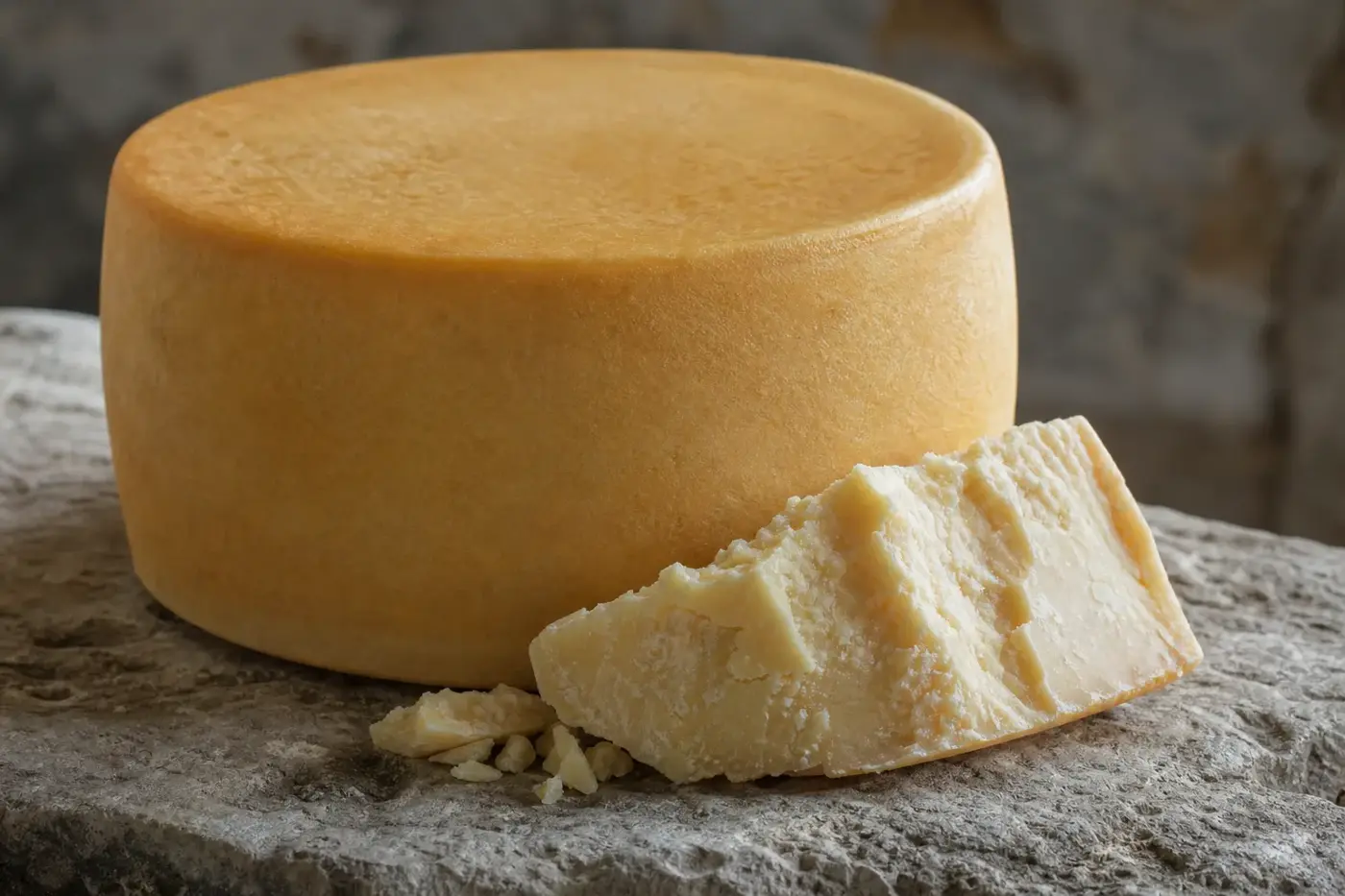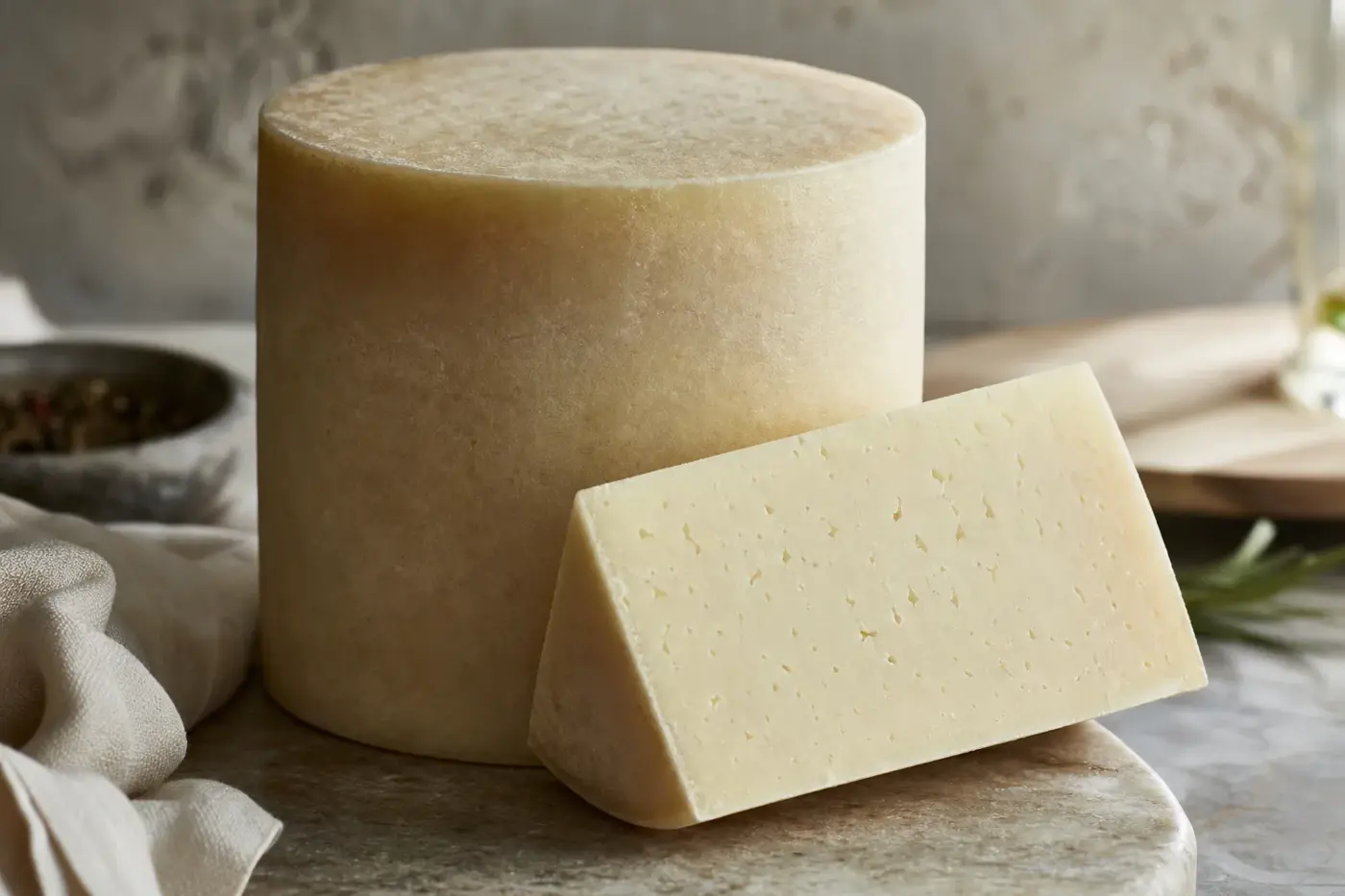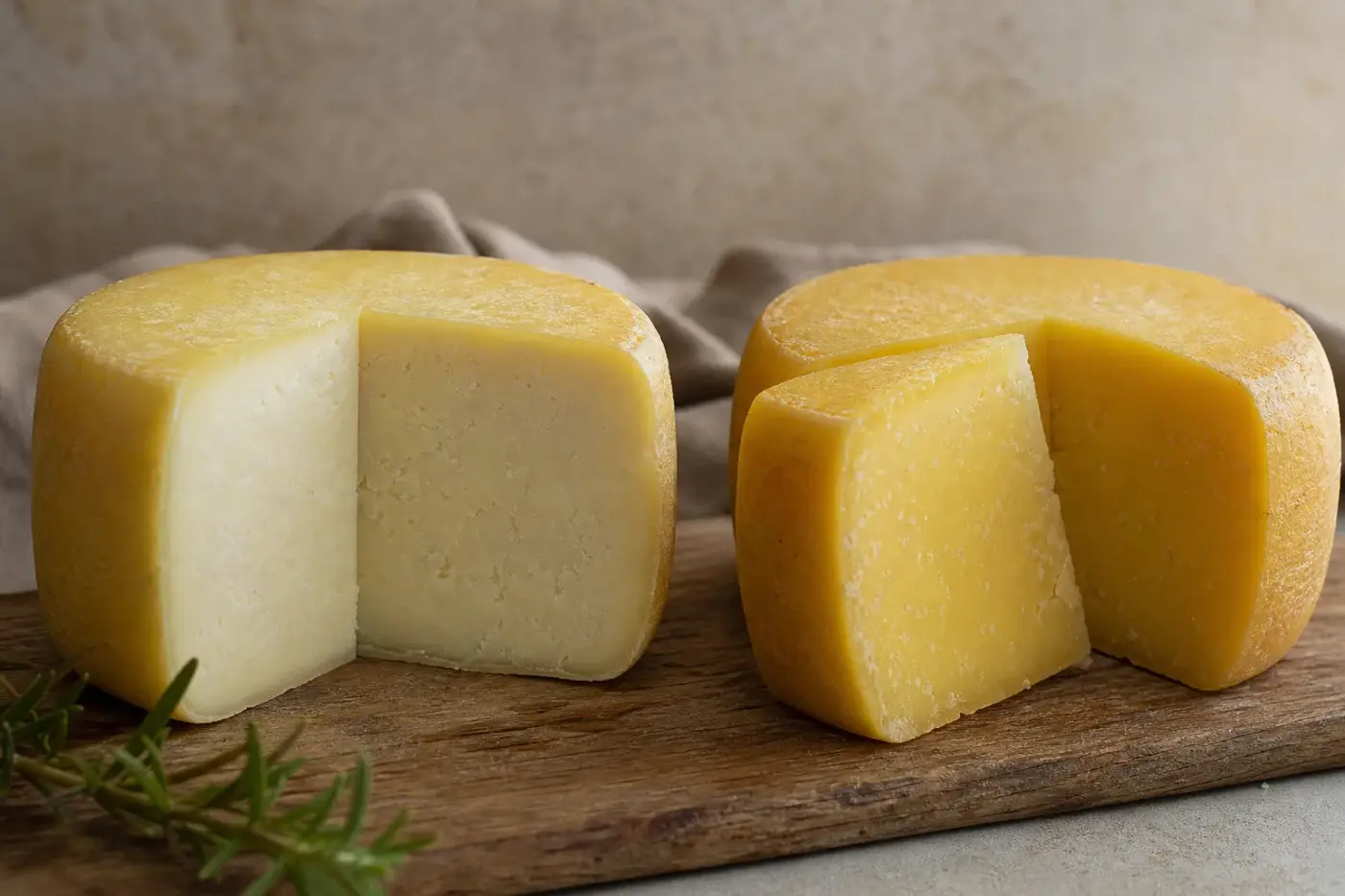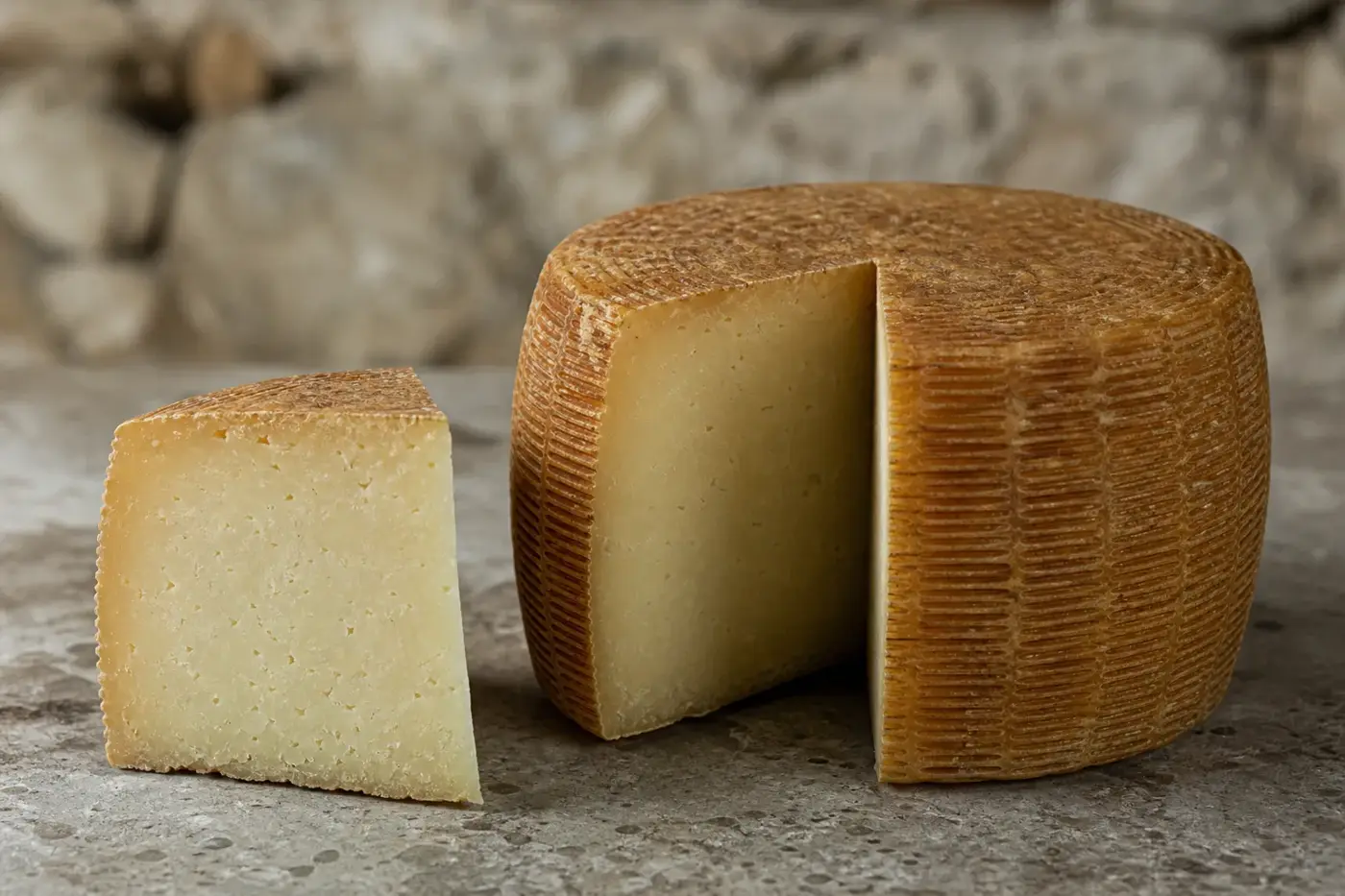
Before you reach for the knife, look at the rind. Across a wedge of Canestrato Pugliese runs the weave of a rush basket: the mark of a working tool, not a cheesemaker getting artistic. Beneath it sits firm, compact sheep’s milk cheese from Puglia, ready for your cheeseboard or grater. The region’s pastoral traditions run through its name and making, and it carries an EU protected designation of origin, or PDO.[1][2][4]
| At a glance | What to know |
|---|---|
| Name to look for | Canestrato Pugliese.[1] |
| EU registration authority | European Commission, eAmbrosia.[3] |
| EU protection | PDO, identified by Regione Puglia; live register status: unconfirmed.[1][3] |
| Where it is made and matured | Province of Foggia and specified municipalities historically listed under the province of Bari.[1][2] |
| Milk in the making | Exclusively whole sheep’s milk.[1][2] |
| Coagulant | Animal rennet in the available specification text.[2] |
| Size of a wheel | Cylindrical, generally 7 to 14 kg.[1] |
| Rind and centre | Hard, thick, basket-marked rind; compact, friable, straw-coloured interior.[1] |
| Technical detail | Minimum 38% fat in dry matter in the available specification text.[2] |
| Information date | November 2026. |
Read the basket’s imprint
The name begins with the canestro, the basket used to shape the cheese. Slow Food describes traditional rush baskets leaving their woven impressions on the rind. What you see is a trace of the making, rather than decoration added afterwards.[4]
Regione Puglia describes pressing the cheese in these moulds to create that characteristic roughness. Choose a wedge with some rind attached and follow the textured outside round to the compact cut face. You have met two of its defining features before taking a bite.[1]
At the counter, ask for the full name, Canestrato Pugliese: “canestrato” alone does not identify it. Keep the label or counter ticket if you hope to find the same cheese again. For the difference between a regional designation and a general description, see protected names explained.
Get to know the land behind the milk
The historical specification reproduction places production in the province of Foggia and specified municipalities listed under the province of Bari. The current authorised areas for milk production, cheesemaking and maturation remain uncertain.[2]
To understand the landscape’s part in this cheese, start with what the sheep eat. Regione Puglia says their feed includes green or conserved forage from the area’s natural pastures. Hay supplements it, with simple concentrated feeds used exceptionally.[1]
Those pastures are more than a handsome backdrop: local forage belongs to the production description. Ask your cheesemonger about the milk supply and season of manufacture. These details help you get to know a particular cheese, because a regional name cannot tell you how every flock is managed.
Travel with the flocks from Abruzzo to Puglia
Canestrato Pugliese’s history follows sheep between seasonal grazing grounds, a practice known as transhumance. Slow Food connects the cheese with this movement and says the associated traditions remained substantially unchanged until the 1950s. Its account gives no date for the cheese’s first production.[4]
Fondazione Qualivita links earlier cheesemaking to winter and spring, when flocks travelled from Abruzzo into Puglia. It records a historical production season running from December to May. The available specification, however, allows production throughout the year.[2][5]
Keep that distinction in mind when you choose your wedge. Seasonal grazing tells you about the cheese’s background; the manufacture date tells you when your piece was made. To explore season and age, ask for that date or the stated maturation period.
See how milk takes its basket shape
The historical specification reproduction starts with whole sheep’s milk from one or two daily milkings. It describes coagulation at 38 to 45 °C using animal rennet, followed by pressing in suitable basket moulds. Its standing as the current operative specification remains uncertain.[2]
Qualivita brings you closer to the curd: it is broken into rice-sized granules, gathered into baskets and pressed. That gives you a picture of the work involved; the applicable specification remains the reference for production requirements.[5] For the stages of curd formation and whey drainage, explore how cheese is made.
Salting can be dry or in brine. In the available specification, it begins two to four days after preparation, with repeated applications during the initial working period while the cheese stays in its basket. The wheels then move to cool, lightly ventilated rooms to mature.[2]
If you avoid animal-derived coagulants, pause at the animal rennet. Ask about the named product rather than making assumptions about sheep’s milk cheese in general. The guide to rennet explained covers animal, microbial and fermentation-produced versions.
Taste what time brings to the wedge
Cut through the hard, thick rind and you reach a compact interior with a little crumble. Regione Puglia describes a brown rind tending towards yellow, treated with olive oil, sometimes mixed with wine vinegar. Inside, the paste is only slightly elastic, with barely visible small openings and a straw colour that varies in intensity as it matures.[1]
Age changes the flavour, too. Qualivita describes younger Canestrato Pugliese as more delicate and lightly savoury. Mature cheese brings a fragrant aroma and a more assertive character.[5]
Let your plans for eating it guide your choice. Try a younger piece in slices with simple accompaniments, or a mature piece when you want a more pronounced finishing ingredient. If tasting is available, compare two ages from the same maker: you can follow maturation without changing everything else.
Make the cheese counter work for you
The wheel has flat faces and a slightly convex side in the available specification. Its diameter is 25 to 34 cm and its height 10 to 14 cm, with dimensional variation allowed according to production conditions.[2] At the counter, you are more likely to make its acquaintance as a cut wedge.
Ask three questions: who made it, how long did it mature, and when was this piece cut? Request an age in months where available, rather than settling for “young” or “mature”. Tell the cheesemonger whether you want pieces for serving or cheese for grating.
Look for the published characteristics: a basket-marked rind and compact interior, rather than a springy cheese with an open texture.[1] Choose a piece whose cut face you can inspect, and keep its handling instructions. For the details worth holding on to, see reading a cheese label.
Give your cheeseboard a little breathing room
Taste the cheese alone first. For younger Canestrato Pugliese, Qualivita records broad beans, pears and raw vegetables as accompaniments.[5] They give you a more revealing starting point than several strongly seasoned preserves, each convinced it is the main attraction.
Keep serving simple: small pieces, a plain plate, bread and one of those accompaniments. Leave some rind attached so you can still see the basket pattern. Before eating the rind, ask the seller whether that particular product’s rind is intended to be eaten.
Serving advice is one thing; chilled-food guidance is another. For current advice in England, Wales and Northern Ireland, consult the Food Standards Agency guidance.[6]
Put your grater to good use
Orecchiette and capunti are among the pastas Slow Food records with grated Canestrato Pugliese. Its account also puts the cheese in braised artichokes, lampascioni and lamb rolls. If lampascioni are new to you, they are edible bulbs used in southern Italian cooking.[4]
To get to know a mature piece as a finishing ingredient, grate a little over one portion. Taste before adding more. You can judge that particular cheese before committing the whole pan.
Keep some of the same purchase in recognisable pieces for your cheeseboard, then grate some over pasta close to serving. That gives you two ways to taste it, without buying a second cheese. Not that cheese lovers generally need much encouragement on that front.
Pour a simple partner for your cheese
For younger Canestrato Pugliese, Qualivita recommends dry, still white wines or rosés.[5] Taste the cheese, follow it with a small sip, and decide whether you enjoy the combination. Your own palate deserves a say.
Wine suggestions are for adults of legal drinking age, with small servings. Give alcohol-free choices equal consideration: try plain sparkling water alongside pear or bread. Simple accompaniments bring your attention back to the cheese; for broader pairing ideas, read cheese and wine pairing.
Meet its Italian sheep’s milk neighbours
If you know Pecorino Romano, you have a useful culinary reference for a forceful sheep’s milk cheese. Its consortium describes it as aromatic, intense and piquant, with character that changes through maturation.[8] Canestrato Pugliese and Pecorino Romano are nevertheless distinct regional products, each with its own name.
Pecorino Toscano gives you another comparison. Its consortium describes the fresh version as soft, sweet and milky, while the mature version is semi-hard, with more developed dried-fruit and hay aromas.[9][10] Set those descriptions beside Canestrato Pugliese’s compact, friable texture.[1]
Making a substitution in a recipe? Compare the actual pieces before deciding how much to use, then taste, grate and season incrementally. For serving, begin with texture: do you want a soft slice, a firm wedge or a crumbly finishing cheese?
Keep your wedge well, and know when to stop
Follow the product’s storage and after-opening instructions. For England, Wales and Northern Ireland, FSA guidance recommends a domestic fridge between 0 and 5 °C and refrigerating dairy products. Keep your cheese protected and separate from raw foods.[6]
Read the dates carefully: they serve different purposes. UK government labelling guidance distinguishes use-by dates, which concern safety, from best-before dates, which concern quality. Observe any use-by date and its attached storage conditions, because incorrect storage can make food unsafe before that date.[11]
For cheese carrying a best-before date, official guidance allows sensory checks to assess quality, including looking for mould and noticing souring in dairy products.[11] Unexpected growth or an unfamiliar smell calls for caution, not an experimental taste. Discard the piece if you have a safety concern, and follow any recall notice affecting its batch.
For wrapping and refrigerated storage, turn to storing cheese at home. Keep the original product information until you have finished the cheese, especially with a prepacked portion.
General information only, not medical advice: follow the official guidance where you live.
Questions people ask
What milk is Canestrato Pugliese made from?
It is made exclusively from whole sheep’s milk. The historical specification describes using milk from one or two daily milkings.
Is Canestrato Pugliese vegetarian?
The retrieved specification describes the use of animal rennet. Ask about the named product if you avoid animal rennet.
What does Canestrato Pugliese taste like?
Qualivita describes younger cheese as delicate and lightly savoury. Mature cheese has a fragrant aroma and a more assertive character.
How is Canestrato Pugliese served?
Younger cheese can be served with broad beans, pears or raw vegetables. Slow Food records it grated over orecchiette and capunti, as well as used in dishes including braised artichokes and lamb rolls.
How should I store Canestrato Pugliese?
Follow the product’s storage and after opening instructions. For England, Wales and Northern Ireland, the Food Standards Agency recommends refrigerating dairy products and keeping a domestic fridge between 0 and 5 °C.
Sources
- Regione Puglia. Canestrato Pugliese DOP, published 25 May 2022. Regional description of production, feeding, territory, maturation and sensory characteristics. Official regional page.
- Italian production specification, reproduced by ONAF. Disciplinare di produzione della Denominazione di origine del formaggio “Canestrato pugliese”, referring to DPR 10 September 1985, GURI No. 112 of 16 May 1986. Undated reproduction, displaying a 2010 print date. This is the retrieved historical specification text; its equivalence to the current official version requires verification. Retrieved specification.
- European Commission. eAmbrosia: Canestrato Pugliese, entry destination EUGI00000012986. The destination opened, but its substantive register fields were not exposed by the research interface. Official register destination.
- Fondazione Slow Food. Canestrato Pugliese, Ark of Taste record, undated. Used for its attributed traditional account, basket-name explanation and documented culinary uses. Published record.
- Fondazione Qualivita. Canestrato Pugliese DOP, Qualigeo record, undated. Used for attributed age-related descriptions, historical account and serving suggestions, not as controlling legal evidence. Published record.
- Food Standards Agency. How to chill, freeze and defrost food safely, published 18 December 2017, retrieved November 2026. Applies to England, Northern Ireland and Wales. Official guidance.
- UK government. Food safety in a heatwave: advice for consumers, current retrieved edition, November 2026. Official guidance.
- Consorzio per la Tutela del Formaggio Pecorino Romano. Official website, undated product description, retrieved November 2026. Industry-body description of aroma, intensity and piquancy. Consortium website.
- Consorzio Tutela Pecorino Toscano DOP. Pecorino Toscano DOP Fresco, undated, retrieved November 2026. Consortium description.
- Consorzio Tutela Pecorino Toscano DOP. Pecorino Toscano DOP Stagionato, undated, retrieved November 2026. Consortium description.
- UK government. Understanding food labelling: Best before and use-by dates, current retrieved edition, November 2026. Official guidance.
Researched through regional institutional material, a retrieved specification reproduction, attributed food-tradition records, cheese consortia and official food-handling guidance.
Last checked: November 2026
Last checked November 2026.
The editors suggest you read next
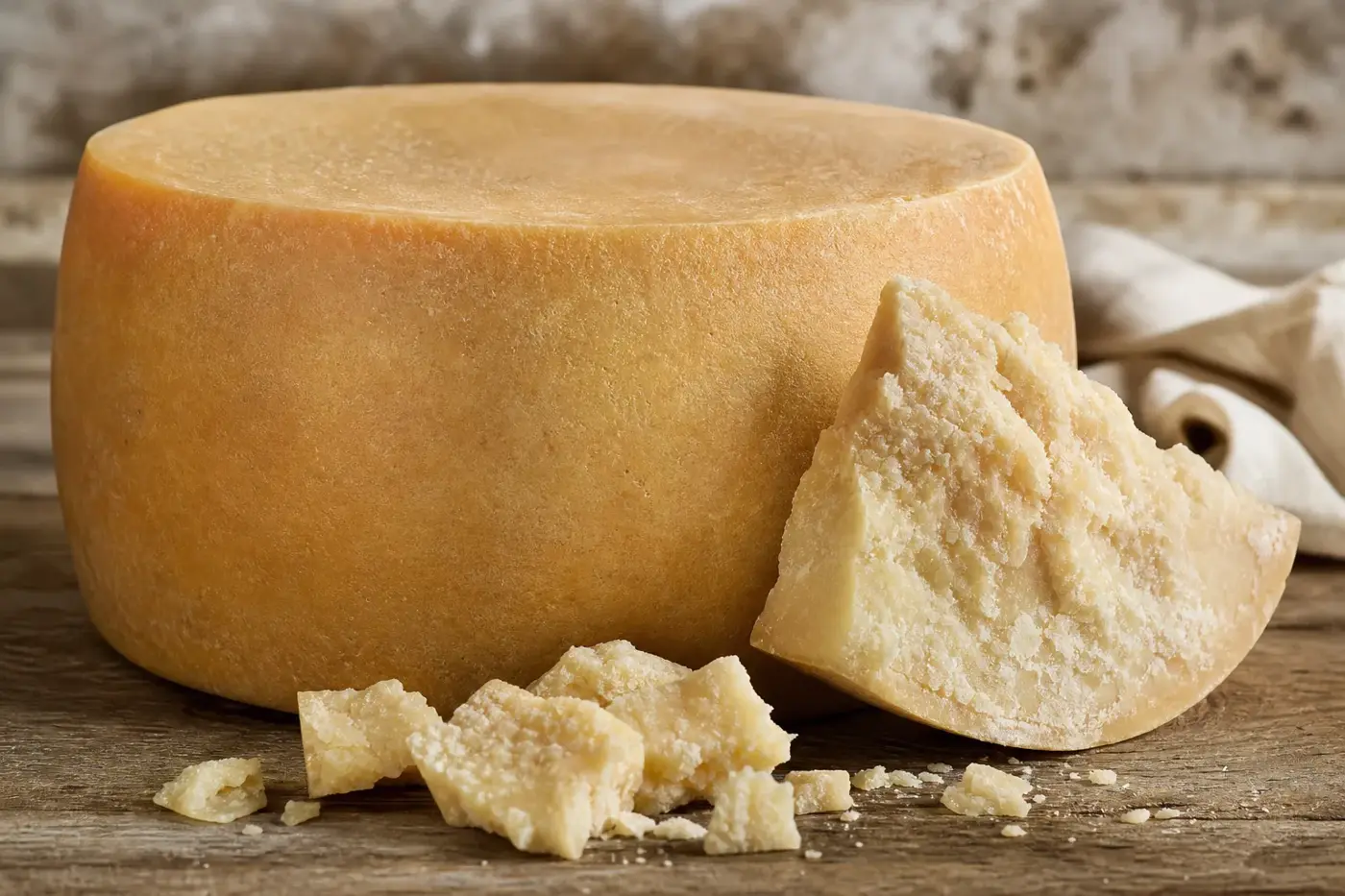
Parmigiano Reggiano
Break into a wheel of Parmigiano Reggiano and flakes fall away, revealing a finely granular cheese, pale straw to straw in colour.