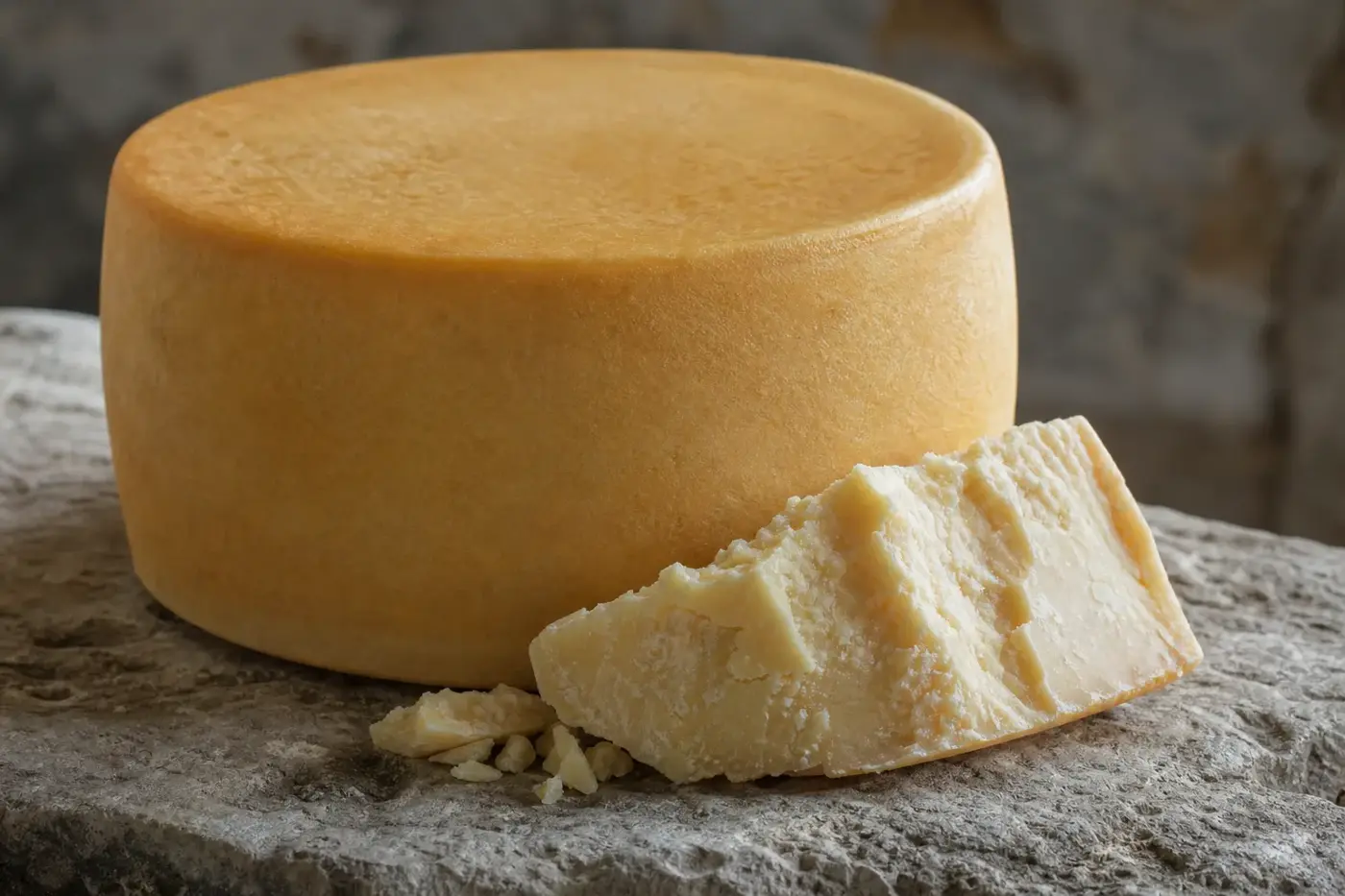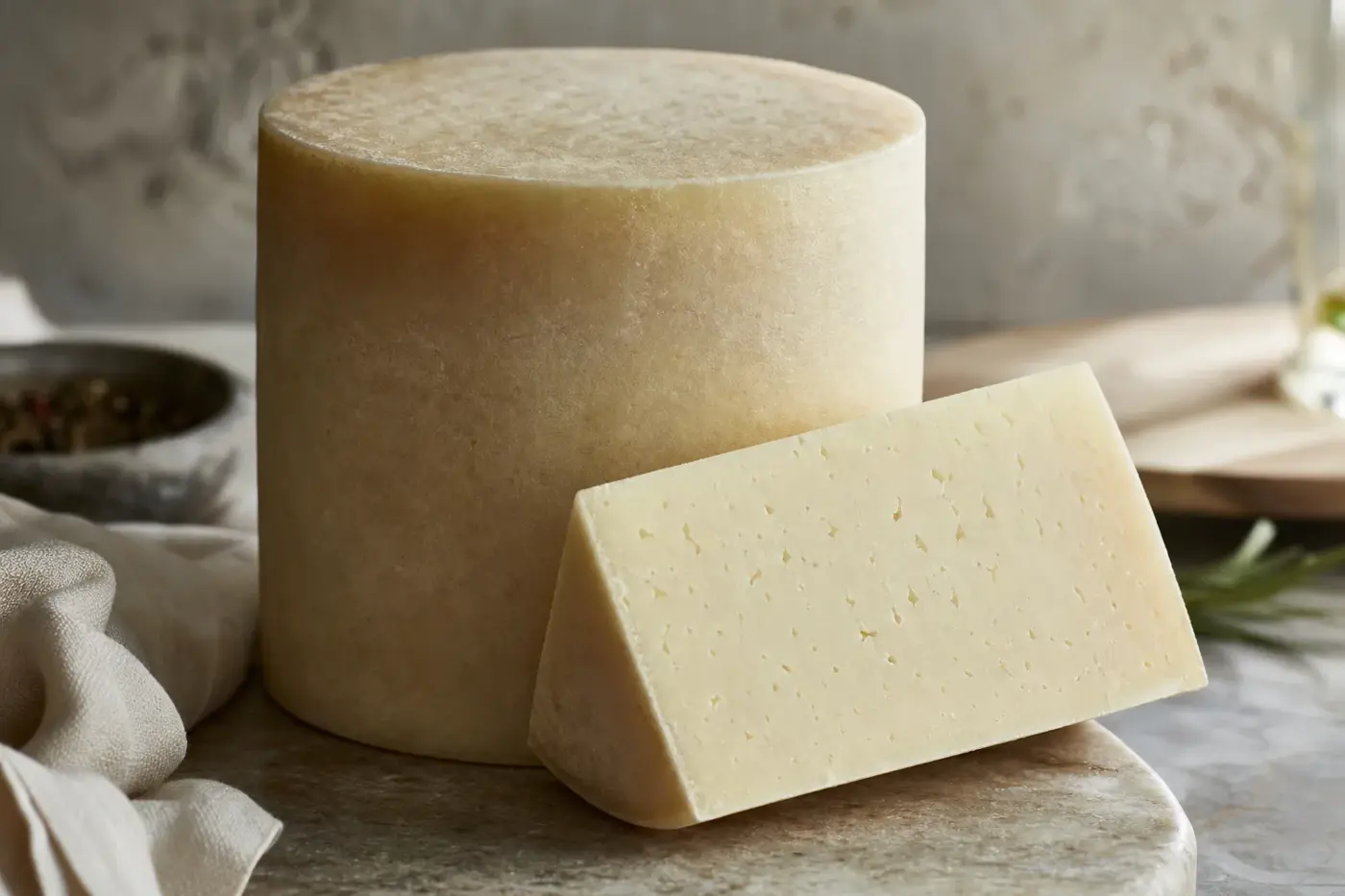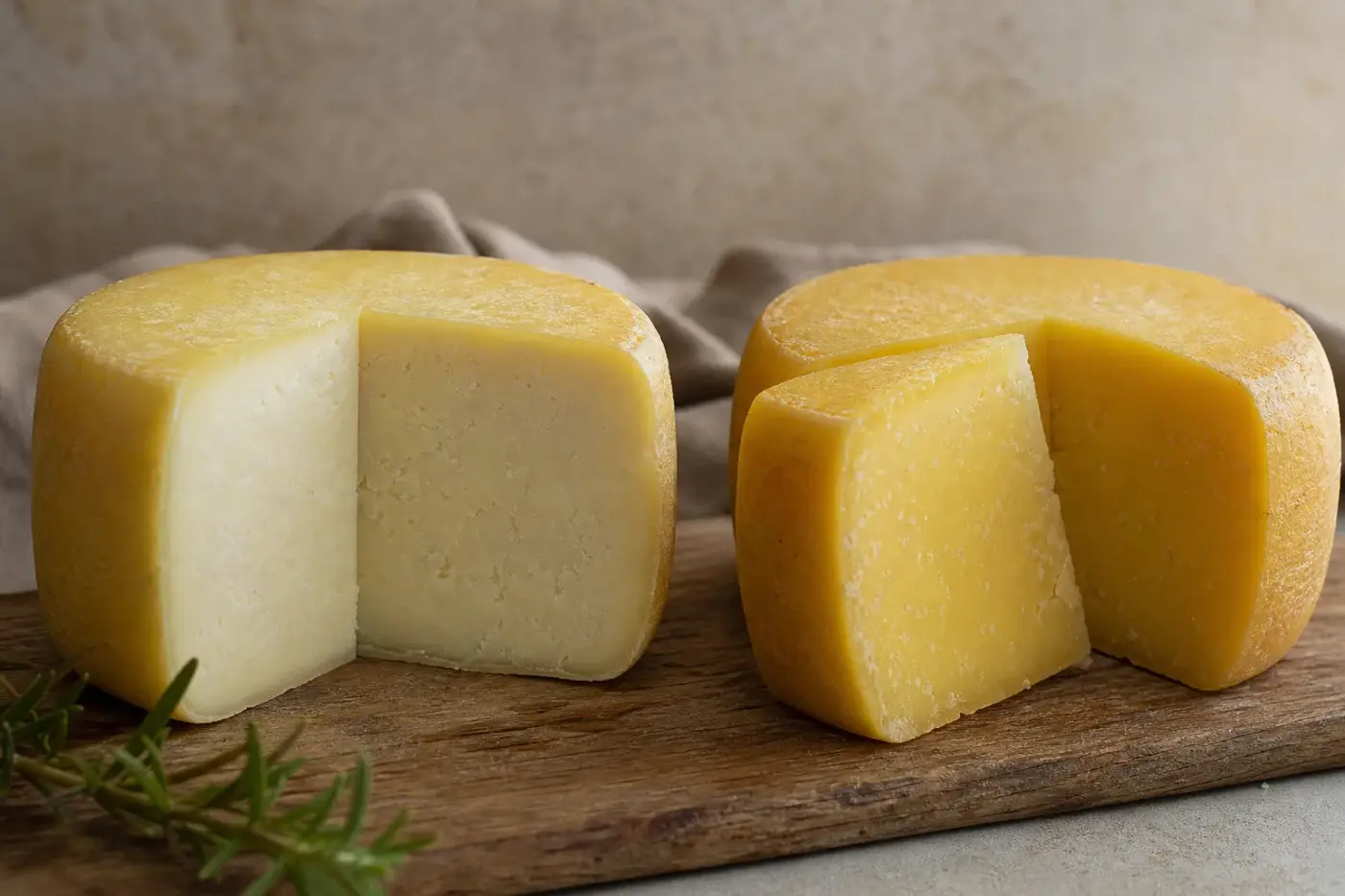
The curd has drained. In Piedmont’s Grana Valley, you might expect the cheesemaker to reach for a mould. Instead, the curd goes back under whey for several days, then gets broken up again before salting and pressing. Castelmagno takes the scenic route to becoming a wheel: a mountain cheese with PDO status in the European Union and Great Britain. [1,2]
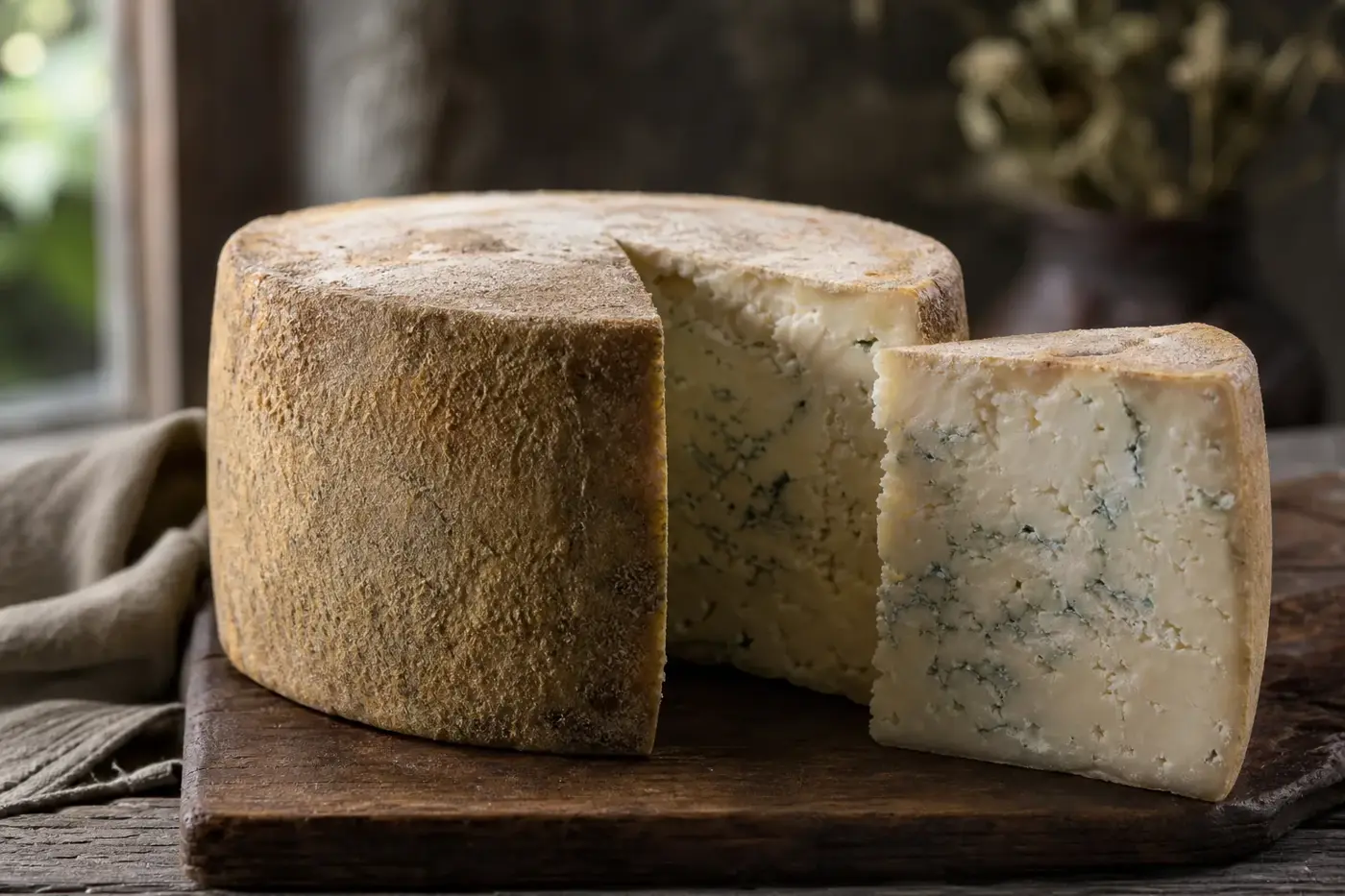
Cut into it and you may find a pale, crumbly interior, with blue-green veins appearing as it ages. Those veins are only part of its character. To get to know this cheese, follow it back to the mountains and the hands that make it. [1,3,4]
| What to know | The details |
|---|---|
| Familiar and registered name | Castelmagno. [1,2] |
| Registration authority and ID | EU register entry and record ID: Not specified here. |
| EU designation | Protected Designation of Origin (PDO), recorded in the Italian ministry’s specification; November 2026. [1] |
| EU registration instrument | Regulation (EC) No 1263/96, as recorded by Regione Piemonte. [3] |
| Great Britain status | Registered PDO; scheme registration 31 December 2020; November 2026. [2] |
| Where it is made | Castelmagno, Pradleves and Monterosso Grana, Cuneo province, Italy. [1,3] |
| Milk | Raw cow’s milk; optional sheep’s and/or goat’s milk addition of 5 to 20%. [1,3] |
| What sets the milk | Liquid calf rennet. [1,4] |
| Minimum maturation | 60 days. [1,4] |
| Wheel shape and size | Cylinder; diameter 15 to 25 cm; height 12 to 20 cm; weight 2 to 7 kg. [1,4] |
| Rind | Non-edible. [1,3,4] |
Meet the three communes behind the cheese
Castelmagno belongs to three communes in Cuneo province: Castelmagno, Pradleves and Monterosso Grana. Its milk must come from this protected area, and both cheesemaking and maturation must happen there. If you spot DOP on an Italian label, it means the same as PDO: Protected Designation of Origin. [1,2,3]
The boundary reaches right into the fields. The animals’ basic forage ration must come predominantly from the three communes, using fresh or conserved grassland forage; maize silage is prohibited. Follow your piece of cheese back through its milk and you arrive at the farming that sustains it. [1]
For a closer look at what these protections mean, see protected names explained.
Pasture disputes and life under one roof
In the producers’ consortium’s account, Castelmagno’s story reaches back to a 1277 arbitration involving cheese paid as tribute to the Marquis of Saluzzo. There is no neat tale of a lone inventor here. Instead, this medieval record places the cheese firmly among disputes over mountain pasture rights. [5]
Centuries later, cheesemaking still threaded through village life. In 2007, Piemonte’s official bulletin published the Terra del Castelmagno ecomuseum project, connecting cheese with Occitan culture, mountain work and local buildings. It described household production in the upper valley and cooperative production further down. [6]
The project also covered the recovery of buildings that combined a stable, dairy, maturing room and home. Picture those spaces together and you get a sense of how closely livestock, milk, work and domestic life fitted together. [6]
These records give the three names on the label substance: pasture, animals, buildings and the labour of making cheese that could mature. “Italian mountain cheese” gives you the broad picture. Castelmagno belongs to these particular places and the people working in them. [5,6]
Follow the milk towards the alpine pasture
In the dairy, everything begins with raw cow’s milk. Makers can use it alone or add sheep’s milk, goat’s milk or both, with that optional addition specified at 5 to 20%. They may partly skim the milk by allowing the cream to rise naturally. [1,3,4]
Pasteurisation, thermisation and added starter cultures are prohibited. Liquid calf rennet supplies the enzymes that set the milk into curd, the solid part, with liquid whey around it. You can follow that separation in how cheese is made. [1,3,4]
The words di alpeggio take you higher, to a particular pasture-based production within the PDO. The milk must come from animals grazing alpine pasture between the beginning of May and the end of October, with at least 90% local flora in their pasture diet. The entire production process must happen on the alpine pasture, with cheesemaking above 1,000 metres. [1,3,4]
Look for green on the di alpeggio label; the specification uses blue for prodotto della montagna. These colours tell you the production category, not how mature the cheese is. For that, ask the seller how long it has aged. [1,3]
The curd goes back for another dip
After the first draining, Castelmagno takes its unusual turn. Rather than shaping the finished wheel straight away, the maker submerges the curd in whey to ferment, then breaks it down again. Remember that repeated handling when you taste the friable texture described in the specification. [1,4]
| Step | What happens [1,4] |
|---|---|
| Setting and cutting | Raw milk is set with calf rennet; the curd is cut into grains from maize-kernel to hazelnut size. |
| Draining | The curd rests in a cloth called a risola for at least 18 hours. |
| Fermenting | The curd spends 2 to 4 days submerged in whey from previous cheesemaking. |
| Salting and pressing | The curd is broken, finely chopped, mixed and salted, then pressed in cloth-lined moulds for at least one day. |
| Maturing | Wheels mature for at least 60 days in natural caves or rooms recreating cool, humid cave conditions. |
Further dry salting is allowed. The consortium calls Castelmagno a pasta rotta cheese, literally a broken-paste cheese, and emphasises pressing followed by maturation in caves or damp cellars. It is that spell of whey fermentation between draining and pressing that sets this journey apart. [1,7]
A crumbly heart beneath the rind
A whole Castelmagno is a substantial cylinder with flat faces. Its rind starts thin, smooth and yellowish-red, then darkens, thickens and grows rougher with age. Cut through it and the interior moves from pearly white or ivory in younger cheese towards yellow-ochre in older wheels. [1,3,4]
Age changes the texture, too. The specification describes a friable young cheese that becomes more compact later. The rind is non-edible, so remove it before serving or cooking. [1,4]
For your cheeseboard, cut manageable pieces rather than coaxing a crumbly wedge into thin, identical slices. A few irregular fragments belong there too. This is cheese, not an exercise in geometry. [1,4]
Let age lead you from delicate to piquant
As Castelmagno ages, its flavour grows more intense. The producers’ consortium describes increasingly piquant flavours, including notes of hay and dried fruit. The Italian cheese tasters’ association ONAF finds younger examples relatively delicate, with lactic and vegetal aromas, while older cheeses become more persistent and sometimes recall walnuts. [4,8]
Blue-green veins may develop during maturation, but they are optional. The specification permits traditional piercing to encourage them, so the piece you buy may have a white interior or a veined one. Ask about age and flavour first, then whether that particular wheel has developed blueing. [1,3,4]
Think about the role you want the cheese to play at your table. A gentler piece can sit comfortably beside other foods; a small portion of mature, assertive cheese can lead the tasting. Let flavour guide your choice rather than judging by veins alone. [4,8]
Ask at the counter, keep cool at home
Ask your cheesemonger for the producer, maturation age and label category. Prepacked portions must identify both producer and maturer, with the PDO identifiers and batch number visible. To get a feel for the flavour, ask: “Is this wheel relatively delicate, or has it become more piquant?” [1,8]
At home, follow the packaging instructions. UK Government consumer guidance for England, Wales and Northern Ireland recommends keeping dairy products refrigerated at 0 to 5 °C (32 to 41 °F). During preparation, keep chilled food out for the shortest possible time, with a maximum of four hours. [9]
To take the refrigerator chill off, bring out only the portion you plan to serve while you prepare the table. Keep the rest refrigerated, and retain the label for storage instructions and traceability. In hotter than usual weather, UK Government advice limits time out of refrigeration to two hours, with perishables left out longer thrown away. [9,10]
For wrapping advice and help arranging your fridge, see how to store cheese at home.
Make room for gnocchi, risotto and polenta
Gnocchi al Castelmagno is a good place to begin cooking with this cheese. Regione Piemonte publishes a version with potato gnocchi and a sauce of crumbled Castelmagno, milk, butter and flour. The soft dumplings provide a plain, substantial setting, leaving the sauce to carry the cheese’s flavour through the dish. [3]
The consortium also lists risotto, polenta, fonduta, potato dishes and cheese soufflés among its uses. For risotto, keep the other flavours restrained and let Castelmagno supply the principal cheese character. Consider its maturity before you start: a more assertive piece changes the balance of the finished dish. [8]
On a cheeseboard, try a mouthful alone before reaching for bread or fruit. ONAF recommends fresh fruit with some acidity, walnuts, fruit compotes and honey. Set these beside the cheese rather than over it, so you can adjust the contrast as you taste. [4]
Pour a regional red, or go alcohol free
ONAF suggests regional reds including Dolcetto di Diano d’Alba, Grignolino d’Asti and Carema, moving towards Barbaresco or Barolo for longer-matured cheese. Match the cheese’s growing intensity with the drink’s presence. Begin with a small serving, and taste your cheese before settling on the pairing. [4]
Alcoholic suggestions are for adults of legal drinking age. People who are pregnant, driving, taking medicines that interact with alcohol, or recovering from alcohol dependence should not drink. Consult the NHS or your national health authority for current advice.
For an alcohol free table, try still water alongside pear or apple, or a small spoonful of fruit compote. The drink stays neutral while the accompaniment provides the contrast. With an older, piquant piece, taste honey separately and compare the combination with the cheese alone; with a gentler piece, start with fresh fruit. [4]
For more on matching intensity, see cheese and wine pairing.
A little reading for your next slice
- How to Read a Cheese Label: get to know the origin, producer and maturation information.
- How to Tell Cheese Styles Apart: Milk, Rind, Texture and Method: put Castelmagno’s crumbly body and occasional veining in context.
General information only, not medical advice: follow the official guidance where you live.
Questions people ask
Where is Castelmagno made?
Castelmagno is made in three communes in Italy’s Cuneo province: Castelmagno, Pradleves and Monterosso Grana. The milk, cheesemaking and maturation must all come from or take place within this protected area.
What milk and rennet are used in Castelmagno?
Castelmagno is made with raw cow’s milk. Sheep’s milk, goat’s milk or both may be added at 5 to 20%, and liquid calf rennet is used to set the milk.
Is Castelmagno always a blue cheese?
No. Blue and green veins are optional, so the interior can be white or veined. Traditional piercing is permitted to encourage the veins to develop.
What does di alpeggio mean on a Castelmagno label?
It identifies a pasture based production within the PDO. The animals must graze alpine pasture between the beginning of May and the end of October, and the entire production process must take place on the alpine pasture. Look for the green di alpeggio label.
Can you eat the rind, and how can you use Castelmagno?
The rind is non edible and should be removed before serving or cooking. Castelmagno can be used in gnocchi, risotto, polenta and fonduta, or served with fruit, walnuts or honey.
Sources
- Ministero dell’agricoltura, della sovranità alimentare e delle foreste, Disciplinare di produzione del Formaggio Castelmagno, Denominazione di Origine Protetta (DOP), undated six-page text hosted by the ministry, Articles 1 to 8. Official specification.
- Department for Environment, Food & Rural Affairs, Castelmagno, GB protected food names register entry, published 4 January 2021, live record retrieved November 2026. Official register entry.
- Regione Piemonte, PiemonteIS, Castelmagno, undated product profile, labelling information and published gnocchi recipe, retrieved November 2026. Regional authority profile.
- Organizzazione Nazionale Assaggiatori di Formaggio, Castelmagno, undated technical and sensory sheet, retrieved November 2026. ONAF technical sheet.
- Consorzio per la Tutela del Formaggio Castelmagno, Territorio, undated producers’ consortium account, retrieved November 2026. Consortium territory and history account.
- Regione Piemonte, Bollettino Ufficiale n. 15, 2007, section “Ecomuseo Terra del Castelmagno: scheda identificativa”. Official bulletin.
- Consorzio per la Tutela del Formaggio Castelmagno, Lavorazione, undated producers’ consortium description, retrieved November 2026. Consortium production account.
- Consorzio per la Tutela del Formaggio Castelmagno, Caratteristiche organolettiche, including “Le tipologie” and “In cucina”, undated, retrieved November 2026. Consortium characteristics and uses.
- UK Government, How to chill, freeze and defrost food safely, published 18 December 2017, live guidance retrieved November 2026; applies to England, Northern Ireland and Wales. Official chilling guidance.
- UK Government, Food safety in a heatwave: advice for consumers, published 27 June 2024, live guidance retrieved November 2026; applies to England, Northern Ireland and Wales. Official hot-weather guidance.
This desk-researched article synthesises the ministry’s specification, official regional records, published sensory descriptions and government handling guidance.
Last checked: November 2026
Last checked November 2026.
The editors suggest you read next
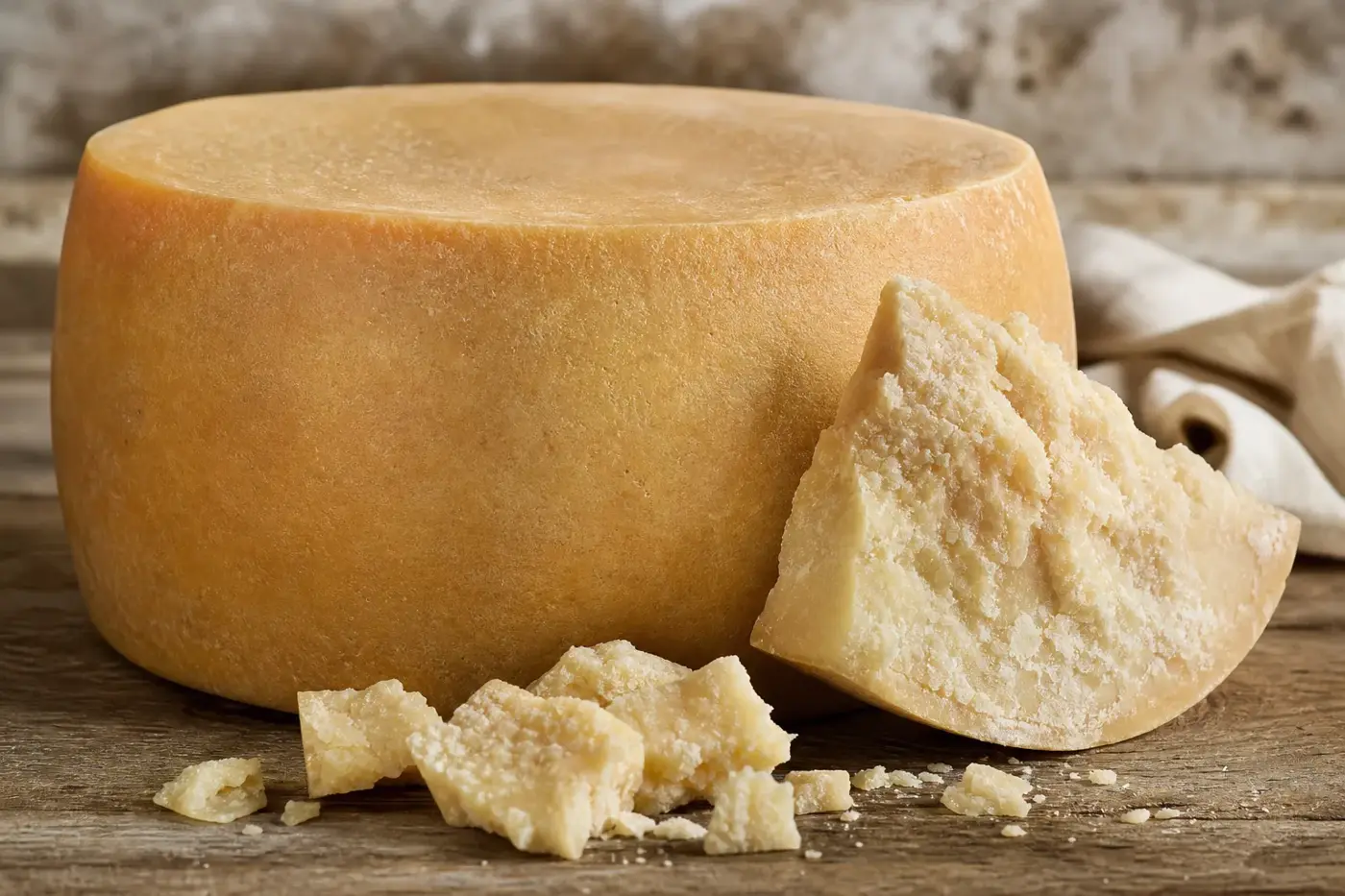
Parmigiano Reggiano
Break into a wheel of Parmigiano Reggiano and flakes fall away, revealing a finely granular cheese, pale straw to straw in colour.