Cheese Crystals: What Are the Crunchy Bits?
Your knife slips through Parmigiano Reggiano or long-aged Gouda.
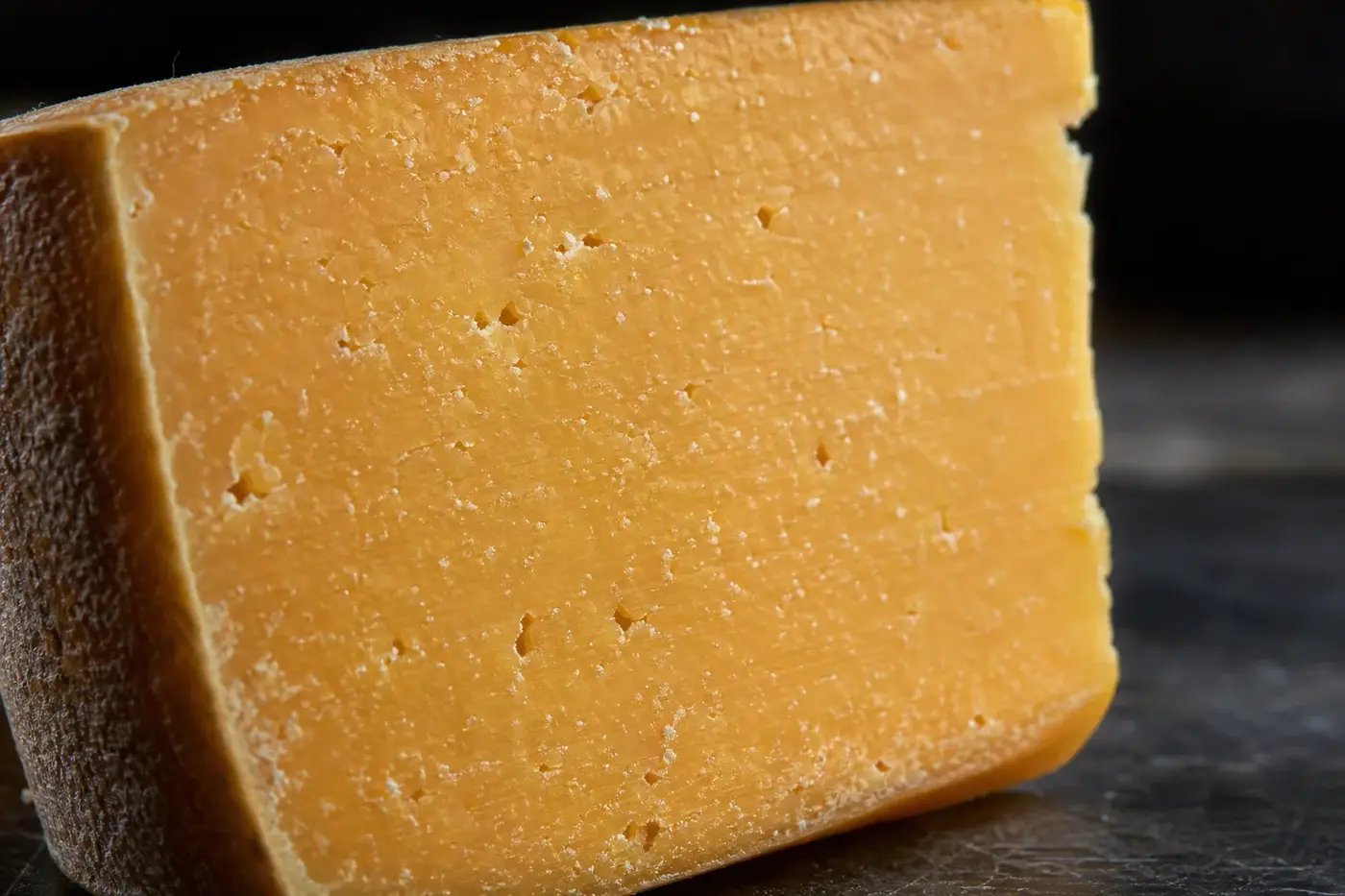
Your knife slips through Parmigiano Reggiano or long-aged Gouda. Inside the wedge, tiny, hard specks catch your eye. Those tyrosine crystals were there before you made the cut, as researchers have established.[1]
Tyrosine and calcium lactate are two notable sources of that crystalline crunch. Both are edible and need no removal. But a white mark alone cannot tell you which, if either, you have found.[1][2]
Follow the crunch beneath the rind
In Parmigiano Reggiano and long-aged Gouda, hard tyrosine crystals sit as distinct little inclusions in the paste, the cheese’s body beneath its rind. That speck on your freshly cut wedge may have stayed hidden until your knife brought it into view.[1]
Calcium lactate can crystallise inside cheese too, or on its outer surfaces. That includes places where moisture gathers against wrapping. Researchers examining some aged Gouda samples also found crystals lining the eyes, those small holes inside the cheese. Location offers clues, but “inside means tyrosine, outside means calcium lactate” is too tidy a rule.[1][2]
Tyrosine: the little specks that ripening makes
The story begins with milk protein breaking down as cheese ripens. Enzymes cut proteins called caseins into smaller fragments, or peptides, and release individual amino acids, protein’s building blocks. This process is called proteolysis. Tyrosine is one of the amino acids it releases.[2]
Tyrosine does not dissolve readily in the cheese’s watery phase. When enough gathers in one place, it can leave that solution and form crystals. Those characteristic specks are crystals of a released amino acid, then, not little fragments of intact milk protein.[2]
Microscopy and amino acid analysis have confirmed crystalline tyrosine in small, hard specks from hard and extra-hard cheeses. Larger pale spots turned out to be more intricate, containing curd granules, cavities and microcrystals. What looks to you like one pale inclusion may be far more complicated than a single crystal.[3]
Curious about everything happening around those specks? Follow how cheese is made for the wider story of ripening.
Calcium lactate finds another way to crunch
Calcium lactate begins with fermentation, not protein breakdown. Cheesemaking bacteria turn lactose, the milk sugar, into lactic acid. Some calcium in cheese is dissolved. When conditions favour it, calcium and lactate can crystallise together into a calcium salt, rather than an amino acid.[4][5]
In Cheddar, researchers often identify calcium lactate pentahydrate. The long name carries a useful detail: “pentahydrate” means water forms part of the crystal structure. Researchers have distinguished forms containing L-lactate from forms containing both D-lactate and L-lactate, two differently arranged versions of lactate. That molecular difference helps explain why the bacteria present can influence crystallisation.[6]
These are not simply grains of the salt added during cheesemaking. Common salt is sodium chloride, an entirely different compound. Calcium lactate is not the same as lactose, either: one is a salt associated with fermentation; the other is the milk sugar the bacteria use.[4][7]
Meet the cultures, moisture and acidity at work
The bacteria chosen to start fermentation help shape what can crystallise later. These starter cultures influence which substances become available during ripening. The Wisconsin dairy research centre describes how peptide-breaking enzymes associated with Lactobacillus helveticus can release tyrosine as cheese matures.[2]
For calcium lactate, acidity joins bacterial activity in shaping the outcome. Experiments using milks with different protein concentrations found that lowering pH increased soluble calcium. Crystals appeared under different pH conditions in the different cheese compositions, rather than at one fixed threshold.[5]
In one experimental cheese, reducing pH from 5.4 to 5.1 increased soluble calcium by 61.6%. That figure belongs to that particular study cheese, not every wedge you bring home. It shows why two cheeses with similar total calcium can offer very different conditions for crystals. How much calcium is dissolved and available matters too.[5]
Moisture gives dissolved substances a way to travel through cheese. Research on Cheddar packaging describes liquid moving to surfaces and crevices, where lactate can concentrate; evaporation can also encourage crystals. In a manufacturing experiment, packaging method, milk composition and an added bacterial culture all contributed to surface calcium lactate development.[4]
Time gives these processes room to unfold, but age alone does not decide the result. The relevant substances need the right local conditions and an opportunity for crystals to start growing. That helps explain why two equally old pieces of cheese can give you different numbers and types of crystals.[4][5]
What might your favourite wedge reveal?
Analyses have confirmed tyrosine in Parmigiano Reggiano and long-aged Gouda, and calcium lactate pentahydrate in Cheddar. Treat these as examples from the samples examined, not a promise about every wedge. Cheese is not obliged to follow a checklist.[1][3][6]
| Cheese examined | What researchers found | Where it turned up |
|---|---|---|
| Parmigiano Reggiano | Tyrosine confirmed by X-ray diffraction | Small, hard crystals within the body.[1] |
| Long-aged Gouda | Tyrosine confirmed by X-ray diffraction | Within the body; eye deposits also contained crystals.[1] |
| Cheddar | Calcium lactate pentahydrate | Surface deposits and internal crystals in analysed aged samples.[1][6] |
Small, hard specks and larger pale spots deserve different attention. In the hard-cheese microscopy study, the spots contained less moisture and more protein than the surrounding cheese, with several amino acids concentrated inside. That is a complex patch of cheese, not the same thing as a hard speck identified as pure crystalline tyrosine.[3]
To investigate smaller particles, researchers combined light and electron microscopy with micro-Raman analysis, examining structure and composition. They detected calcium phosphate among the crystals too. Look closely enough, and aged hard cheese has more to reveal than its two familiar crystalline names, tyrosine and calcium lactate.[3]
A white mark has more than one story
White tells you how something looks, not what it is. Colour and shape offer clues, but scientists use analytical methods to establish chemical identity. Powder X-ray diffraction compares a sample’s pattern with known crystal patterns, and one cheese can contain several crystalline substances. An ordinary photograph therefore makes confident identification especially difficult.[1][6]
In an experimental microscopy study, researchers deliberately crystallised five compounds on mild Cheddar: tyrosine, calcium lactate, calcium phosphate, sodium chloride and sorbic acid. Their microscopic features differed. Those differences show a range of possible substances and features that need closer examination than your unaided glance.[7]
That experiment induced deposits to explore identification. It did not measure how often each substance appears in cheeses on sale. Analysing crystals collected from aged cheeses answers another question: what was actually in those particular samples? Both approaches offer evidence, but they tell you different things.[1][7]
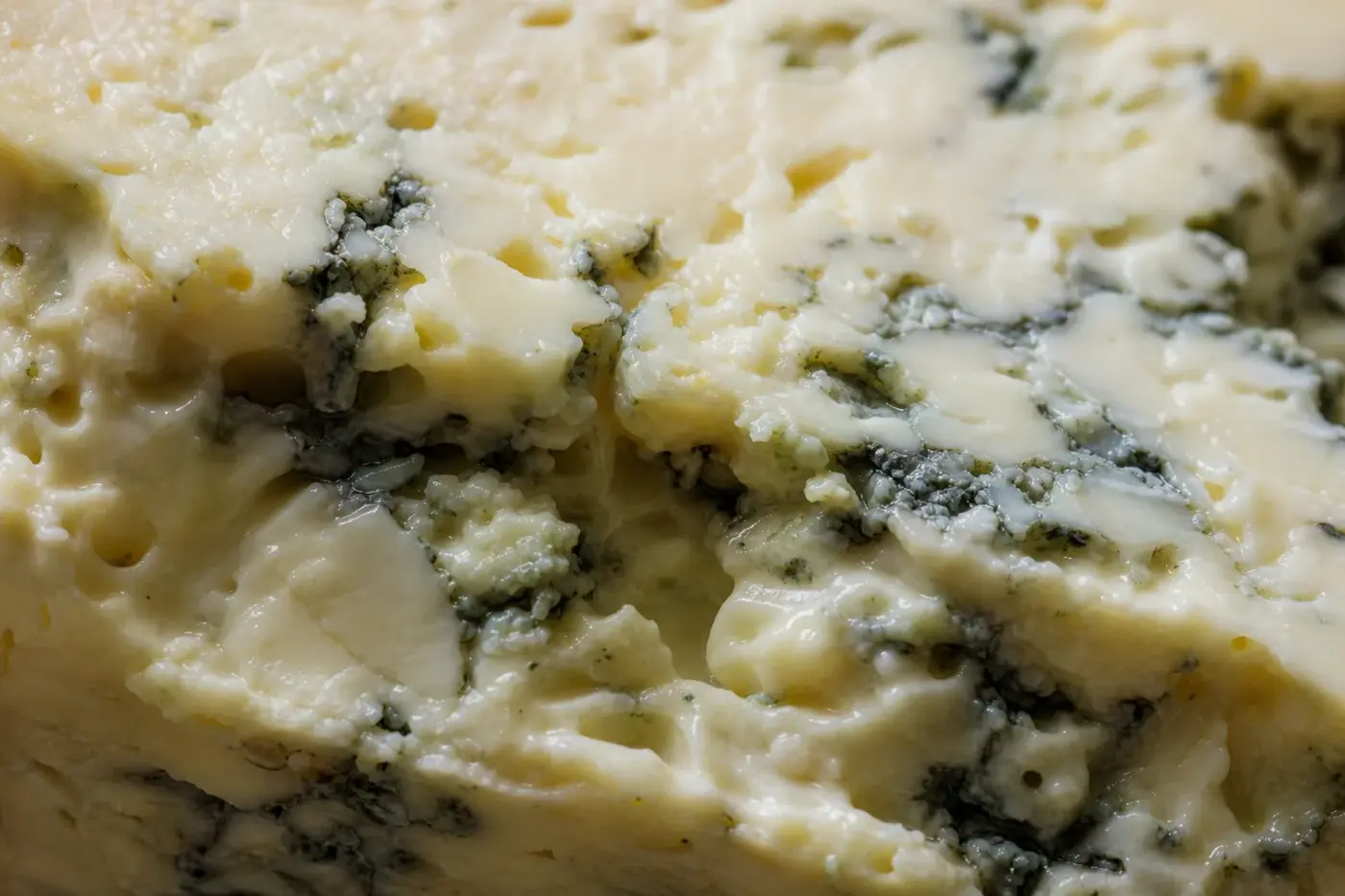
Added salt, crystalline deposits and mould are different things too. Salt is an ingredient; crystals form when a dissolved substance takes an ordered solid form; mould is fungal growth. Pale spots may instead be complex parts of the cheese’s own structure.[3][7]
If you find an unexpected deposit, ask the cheesemonger or manufacturer about the product and its intended appearance. Keep the packaging and batch details so they can give you a useful answer. Neither whiteness nor a grainy-looking photograph gives you a sound basis for deciding whether to eat it.[8]
Can you leave the crystals in your next bite?
Tyrosine and calcium lactate crystals themselves are edible, so you can leave them where they are. A confirmed crystal deposit needs neither picking out nor scraping away.[2] Unexpected mould or spoiled cheese is a separate matter.[8]
For the UK, the Food Standards Agency’s home food guidance (November 2026) advises against eating food that is obviously rotten or contains mould. Cutting away mould and some surrounding food does not guarantee that all unseen toxins have gone. For that separate question of unexpected growth, see mould on cheese.[8]
Enjoy the crunch without keeping score
Crystals tell you that conditions allowed crystallisation, not exactly how old a cheese is. Milk composition, cultures, acidity and moisture movement all influence their development. The experiments reveal those interacting causes, but counting white dots will not give you an ageing clock.[4][5]
Choose crunch because you enjoy it, not because you think it awards a cheese extra points. Your cheeseboard need not become a competitive sport. Pronounced crystals might be part of your pleasure, or you might prefer a more even texture. Judge the whole bite, flavour as well as texture, rather than assuming the wedge with the most white dots must be better.
Give your crystalline cheese a good home
Crystals need no special storage regime. Follow the cheese’s packaging instructions, including directions for use after opening. The UK Food Standards Agency’s chilling guidance (November 2026) advises keeping your home fridge at 5 °C or below and recommends checking it with a fridge thermometer.[9]
Moving your cheese to another container? Keep the label so you still have its date and storage directions. Crystal formation does not reset those instructions. For wrapping choices and a fuller home routine, see how to store cheese at home.[9][10]
A deposit becoming more obvious during storage may reflect crystallisation, including changes at a moist cut surface. The cheese’s storage history and the maker’s description tell you more than whiteness alone when assessing a change. If something unfamiliar appears, set the cheese aside while you establish what it is. Tasting cannot reliably settle a safety doubt.[4][8]
Date labels still matter. UK government guidance distinguishes a use-by date, which concerns safety, from a best-before date, which concerns quality. It advises against eating food after its use-by date even if it looks and smells acceptable. Consult the official date-label guidance (November 2026) alongside your cheese’s own instructions.[10]
General information only, not medical advice: follow the official guidance where you live.
Questions people ask
What causes crunchy crystals in cheese?
Tyrosine crystals can form when protein breaks down during ripening and releases amino acids. Calcium lactate crystals can form when calcium and lactate crystallise together.
Which cheeses have crystals?
Analyses have confirmed tyrosine crystals in samples of Parmigiano Reggiano and long aged Gouda. Calcium lactate pentahydrate has been found in Cheddar, though these findings do not apply to every wedge.
Can I tell what a white spot is by looking at it?
No. A white mark alone cannot identify a crystal, and a cheese can contain several crystalline substances. For an unexpected deposit, ask the cheesemonger or manufacturer and keep the packaging and batch details.
Are cheese crystals safe to eat?
Tyrosine and calcium lactate crystals themselves are edible and need no removal. For a separate question about mould, the UK Food Standards Agency advises against eating food that is obviously rotten or contains mould; see its [home food guidance](https://www.gov.uk/government/publications/home-food-fact-checker/home-food-fact-checker).
How should I store cheese with crystals?
Crystals need no special storage regime, so follow the packaging instructions. The UK Food Standards Agency advises keeping a home fridge at 5 °C or below and checking it with a fridge thermometer; see its [chilling guidance](https://www.gov.uk/government/publications/how-to-chill-freeze-and-defrost-food-safely/how-to-chill-freeze-and-defrost-food-safely).
Sources
-
Dairy Science & Technology, Crystal fingerprinting: elucidating the crystals of Cheddar, Parmigiano-Reggiano, Gouda, and soft washed-rind cheeses using powder x-ray diffractometry, volume 95, pages 651 to 664, 2015. Full paper. Original analysis of crystals collected from commercial cheeses.
-
University of Wisconsin Center for Dairy Research, Crystallization in cheese, Dairy Pipeline, volume 26, number 3, 2014. Publication PDF. Technical account incorporating the centre’s observations and experimental work.
-
Journal of Dairy Science, New insight on crystal and spot development in hard and extra-hard cheeses: Association of spots with incomplete aggregation of curd granules, volume 99, issue 8, pages 6144 to 6156, 2016. Published abstract. Original microscopy and compositional investigation.
-
Journal of Dairy Science, Gas-Flushed Packaging Contributes to Calcium Lactate Crystals in Cheddar Cheese, volume 88, issue 11, pages 3773 to 3783, 2005. Full paper PDF. Original manufacturing and packaging experiment.
-
Journal of Dairy Science, Cheese pH, protein concentration, and formation of calcium lactate crystals, volume 89, issue 11, pages 4144 to 4155, 2006. Published abstract in PubMed. Original experimental investigation of calcium availability and crystallisation.
-
Journal of Dairy Science, Powder X-ray diffraction can differentiate between enantiomeric variants of calcium lactate pentahydrate crystal in cheese, volume 97, issue 12, pages 7354 to 7362, 2014. Published abstract in PubMed. Original crystal-identification study.
-
Journal of Food Protection, Microstructure of Various Chemical Compounds Crystallized on Cheddar Cheese, volume 45, issue 7, pages 594 to 596, 1982. Published abstract in PubMed. Original scanning electron microscopy experiment.
-
Food Standards Agency, Home food fact checker, current online edition retrieved November 2026, section “Can you still eat food if you remove the mouldy part?”. Official guidance.
-
Food Standards Agency, How to chill, freeze and defrost food safely, current online edition retrieved November 2026, section “Chilling food”. Official guidance.
-
GOV.UK, Understanding food labelling: Best before and use-by dates, current online edition retrieved November 2026. Official guidance.
This piece was researched from original dairy-science papers, a university dairy research publication and UK official consumer guidance.
Last checked: November 2026
Last checked November 2026.
The editors suggest you read next