Penicillium camemberti and Bloomy Rinds
Cut into a young bloomy-rind cheese and look beneath its white coat.
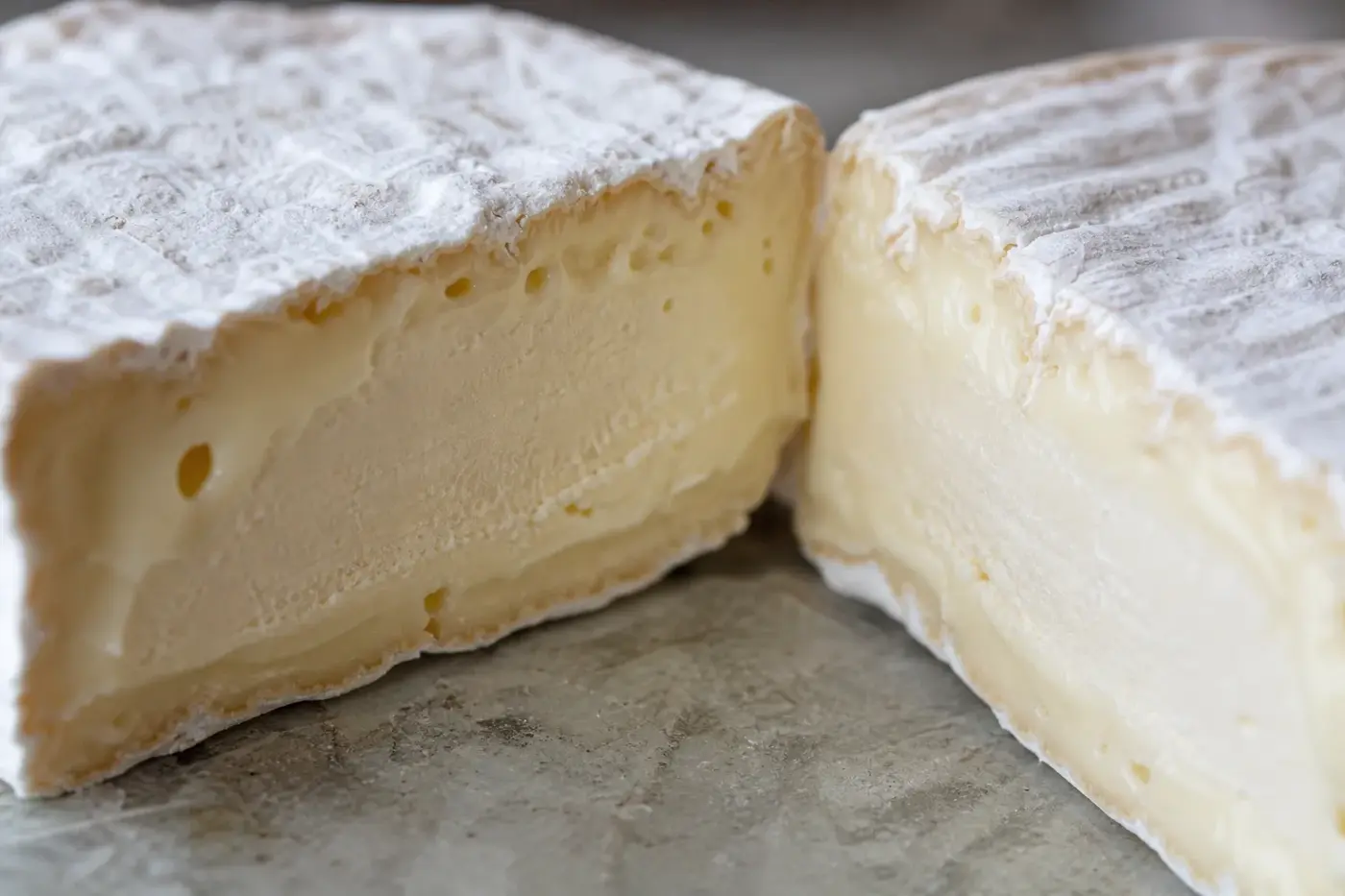
Cut into a young bloomy-rind cheese and look beneath its white coat. A softening layer may surround a firmer centre, still catching up with the action outside. Penicillium camemberti builds the bloom on many cheeses, while its enzymes work with neighbouring microbes to change the texture and aroma beneath. Your cut wedge tells a ripening story, and the first chapter is written on the rind. [1,2]
This page summarises published guidance from the official sources it cites. It is not medical advice. Guidance differs between countries and changes over time, so check the current source for where you live, and ask your doctor, midwife, pharmacist or dietitian about your own circumstances.
Meet the mould behind the white coat
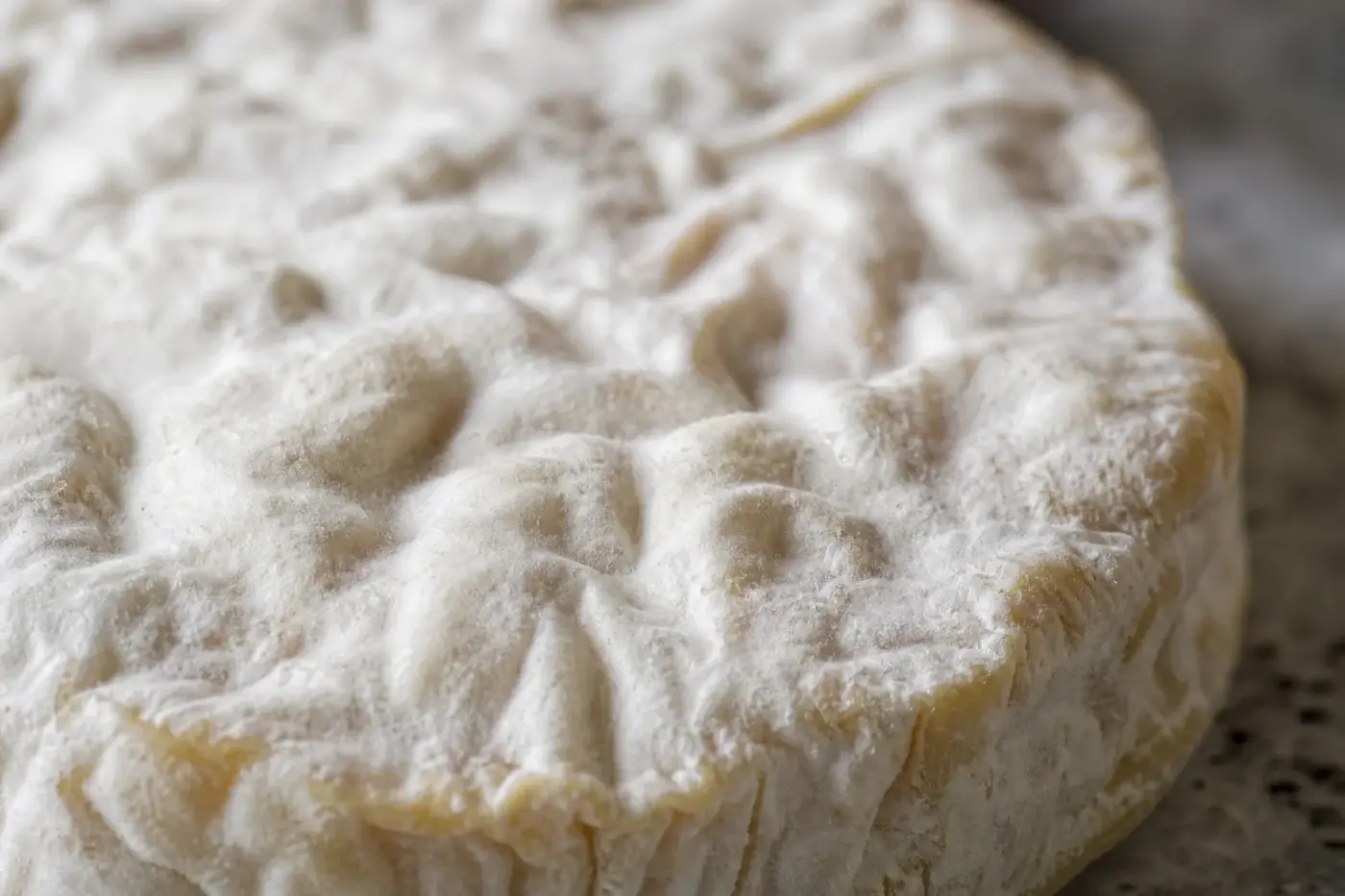
Look closely at that bloom and you are looking at a network. Penicillium camemberti grows in microscopic threads called hyphae, which together form a mycelium. This filamentous fungus makes the familiar white surface, while enzymes reach beneath it to help break down proteins and fats. [1]
Its talents are no accident: this is a domesticated cheesemaking organism. A 2020 study combined whole-genome comparisons with growth experiments and identified a strongly domesticated P. camemberti lineage with two differentiated varieties. They differed in colour, growth and competitive ability, among other characteristics. For a cheesemaker, choosing the culture helps choose the rind. [3]
Why you also meet the name Penicillium candidum
If Penicillium candidum keeps appearing in your cheesemaking reading or culture descriptions, you have met a familiar alternative name. Kew’s fungal names record, using Index Fungorum as its naming authority, accepts Penicillium camemberti Thom and lists Penicillium candidum Link as a synonym. [4]
Older names carry earlier chapters of the classification story. The Codex cheese standards use spellings and names including P. camembertii and P. caseicolum. A species name identifies the organism at one level; a strain identifies a more specific culture within it. Even two cultures sharing a species name can behave differently in cheese. [3,5,6]
How the cheesemaker starts the bloom
The cheesemaker has two routes: add the mould culture to the milk, or apply it to the surface of young cheeses. Both establish the ripening organism on the cheese. Whichever route they choose, the visible bloom develops outside. [7]
Other microbes have already done some important groundwork. Lactic acid bacteria have acidified the milk, and the curd, the coagulated solids, has been separated from much of the whey, the liquid fraction. The young cheese now offers a surface and nutrients for the organisms that follow. [1,2]
Surface application puts the culture where the bloom will grow. Adding it to the milk introduces it earlier, but oxygen availability still favours visible growth outside. You are looking at a living, growing rind, not a finishing coat applied to a completed cheese. [1,7]
Curious about the work before the white coat appears? Follow how cheese is made through the earlier stages. Once the curd is made, the cheesemaker’s task becomes managing the microbial community that will ripen it.
Make the bloom feel at home
Moisture, temperature and oxygen all help shape that white coat. Cheesemakers manage the ripening environment around those needs, while salt, acidity and the cheese’s composition influence how the mould establishes itself. Research on P. camemberti shows that germination and colony growth respond to conditions including salt and the surrounding gas atmosphere. [1,8]
Oxygen explains why you find the mould at the surface. P. camemberti is aerobic, meaning its energy metabolism depends on oxygen. The exposed surface offers access that the dense interior cannot, giving you a rind rather than a white network throughout an intact cheese. [1]
The right surroundings change with the cheese’s stage of life. A controlled dairy encourages the rind as part of a planned production process; your purchased wedge belongs under refrigeration, following its storage instructions and official food safety advice. A ripening room and a domestic fridge have different jobs. [5,6,9]
There is no single household temperature or humidity setting that reproduces every bloomy cheese’s maturation. The strain, recipe and stage at which the cheese is wrapped all affect the result. [3,7]
Meet Geotrichum candidum, the rind’s collaborator
The white mould rarely works alone. Geotrichum candidum, a yeast-like fungus, is an important partner in many Camembert-type cheeses. Other yeasts and bacteria can share the surface, with their roles shaped by the recipe and the microbial community. [1,2]
One early task is consuming lactate, produced during acidification. Remove that acid source and the surface pH rises: the rind becomes less acidic, changing conditions for other organisms and enzymes. Both G. candidum and P. camemberti contribute to this shift. [1,10]
Their partnership also affects protein breakdown. Experiments growing the two organisms in mixed culture found enhanced proteolytic activity, meaning greater activity against proteins. A cheesemaker’s culture combination shapes much more than how white or fluffy your rind looks. [11]
Research on controlled Camembert-type cheeses found that other community members, including a yeast and a bacterium, also contributed to overall protein breakdown. The white mould gets the attention, but it cannot take all the credit. Ripening is a group effort. [2]
Watch your cheese soften from the outside in
Two processes sit at the heart of ripening: proteolysis, the breakdown of proteins, and lipolysis, the breakdown of fats. Fungal enzymes take part in both. Gradually, they change the cheese’s structure and supply smaller molecules for further flavour-producing reactions. [1,7]
Proteases cut proteins into smaller fragments, including peptides, and further enzyme activity releases amino acids. Casein proteins make up much of the cheese’s supporting structure. Break them down and you change how the paste holds together. [1,11]
Your cut wedge lets you see that progress. Early in maturation, the outer paste has felt the strongest influence of the surface community, while the centre can remain firmer. Codex describes both Brie and Camembert as ripening from the surface towards the centre. [5,6]
Changing acidity helps shape the texture too. Experimental work with surface-ripened cheese linked lactate consumption, ammonia production and mineral redistribution with texture development. Softening comes from these interacting chemical changes, not just enzymes cutting protein chains. [10]
| Stage | What is happening | What you can notice or learn |
|---|---|---|
| The surface gets going | Fungi grow and use available nutrients. [1,2] | The white rind develops. |
| The surface becomes less acidic | Lactate is consumed and surface pH rises. [1,10] | The conditions for ripening change. |
| Ripening moves inwards | Protein breakdown is greater near the rind before the interior catches up. [2,5,6] | Softer outer paste surrounds a firmer centre. |
| Metabolism carries on | Amino acids and fats undergo further transformation. [7,10] | Aroma increases and ammonia develops. |
Follow the mushroom aroma, then the ammonia
That bloomy aroma comes together through a succession of reactions. Fat breakdown releases free fatty acids, which can become aroma compounds, while protein breakdown supplies another set of starting materials. No single substance made by the white mould explains everything you smell. [7]
The earthy, mushroom-like character you associate with bloomy cheeses belongs to this wider fungal ripening chemistry. Sulphur-containing compounds formed through amino-acid metabolism can bring other notes. Research on Camembert-type cheese identifies both P. camemberti and G. candidum as contributors to the pathways behind its sensory character. [1,7]
Then comes the sharper character of ammonia. It can form when microorganisms metabolise amino acids and release nitrogen in ammonia form. Experimental work found ammonia production alongside lactic acid consumption, both contributing to a rise in pH. [10]
In a controlled Camembert study, researchers measured higher ammonia concentrations in the rind than in the core. Concentrations increased during ripening. The authors considered diffusion from the surface towards the centre a likely part of the process. [2]
Ammonia has a clear biochemical place in ripening, but its aroma cannot tell you whether a particular wedge is suitable to eat. Appearance and smell describe condition and maturity. Safety is a separate question, guided by storage instructions, dates and recalls. [2,12]
Brie and Camembert: a shared method, different recipes
Brie and Camembert make this outside-in ripening easy for you to recognise. Codex describes both as having a soft rind covered with white mould and maturing towards the centre. Its descriptions also allow other microorganisms, including Geotrichum candidum, yeasts and Brevibacterium linens. [5,6]
These international reference standards leave room for different cultures and ripening practices. They describe the broad mechanism; each cheese’s recipe determines how it unfolds. Codex standards are international references, not automatically binding rules in every country. [5,6]
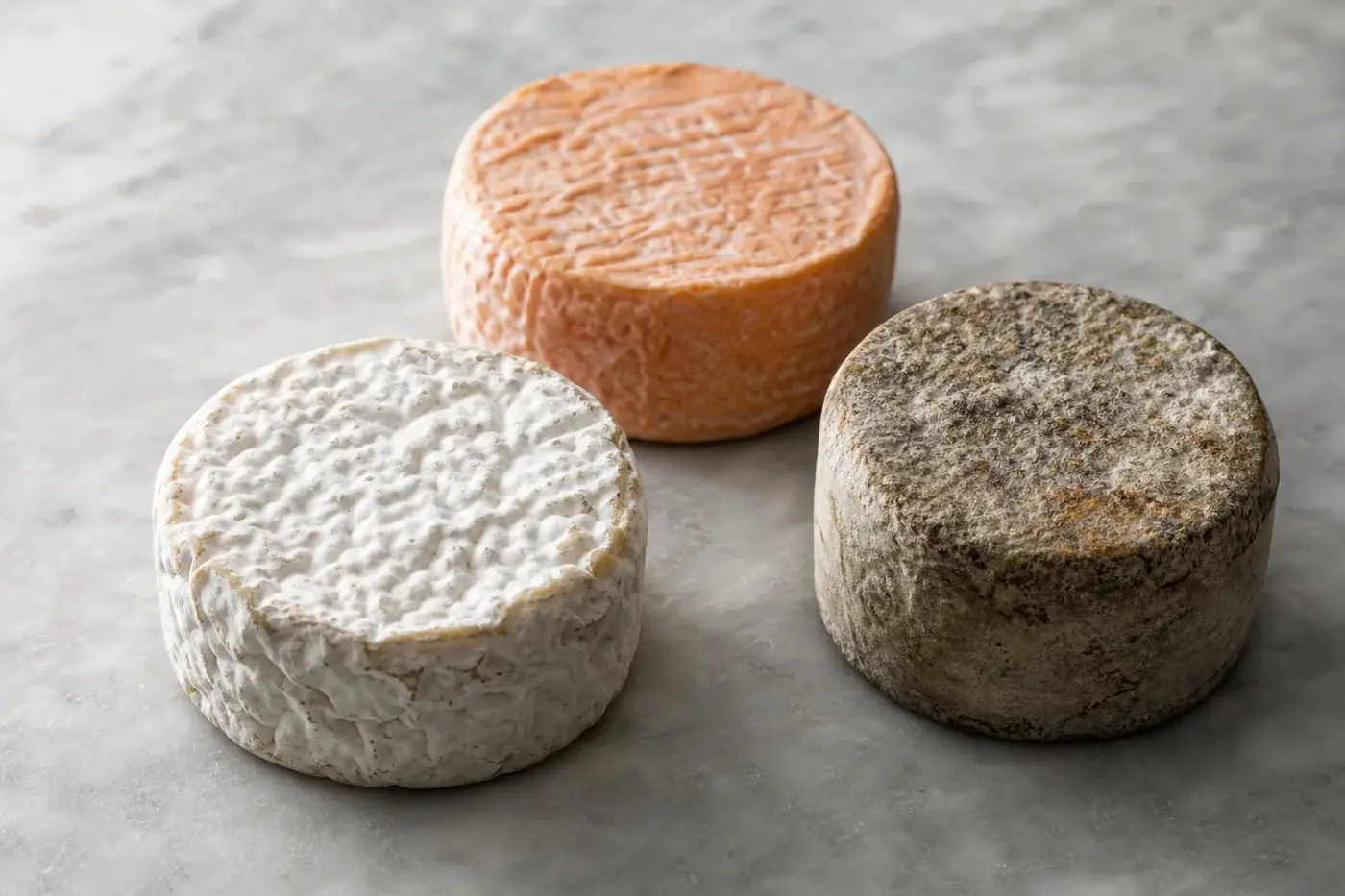
A white rind gives you a useful clue to the method, but reveals less about the exact culture mixture, milk treatment or stage of maturity. For those details, turn to the particular cheese and its label. You can explore the named cheeses in the separate guides to Brie and Camembert.
Read the rind and the cheese beneath it
Start with the producer’s instructions when deciding how to eat a particular product, including what to do with any non food wrapping or coating. The white mould rind itself is part of the Codex descriptions of Brie and Camembert. [5,6]
Now look at the cut face. A firmer centre beneath softer outer paste can show you the direction of maturation. A more uniformly soft paste means the changes have progressed further through the cheese, not that the white coat has packed its bags and moved into the middle. [2,5,6]
A recognised rind need not be spotless white, either. The Codex descriptions allow some red, brownish or orange spots on these cheeses. If you find an unfamiliar patch on a purchased wedge, compare it with the product’s description: colour alone cannot identify it. [5,6]
Expected rind development and unwanted spoilage call for different decisions. FSA advice says not to eat food that is obviously rotten or affected by unwanted mould; removing the visible part does not guarantee removal of unseen contamination. For practical help with that distinction, see mould on cheese. [12]
Once your cheese is home, keep it chilled
Keep your fridge between 0 and 5 °C and check it with a thermometer. That is the FSA recommendation for England, Wales and Northern Ireland. Follow the packaging’s storage instructions, and keep chilled cheese out for the shortest practical time during preparation. [9]
Keep the label with your cheese so the date and after-opening instructions stay to hand. Those instructions are more useful than giving every bloomy cheese the same remaining life. The NHS advises using opened food within two days unless the packaging says otherwise. [13]
For food with a use by date, your nose is not a safety test. In England, Wales and Northern Ireland, the FSA says not to eat food after that date, even if it looks and smells fine. You cannot reliably smell the organisms responsible for food poisoning. [12]
For broader handling decisions, turn to the guide to storing cheese at home. Keep the product’s own instructions alongside that advice.
When you need extra care: the UK guidance
UK NHS guidance, November 2026: during pregnancy, mould-ripened soft cheeses with a white coating, including Brie and Camembert, should be thoroughly cooked. This applies whether the milk is pasteurised or unpasteurised. The NHS identifies cheese cooked until steaming hot as suitable during pregnancy. [14]
The NHS’s wider dairy guidance recommends avoiding mould ripened soft cheeses such as Brie and Camembert for infants and young children, people over 65, pregnant people, and people with a long term medical condition or weakened immune system. It also discusses using these cheeses in cooked recipes and gives relevant cooking advice. [15]
Consult the linked NHS guidance for your circumstances, including its cooking advice. The concern here is Listeria, a bacterium, rather than the intended white mould. The NHS lists soft mould-ripened cheeses among foods associated with listeriosis. [13,15]
For more on the organism, continue to Listeria and cheese safety. You will also find the official precautions there.
Questions people ask
Is Penicillium candidum the same as Penicillium camemberti?
Kew’s fungal names record accepts Penicillium camemberti and lists Penicillium candidum as a synonym. A strain is a more specific culture within a species, and two strains can perform differently in cheese.
Why is my Camembert soft near the rind but firm in the middle?
Brie and Camembert ripen from the surface towards the centre. The outer paste is influenced first by the surface community, while the centre can remain firmer earlier in maturation.
Can I eat the white rind on Brie or Camembert?
The white mould rind is part of the Codex descriptions of both cheeses. Check the producer’s instructions for the particular product, including how to deal with any non food wrapping or coating.
How should I store bloomy cheese at home?
The FSA recommends keeping the fridge between 0 and 5 °C in England, Wales and Northern Ireland. Follow the packaging’s storage instructions and keep the label for its date and instructions after opening. The NHS advises using opened food within two days unless the packaging says otherwise.
Can I eat Brie or Camembert during pregnancy?
The NHS advises that mould ripened soft cheeses with a white coating, including Brie and Camembert, should be thoroughly cooked during pregnancy, whether made from pasteurised or unpasteurised milk. It identifies cheese cooked until steaming hot as suitable. Consult the NHS pregnancy guidance for your circumstances.
Sources
- BMC Genomics, “Metatranscriptome analysis of fungal strains Penicillium camemberti and Geotrichum candidum reveal cheese matrix breakdown and potential development of sensory properties of ripened Camembert-type cheese”, volume 15, article 235, 2014. Full-text research paper.
- Journal of Dairy Research, “Controlled production of Camembert-type cheeses. Part I: Microbiological and physicochemical evolutions”, 2004. Retrieved research abstract describing controlled model cheeses.
- Current Biology, “Domestication of the Emblematic White Cheese-Making Fungus Penicillium camemberti and Its Diversification into Two Varieties”, volume 30, 2020. Published paper and retrieved full-text manuscript.
- Royal Botanic Gardens, Kew, “Penicillium camemberti Thom”, online species record, Index Fungorum name authority, retrieved November 2026.
- FAO and WHO, Codex Alimentarius, Codex Standard for Camembert, CODEX STAN 276-1973, retrieved edition recording revision 2007 and amendments 2008 and 2010, sections 2, 3.2 and 3.5. Used for descriptive production characteristics, not current national legal requirements.
- FAO and WHO, Codex Alimentarius, Codex Standard for Brie, CODEX STAN 277-1973, retrieved edition recording revision 2007 and amendments 2008 and 2010, sections 2, 3.2 and 3.5. Used for descriptive production characteristics, not current national legal requirements.
- Food Chemistry, “What happens to commercial camembert cheese under packaging? Unveiling biochemical changes by untargeted and targeted metabolomic approaches”, 2022. Retrieved research abstract and indexed text.
- Food Microbiology, “Impact of sodium chloride and carbon dioxide on conidial germination and radial growth of Penicillium camemberti”, 2023. Retrieved research record.
- Food Standards Agency, “How to chill, freeze and defrost food safely”, published 18 December 2017, current retrieved guidance, November 2026. Applies to England, Northern Ireland and Wales.
- Journal of Dairy Science, “Integrated Roles of Lactate, Ammonia, and Calcium in Texture Development of Mold Surface-Ripened Cheese”, 1987. Retrieved research abstract.
- Enzyme and Microbial Technology, “Enhanced proteolytic activities of Geotrichum candidum and Penicillium camembertii in mixed culture”, 2006. Retrieved research abstract and indexed text.
- Food Standards Agency, “Home food fact checker”, updated 21 August 2026, sections on the sniff test and removing mould. Applies to England, Northern Ireland and Wales.
- NHS, “Listeriosis”, current online guidance retrieved November 2026.
- NHS, “Foods to avoid in pregnancy”, current online guidance retrieved November 2026, cheese, milk and other dairy section.
- NHS, “Dairy and alternatives in your diet”, current online guidance retrieved November 2026, cheese section.
Researched through fungal taxonomy records, primary cheesemaking studies, Codex descriptions and current UK official food safety guidance.
Last checked: November 2026
Last checked November 2026.
The editors suggest you read next