Cheese from Yak, Camel, Reindeer and Other Milks
Sweet, hard and chewy, a piece of Sikkim chhurpi gives you plenty to linger over.
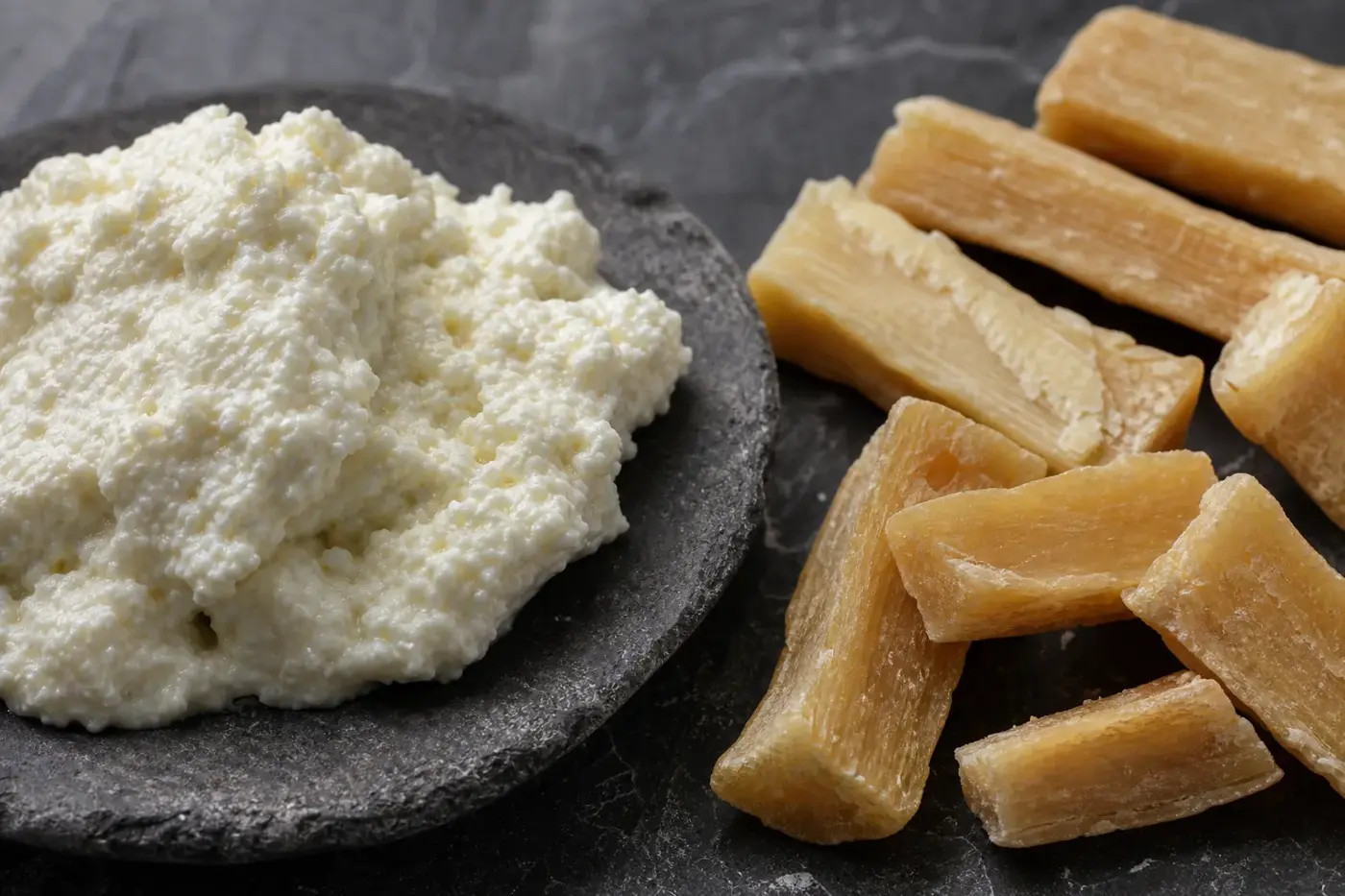
Sweet, hard and chewy, a piece of Sikkim chhurpi gives you plenty to linger over. In the Himalayas, milk from female yaks and yak cattle hybrids becomes chhurpi, sometimes soft, sometimes dried hard. Far north, in Fennoscandia, museum records open another chapter: cheese made from reindeer milk.[1][2][3][8]
Camel and moose milk become cheese too, through very different encounters between animal, keeper and curd.[5][10] Before you taste any of them, two questions will take you further than the animal on the label. Whose milk is it, and what has the maker done with it?
Three useful things to bring to the cheese counter
- Camel milk can need different coagulation techniques from cow's milk.[5]
- The Inari museum account describes a local Sámi practice, not one shared by every community.[8]
- An animal named in a coagulant does not necessarily tell you whose milk is in the cheese.[6]
Meet the keepers before you meet the cheese
Follow the herds in Nepal's Sailung and Thodung regions, and the cheese starts to make sense. A FAO field study describes seasonal journeys between grazing grounds, with chauri, yak cattle hybrids, supplying milk. In Sailung, producers had no outlet for fresh milk, so they sold ghee and dried cheese instead.[1]
Grazing, transport and preservation shaped these foods. This is not the familiar supply chain behind cow, goat, sheep and buffalo cheeses. The story begins with what keepers can gather, carry and preserve.
Each animal asks something different of its keeper. Camel milk can resist forming a firm curd, while a Swedish moose cheese producer describes milking that needs exceptional quiet and close familiarity with individual animals.[5][10]
Reindeer milk cheese belongs to distinct local food traditions, not a uniform Sámi dairy industry.[8][9] If you wonder why these cheeses remain uncommon, look beyond the milk. Much of the answer lies in the working day.
Chhurpi: find out which bite awaits you
Look closely at “yak milk” and you find more than the name suggests. ILRI's proceedings on Himalayan livestock identify nak as a local name for a female yak in Nepal, and chauri as a female yak cattle hybrid used for milk, butter and cheese.[2] Female yak milk and hybrid milk are distinct sources, each with its own place in Himalayan dairying.
Chhurpi deserves the same closer look. A field account from Sikkim distinguishes soft chhurpi, hard chhurpi and dudh chhurpi. Its authors describe the hard form as very low in moisture, sweet and chewy.[3] Those tasting notes belong to Sikkim's documented hard chhurpi, not everything carrying the name.
The soft and dried forms have different jobs. Fresh, soft chhurpi is a moist fermented dairy food; dried chhurpi is a hard cheese suited to transport, as Nepal's pastoral accounts show.[1][2][3] Before you plan how to serve yours, find out which form you have. Your cheese knife would appreciate being consulted.
FAO's traditional dairy survey lists yak and chauri milk for a chhurpi entry, while the Nepal case study documents hybrid herds supplying local dairy production.[1][4] Sources vary by producer and locality, so ask whether yours uses female yak milk, hybrid milk or a mixture with another milk. Where the cheese was made and which animal supplied the milk are separate questions. Both deserve an answer.
Camel milk asks the cheesemaker to think again
Camel milk can become cheese, including soft, unripened cheese. It simply does not behave like cow's milk in the vat. In a 2020 experiment comparing camel and bovine milk, researchers used either chymosin, an enzyme, or acid to set the milk, then assessed texture, microscopic structure and sensory quality.[5]
The camel milk cheeses had weaker structures and lower measured hardness than the bovine versions. They also took longer to coagulate. The researchers linked this setting behaviour to differences in casein composition: caseins are the milk proteins that form the curd's main network.[5]
For the cheesemaker, the task is to match the coagulant and processing conditions to the milk. One method does not suit every species. Camel milk, it seems, has not read the cow's instructions.
Then there is camel chymosin, a name that can lead you astray. Research has used fermentation-produced camel chymosin to make cheese from cow's milk.[6] “Camel chymosin” names the enzyme; “camel milk cheese” names the milk. The enzyme alone cannot tell you which animal supplied the vat.
A 2014 study reported by CIRAD tested temperature, calcium addition and acidification in camel milk processing. Warmer experimental conditions gave faster coagulation and firmer curds; adding calcium did not improve those measures in that trial.[7] Technique matters enormously here. For the wider distinction between enzymes and their sources, turn to rennet explained.
Reindeer cheese: an autumn story from Inari
On the autumn grazing grounds of Inari, in northern Finland, reindeer were milked and cheese was made. The Sámi Museum's Anaras account records that seasonal practice, alongside cheeses made from cow, sheep and reindeer milk, set with rennet from a reindeer or calf stomach.[8] Cheesemaking belonged to a food system that also included fishing, other livestock and preserved foods.
The same account records reindeer milk frozen for winter uses, including coffee.[8] Pause over that detail: milk added to coffee and milk made into cheese are different preparations. If you spot “coffee cheese” in a café, ask which milk it contains. A serving custom tells you how a food is used, not necessarily which animal was milked.
Historical research drawing on archaeological evidence and written sources also stresses differences between Sámi communities, their environments and their neighbours.[9] Inari gives you a specific local history, not a template for every community. Its detail is part of its value.
For a cheese made today, ask where it comes from, whose tradition the maker describes and whether it actually contains reindeer milk. History supplies context. The present maker can explain what is on your plate.
Moose cheese begins with a little quiet
At Älgens Hus in Sweden, milking can take from half an hour to two hours. The moose cheese producer describes animals accustomed to close human contact, milked in solitude and quiet. A disturbance can stop the milk flow.[10] Familiarity between keeper and animal is part of the work behind every cheese.
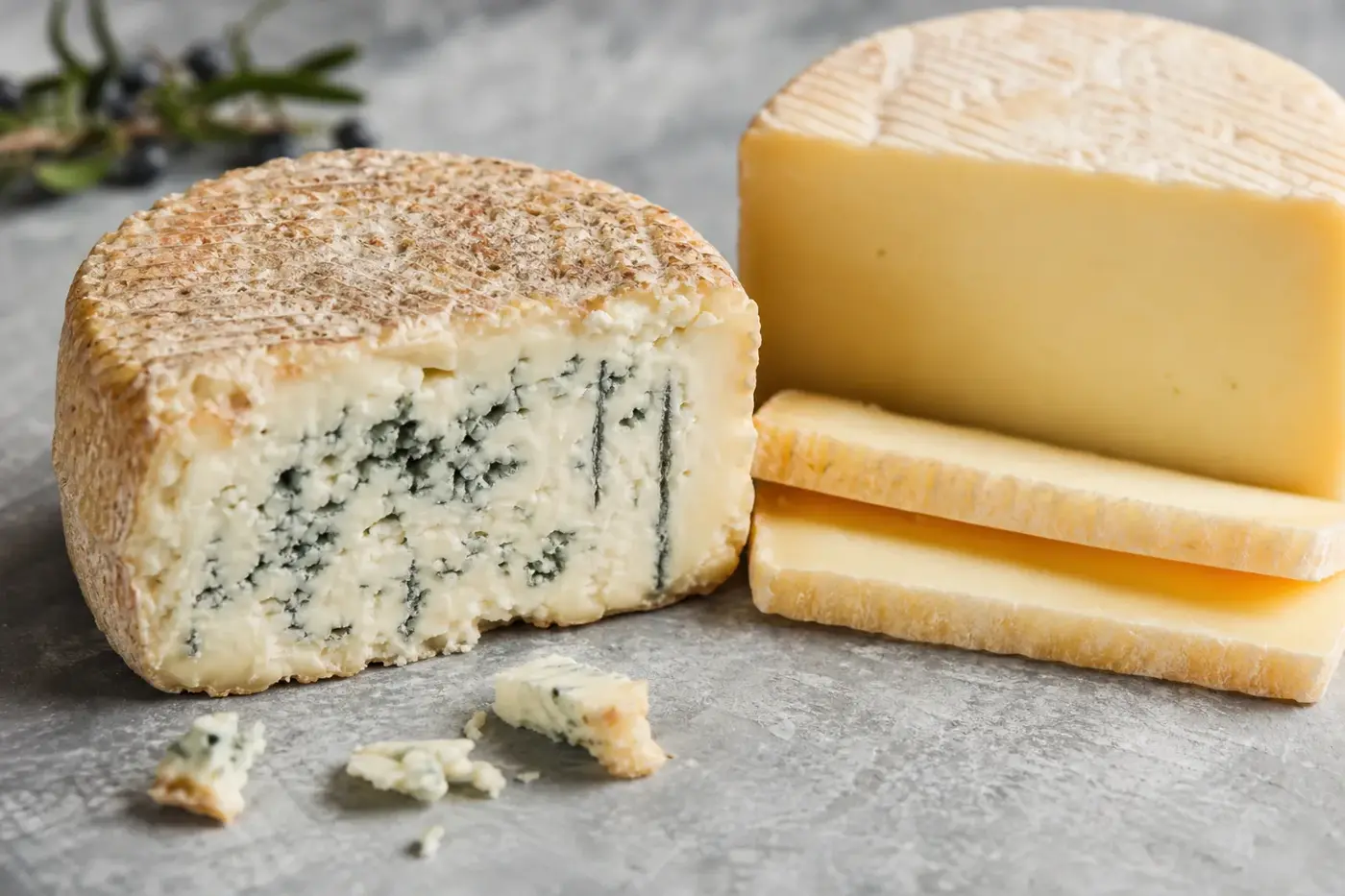
The producer makes several styles, including a white mould cheese, a soft blue cheese and a dried blue cheese.[10] Even such an uncommon milk can take very different forms. Älgens Hus describes its white mould cheese as mild, with a smooth flavour and a creamy texture. Those are the maker's tasting notes for that particular product.
Milking time and the close relationship it demands can limit how readily these cheeses reach other markets.[10] If you hope to visit and taste them, start with the producer's current information. Contact it about access and the cheese you would like to try.
Mare's milk takes you towards a drink
With airag, you are heading towards a drink, not a cheese. FAO's survey documents this Mongolian preparation as liquid mare's milk fermented with a mixed culture of bacteria and yeasts.[4] There is no curd collected and drained of whey, the liquid separated during cheesemaking.
“Fermented” tells you that a transformation has happened, not that the result is cheese. Soft chhurpi, dried cheese and fermented milk drinks all belong to dairying traditions, but they remain different foods.[3][4] Keep that distinction in mind and unfamiliar names become easier to navigate. For the basic sequence of setting milk and separating curd from whey, see how cheese is made.
The animal on the label is only the beginning
The animal gives you a starting point, not the whole story. Camel milk experiments compared enzyme and acid coagulation; the Sikkim account distinguishes soft chhurpi from hard.[3][5] Ask how the milk was set, how much moisture was removed and whether the cheese underwent further ripening. Those details give you a much clearer idea of what to expect.
Heat and cultures help shape the result too. CIRAD's camel milk trial measured different acidification rates and curd firmness at its experimental temperatures.[7] A starter culture is a selected population of microorganisms used to guide fermentation.
In the fermented drinks FAO describes, bacteria and yeasts work together. A cheese producer may instead select cultures for a particular cheesemaking process.[4][6] The animal supplies the milk; the choices made afterwards help determine what reaches your plate.
Good flavour descriptions are equally specific. Think of the Sikkim researchers' sweet, chewy hard chhurpi, or a sensory panel's assessment of experimental camel milk cheese.[3][5] Ask for the maker's notes on the actual style and batch. Fresh, dried, mould ripened or otherwise matured tells you more than the animal's name alone.
Take these questions to your UK cheesemonger
For UK availability, begin with a specialist importer or cheesemonger. Ask where a particular cheese was made and whether it is supplied for people to eat. Then work through these practical questions.
- Whose milk is it? Ask which animal supplied it and whether it is a blend. If the product name is ambiguous, request the species in writing. A yak image or a northern origin does not identify the milk.
- Who made it, and where? Ask for the country, locality and dairy. The place of cheesemaking is not the same thing as an importer's address.
- How was it made? Is it fresh, dried or ripened, and how was the milk treated? Ask separately about the coagulant, especially if the description mentions camel chymosin.[6]
- What is in it? Request ingredients and allergen information, including added ingredients. FSA guidance for England, Wales and Northern Ireland includes milk from mammals in its discussion of the milk allergen.[11]
- How should you handle it? Establish how it should travel, where to store it and how soon to eat it after opening. Keep the seller's information with the cheese.[14]
Use how to read a cheese label when looking at a particular pack. If the animal, maker or storage directions remain unclear, choose a product whose seller can give you those details.
This page summarises published guidance from the official sources it cites. It is not medical advice. Guidance differs between countries and changes over time, so check the current source for where you live, and ask your doctor, midwife, pharmacist or dietitian about your own circumstances.
Enjoy the discovery, with safety advice close at hand
Milk protein allergy and lactose intolerance are different conditions. The NHS explains that lactose intolerance affects digestion of milk sugar; the FSA warns that someone with a cow's milk allergy may also react to milk from other mammals.[12][13][11] Lactose free dairy is unsuitable for someone with milk allergy, and milk from goats, sheep, buffalo or other animals is not a safe substitute. Ask your doctor or dietitian about your circumstances.[11][12]
Lactose occurs in animal milk foods, including cheese, as the NHS notes.[13] Neither an unfamiliar animal nor a hard texture establishes a cheese's lactose content. If this matters to you, request information specific to the product and discuss your needs with a healthcare professional. Cheese allergy versus lactose intolerance explains the distinction in more detail.
Pasteurisation uses heat to kill harmful bacteria, according to the NHS.[12] It does not remove every subsequent risk: Listeria can contaminate cheese after pasteurisation. See listeria and cheese safety for more on this risk.
The NHS notes that some cheeses use unpasteurised milk and advises checking the label.[12] With an unfamiliar cheese, ask the maker directly. People who are pregnant, older, unwell or buying for children should consult the NHS guidance relevant to their circumstances.[12]
For home storage in England, Wales and Northern Ireland, FSA guidance recommends a fridge temperature between 0 and 5 °C and following the packaging's storage instructions.[14] Refrigerate chilled cheese, observe its use-by date and follow instructions for use after opening. For dried cheese, follow that product's directions. A historical account of mountain dairying is not a storage guide for the piece you have bought.
Keep the packaging, or a photograph of its batch details, until you have finished the cheese. That lets you match the product to any official alert. For everyday wrapping and fridge organisation, follow how to store cheese at home.
Questions people ask
Is chhurpi made from yak milk?
Chhurpi can be made from female yak milk or milk from yak cattle hybrids called chauri. Milk sources vary by producer and locality, so ask which milk a particular cheese contains.
What does chhurpi taste like?
A Sikkim field account describes hard chhurpi as sweet and chewy. It also distinguishes soft chhurpi and dudh chhurpi from the hard form.
Why is camel milk difficult to make into cheese?
Camel milk can be difficult to coagulate into a firm curd. In a 2020 experiment, it took longer to coagulate and produced cheeses with weaker structures and lower measured hardness than cow's milk.
Does camel chymosin mean a cheese contains camel milk?
No. Camel chymosin identifies an enzyme, not the milk used in the cheese. Research has used fermentation produced camel chymosin to make cheese from cow's milk.
Is reindeer cheese part of Sámi food traditions?
The Sámi Museum records reindeer milking and cheesemaking on autumn grazing grounds in Inari, northern Finland. This is a local account, rather than a practice shared by every Sámi community.
Sources
- Food and Agriculture Organization of the United Nations. Transhumant grazing systems in temperate Asia, Chapter XVI, “Nepal case study: High altitude pastoral systems of Sailung and Thodung regions, Ramechap District, Nepal”. Field case study, online edition. Official chapter.
- International Livestock Research Institute. Yak production in central Asian highlands. Proceedings of the Third International Congress on Yak, held in 2000; published 2002. Nepal sections, including discussion of female yak and chauri on page 148. Proceedings.
- Sikkim University researchers, IOSR Journal of Agriculture and Veterinary Science. “Indigenous rearing practices of Yak and its multipurpose uses in the Sikkim Himalayas”. Volume 9, issue 3, version I, 2016, pages 1 to 8. Section 2.1.5, “Chhurpi”. Research paper.
- Food and Agriculture Organization of the United Nations. The technology of traditional milk products in developing countries. Animal Production and Health Paper 85, 1990. Chhurpi entry and “Acidified milks”, section 2.1, “Airag”. Publication; acidified milks chapter. The chhurpi raw-material entry was also retrieved in an indexed copy of the publication.
- NFS Journal. “Physicochemical properties, sensory quality, and coagulation behavior of camel versus bovine milk soft unripened cheeses”. Volume 20, 2020, pages 28 to 36. Publisher's abstract. Article record.
- International Dairy Journal. “Suitability of recombinant camel (Camelus dromedarius) chymosin as a coagulant for Cheddar cheese”. Volume 19, issue 9, 2009, pages 510 to 517. Publisher's abstract. Article record.
- CIRAD; Emirates Journal of Food and Agriculture. “Some parameters to process camel milk into cheese”. Volume 26, issue 4, 2014, pages 354 to 358. Research abstract deposited by CIRAD. Institutional record.
- Sámi Museum. Anaras, “Way of Life: Food Tradition”. Undated online cultural account, particularly the passage beginning “We went to the cow farm to eat viili”. Museum account.
- University of Oulu repository. “‘Not on bread but on fish and by hunting’: Food Culture in Early Modern Sápmi”. Repository manuscript, undated in the retrieved opening. Research manuscript.
- Älgens Hus. “Framställning av älgost”. Producer's account, webpage dated 28 March 2017. Commercial source for its own milking practices, products and tasting descriptions. Producer account.
- Food Standards Agency. Food allergen labelling and information requirements technical guidance. Updated 3 November 2026; applies to England, Northern Ireland and Wales. Paragraphs 40 to 42, “Milk”. Official guidance.
- NHS. “Dairy and alternatives in your diet”. Reviewed 11 December 2023. Sections on pasteurisation, milk allergy and lactose intolerance. Official guidance.
- NHS. “Lactose intolerance”. Current online edition retrieved November 2026. Official guidance.
- Food Standards Agency. “How to chill, freeze and defrost food safely”. Published 18 December 2017; current online edition retrieved November 2026. Applies to England, Northern Ireland and Wales. Official guidance.
Research combined pastoral field accounts, dairy experiments, museum documentation, a producer's published account and current official UK consumer guidance.
Last checked: November 2026
Last checked November 2026.
The editors suggest you read next
Cow's Milk Cheese
Picture a drum of Blue Stilton, its curd settling under its own weight, without a press.